🦶 CRYPTID SIGHTING · EXP. Nº6501
ACTIVE
Tsuchinoko
The tsuchinoko is Japan's fat snake: a creature 30 to 80 centimetres long with a midsection as thick as a beer bottle, a small triangular head, and a habit of jumping, rolling downhill and snoring.
Where and when was Tsuchinoko sighted?
- Location
- Japón, Japan
- Date sighted
- Unknown
- Coordinates
- 34.2, 135.4
- Last updated
LOCATION
What is Tsuchinoko?
It is usually sold as an ancient monster, but the sources split in two. The old creature is the nozuchi, a mallet-shaped serpent that appears in a Kamakura Buddhist parable as the rebirth of hypocritical monks and is described in the 1712 encyclopaedia Wakan Sansai Zue, which spells its name nozuchi-hebi and never tsuchinoko. The modern celebrity arrived in the 1970s, when the angler Yamamoto Soseki's search, a 1972 newspaper serial by Tanabe Seiko and a 1973 manga by Yaguchi Takao turned a Kansai dialect word for a wooden mallet into a national character. The bounties followed the fame: Shimokitayama, in Nara, offered a million yen in 1988, at the height of the asset bubble, and dozens of towns copied it. Nothing has ever been caught. In Higashi-Shirakawa, Gifu, the reward is still advertised and still rising — ¥1,340,000 for 2026.
What is the history of Tsuchinoko?
The tsuchinoko is usually introduced as an ancient Japanese monster. Read in order, the sources tell a different story: an old creature called the nozuchi (野槌), and a modern celebrity called the tsuchinoko (ツチノコ), which acquired the older creature's biography during the 1970s.
The oldest layer is religious, not zoological. The Kamakura-period Buddhist tale collection Shasekishū explains that monks without virtue are reborn as a mallet-shaped snake in the deep mountains: because in life they had a glib mouth but no eye of wisdom, no hand of faith and no foot of discipline, the nozuchi has a mouth and nothing else. The creature is a sermon about hypocrisy before it is an animal.
The first description that reads like natural history is in Terashima Ryōan's encyclopaedia Wakan Sansai Zue (1712). In volume 45, "Dragons and Serpents", the entry is headed 野槌蛇 and glossed のづちへび, nozuchi-hebi — not tsuchinoko. Terashima writes that it lives in the shade of trees in the deep mountains; that a large one is five sun thick and three shaku long (roughly 15 cm by 90 cm); that head and tail are equal and the tail is not pointed, "resembling a mallet without a handle, and therefore commonly called nozuchi"; that it is often met in the Yoshino mountains of Yamato, around the Natsumi river and the Seimei falls; and that it has a large mouth and bites people's legs, running downhill very fast but climbing very slowly, so that anyone who meets one should get to high ground at once. Two details of that page are rarely quoted. First, the woodcut printed beside the text does not show a fat, mallet-shaped body at all — the artist drew an ordinary slender snake on a rocky slope. Second, the entry immediately above it, the 千歳蝮, is described as "one or two shaku long, with four legs, shaped like a lizard, its head and tail equally large, like a cloth-beating pestle", and is illustrated as a four-legged, long-tailed lizard climbing a tree.
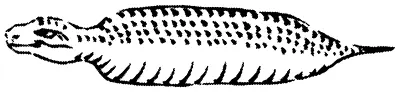
That matters, because when Ide Dōtei (1756–1839) recorded the creature in Shinano in his Shinano Kishōroku, he headed the entry 「野槌 のつち 漢名千歳蝮」 — nozuchi, whose Chinese name is the four-legged sensai-fuku. Ide's own drawing, however, is the familiar shape: a fat, banded, legless spindle with a small head. His notes say it appears around the eighth month, rolls down slopes, does people no harm, and differs from the account in the Wakan Sansai Zue. The manuscript was printed only after his death; the copy digitised by the National Diet Library is the 1887 edition prepared by Ide Tōru. That drawing is the illustration used on this page.
So where does the word tsuchinoko come from? It was a dialect word, current in Kyoto, Mie, Nara and northern Shikoku, for the yokozuchi, the wooden mallet used to beat straw and cloth. Across Japan the animal carried some forty regional names — bachihebi in Tōhoku, nozuchi, tatekurikaeshi, tsuchinbo, tsuchihebi, tsuchikorobi. Neither of the two Edo-period books above calls it a tsuchinoko. The name won nationally in living memory, and it is possible to say almost exactly how.
The man who lit the fuse was Yamamoto Soseki (1919–1988), a Shiga-born angler and essayist whose real name was Yamamoto Kanji. He said he had met the creature on 24 August 1959 in the upper Kamo valley at Kumogahata, north of Kyoto, and he spent the rest of his life looking for it, founding a hunting club, the Notarin Club, and publishing Nigero Tsuchinoko ("Run, Tsuchinoko", Futami Shobō, 1973). In 1972 the novelist Tanabe Seiko serialised Subette Koronde in the evening edition of the Asahi Shimbun, with a character modelled on Yamamoto; NHK dramatised it the following year. In 1973 the manga artist Yaguchi Takao (1939–2020) published Maboroshi no Kaija Bachihebi, which shared the 4th Kōdansha Publishing Culture Award in 1974 with his Tsurikichi Sanpei. In July 1974 Doraemon ran an episode about hunting one in the magazine Shōgaku Gonensei. Within three years a regional dialect word had become a national character. The standard academic study of the subject, Itō Ryūhei's Tsuchinoko no Minzokugaku (Seikyūsha, 2008), states the trajectory in its subtitle: "from yōkai to cryptid".
The bounties came last, and they came with the bubble economy. In 1988 Kazuo Nozaki, a village councillor in Shimokitayama (Nara), launched a "Tsuchinoko Expedition": one million yen for a live capture, three hundred thousand for a shed skin. A photograph taken on 17 April 1988 shows more than two hundred people from around the country taking part. Television crews and weekly magazines arrived daily. Other places followed — Higashi-Shirakawa in Gifu, Susami in Wakayama, Jōge (now Fuchū) in Hiroshima, and in 1989 Mikata in Hyōgo, whose mayor Tsujio Yoshida offered roughly 330 square metres of land. Shimokitayama's own expedition stopped in 1990 as the bubble began to collapse. "No matter how hard we looked, we couldn't even find a tail," Nozaki told Kyodo News in 2024.
The one place that never stopped is Higashi-Shirakawa, a forestry village of the Gifu highlands. In 1989, the Year of the Snake, its municipal newsletter ran a feature on the creature; villagers who had used the local name tsuchihenbi and had kept quiet — the animal was treated as a messenger of the gods — began to talk. The village has published a register of about twenty sightings ever since, and it still advertises a capture bounty that rises every year.
Timeline: the documented record of Tsuchinoko
- 1712 Terashima Ryōan's encyclopaedia Wakan Sansai Zue devotes an entry in volume 45 to the 野槌蛇, glossed nozuchi-hebi and never tsuchinoko: a creature of the Yoshino mountains, three shaku long and five sun thick, with head and tail equal, 'like a mallet without a handle', which bites legs and runs downhill fast but climbs slowly. The woodcut beside the text shows an ordinary slender snake, not a mallet-shaped one.
- before 1839 Ide Dōtei (1756–1839) records the creature in his Shinano Kishōroku under the heading 'Nozuchi, Chinese name sensai-fuku', noting that it appears around the eighth month, rolls down slopes and does people no harm, and that this differs from the Wakan Sansai Zue. His drawing — a fat, banded, legless spindle — is the image reproduced on this page; the copy digitised by the National Diet Library is the 1887 printing prepared by Ide Tōru.
- 24 August 1959 The angler and essayist Yamamoto Soseki (1919–1988) says he sighted the creature at Kumogahata, in the upper Kamo valley north of Kyoto. He devotes the rest of his life to the search, founds the Notarin Club and becomes the central figure of the modern legend.
- 1972 The novelist Tanabe Seiko serialises Subette Koronde in the evening edition of the Asahi Shimbun, with a character modelled on Yamamoto Soseki. NHK dramatises it the following year and the word tsuchinoko — until then a dialect term of Kyoto, Mie, Nara and northern Shikoku for a wooden mallet — begins to travel nationally.
- 1973 Two books turn the creature into a national character: Yamamoto Soseki publishes Nigero Tsuchinoko (Futami Shobō) and the manga artist Yaguchi Takao (1939–2020) publishes Maboroshi no Kaija Bachihebi, which shares the 4th Kōdansha Publishing Culture Award in 1974. In July 1974 Doraemon runs a tsuchinoko-hunting episode in Shōgaku Gonensei.
- 17 April 1988 Kazuo Nozaki, a village councillor in Shimokitayama, Nara, launches the 'Tsuchinoko Expedition': one million yen for a live capture, 300,000 for a shed skin. A photograph from that day shows more than 200 people from across Japan taking part, with television crews and weekly magazines arriving daily.
- 1989 The bounty wave spreads. Mikata, in Hyōgo, under mayor Tsujio Yoshida, offers roughly 330 square metres of land for a capture; Higashi-Shirakawa, in Gifu, devotes its municipal newsletter to the creature in the Year of the Snake, and villagers who had used the local name tsuchihenbi and kept quiet — the animal was held to be a messenger of the gods — begin to talk.
- 1990 Shimokitayama's expedition is wound up as the asset bubble begins to collapse. 'No matter how hard we looked, we couldn't even find a tail,' Nozaki later told Kyodo News. The register of sightings published by Higashi-Shirakawa also ends this year: its last entries are an August 1990 report of something 'glinting silver, as thick as an arm' seen while cutting grass by a riverbed, and a May 1990 report by a witness who took it for a rolling sake bottle.
- 1992 A corpse found on a farm at Tsukechi, Nakatsugawa, in Gifu causes a stir and is then identified as a shingleback, Tiliqua rugosa — an Australian skink with no wild population in Japan, present only through the pet trade and imported cargo.
- 21 May 2000 A tsuchinoko-shaped animal is found at Yoshii, Okayama, followed days later by a corpse. The Kawasaki University of Medical Welfare identifies it as a yamakagashi, Rhabdophis tigrinus, and locals nickname it tsuchinaro — 'the snake that never made it to tsuchinoko'. The town nonetheless forms a search party and posts a 20-million-yen bounty rising by ¥10,000 a year.
- 16 June 2001 Kenzo Moriguchi reports from Mikata for The Japan Times under the headline 'Town touting mythical snake find; is "rare" creature really a cash cow?'. A reptile captured on 6 June is on show for tourists and a cage is being built at the souvenir shop; the official Toshikazu Miyawaki says it 'might be a tsuchinoko' and hopes for 'the first such species recognized in the 21st century'. Moriguchi notes the town is in no rush to test its authenticity.
- June 2004 After announcing in May that its expedition had found a tsuchinoko carcass — which examination disproved — Mikata keeps a stubby snake christened 'Tsū-chan' alive in the town. It lays its eggs, deflates and turns out to have been a gravid yamakagashi all along.
- 1 April 2007 A tsuchinoko-shaped dead snake is found in hay on a farm at Ōkura, Yamagata, and photographed; the images circulate as among the most convincing on record. The Japan Snake Institute observes that the hay was imported from Australia and suggests a death adder, Acanthophis — the same pattern of Australian animals arriving in Australian cargo.
- March–May 2023 Shimokitayama opens the Tsuchinoko Park to revive the memory of the 1988 craze, displaying the literature and photographs Nozaki collected. On 3 May, Higashi-Shirakawa's Tsuchinoko Festa returns after three years of pandemic cancellations: about 230 people search, and find nothing.
- 3 May 2026 The 34th Tsuchinoko Festa is scheduled at Nakagawara Mizube Park in Higashi-Shirakawa. The village's capture bounty for the 2026 fiscal year stands at ¥1,340,000, valid to 31 March 2027 — the same reward, raised by ¥10,000 every year, that it has been advertising since the Year of the Snake in 1989.
Is there a rational explanation for Tsuchinoko?
Almost every celebrated tsuchinoko has been identified, and the identifications are on the record with the names of who made them.
On 21 May 2000 a tsuchinoko-shaped animal was found at Yoshii, Okayama, followed days later by a corpse of the same kind. The Kawasaki University of Medical Welfare examined it and identified a yamakagashi (Rhabdophis tigrinus), a common Japanese snake; locals nicknamed it tsuchinaro, "the snake that never made it to tsuchinoko". In 2004 the Mikata expedition in Hyōgo announced a find that turned out not to be one, and in June of that year a stubby snake christened "Tsū-chan" was kept alive in the town until it laid its eggs and deflated into an ordinary pregnant yamakagashi. In 1992 a corpse from a farm at Tsukechi, Nakatsugawa, in Gifu was identified as a shingleback, Tiliqua rugosa. On 1 April 2007 a tsuchinoko-shaped dead snake surfaced in hay on a farm at Ōkura, Yamagata; the Japan Snake Institute pointed out that the hay had been imported from Australia and suggested a death adder (Acanthophis).
That last detail is the key to the most repeated explanation, which is usually stated wrongly. The blue-tongued skinks — Tiliqua scincoides and its stubby relative Tiliqua rugosa — are not Japanese animals. The Reptile Database gives their range as Australia, and Acanthophis antarcticus as Australia and Papua New Guinea. None of them is a native of the Japanese mountains, so "people saw a blue-tongued skink" is not, by itself, an explanation. It becomes one only through a specific mechanism, and the mechanism is documented: Tiliqua have been kept as pets in Japan since the 1970s, exactly the decade in which reports multiplied, and both escaped pets and animals stowed away in imported Australian timber and fodder turn up in the countryside. Higashi-Shirakawa is a forestry village that handles imported timber, and a creature taken for a tsuchinoko in a neighbouring town proved to be a blue-tongued skink. The writer Araki Hiroshi added the twist that explains why the modern creature has no legs at all: the legless silhouette spread from the manga that started the craze — whereas the 1712 encyclopaedia identifies the beast with the 千歳蝮, which it says has four legs and looks like a lizard.
The native candidates need no import. The mamushi, Gloydius blomhoffii, is genuinely Japanese, genuinely venomous and genuinely short and thick-bodied; the Ryukyuan hime-habu, Ovophis okinavensis, is stouter still. The link is older than the cryptid: the Heian-period character dictionary Shinsen Jikyō glosses 蝮, the character for mamushi, with the reading 乃豆知 — nozuchi. In the oldest lexical record available, "nozuchi" simply meant the Japanese pit viper. Add the ordinary fact that any snake which has swallowed a large animal, or any gravid female, carries a swollen midsection for days, and the beer-bottle silhouette needs no new species.
The strongest argument, though, is chronological rather than zoological. The shape of the phenomenon tracks the media and the economy, not the biology. The register of sightings published by Higashi-Shirakawa — the fullest local record anyone has put in public — runs from about 1934 to 1990 and then stops. The bounty wave begins in 1988, at the peak of the bubble, and dies in 1990 with it, which is how Nozaki himself explains the end of his expedition. The claim that the creature is attested in Japan's eighth-century chronicles does not survive checking either: the Kojiki and the Nihon Shoki record Kayanohime, a goddess of grass and open country, whose alternative name is written Nozuchi — and, as the standard reference works note, nothing in those texts describes her as a snake.
The commercial incentive is not an insinuation; it was reported at the time by a newspaper, in its headline. On 16 June 2001 Kenzo Moriguchi covered Mikata for The Japan Times under the title "Town touting mythical snake find; is 'rare' creature really a cash cow?". A reptile captured on 6 June had been put on show for tourists, and a cage was being built for it on the patio of the souvenir shop. The town official Toshikazu Miyawaki told him the creature "might be a tsuchinoko", that "when the creature was brought to the town hall, its body was really thick and short", and that he hoped it would be "the first such species recognized in the 21st century". Moriguchi's own observation is the one worth keeping: the town was "in no rush to test its authenticity".
In fairness, the believers have a name too, and the village publishes him. Teshima Shigenobu, chairman of the Unidentified Creature Research Society, writes on Higashi-Shirakawa's own site that the tsuchinoko "is not an imaginary creature like the tengu or the kappa", that he has encountered one three times, that they shelter near water and never on high mountains, and — the least commercial sentence on the page — that anyone who meets one should on no account kill it with a stone or a stick. His account also contradicts the village's own fact sheet directly: the village lists the animal as active by day and venomous, Teshima says it forages at night and is harmless. Two descriptions of the same animal, on the same website, that cannot both be right.
Can you visit Tsuchinoko?
Two municipalities keep the tsuchinoko, and both publish their own figures.
Higashi-Shirakawa, Gifu. The Tsuchinoko-kan stands at 426-1 Kando, Higashi-Shirakawa-mura, Kamo-gun, Gifu 509-1302, telephone +81 574-78-3192, and is run by the third-sector company Furusato Kikaku. The operator's own site gave, on 22 September 2026, opening hours of 09:00 to 17:00, shortened to 16:00 in winter, Wednesdays closed, admission of ¥300 for adults and ¥100 for primary and middle-school pupils, and a telephone answered between 09:00 and 16:00. The building sells local produce and tsuchinoko merchandise and houses the Tsuchinoko Shiryōkan, a documentation room the village describes as "believed to be the only one in the world". The village office is on +81 574-78-3111. Higashi-Shirakawa sits deep in the Gifu highlands and has no railway station.
The bounty is current. The village's capture reward for the 2026 fiscal year is ¥1,340,000, running from 1 April 2026 to 31 March 2027; it has risen by ¥10,000 a year for decades and stood at ¥1,310,000 in the 2023 fiscal year. The village's own instructions ask for a live capture by a pair of searchers: one photographs the animal to hold its attention while the other pins it with a capture pole, and it is then scooped tail-first with a landing net into a cage or bag, after which the village tourism association is telephoned on +81 574-78-3111.
The 2026 festival is already over. The 34th Tsuchinoko Festa was held on Sunday 3 May 2026 at Nakagawara Waterside Park, 902-5 Kando, from 08:00 to 15:30. Some 2,300 people came, more people than the village itself holds, and 800 of them had registered for the "serious search". Nothing was caught, and the reward rolls over into 2027. Around the search ran a treasure hunt, a QR-code hunting rally, trout catching by hand, a log-sawing contest and a 150-metre line of food stalls. Registration for that edition opened at 09:00 on 2 February 2026 through the Tsuchinoko Fan Club site, first come first served. The festival was cancelled from 2020 to 2022 and resumed on 3 May 2023, when about 230 people searched and found nothing.
Shimokitayama, Nara. The books and photographs Kazuo Nozaki gathered for the 1988 expedition, together with the memorabilia of the self-declared Tsuchinoko Republic, are now held by the Shimokitayama Tsuchinoko Park association, which occupies a former kindergarten at 849 Kamikuwahara, Shimokitayama-mura, Yoshino-gun, Nara 639-3808, telephone 07468-6-0070. On 22 September 2026 its site gave hours of 10:00 to 17:00 and listed Saturdays, Sundays and public holidays as closing days.
The two-hundred-million-yen bounty is gone. Chikusa, in Hyōgo, advertised the largest reward ever offered for a tsuchinoko in 1992; the town was absorbed into the city of Shisō in 2005 and the scheme died with it. Nose, in Osaka prefecture, is named as a bounty town by several foreign sources and has never operated one.
The undergrowth is mamushi country. Gloydius blomhoffii is native here, venomous, and built with exactly the short thick body that starts tsuchinoko reports. It bites people every year.
Sources consulted
- 寺島良安 (Terashima Ryōan), «和漢三才図会 巻第四十五 龍蛇部「野槌蛇」/ Wakan Sansai Zue, vol. 45 'Dragons and Serpents', entry 'nozuchi-hebi'» — 国立国会図書館デジタルコレクション (National Diet Library Digital Collections); 中近堂 printing of 1885, of the work compiled in 1712, 1712 book
- 井出道貞 (Ide Dōtei, 1756–1839), ed. 井出通 (Ide Tōru), «信濃奇勝録 巻之一「野槌 のつち 漢名千歳蝮」/ Shinano Kishōroku, vol. 1, entry 'Nozuchi'» — 国立国会図書館デジタルコレクション (National Diet Library Digital Collections), 1887 printing, 1887 book
- Kenzo Moriguchi, «Town touting mythical snake find; is 'rare' creature really a cash cow?» — The Japan Times, 2001 newspaper archive
- Taiga Iyama, «FEATURE: Village revisiting craze of phantom creature for local promotion» — Kyodo News, 2024 newspaper archive
- 東白川村役場 産業建設課 (Higashi-Shirakawa Village Office, Industry and Construction Section), «つちのこフェスタ — 第34回つちのこフェスタ2026 開催概要と「つちのこ捕獲懸賞金」/ Tsuchinoko Festa: 34th edition and capture bounty» — 東白川村 公式サイト (Higashi-Shirakawa Village official website), 2026 report
- 東白川村役場 (Higashi-Shirakawa Village Office); 手嶋重信, 未確認生物研究会会長 (Teshima Shigenobu, Unidentified Creature Research Society), «つちのこ秘伝 — 「つちのこ」とは?・東白川村でのつちのこ見聞録(主な目撃例)/ Tsuchinoko Hiden: village fact sheet and register of local sightings, c. 1934–1990, with the essay 'On the tsuchinoko' by Teshima Shigenobu» — 東白川村 公式サイト (Higashi-Shirakawa Village official website), 2026 report
- 東白川村役場 (Higashi-Shirakawa Village Office), «東白川村施設情報 — 第3セクターなど:「つちのこ館」/ Village facilities: the Tsuchinoko-kan and its documentation room» — 東白川村 公式サイト (Higashi-Shirakawa Village official website), 2026 report
- 山本素石 (Yamamoto Soseki, 1919–1988), «逃げろツチノコ / Nigero Tsuchinoko ('Run, Tsuchinoko')» — 二見書房 (Futami Shobō); catalogue record, National Diet Library, 1973 book
- 伊藤龍平 (Itō Ryūhei), «ツチノコの民俗学:妖怪から未確認動物へ / Tsuchinoko no Minzokugaku: From Yōkai to Cryptid» — 青弓社 (Seikyūsha); catalogue record, National Diet Library, 2008 academic
- Peter Uetz et al. (eds.), «Species accounts: Tiliqua scincoides, Tiliqua rugosa, Acanthophis antarcticus, Gloydius blomhoffii, Ovophis okinavensis (distribution data)» — The Reptile Database, 2026 academic
- 下北山ツチノコ共和国 (Shimokitayama Tsuchinoko Republic), «下北山ツチノコ共和国 / The Shimokitayama Tsuchinoko Republic — history, archive and access notices» — Official website of the Shimokitayama Tsuchinoko Republic, 2024 report
- 能勢町役場 (Nose Town Office), «能勢町公式サイト 全ページ(3.080 páginas, 110 MB)— barrido de verificación / Full crawl of the official website of Nose, Osaka, used as a negative check on the alleged bounty» — 能勢町 公式サイト (Nose Town official website), 2026 archive
Reviewed by V. Serrano on 2026-08-11 · How we verify our content
📎 Source: Enigma Atlas
💬 Field testimonies (0)
No testimonies yet. Add the first.
Add your testimony
🔒 Log in to add a testimony