🦶 CRYPTID SIGHTING · EXP. Nº0555
ACTIVE
Gashadokuro
The gashadokuro is a giant skeleton said to assemble itself from the unburied bones of the war dead and the starved — and unlike almost any other monster, it has a birth certificate.
Where and when was Gashadokuro sighted?
- Location
- Tokyo (Kantō), Japan
- Date sighted
- Unknown
- Coordinates
- 35.687, 139.763
- Last updated
LOCATION
What is Gashadokuro?
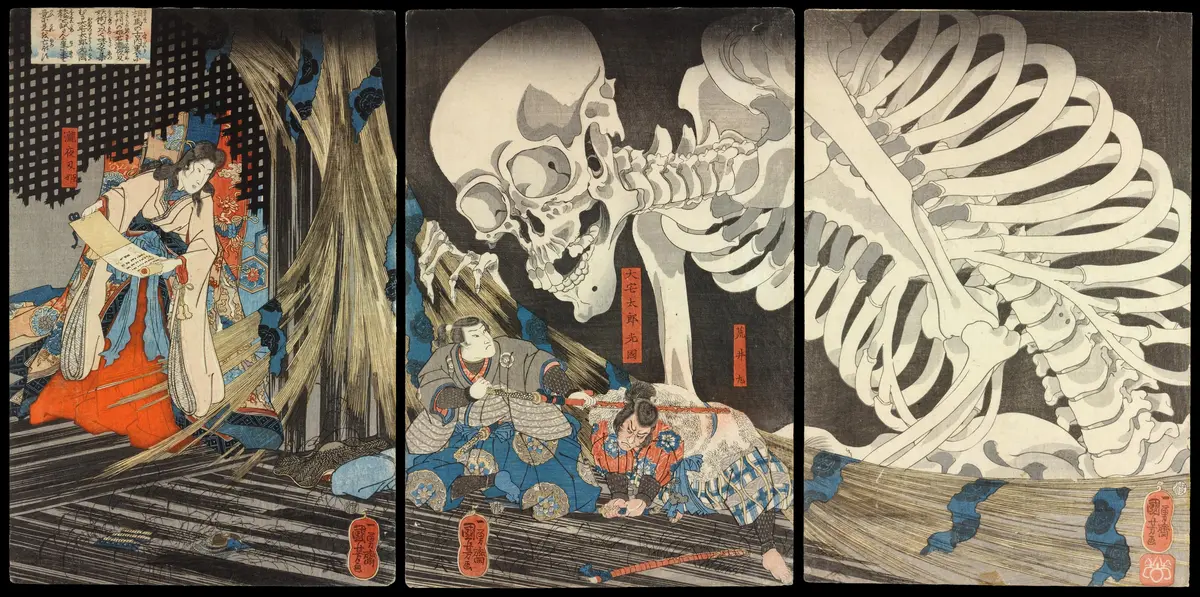
It appeared in print for the first time in November 1966, in a feature on "the Japanese yokai right beside you" in the Kodansha girls' manga magazine Bessatsu Shōjo Friend: a huge skeleton that clatters gachi-gachi at every step, with only its eyeballs bulging out. The author was Saitō Morihiro, a science journalist, science-fiction writer and founding member of the Science Fiction Writers of Japan, who later explained that he had built the creature out of a British ghost story printed in a boys' magazine the year before — the rattling Black Knight of Glamis Castle, whose gasha-gasha gave the thing its name. The colossal skeleton everybody pictures is older and is somebody else: Utagawa Kuniyoshi's print of about 1844, where Takiyasha raises skeletons in the ruined palace at Sōma. Children's yokai encyclopedias of the 1970s welded the two together. In the standard database of Japanese folklore reports, the word returns nothing at all.
What is the history of Gashadokuro?
Almost no monster has a birth certificate. This one does, and it is dated November 1966.
That month the Kodansha girls' manga magazine Bessatsu Shōjo Friend ran a feature called "the Japanese yokai right beside you". Among the creatures listed was a giant skeleton described in one line: it clatters, gachi-gachi, at every step, and only its eyeballs bulge out. The piece was written by Saitō Morihiro, and that first printed description is the whole of the gashadokuro. There is no earlier one.
Saitō (7 July 1932 – 14 April 2017) was not a folklorist. Born in Mikawashima, in what is now Tokyo's Arakawa ward, he read particle physics at Tokyo University of Education, called himself an "avant-garde science critic", belonged to the Japanese Archaeological Association and the Astronomical Society of Japan, and on 5 March 1963, in a restaurant in Shinjuku, was one of the founders of the Science Fiction Writers of Japan alongside Komatsu Sakyō, Hoshi Shin'ichi and Fukushima Masami. Through the sixties and seventies he was a fixture on Japanese television and radio as a science explainer, and later wrote on lost civilisations and UFOs. The yokai he supplied to children's magazines were work, and some of them he made up.
This one he made up out of Scotland. Saitō said so himself, and the account is set down by Makuhari Hongō Takeshi in his chapter on the horror features of Japanese children's magazines and where their material came from, in Retsudentai yōkaigaku zenshi (Bensei Shuppan, 2021), pages 152-154: the model was a British ghost story, "the Black Knight of Glamis Castle", which Kodansha's boys' magazine Bokura had printed in its May 1965 issue. The ghost rattled — gasha-gasha — and that noise, transplanted, is where the name comes from. A yokai routinely sold as ancient Japanese folklore is named after the sound a Scottish castle ghost made in a comic for boys.
The famous picture is older, and it is not a gashadokuro. It is Utagawa Kuniyoshi's ōban triptych Sōma no furudairi, known in English as Takiyasha the Witch and the Skeleton Spectre, which the Victoria and Albert Museum dates to about 1844 and Japanese cataloguing to Kōka 2-3, 1845-46. It illustrates Santō Kyōden's yomihon Utō Yasukata chūgiden, published in 1806 and never finished. Takiyasha-hime — originally Satsuki-hime, and according to the Nihon jinmei daijiten a character Kyōden built on Nyozōni, the third daughter of Taira no Masakado — is cornered in the ruined palace at Sōma, in Shimōsa, and raises skeletons against Ōya Tarō Mitsukuni and Yamashiro Mitsunari, the two men sent from the capital to finish off her father's cause. Japanese scholarship on the print, citing the 1996 Kuniyoshi bicentenary catalogue and volume 12 of Kyōden's collected works, makes a point of the difference: in the novel many life-size skeletons appear, and the single colossus is Kuniyoshi's own invention.
The fusion came later. In the 1970s both Mizuki Shigeru and Satō Arifumi attached Kuniyoshi's colossus to Saitō's name, and Satō's Nihon yōkai zukan (Rippū Shobō, Jaguar Backs series, 1972, pages 178-179) was a children's bestseller reprinted dozens of times — a 27th printing by 1978. Saitō himself is credited among that book's material contributors. From there the gashadokuro entered video games, anime and the English-language internet with a thousand years of history it had never had.
Timeline: the documented record of Gashadokuro
- Twelfth month of Hōki 9 (778) Homuchi no Makihito of Ōyama village, Ashida district, Bingo province, finds a skull with a bamboo shoot through its eye socket, removes it and leaves an offering. The skull names itself Anano Otogimi and says its uncle Akimaro murdered it. The tale is written down around 822 in the Nihon ryōiki, book three, tale 27, and has nothing to do with any giant skeleton.
- 940 Taira no Masakado, who had proclaimed himself New Emperor in the Kantō, is killed by his cousin Taira no Sadamori and Fujiwara no Hidesato. His head is carried to the capital. The mound in Ōtemachi where it is said to have come to rest is still there, and is the only physical anchor the later legend ever had.
- 1806 Santō Kyōden publishes the yomihon Utō Yasukata chūgiden, left unfinished. In it Takiyasha-hime — a character the Nihon jinmei daijiten says he modelled on Nyozōni, Masakado's third daughter — is cornered in the ruined palace at Sōma and raises skeletons against the envoys Ōya Tarō Mitsukuni and Yamashiro Mitsunari. Many life-size skeletons, not one colossus.
- 1836 The kabuki dance-drama Shinobiyoru koi wa kusemono premieres at the Ichimura-za as a scene of Yo ni Utō Sōma no furugosho, carrying Takiyasha onto the stage. Her fame in the nineteenth century is theatrical and literary, not devotional.
- c. 1844-46 Utagawa Kuniyoshi issues the ōban triptych Sōma no furudairi, the print the English-speaking world calls Takiyasha the Witch and the Skeleton Spectre. The Victoria and Albert Museum dates its set (E.1333:1 to 3-1922) to about 1844; Japanese cataloguing puts it at 1845-46. The single giant skeleton is Kuniyoshi's departure from his source, and it is not called a gashadokuro by anyone for another 120 years.
- May 1965 Kodansha's boys' magazine Bokura prints the British ghost story of "the Black Knight of Glamis Castle". Saitō Morihiro later identified this piece as the model for the creature he was about to invent, and the rattling gasha-gasha of the Scottish ghost as the source of its name.
- November 1966 The gashadokuro appears in print for the first time, in the feature "the Japanese yokai right beside you" in Bessatsu Shōjo Friend, written by Saitō Morihiro: a huge skeleton that clatters gachi-gachi at every step, with only its eyeballs bulging out. That sentence is the creature's entire documented origin.
- 1968 Saitō's yokai material is reprinted in Yamauchi Shigeaki's Sekai kaiki thriller zenshū 2: Sekai no monsutā (Akita Shoten), one of the cheap illustrated horror volumes that carried the invention out of the magazines and into children's bookshelves.
- 1972 Satō Arifumi's Nihon yōkai zukan (Rippū Shobō, Jaguar Backs) devotes pages 178-179 to the gashadokuro and illustrates it with Kuniyoshi's colossus. Mizuki Shigeru does the same in his yokai plates. The book is a bestseller, reaching a 27th printing by 1978, and the name and the picture are welded together for good.
- 2021 Makuhari Hongō Takeshi sets out the origin in his chapter on the horror features of Japanese children's magazines and their sources, in Itō Shingo and Hyōrintei Hyōsen's Retsudentai yōkaigaku zenshi (Bensei Shuppan), pages 152-154, naming the 1966 issue, the 1965 Glamis story and Saitō's own account of how he built the creature.
- 14 August 2026 A search of the Nichibunken Kaii-Yōkai Denshō Database, 35,255 folklore case records, returns no match for がしゃどくろ, repeated twice, and none for the ateji 餓者髑髏. Controls run the same day in the same box: 髑髏 21 records, どくろ 1, ろくろ首 7, 大入道 103.
Is there a rational explanation for Gashadokuro?
The first question is not whether a giant skeleton walks at night. It is whether Japanese people ever said one did.
The place to look is the Kaii-Yōkai Denshō Database of the International Research Center for Japanese Studies (Nichibunken), built under Komatsu Kazuhiko from the folklore journals catalogued in Takeda Dan's 1978 bibliography, from the Nihon zuihitsu taisei, from the folklore volumes of the prefectural histories and from Yanagita Kunio's Yōkai meii. It held 35,255 case records as of April 2023, and it is the closest thing there is to a census of what was actually collected in the field. Searched on 14 August 2026, がしゃどくろ returns no matches at all. The query was repeated to be sure; the second run returned nothing either, and the ateji spelling 餓者髑髏 returns nothing. In the same search box, the same day: 髑髏 (skull) returns 21 records, どくろ 1, ろくろ首 7, and 大入道 103. The zero is not a broken search. The word is simply not in the folklore record.
The details our own file used to carry go the same way. The ringing in the ears and the vanishing at cockcrow could not be traced to any Japanese text, and neither is in the 1966 description, which gives a noise the thing makes with its own bones, not a sound inside the victim's head. The Shinto charm has a traceable source, and it is not Japanese: the English Wikipedia article attributes invisibility, indestructibility and the warding charms to Jonathan Maberry's Vampire Universe (Citadel, 2006), a pop compendium by an American horror novelist, tagged "better source needed" since April 2014, under a sentence the article itself prints: "The following characteristics are not confirmed by Japanese data." The hour of 2 a.m. comes from Matthew Meyer's The Night Parade of One Hundred Demons (2012). And the story of a skeleton loosed on Kyoto, which yokai.com carries, is not in Kyōden or in Kuniyoshi: there the skeleton rises in a ruined palace in Shimōsa, against two men, and it loses.
Japan does have an ancient skull tale, and it is worth reading precisely because it is not this one. In the Nihon ryōiki, compiled around 822 by the monk Kyōkai of Yakushi-ji, book three, tale 27, Homuchi no Makihito of Ōyama village, Ashida district, Bingo province, finds in the twelfth month of Hōki 9 — 778 — a skull with a bamboo shoot driven through its eye socket. He pulls it out, leaves an offering of dried rice, and the skull thanks him, names itself as Anano Otogimi and says it was murdered by its uncle Akimaro. Mizuki Shigeru printed that story next to his gashadokuro entry with a note that it is not a gashadokuro. The note did not survive the journey: the official yokai list of Mizuki Shigeru Road today gives the gashadokuro's place of appearance as Ōyama village, Ashida district, Bingo — the address of a ninth-century skull, pinned to a creature invented in 1966.
Can you visit Gashadokuro?
The addresses that can be given for the gashadokuro belong to the objects and places out of which the legend was assembled.
Kuniyoshi's triptych of Takiyasha and the skeleton is held by the Victoria and Albert Museum in London under museum number E.1333:1 to 3-1922, dated about 1844 and measuring 35 by 71 cm across the three ōban sheets. The museum's online record, consulted on 22 September 2026, gives the object as being in storage and part of the Order an Object service, adds that it is “currently reserved and unavailable to book”, and carries an image.
A gashadokuro stands in bronze at Sakaiminato, in Tottori prefecture, the home town of Mizuki Shigeru. Mizuki Shigeru Road runs about 800 metres from Sakaiminato station to the Mizuki Shigeru Memorial Museum with 178 bronze yokai along it; the road's official list numbers the gashadokuro 93 and its statues are lit every evening from sunset until 10 p.m. The museum is at Honmachi 5-chōme, Sakaiminato 684-0025, telephone 0859-42-2171, and its own site gave the hours on 22 September 2026 as 9:30 to 17:00 with last admission at 16:30 and no regular closing day through the year; the same page sells tickets online through JTB or at the first-floor reception desk without publishing a price. Sakaiminato is the terminus of the JR Sakai line from Yonago.
The third address belongs to the history the legend borrowed. Masakado-zuka, the mound of the head of Taira no Masakado, sits at Ōtemachi 1-2-1, Chiyoda, Tokyo, in the open air beside the Ōtemachi One towers, free of charge and designated a historic site by the Tokyo metropolitan government. The preservation society recorded a completion ceremony for the sixth restoration on Monday 26 April 2021, with a Buddhist service at one o'clock by the chief priest of Nichirinji in Kanda and a Shinto rite at three by priests of Kanda Myōjin. Since that work the offerings and the incense stand have been withdrawn, while the coin box remains. Nothing on the mound refers to a giant skeleton; it is a working place of worship in an office district and is run as one.
The birthplace is a magazine: Bessatsu Shōjo Friend for November 1966, which turns up in Japanese library holdings and in the second-hand trade.
Sources consulted
- Komatsu Kazuhiko (dir.), «怪異・妖怪伝承データベース (Kaii-Yōkai Denshō Database), 35,255 case records as of April 2023» — International Research Center for Japanese Studies (Nichibunken), Kyoto, 2023 academic
- Makuhari Hongō Takeshi; Itō Shingo & Hyōrintei Hyōsen (eds.), «少年少女雑誌の怪奇記事とネタ元 (The horror features of children's magazines and where they came from), pp. 152-154» — 列伝体 妖怪学前史, Bensei Shuppan, Tokyo, ISBN 978-4-585-32010-4 (CiNii BC11102521), 2021 book
- Japanese Wikipedia contributors, «がしゃどくろ (Gashadokuro)» — ja.wikipedia.org — the accessible synthesis of Makuhari 2021, with the citations to Satō 1972 (pp. 178-179), Mizuki 2014 (p. 188) and Kyōgoku et al., Yōkai baka, 2001 (p. 340), 2026 web
- Utagawa Kuniyoshi, «Takiyasha the Witch and the Skeleton Spectre (相馬の古内裏), colour woodblock triptych, ōban, 35 × 71 cm, museum no. E.1333:1 to 3-1922» — Victoria and Albert Museum, London, 1844 archive
- Digital Daijisen; Seisenban Nihon kokugo daijiten; Nihon jinmei daijiten+Plus, «滝夜叉姫 (Takiyasha-hime)» — Kotobank (Asahi Shimbun / Kōdansha / Shōgakukan reference works), 2026 web
- English Wikipedia contributors, «Gashadokuro — including the flag "The following characteristics are not confirmed by Japanese data" over the invisibility and Shinto-charm claims sourced to Jonathan Maberry, Vampire Universe (Citadel, 2006)» — en.wikipedia.org, 2026 web
- Matthew Meyer, «Gashadokuro — the entry that sends the skeleton against the city of Kyōto» — yokai.com, 2026 web
- Hongō Masatsugu, specially appointed professor of Japanese ancient history, Faculty of Letters, «『日本霊異記』の世界 Vol.8 — the skull of Ashida, Nihon ryōiki book three, tale 27, Hōki 9 (778)» — Ritsumeikan University Parents' Educational Support Association, 2023 academic
- Masakado-zuka Hozonkai (Masakado Mound Preservation Society), «将門塚 改修工事完了 — completion of the sixth restoration, Ōtemachi 1-2-1, Chiyoda, Tokyo» — masakado-zuka.jp, 2021 report
- Sakaiminato Tourism Association / Mizuki Shigeru Memorial Museum, «水木しげるロードの妖怪たち — official list of the road's bronze yokai, no. 93 がしゃどくろ, place of appearance given as Ōyama, Ashida district, Bingo» — mizuki.sakaiminato.net, 2026 web
Reviewed by V. Serrano on 2026-08-14 · How we verify our content
📎 Source: Enigma Atlas
💬 Field testimonies (0)
No testimonies yet. Add the first.
Add your testimony
🔒 Log in to add a testimony