🦶 CRYPTID SIGHTING · EXP. Nº6501
ACTIVE
Kappa
The kappa is the water creature of Japanese rivers, ponds and irrigation channels, and the folklorist who made it a national subject was frank about how thin his record was.
Where and when was Kappa sighted?
- Location
- Japón, Japan
- Date sighted
- Unknown
- Coordinates
- 36.205, 138.253
- Last updated
LOCATION
What is Kappa?
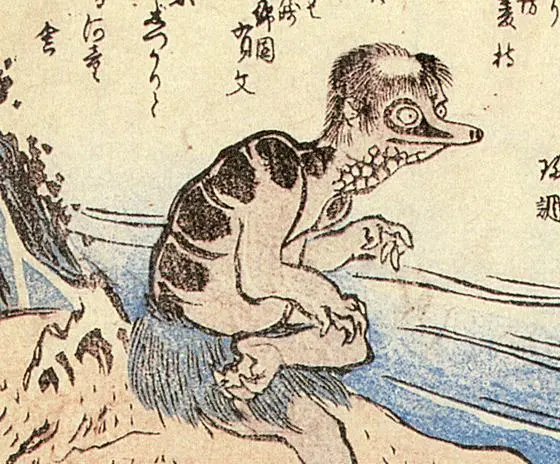
Kunio Yanagita's Tono Monogatari of 1910, the founding text of modern Japanese folklore studies, took all five of its kappa tales from one informant, Sasaki Kizen, and under the tale of the kappa that tried to drag a horse into a pool Yanagita noted that stories of this type saturate the whole country. The kappa of Tono are red in the face, leave tracks in the riverbank sand with the thumb set apart like a monkey's, and father children on village women. The monkey runs through the tradition: Ishida Eiichiro's 1950 study argued that the kappa descends from water-gods that, in degenerate form, became monkey-like monsters. In the Tsugaru plain of Aomori the kappa is still worshipped as Suiko-sama, though in western Tsugaru almost all its kappa-shaped statues were carved in the Meiji era, after 1868, at places where children drowned in rivers and irrigation channels. That is the part of the legend that never stopped working: in 2008 a Japanese transport ministry working group told designers of riverside warning signs to include each river's folk traditions, and in 2024 eighteen of the 28 Japanese children of middle-school age or younger who died or went missing in water were in rivers.
What is the history of Kappa?
The kappa is usually filed under "extinct monsters of a picture book". In Tono a "kappa capture permit" is still on sale at the roadside station and the town's tourist facilities, and in the Tsugaru plain the door of a Suiko-sama shrine is opened on its festival day, when cucumbers are laid out for the kappa god.
The name covers several creatures. What Tokyo calls kappa is gataro in the Kinki region, enko in parts of Kyushu, medochi in the old Nambu domain of the northeast, mizushi in Kaga and Noto, mintsuchi in Ainu. Kunio Yanagita argued that mizushi, medochi and mintsuchi all descend from mizuchi — mizu-tsuchi, "the divine being in the water" — and therefore that the kappa is a god that fell. Ishida Eiichiro, whose 1950 monograph in Folklore Studies remains the only book-length treatment of the kappa in English, records a detail in its favour: in Hyuga and Osumi, in southern Kyushu, where the kappa is most venerated, people simply call it sui-jin, water-god. In parts of Kyushu it is kawa-no-tono, "lord of the river".
The text that made the kappa a national subject is Kunio Yanagita's Tono Monogatari, published on 14 June 1910 and generally taken as the founding document of modern Japanese folklore studies. Its preface is unusually candid about its own method: every story came from one man, Sasaki Kizen of Tono, who began visiting Yanagita in about February 1909, and Yanagita insists he wrote them down "without adding or subtracting a single word". The book ends its preface with the sentence Japanese schoolchildren still quote: "Would that these tales be told, and make the people of the plains shudder."
Five of its 119 tales are kappa tales, numbers 55 to 59, and they are stranger than the cartoon version. Tale 59 states flatly that although kappa are said to be blue elsewhere, "the kappa of Tono are red in the face" — Sasaki's own great-grandmother saw a scarlet boy's face between the walnut trees. Tale 57 says kappa footprints in the riverbank sand are a perfectly ordinary sight after rain: thumb separated like a monkey's, under three sun long, the fingertips not as distinct as a human's. Tales 55 and 56 are about women bearing kappa children, and they are grim: a newborn cut up and buried in a cask, another abandoned at a crossroads and then, on second thoughts, judged worth selling as a sideshow. Tale 58 is the classic: a kappa at Ubako-buchi tries to drag a horse into the pool, is dragged into the stable instead, and is released after swearing never to touch the village horses again.
All of this is folklore that never stopped working. In the Tsugaru plain of Aomori, the folklorist Takahide Oyama documented in 2020 a living cult of Suiko-sama — the water-tiger deity, understood locally as the kappa's divine form — with festivals photographed in 2008, 2018 and 2019. A pair of wooden kappa images was enshrined at Chitose in Kizukuri in May 1888, split from a main image at the Nichiren temple Jissoji, the pedestal inscribed with the abbot who consecrated it; a stone marker in Ohata is dated 21 June 1896 and stands on what was then the middle of the Akagawa river, at a horse-washing place where children drowned nearly every year. The first cucumber of the season went to Suiko-sama, and eating it before he did meant "the kappa will take you". In two hamlets people used false names, mentochi-nameko, so that the water god calling from the river would not know who to call. In 1934 the folklorist Shinobu Origuchi saw one household's Suiko image, admired it, had a copy carved by a Kizukuri sculptor and held a river festival with it at Kokugakuin University in Tokyo.
The kappa also made a living in the city. Sogenji, a Soto Zen temple in Taito ward, records that in 1814 the raincoat merchant Kappaya Kihachi, who had spent his own fortune digging the Shinbori canal through a low, badly drained district, died and was buried there; a kappa of the Sumida River he had once saved is said to have worked on the canal at night, and whoever saw it prospered in business. The canal is now Kappabashi kitchenware street, and the temple's Kappa Daimyojin is petitioned for trade and against fire and flood.
Timeline: the documented record of Kappa
- 1490 Jokenji, a Soto Zen temple, is founded at Tsuchibuchi in Tono. The stream behind it is the pool later known as Kappabuchi; the temple's guardian lion-dogs are carved as kappa, with the water dish hollowed into the crown of the head.
- 1814 The raincoat merchant Kappaya Kihachi, who had spent his own fortune digging the Shinbori canal through a low-lying Edo district, dies and is buried at his family temple Sogenji. The temple's own record says a kappa of the Sumida River that Kihachi had once saved helped with the work, and that whoever saw it prospered in trade.
- 1820 The Confucian scholar Koga Toan compiles Suiko koryaku, an Edo-period "kappa research book" gathering sighting reports and Japanese and Chinese textual sources, illustrated by the naturalist Kurimoto Tanshu with sketches of kappa said to have been captured. The Iwase Bunko library holds an 1836 manuscript copy.
- May 1888 A pair of wooden kappa images is enshrined as Suiko Daimyojin at Chitose in Kizukuri, Aomori, split from the main image held at the Nichiren temple Jissoji; the pedestal bears the name of the 20th abbot as consecrator. Local explanation: too many children were drowning in the Koden river.
- 21 June 1896 A stone marker to Suiko-sama is dated in the Ohata hamlet of Kizukuri. It stands on ground that was then inside the Akagawa river, at a horse-washing place where, according to residents, a child drowned almost every year.
- 14 June 1910 Kunio Yanagita publishes Tono Monogatari, the founding text of modern Japanese folklore studies. Tales 55 to 59 are the kappa tales; tale 59 states that the kappa of Tono are red in the face, not blue. The preface names a single informant, Sasaki Kizen, who began telling the stories around February 1909.
- 1934 The folklorist Shinobu Origuchi, doing fieldwork at Nagata in Kizukuri, is shown a household's Suiko image, praises it, has a copy carved by a local Buddhist sculptor and takes it to Tokyo, where he holds a river festival with it at Kokugakuin University.
- 1950 Ishida Eiichiro publishes The Kappa Legend in Folklore Studies IX — still the only book-length study of the kappa available in English. It endorses Yanagita's thesis that kappa are water-gods degenerated into water-monsters, and records that in Hyuga and Osumi the creature is simply called sui-jin, water-god.
- October 2008 After the Togagawa flash flood killed five people, including children, in Kobe that July, Japan's transport ministry working group circulates its guidance on riverside warning signs. It instructs designers to "incorporate the folk traditions of each river and each district as far as possible", and to make children's signs richer in local lore instead of URLs.
- 2016 Tono adopts a town-centre revitalisation plan that includes detailed marketing analysis of projected sales of the kappa capture permit and of visitor numbers expected from kappa and zashiki-warashi tourism. The permit, once carried only by the maburitto guides, had sold over 500 copies in its first fortnight on public sale.
- 2019 Tomoki Takada and Ayaka Kondo publish a study in the Japan Society of Civil Engineers' education journal treating yokai as an intellectual resource for disaster education. Searching the national folklore database, the keyword "water accident" returns 53 traditions, led by kappa, gawappa and hyosube.
- 7 February 2023 A team led by Professor Takashi Kato of Kurashiki University of Science and the Arts delivers its final report on the "mermaid mummy" of Enjuin: cloth, paper, cotton stuffing and a plaster-like base, surfaced with layered paper and pufferfish skin, the scales dating most likely to the late 1800s. It is the clearest published demonstration of how Japanese monster mummies were made.
- 19 June 2025 Japan's National Police Agency publishes its account of water accidents in 2024: of 28 children of middle-school age or younger who died or went missing, 18 (64.3%) were in rivers and 15 (53.6%) were playing in the water. The danger the kappa was invented to name has not gone anywhere.
Is there a rational explanation for Kappa?
The most damaging witness against the kappa is Kunio Yanagita himself. Under tale 58, the horse dragged into the pool, he appended his own note: "stories of this type saturate the whole country. In any region where kappa are said to live, this story exists without fail. Why is that?" And the corpus rests on a single informant: the preface says that every one of the 119 Tono tales was heard from Sasaki Kizen, whom Yanagita describes as "not a skilled talker, but a sincere man".
The descriptions are unhelpfully honest about their own sources. Yanagita's own tale 57 says kappa tracks have "the thumb separated, as in a monkey's foot". Ishida's 1950 study concludes that certain Japanese water-gods, in their degenerate form, "became peculiar monsters resembling monkeys", and in Kyushu one of the creature's names, enko, means monkey. Oyama, writing in 2020, recorded that in Kizukuri, in the Tsugaru plain, midochi, suiko, mentochi and kappa are held to be one and the same god, with a face like a monkey's.
The cult is also younger than it looks. Oyama cites a survey carried out by Kazuo Kawakami between 1965 and 1974, which found that almost all the kappa-shaped Suiko statues in western Tsugaru were carved by Meiji-era sculptors from Kizukuri and Jusan, and that the stone markers bear only Meiji, Taisho and Showa dates; Kawakami inferred that the Suiko-sama devotion as practised today is not very old. Oyama sets it on a plain that the Hirosaki domain reclaimed in the middle and later Edo period, with new paddy, many reservoirs and irrigation channels, and cites Shin Hirose's finding that kappa traditions across Aomori cluster on land reclaimed from the 16th century onward, at nearby rivers and man-made waterworks that people could control. The older layer is there too: Oyama lists a snake-like thing called a medochi said to have come out of a child drowned in a Hirosaki stream between 1624 and 1644, and a kawataro blamed for a boy drowned in a new reservoir at Morita in 1776.
Temple "mummies" of this kind can be examined, and one has been: the "mermaid mummy" of Enjuin in Asakuchi, Okayama, studied by a team led by Professor Takashi Kato of Kurashiki University of Science and the Arts using X-ray, X-ray CT, electron microscopy, fluorescent X-ray analysis, DNA work and radiocarbon dating. The final report of 7 February 2023 found a core of cloth, paper, cotton stuffing and a plaster-like substance, surfaced with layered paper and pufferfish skin, the scales dating most likely to the late 1800s. DNA yielded nothing. The same report counts twelve other mermaid mummies known in Japan, most of them held by temples, shrines and museums, cites an illustrated record of 1832 that shows one in a sideshow, and concludes that many were made from the Edo period onward and circulated in Japan and abroad.
And then there is the part that engineers take seriously. Takada and Kondo, in a 2019 paper in the Japan Society of Civil Engineers' education journal, treat yokai as an "intellectual resource" for disaster education: searching the International Research Center for Japanese Studies' folklore database, the keyword "water accident" returns 53 traditions, headed by kappa, gawappa and hyosube. They read yokai lore as a device for passing on knowledge of risk, and ran workshops in which children invented new yokai of their own. The risk is current. Japan's National Police Agency reported on 19 June 2025 that of 28 children of middle-school age or younger who died or went missing in water in 2024, 18 (64.3%) were in rivers, and 15 (53.6%) were simply playing in the water. Official guidance for riverside warning signs, drafted after the 2008 Togagawa flash flood that killed five in Kobe, tells sign designers to "incorporate the folk traditions of each river and each district as far as possible", and specifically to enrich children's signs with local lore. The kappa is, in the most literal administrative sense, still on duty.
Can you visit Kappa?
Kappabuchi, Tono, Iwate. The pool sits in a small stream behind Jokenji, a Soto Zen temple founded in 1490, at Tsuchibuchi, Tsuchibuchi-cho, Tono (postcode 028-0555). Jokenji is worth the detour on its own account for its kappa komainu — guardian lion-dogs carved with the dish-shaped hollow on the crown of the head. The stream bank has two kappa figures, a small shrine to a milk deity where nursing mothers leave red breast-shaped offerings, and fishing rods left out for anyone who wants to try. Tono's tourist information gives visiting hours of 9:00-16:00. There is no car park at Kappabuchi itself: use the Sawayaka Toilet car park at Denshoen, about ten minutes' walk away. Denshoen is roughly 5.3 km from JR Tono station, about eleven minutes by car.
The kappa capture permit. Sold for 220 yen at the Denshoen shop and by the Tono City Tourism Association, valid for one year. The back carries seven conditions, including catching the kappa without damaging the dish on its head or spilling the water in it, and using fresh vegetables as bait; the association offers a reward of 10 million yen for a live kappa delivered on good terms. It began as a card carried only by the maburitto, the local guides who watch over Kappabuchi, before it was sold to the public; Oyama records that more than 500 sold in the first fortnight, and that Tono's 2016 town-centre revitalisation plan contains sales projections for it.
Sogenji (Kappadera), Tokyo. 3-7-2 Matsugaya, Taito-ku, tel. 03-3841-2035; about seven minutes on foot from Asakusa station on the Tsukuba Express, or two minutes from the Kita-Ueno 2-chome stop on the Megurin bus. The Kappa Daimyojin can be visited in the grounds. Entering the gallery hall requires contacting the temple in advance, and the temple states it cannot always accommodate visits. Kappabashi kitchenware street — the old canal Kihachi dug — begins a short walk away. The temple has hosted a Tokyo summit of the Kappa Federal Republic, the nationwide network of towns with kappa traditions, which brought about fifty people from kappa villages across Japan.
Aomori. The Suiko-sama rites of the Tsugaru plain fall on 20 July, with kagura the following day, in hamlets around Kizukuri in Tsugaru city. These are community and household observances, not attractions: some images are deliberately never shown, one household having been told by a priest that the figure should not be displayed to outsiders. Go as a guest or not at all.
For the documents. The Iwase Bunko library in Nishio, Aichi, holds an 1836 manuscript copy of Suiko koryaku, the kappa compendium assembled in 1820 by the Confucian scholar Koga Toan, illustrated with drawings by Kurimoto Tanshu of kappa said to have been captured.
Sources consulted
- 柳田國男 (Kunio Yanagita), «遠野物語 (Tono Monogatari / The Legends of Tono), tales 55-59 and preface» — First published 14 June 1910; full text via Aozora Bunko (base text: Iwanami Bunko), 1910 book
- Ishida Eiichiro (trans. Yoshida Ken'ichi), «The Kappa Legend: A Comparative Ethnological Study on the Japanese Water-Spirit Kappa and Its Habit of Trying to Lure Horses into the Water» — Folklore Studies, vol. IX, pp. 1-152, Tokyo, 1950 academic
- 小山隆秀 (Takahide Oyama), «青森県津軽地方のスイコ様信仰の諸相と現在 (Belief in Suiko in Various Forms in Modern Society: A Case Study in the Tsugaru Region of Aomori Prefecture)» — 青森県立郷土館研究紀要 (Bulletin of the Aomori Prefectural Museum), no. 44, pp. 69-80, 2020 academic
- 高田知紀・近藤綾香 (Tomoki Takada and Ayaka Kondo), «妖怪伝承を知的資源として活用した防災教育プログラムに関する一考察 (A study of disaster-prevention education programmes using yokai folklore as an intellectual resource)» — 土木学会論文集H(教育)/ Journal of JSCE, ser. H (Education), vol. 75, no. 1, pp. 20-34, 2019 academic
- 国土交通省 中小河川における水難事故防止策検討WG (MLIT working group on water-accident prevention in small and medium rivers), «中小河川における水難事故防止策〜平常時における看板を用いた情報提供〜 (資料3-3, 第2回WG, 27 Oct 2008)» — Ministry of Land, Infrastructure, Transport and Tourism, Japan, 2008 report
- 西尾市岩瀬文庫 (Nishio City Iwase Bunko Library), «水虎考略 (Suiko koryaku) — Iwase Bunko collection entry» — Iwase Bunko collection catalogue (1836 manuscript copy, 1 vol. of 77), 2020 archive
- 曹源寺 (Sogenji temple, Taito-ku, Tokyo), «かっぱ大明神 (Kappa Daimyojin)» — Official temple website, 2026 web
- 遠野時間 — 一般社団法人遠野市観光協会 / 株式会社遠野ふるさと商社, «カッパ淵 (Kappabuchi) and 遠野市のカッパ伝説を巡る旅» — Official Tono city tourism information site, 2026 web
- 加藤敬史 (Takashi Kato) et al., Kurashiki University of Science and the Arts, «人魚ミイラの実態解明 — 圓珠院所蔵『人魚のミイラ』研究最終報告» — University research report, 7 February 2023, 2023 report
- 警察庁生活安全局生活安全企画課 (National Police Agency, Community Safety Bureau), «令和6年における水難の概況等 (Overview of water accidents in 2024)» — National Police Agency of Japan, 19 June 2025, 2025 report
Reviewed by V. Serrano on 2026-07-29 · How we verify our content
📎 Source: Enigma Atlas
💬 Field testimonies (0)
No testimonies yet. Add the first.
Add your testimony
🔒 Log in to add a testimony