📜 LEGEND · EXP. Nº0270
ACTIVE
Princess Kaguya of the Bamboo
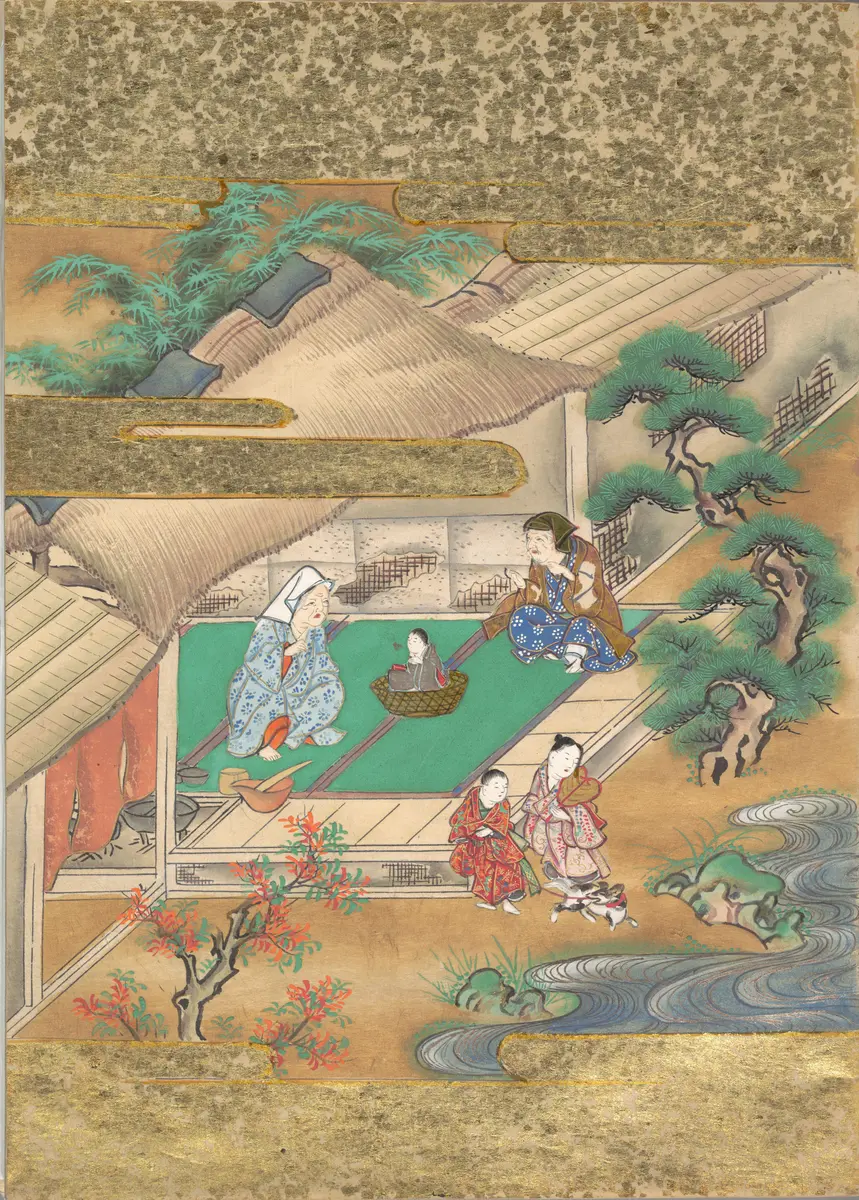
A bamboo cutter with a name — Sanuki no Miyatsukomaro — splits a shining stalk and finds a girl three sun tall, about nine centimetres, so small she has to be raised in a basket.
Where does the legend of Princess Kaguya of the Bamboo come from?
- Location
- Mount Fuji, Shizuoka, Japan, Japan
- Kind of legend
- Folk tale
- Coordinates
- 35.361, 138.727
- Last updated
LOCATION
What is the legend of Princess Kaguya of the Bamboo?
In three months she is a grown woman, and a specialist is called in to name her: Nayotake no Kaguya-hime. Five suitors come, and they are not anonymous nobles: three carry the names and the actual court offices of ministers who died between 701 and 717, and the two princes are thinly veiled portraits of two more. Each is sent after an impossible object and each is humiliated in a different way; the last of them falls from a swallow's nest, breaks his back and dies clutching a handful of droppings. When the moon reclaims her, Kaguya-hime leaves her robe as a keepsake and is stopped from wrapping any elixir of immortality in it. The Emperor asks which mountain stands nearest to heaven, not which is highest, and sends a named envoy to burn her letter and the elixir on the summit in Suruga. That last paragraph is the only line that puts this story on a map — and it is absent from the oldest surviving retelling.
What is the history of Princess Kaguya of the Bamboo?
The oldest thing in this story is not the story. It is a headnote in the Man'yōshū, the poetry anthology compiled around 759. In Book 16, before poem 3791, a short passage in Chinese prose introduces "an old man, called Taketori no Okina" — the old bamboo cutter — who climbs a hill in the last month of spring and comes upon nine maidens boiling herbs. They mock him; he apologises in verse for having come too near, saying he has "by chance met shinsen", immortals. There is no moon, no glowing stalk and no princess. But a hundred years or more before the tale exists, the bamboo cutter and the celestial women are already a pair.
The Taketori Monogatari itself was written by an unknown hand, most likely in the second half of the ninth century; it is mentioned in tenth- and eleventh-century works, so it was certainly finished by the mid-tenth. Its opening names the man: Sanuki no Miyatsukomaro. The text calls him taketori no okina, the old bamboo-taker, who went into the fields and hills cutting bamboo "and used it for all manner of things"; it never says where he lives — only, much later, that his house is "near the foot of the hills", when the Emperor plans a hunt as a pretext to see the girl.
What he finds inside the shining stalk is "a person about three sun tall" — some nine centimetres, a sun being about three. She is so small she has to be raised in a basket. In roughly three months she is a grown woman, and when she is grown the couple summon a specialist to name her: Mimuroto no Inbe no Akita, who calls her Nayotake no Kaguya-hime, Shining Princess of the Supple Bamboo. Three days of feasting follow.
Then comes the part that turns a fairy tale into something sharper. The five suitors are not five anonymous nobles. Three are named after real ministers, with their real offices:
- Abe no Miushi, Minister of the Right — a real man, born about 635, dead on 20 May 703, who really held that office;
- Ōtomo no Miyuki, Grand Counsellor — born about 646, dead 27 February 701, and Grand Counsellor in fact;
- Isonokami no Maro(tari), Middle Counsellor — Isonokami no Maro, 640 to 22 April 717.
The two "princes" are thinly veiled. Prince Kuramochi is usually identified with Fujiwara no Fuhito (659–720), whose mother was of the Kurumamochi line; Prince Ishitsukuri with Tajihi no Shima (624–701).
Each is given an impossible errand: the Buddha's stone begging bowl from India; a branch from the tree of Hōrai with silver roots, a golden stem and pearls for fruit; the fire-rat's fur robe from China; the five-coloured jewel from a dragon's neck; a swallow's koyasugai, the cowry of easy birth. Each fails, and each failure is a specific humiliation. Kuramochi has the jewelled branch forged and is exposed when the craftsmen turn up demanding payment. Abe's robe burns. Ōtomo comes home with two eyes swollen like plums. Isonokami has himself hoisted in a basket to a swallow's nest in the Imperial Kitchen Bureau, the rope snaps, he falls onto the cauldrons, breaks his back, and finds he is clutching not a cowry but old swallow droppings. He dies of the shame.
That is a joke aimed at a specific generation: all five men were dead by 720, and the tale that kills off Isonokami was written by someone who knew that the real Isonokami no Maro had been on the losing side of the Jinshin War of 672, was pardoned, and rose to be Minister of the Left and the most powerful man in the council of state between 715 and his death.
The ending is exact and almost nobody reports it exactly. Kaguya-hime writes a farewell, takes off her outer garment and leaves it as a keepsake; she tastes a little of the elixir of immortality and tries to wrap a portion of it in that same garment for her foster parents, and a celestial being stops her. The feather robe is then put on her, and with it every earthly feeling goes. The letter and the jar of elixir go to the Emperor, who asks his ministers not which mountain is highest but "which mountain is nearest to heaven". One answers that the mountain in the province of Suruga is near both to heaven and to the capital. A named envoy, Tsuki no Iwakasa, is sent with many soldiers to the summit to burn the letter and the jar together. The text closes: because he climbed it with so many soldiers, the mountain was called Fushi no yama — and the smoke of that burning, it is handed down, still rises into the clouds.
Timeline: the documented record of Princess Kaguya of the Bamboo
- c. 759 The Man'yōshū, Book 16, carries a Chinese-prose headnote before poem 3791 in which "an old man called Taketori no Okina" meets nine maidens on a hill and apologises in verse for approaching "immortals". It is the earliest datable appearance of the bamboo cutter with celestial women — over a century before the tale.
- 864–866 Mount Fuji erupts on its north-western flank from June 864; the Japan Meteorological Agency dates the eruption into 866. The tale's closing line — that the smoke of the burning still rises — describes a volcano that was active in living memory when it was written.
- Late 9th century An unknown author writes the Taketori Monogatari. It names the bamboo cutter Sanuki no Miyatsukomaro, gives the girl the name Nayotake no Kaguya-hime from a specialist called in for the purpose, and mocks by name five ministers who had all been dead for more than a century and a half.
- c. 1008 The Genji Monogatari, in the chapter E-awase, calls the Bamboo Cutter "the ancestor of the coming-into-being of tales" — inside a scene in which a court faction argues that Kaguya-hime "seems a person of low birth" and even its defenders concede the story has "nothing especially amusing in it". The tale's oldest praise and its oldest insult are on the same page.
- c. 1120 The Konjaku Monogatarishū includes an abridged version in volume 31: only three impossible tasks, no departure on the fifteenth night, and no naming of Mount Fuji at all. The tale's only geographical anchor is absent from its earliest surviving retelling.
- Late 13th – late 14th century The oldest surviving physical witnesses are written: eleven cut leaves, ten traditionally attributed to Emperor Go-Kōgon and one to Nijō Tamesada. Radiocarbon dating of one leaf, reported by Ikeda Kazuomi and Oda Hirotaka in 2021, confirmed the late Kamakura to Nanboku-chō range.
- By the end of the Kamakura period The Fujisan Engi, the origin-records of the Fuji shrines, are in existence. In them Kaguya-hime does not return to the moon: she climbs Mount Fuji, vanishes, and is the mountain's deity — telling pilgrims they may come to the summit to meet her, but that women may go no further than the Chūgū. This is stated by Ōtaka Yasumasa of the Shizuoka Prefectural Mt. Fuji World Heritage Centre.
- 1570 The Satomura Jōha manuscript is copied — the oldest complete text of the tale with a dated colophon. Some seven centuries after composition, and the bamboo cutter's name still varies across the tradition between Sanuki, Sakaki and Saruki.
- 1592 Nakanoin Michikatsu collates the Mutō manuscript, re-collating it in 1596. It was held to be the oldest surviving copy until the Jōha manuscript came to light, which is why English-language reference works still give 1592 as the date of the oldest manuscript.
- 1707 The Hōei eruption — Mount Fuji's last. Every retelling published since then that says the smoke "still rises" is copying a Heian sentence, not describing a mountain.
- 1888 F. V. Dickins publishes the first English translation made from the Japanese, and renders the Emperor's question as which mountain "towered highest towards heaven", sending the envoy to "the highest peak". The Japanese asks which is nearest to heaven.
- 1906 After a public quarrel with the naturalist Minakata Kumagusu, and then with his help, Dickins publishes a revised translation that reads "which mountain towered nearest to heaven" and "whereof the peak is nighest heaven". He corrected his own error eighteen years later; English retellings still print the old one.
- April 1911 Kōda Rohan lectures on the parallels between the tale and the Candrottarā sūtra, translated into Chinese in 591 — and closes by stating that he is "by no means saying that the Taketori came out of the Gatsujō-nyo-kyō". The scholar who found the parallel refused the derivation.
- 1961 Tian Haiyan publishes "Banzhu Guniang" in the collection Jinyu Fenghuang, attributed to the Aba Tibetans of Sichuan. Itō Seiji argued in 1973 for a shared ancient source; Okutsu Haruo (2000), Song Chengde (2004) and Li Lianrong (2019) concluded instead that the Chinese tale is an adaptation of the Japanese one.
- 19 September – 8 November 2026 Fuji City's municipal museum runs a special exhibition titled Kaguya-hime who returns to Mount Fuji — the local ending, in which she never reaches the moon, stated as the museum's own subject. Admission free.
Is there a rational explanation for Princess Kaguya of the Bamboo?
There is nothing to disprove here — nobody claims a girl came out of a bamboo. What is worth checking is everything the story is routinely said to be, because most of it does not survive contact with the documents.
"Japan's oldest surviving narrative" is a line of dialogue in a novel. The phrase comes from the Genji Monogatari, around 1008, in the chapter E-awase ("The Picture Contest"), where two court factions match paintings against each other: "first they matched The Bamboo Cutter, the ancestor of the coming-into-being of tales, against Toshikage of the Utsubo, and disputed." It is a phrase from inside a work of fiction, describing a game. And in the very same scene the tale is torn apart: the defending side concedes it is "an old thing of many generations of pliant bamboo, with nothing especially amusing in it", while the opposing side argues that Kaguya-hime's cloud-home is unknowable, that her bond in this world "was tied inside a bamboo, so she seems a person of low birth", and that she "may have lit up the inside of one house but never stood beside the awesome light of the hundredfold palace". The oldest label attached to this tale and the oldest sneer at it are the same page.
The original does not survive, and the gap is enormous. The oldest witnesses are eleven cut leaves (kohitsugire), ten of them traditionally attributed to Emperor Go-Kōgon's hand and one to Nijō Tamesada; radiocarbon dating of one of those leaves, reported by Ikeda Kazuomi and Oda Hirotaka in 2021, placed it in the late Kamakura to Nanboku-chō period — the late thirteenth to late fourteenth century. The oldest complete copy with a dated colophon is the Satomura Jōha manuscript of 1570. The Mutō manuscript, collated by Nakanoin Michikatsu in 1592 and again in 1596, was regarded as the oldest until the Jōha copy turned up — which is why English-language reference works still print 1592. Nakata Takenao's survey found that most surviving manuscripts descend from a printed edition of 1646. Between the writing and the oldest complete copy lie roughly seven centuries, and the instability shows in the smallest detail: the bamboo cutter's own name reads Sanuki in some manuscripts, Sakaki in others and Saruki in others still.
The Mount Fuji ending is not in every version. The abridged retelling in the Konjaku Monogatarishū, compiled around 1120, gives the suitors only three tasks, does not have her leave on the fifteenth night, and does not include the naming of Mount Fuji at all. The one detail that ties this legend to a place on the map is missing from its earliest surviving retelling.
The foreign origin ran the other way. Two versions of that claim exist and both need care. In April 1911 the writer Kōda Rohan lectured on the parallels between the tale and the Mahāyāna Candrottarā sūtra (translated into Chinese in 591) — the abnormal speed of growth, the shining name, the crowd of suitors, the decision falling on the night of the full moon — and then said flatly that he was "by no means saying that the Taketori came out of the Gatsujō-nyo-kyō". The second claim is sharper: "Banzhu Guniang", a tale attributed to the Aba Tibetans of Sichuan and published by Tian Haiyan in the 1961 collection Jinyu Fenghuang, is so close in the courtship episode that Itō Seiji argued in 1973 for a common ancestor reaching Japan and Tibet separately. Masuda Katsumi questioned the text's editorial history in 1987; Okutsu Haruo (2000) and Song Chengde (2004) concluded that "Banzhu Guniang" is an adaptation of the Japanese tale; and in 2019 Li Lianrong argued in Minzu Wenxue Yanjiu that its structure and characters do not fit Tibetan narrative tradition at all. The ancient Tibetan source is younger than the electric light.
The smoke. The tale's last line is not a claim that Fuji smokes today; it is iitsutaetaru, "it is handed down", about a volcano that was then active. The Japan Meteorological Agency's record of Fuji's eruptions dates the Jōgan eruption on the north-western flank from June 864 into 866, and lists none after the Hōei eruption of 16 December 1707. Anyone who reads "the smoke still rises" as a present-tense statement is a thousand years late.
And one error we can date precisely, because its own author corrected it. The first English translation from the Japanese, F. V. Dickins's The Old Bamboo-Hewer's Story (1888), renders the Emperor's question as which mountain "towered highest towards heaven" and sends the envoy to "the highest peak". The Japanese asks which is nearest to heaven. Dickins was attacked over his translation by the naturalist Minakata Kumagusu; they quarrelled, then worked together, and in his revised 1906 version Dickins prints "which mountain towered nearest to heaven" and "whereof the peak is nighest heaven". He fixed it himself eighteen years later — and "the highest peak" is still what English retellings say.
Can you visit Princess Kaguya of the Bamboo?
There is no site of this legend, because the legend never had one. What there is, and it is worth the trip, is the place where a different ending is preserved — and the mountain the text actually names.
The Mt. Fuji Kaguyahime Museum, Fuji City. The municipal museum at Denbō 66-2, Fuji City, Shizuoka (tel. 0545-21-3380) is free, open 09:00–17:00, and closed on Mondays (open when the Monday is a public holiday), on the day after a public holiday, and from 28 December to 4 January. It exists because the Fuji region kept its own version of the story, one in which Kaguya-hime does not go to the moon: she climbs Mount Fuji and disappears into it, and she is the mountain's deity. The museum's autumn 2026 special exhibition is titled, without hedging, Kaguya-hime who returns to Mount Fuji (19 September – 8 November 2026, free). Nearby it maintains a trail of local sites — Taketori Kōen with its stone mound, Mikaeshi-zaka, the paths she is said to have taken. Fuji City's own historical office traces the local text to a temple record of 1718 by the Zen master Hakuin and to a village report compiled in 1884 for the Kōkoku chishi gazetteer.
Fujisan Hongū Sengen Taisha, Fujinomiya. The head shrine of more than 1,300 Sengen shrines, at the southern foot of the mountain, is where that older Fuji cult can still be seen; its enshrined deity today is Konohanasakuya-hime, who displaced Kaguya-hime in this role from the Edo period onwards. Open daily, free to enter the precinct.
The summit itself, which the tale reaches only in its last sentence, is not a casual visit. For 2026 the Yoshida and Subashiri trails open on 1 July and the Fujinomiya and Gotemba trails and the crater rim walk (ohachimeguri) on 10 July. Every climber must now register and pay a hiking fee in advance through the official portal — Yamanashi and Shizuoka run separate booking systems for their respective trails — and the Yoshida trail applies a daily cap and closes its gate in the afternoon to anyone without a mountain hut reservation. Outside the season the trails and huts are shut and the mountain is a serious winter climb. Check fujisan-climb.jp before making any plan; the rules have changed in each of the last three years.
And the rival claim. The town of Kōryō in Nara prefecture holds that the tale is set there, on the strength of its Sanuki Shrine and the bamboo cutter's name; it has its own Taketori Park and runs a Kaguya-hime festival. Kyōtanabe in Kyoto has a small Taketori Okina museum. None of these is evidence about a ninth-century text. They are evidence about how much a good story is worth to a town, which is a different and equally real thing.
Sources consulted
- Anonymous (9th century), «竹取物語 (Taketori Monogatari) — full Japanese text, Kokumin Bunko edition digitised on Wikisource; read line by line against this entry» — Kokumin Bunko edition, Japanese Wikisource, 900 book
- Compiled attrib. Ōtomo no Yakamochi, «万葉集 巻第十六, poem 3791 with its Chinese-prose headnote on Taketori no Okina» — Man'yōshū (Japanese Wikisource), 759 book
- Murasaki Shikibu, «源氏物語・絵合 (Genji Monogatari, 'E-awase' chapter) — the picture contest and the disputed judgement of Taketori» — Japanese Wikisource, 1008 book
- Japanese Wikipedia, citing Nakata Takenao (1965), Namba Hiroshi (1960), Yoshida Kōichi (1973), Ikeda & Oda (2021), Okutsu (2000), Song (2004), Li (2019), «竹取物語 — manuscript tradition, dating, translation history and the Banzhu Guniang debate» — ja.wikipedia.org, 2026 report
- Ōtaka Yasumasa, Shizuoka Prefectural Mt. Fuji World Heritage Centre, «Interview with Ōtaka Yasumasa on the Fujisan Engi and Kaguya-hime as the deity of Mount Fuji» — National Council on Fujisan World Heritage (mtfuji.or.jp), 2026 interview
- F. Victor Dickins, «The Old Bamboo-Hewer's Story (Taketori Monogatari): the earliest of the Japanese romances» — San Kaku Sha, Tokyo, 1888 book
- F. Victor Dickins, «Primitive & Mediaeval Japanese Texts, translated into English — revised version of the tale as 'The Story of the Old Bamboo Wicker-Worker'» — Clarendon Press, Oxford, 1906 book
- Fuji City Municipal Museum, «富士山かぐや姫ミュージアム — official site: hours, address, admission and the exhibition '富士山へ帰るかぐや姫'» — Fuji City, Shizuoka Prefecture, 2026 archive
- Fuji City Board of Education, «富士山信仰とかぐや姫伝説 / かぐや姫物語 — the Fuji local version and its documentary basis (Hakuin 1718; Kōkoku chishi village report of 1884)» — City of Fuji, Shizuoka, 2026 report
- Shizuoka and Yamanashi Prefectures, «Official Website for Mt. Fuji Climbing — 2026 trail opening dates and compulsory advance registration» — fujisan-climb.jp, 2026 archive
- 気象庁 (Japan Meteorological Agency), «富士山 有史以降の火山活動 — the chronology of Mount Fuji's historical eruptions: the Jōgan eruption from June 864, and the Hōei eruption of 16 December 1707 as the last on record, with no eruption since» — Japan Meteorological Agency, volcano database, 2013 report
Reviewed by V. Serrano on 2026-08-16 · How we verify our content
📎 Source: Enigma Atlas
💬 Field testimonies (0)
No testimonies yet. Add the first.
Add your testimony
🔒 Log in to add a testimony