📜 LEGEND · EXP. Nº0270
ACTIVE
Urashima Taro and the Sea Palace
The Nihon Shoki, completed in 720, gives the story four sentences: in the seventh month of Emperor Yūryaku's twenty-second year, a man of Tsutsukawa in Yosa district caught a large tortoise that changed into a woman, and the two went into the sea and reached Hōrai, the land of the immortals.
Where does the legend of Urashima Taro and the Sea Palace come from?
- Location
- Tango Peninsula, Kyoto Prefecture, Japan, Japan
- Kind of legend
- Folk tale
- Coordinates
- 35.729, 135.258
- Last updated
LOCATION
What is the legend of Urashima Taro and the Sea Palace?
Then the chronicler adds, "The story is in another Book". Everything else arrived later, and most of it can be dated. In the eighth-century gazetteer of Tango the woman is Kamehime, Princess Turtle; they reach a gem-covered island by rowing on the surface; three years pass for him and three hundred at home; and when he opens her comb-box he neither ages nor dies. The name Urashima Tarō, the princess Otohime, the Dragon Palace and the crane belong to the medieval Otogizōshi. The palace only sinks beneath the water in a comic book of 1830. The children tormenting the turtle first appear in 1896 — and there Urashima does not rescue it, he buys it from them. The version most people can recite, ending in white smoke and grey hair, is a Ministry of Education primary reader, and grey hair is where it stops.
What is the history of Urashima Taro and the Sea Palace?
The tale now told as "Urashima Tarō" is not one story but a chain of texts, and almost every element of the version now taught in Japanese schools entered late and can be dated.
The oldest datable mention runs to four sentences. The Nihon Shoki, completed in 720, records under Autumn, seventh month of the twenty-second year of Emperor Yūryaku — the year W. G. Aston's 1896 translation places at A.D. 478 — that "a man of Tsutsukaha in the district of Yosa in the province of Tamba, the child of Urashima of Midzunoye, went fishing in a boat. At length he caught a large tortoise, which straightway became changed into a woman." They go down into the sea together and reach Hōrai San, which the interlinear kana glosses as Tokoyo, the Everlasting Land. The chronicler then adds a line that is easy to miss and hard to overstate: "The story is in another Book." In 720 a longer written version already existed, and it has not survived.
What comes closest to it is the fragment of the Tango no Kuni Fudoki, the provincial gazetteer compiled after Tango was split off from Tamba in 713, which survives only because Urabe Kanekata quoted it in his Shaku Nihongi in the late thirteenth century. There the fisherman is Shimako of Tsutsukawa, a hamlet of Hioki village in Yosa county. He fishes alone for three days and three nights, catches nothing but a sparkling five-coloured turtle, and the turtle becomes an incomparably beautiful woman in his boat. They row — row, on the surface — to a large island in the ocean that looks as though covered with gems. At the gate seven children come out, then eight, greeting him as the husband of Kamehime, Princess Turtle; she explains that the seven are the Pleiades and the eight the Hyades. Her parents feast him. After three years he grows homesick for his parents, and she gives him her favourite make-up box with the warning never to open it. Back in Tsutsukawa a villager tells him that a man called Mizunoe no Ura no Shimako sailed out alone and never came back, three hundred years ago. He searches a month for his parents, finds no one, and opens the box on an impulse. A sweet fragrance rises in a puff of cloud and soars into the sky. He does not turn old. He does not die. He and the goddess sing to each other across the distance, and the fragment ends there.
Ageing and death arrive with the poem. Book nine of the Man'yōshū carries a long poem attributed to Takahashi no Mushimaro which sets the scene not on the Sea of Japan coast at all but at Suminoe — Sumiyoshi, on Osaka Bay — where the poet stands watching the fishing boats and remembers the tale. There is no turtle in it of any kind. Urashima, proud of his skill at catching bonito and sea bream, rows on beyond the bounds of the ocean and meets a daughter of the god of the sea. Three years pass in a mansion within the sea god's palace, in the immortal land. He asks leave to speak to his father and mother; she gives him a casket and forbids him to open it; his house and his village are gone; he opens it hoping they will come back. In Aston's literal prose rendering, "his body that had been young grew wrinkled; his hair, too, that had been black grew white … Afterwards, at last his life departed." Chamberlain's 1880 verse translation ends the same way: he sinks dead on the shore.
Otohime, the Dragon Palace, the jewelled box and the name Urashima Tarō itself are medieval. They belong to the Otogizōshi, and reached a mass readership through the Otogi Bunko edition printed around 1720. There the hero is a fisherman of twenty-four or twenty-five in Tango province who supports his parents, hooks a turtle and lets it go because "a turtle lives ten thousand years", and is then visited by a woman who arrives by boat claiming to be shipwrecked. The palace has four gates showing the four seasons. Seven hundred years have passed when he returns; an old man points out his own family's grave mound. He opens the box, three purple clouds rise, he turns into a crane and flies to Mount Hōrai, the woman resumes her turtle shape and follows, and in Tango the two are worshipped together as a married pair of myōjin. That last sentence is the reason this story has a point on the map at all.
The palace only sinks beneath the water later still. In the fifteen versions surveyed by Yoshiko Holmes, the sea palace is first placed actually under the sea in Ryūtei Tanehiko's comic Mukashibanashi Urashima Jijī of 1830, in which the fisherman and the turtle dive together.
The children who torment the turtle are younger than photography. They appear in Iwaya Sazanami's Nihon mukashibanashi no. 18 (1896), where boys aged eight to twelve throw stones at a turtle and beat it with a stick — and where Urashima does not rescue it but negotiates and buys it from them for money. The Ministry of Education condensed Iwaya for its second national primary-school textbook, "Urashima no hanashi" (1910–1917), and again for the third, Jinjō shōgaku kokugo tokuhon (1918–1932). In that version the turtle comes back to repay the kindness, invites him onto its back and sinks with him beneath the sea; the princess feasts him and gives him the box; he returns to find his father and mother dead and no face he knows; white smoke puffs out, "and in an instant Urashima suddenly became an old man with grey hair." That is the last line of the lesson. No crane, no death, no deification, no Tango.
Timeline: the documented record of Urashima Taro and the Sea Palace
- AD 478 (Yūryaku 22, 7th month) The Nihon Shoki, completed in 720, dates the episode here: a man of Tsutsukaha in Yosa district catches a large tortoise that turns into a woman, and the two reach Hōrai San, glossed as Tokoyo. The entry runs to four sentences and closes with "The story is in another Book".
- after 713 The Tango no Kuni Fudoki is compiled after Tango is separated from Tamba province. Its Urashimako passage survives only as a quotation in Urabe Kanekata's Shaku Nihongi of the late thirteenth century; it names Kamehime, the Pleiades and Hyades at the gate, three years away and three hundred at home, and ends with the hero neither aged nor dead.
- c. 759 Book nine of the Man'yōshū carries Takahashi no Mushimaro's long poem on Urashima, set at Suminoe on Osaka Bay. There is no turtle in it; the woman is a daughter of the sea god; and the hero, after opening the casket, wrinkles, whitens and dies. Aston's prose version and Chamberlain's verse version agree on the ending.
- 22 July 825 (Tenchō 2) Shrine tradition dates the founding of Ura Jinja at Tsutsukawa here: Emperor Junna, on hearing that Shimako had returned after 347 years, names him Tsutsukawa Daimyōjin and sends Ono no Takamura as imperial envoy to build the sanctuary. The 347 is the difference between the two chronicle dates, 478 and 825.
- 927 (Enchō 5) The Engishiki register of shrines lists the sanctuary as Ura no Kamuyashiro, which makes it a shikinaisha — the earliest independent documentary trace of the shrine itself, a century after its traditional founding.
- 1339 (Ryakuō 2) The shrine records a visit by the shōgun Ashikaga Takauji, who offered cloth, a sacred horse and sake. The sake jar attributed to that donation is one of the pieces shown in the treasure room today.
- c. 1720 The Otogi Bunko edition puts the Muromachi Otogizōshi text of "Urashima Tarō" into mass print. This is where the name Urashima Tarō, the princess, the Dragon Palace, the seven hundred years, the crane and the couple's worship as myōjin in Tango all become the standard telling.
- 1830 Ryūtei Tanehiko publishes the comic Mukashibanashi Urashima Jijī, in which the fisherman and the turtle dive together. In the corpus of fifteen versions surveyed by Holmes this is the first time the sea palace is actually beneath the sea rather than an island in it.
- 1880 Basil Hall Chamberlain publishes his verse translation of the Man'yōshū poem and notes that the tomb, fishing line and casket of Urashima were shown at a temple in Kanagawa near Yokohama, and that the story "thus historically and topographically certified" was accepted as literally true by most educated Japanese of his day.
- 1886 Chamberlain's children's version, The Fisher Boy Urashima, opens "on the coast of the sea of Japan", gives the palace walls of coral and trees with emerald leaves, counts four hundred years, and ends with the fisherman falling down dead on the beach. It is the first English retelling for children and it still kills him.
- 1896 Iwaya Sazanami's Nihon mukashibanashi no. 18 is the earliest text in Holmes' corpus in which children torment the turtle: boys of eight to twelve throw stones and beat it with a stick, and Urashima does not free it — he haggles and buys it from them.
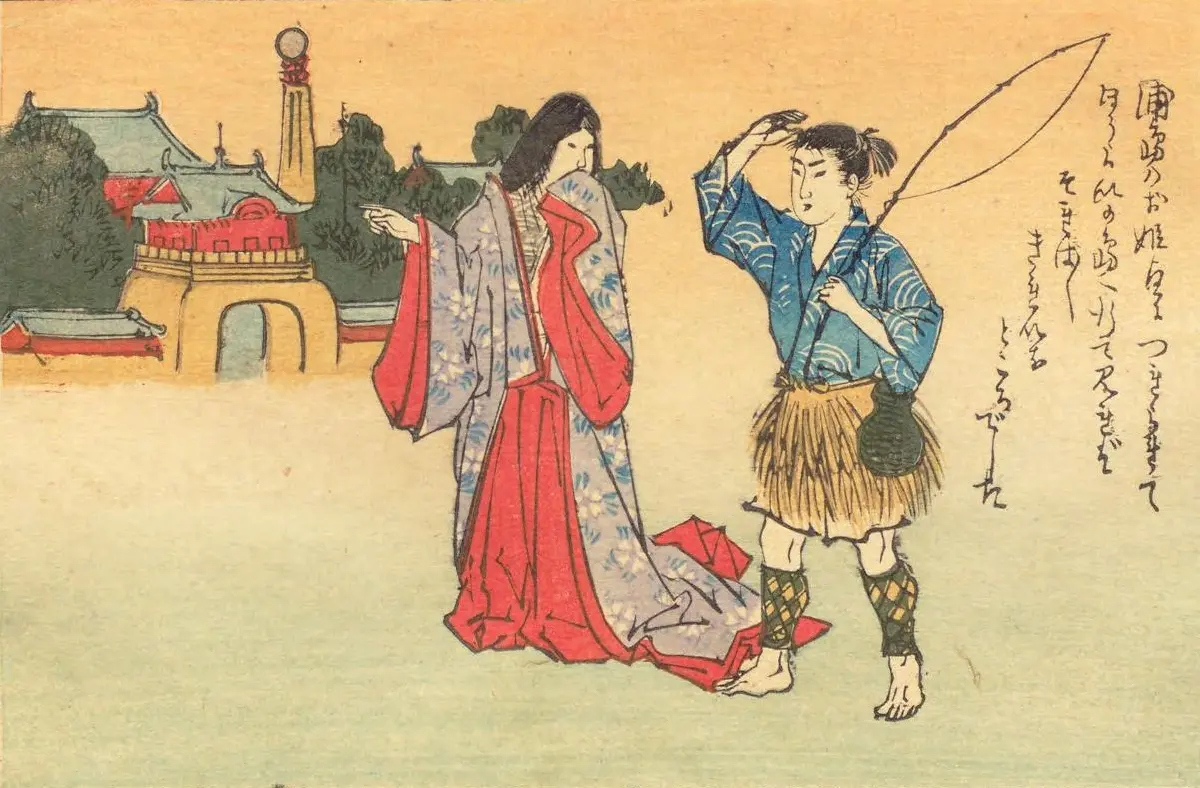
- 1899 Matsuki Heikichi publishes the picture book Kyōiku mukashibanashi: Urashima Tarō. Its page 4, the image on this page, shows the princess and Urashima arriving at Hōrai Island — a gate and roofs among pines under an open sky, with no water overhead and no turtle in sight.
- 1910–1917 The Ministry of Education's second national reader carries "Urashima no hanashi", a condensation of Iwaya. The turtle repays the kindness, carries him on its back beneath the sea, the princess is named Otohime, his father and mother have died on his return, and the lesson ends the instant his hair turns grey.
- 1918–1932 The third national reader, Jinjō shōgaku kokugo tokuhon, prints the version most Japanese adults can still recite, and drops even the princess's name. Its final sentence — white smoke, and Urashima suddenly an old man with grey hair — is where the lesson ends, with the crane, the death and the shrine all cut away.
- 22 June 1971 The shrine's Muromachi handscroll of the Urashima Myōjin engi is designated an Important Cultural Property. The Agency for Cultural Affairs describes it as an illustrated narrative predating the general spread of the Otogizōshi and the only surviving painting of the Urashima Myōjin origin story.
Is there a rational explanation for Urashima Taro and the Sea Palace?
There is nothing here to test in the usual way: no witness, no scene, no object that could be examined. What can be tested is the chain of texts, and that is where the usual claims fail.
The claim most often made about Urashima — that it is immemorial coastal folklore — is the one the documents contradict. Every element of the version taught in Japanese schools today can be dated, and none of the datings is early: the underwater palace to 1830 at the earliest in the surveyed corpus, the children tormenting the turtle to 1896, the ride on the turtle's back and the story's abrupt ending to a state primary-school textbook used between 1918 and 1932. Holmes' survey of fifteen versions concludes that much of the content of the story known in Japan today "has appeared only within the last 150 years".
Where the story came from in the first place is genuinely disputed, and the disputants have names. The Fudoki fragment states that its account agrees with what Iyobe no Umakai, a former provincial administrator and one of the leading scholar-officials of the late seventh century, had already written down. Whether Umakai collected a local tradition and dressed it in the Chinese manner of immortal tales, or transplanted a Chinese story to Tango outright, has been argued both ways — the first position by the Takaoka Man'yō Historical Museum, the second by Katō Shūichi in his history of Japanese literature. No third document exists to break the tie.
The famous arithmetic is a construction rather than a record. The shrine at Ine reckons that Shimako left on the seventh day of the seventh month of 478 and came back in 825, and states the interval as 347 years. Those are the two dates the chronicles supply, and 347 is what is left when the first is subtracted from the second. The Fudoki's villager says three hundred years, a round number; the Otogizōshi says seven hundred; Chamberlain's 1886 English children's book says four hundred, so the number varies like everything else.
The shrine is more cautious than its visitors. Its own official history quotes the late Suzuki Takamichi's town history of Ine to the effect that 825 marks the year the shrine received some form of recognition from the court rather than the year it began, and that its history can probably be traced back to before 710. An institution publishing a caveat against its own founding date is worth more than most sceptics.
And the tale has been taken literally, with relics. Chamberlain noted in 1880 that Urashima's tomb, his fishing line, the casket given him by the maiden and two stones said to be precious were shown at a temple in Kanagawa near Yokohama, and that "by most of even the educated Japanese, the story, thus historically and topographically certified, is accepted as literally true". Tango and Kanagawa cannot both hold the original box.
One detail cuts the other way: the object displayed at Ine as the tamatebako is catalogued as two comb-boxes with a tortoise-shell pattern — that is, a kushige. Kushige, not "treasure box", is the word the eighth-century Fudoki and the Man'yōshū poem both use. On that one detail the shrine's cabinet is older than the schoolbook.
The official history page of the shrine that keeps the eighth-century tradition opens not with the Fudoki or the chronicle, but by quoting the first verse of the Ministry of Education school song "Urashima Tarō", published for second-year primary pupils on 28 June 1911: "Long, long ago Urashima was taken along by the turtle he had saved…". The turtle he had saved is the 1896 turtle. Even at the shrine, the schoolbook goes first.
Can you visit Urashima Taro and the Sea Palace?
The story's anchor on the ground is Urashima Jinja, also written Ura Jinja, in the Honjōhama district of Ine, Yosa County, Kyoto Prefecture, on the eastern shore of the Tango peninsula, about 22 km north-east of Miyazu. It stands on what the eighth-century gazetteer calls Tsutsukawa, in Yosa county — the same hamlet the Nihon Shoki names.
The grounds are an ordinary working shrine and free to enter; the honden and the haiden with its chūden, all built in 1884 by the Nakai Gonji workshop, were entered on the national register of Tangible Cultural Properties in April 2014. What visitors come for is the treasure room, and that is by appointment only. The shrine gives its hours as 09:00 to 16:30, an admission of ¥700 per person with a group discount, and irregular closures on festival and event days; bookings are taken by telephone on 0772-33-0721 or by fax on 0772-33-0103. On display are the hanging-scroll version of the Urashima Myōjin engi (a Kyoto Prefecture designated cultural property), the tamatebako — catalogued as two comb-boxes with a tortoise-shell pattern — Nō masks, and a sake jar recorded as a gift from Ashikaga Takauji. The chief priest performs the etoki, the traditional spoken explanation of the painted scroll, in front of it; that narration, not the building, is the reason to book.
Two of the shrine's holdings are of national rank and are not part of the routine display: a Muromachi-period handscroll of the Urashima Myōjin engi, designated an Important Cultural Property on 22 June 1971 and described by the Agency for Cultural Affairs as the only surviving Urashima Myōjin engi painting, and an embroidered Momoyama-period kosode designated on 28 January 1964. Ask when booking rather than expecting to see them.
The main festival is on 6 and 7 August, and the Ennen-sai on 17 March is a registered intangible folk cultural property; the treasure room may be closed on both.
Getting there takes planning. By train, the Kyoto Tango Railway to Amanohashidate or Miyazu, then a Tankai bus to the Urashima-jinja-mae stop. By car, roughly 40 minutes on Route 178 from the Amanohashidate-Yosa interchange of the Kyoto Jūkan Expressway. Check the current timetable before travelling: bus services on this coast are sparse.
Be aware that Tango is not the only claimant. Keiun-ji in Kanagawa ward, Yokohama, keeps the Kannon image rescued from Kanpuku-ji — the "Urashima temple" — after it burned in 1868, and its steles are registered by the city as Urashima Tarō legend material; Chamberlain was shown relics there in 1880. Mitoyo in Kagawa, Iki in Nagasaki and Kiso in Nagano all tell local versions too. No site holds the original, because there is no original site to hold.
Sources consulted
- W. G. Aston (trans.), «Nihongi: Chronicles of Japan from the Earliest Times to A.D. 697, vol. 1 (Yūryaku, 22nd year, p. 368)» — Japan Society, London, 1896 book
- Yoshiko Holmes, «Chronological Evolution of the Urashima Tarō Story and its Interpretation (MA thesis; Appendix 1 translates fifteen versions)» — Victoria University of Wellington, 2014 academic
- Basil Hall Chamberlain, «The Classical Poetry of the Japanese ('The Fisher Boy Urashima', pp. 33–36, with the note on the Dragon Palace and the Kanagawa relics)» — Trübner & Co., London, 1880 book
- W. G. Aston, «A Grammar of the Japanese Written Language (Specimens appendix: literal prose version of the Man'yōshū Urashima poem, pp. xvi–xix)» — Luzac & Co., London, 1904 book
- Basil Hall Chamberlain (trans.), «The Fisher Boy Urashima (Japanese Fairy Tale Series no. 8)» — Kōbunsha, Tokyo (Getty Research Institute copy; date from the Japanese colophon), 1886 book
- Monbushō (Japanese Ministry of Education), «Jinjō shōgaku kokugo tokuhon, vol. 3 ('Urashima Tarō', pp. 39–46)» — Nihon Shoseki, 1928 book
- Matsuki Heikichi (publisher), «Kyōiku mukashibanashi: Urashima Tarō, p. 4 ('Princess and Urashima Tarō arrive at Hōrai Island') — the picture on this page» — Matsuki Heikichi, Tokyo; file page at Wikimedia Commons, 1899 book
- Bunkachō (Agency for Cultural Affairs), «Shihon chakushoku Urashima Myōjin engi — Important Cultural Property record (designated 22 June 1971)» — National Cultural Properties Database, 2022 archive
- Urashima Jinja / Urashima Jinja Hōsankai, «Urashima Jinja official site: Yuisho (shrine history) and Treasure room, prayers and amulets» — Official shrine website, 2024 web
- Amanohashidate Tourism Association, «Urashima Shrine — opening hours, admission, reservations and access» — Amanohashidate Tourist Information, 2025 web
- Ine Town Tourism Association, «Urashima Jinja — address, telephone and official link» — Umi no Kyoto DMO, 2026 web
Reviewed by V. Serrano on 2026-08-16 · How we verify our content
📎 Source: Enigma Atlas
💬 Field testimonies (0)
No testimonies yet. Add the first.
Add your testimony
🔒 Log in to add a testimony