📜 LEGEND · EXP. Nº0270
ACTIVE
Yuki-onna, the Snow Woman
Everyone tells the same Yuki-onna story, and it has an author. Lafcadio Hearn published it in Kwaidan in 1904: two woodcutters trapped by a blizzard, a white woman who kills the old man and spares the boy on condition he never speak of it, and the wife who years later turns out to be her.
Where does the legend of Yuki-onna, the Snow Woman come from?
- Location
- Niigata Prefecture, Japan, Japan
- Kind of legend
- Creature legend
- Coordinates
- 37.903, 139.024
- Last updated
LOCATION
What is the legend of Yuki-onna, the Snow Woman?
Hearn said plainly where he got it — a farmer of Chōfu, in Musashi province, which is not the snow country but the western edge of present-day Tokyo — and added that he did not know whether it had ever been written down in Japanese. What Japanese collectors did write down is a different creature. In Akita, Niigata and Fukushima in 1928 she is one-legged, and a single dimple in a snowdrift is her footprint; in Niigata in 1939 there are drops of blood along her tracks; her commonest trick by far is to ask a traveller to hold her baby, and to bury whoever does. In Tōno in 1910 she simply comes out on a winter full moon leading a crowd of children, and hardly anybody claims to have seen her. This is the story of how one of those became the other.
What is the history of Yuki-onna, the Snow Woman?
The Yuki-onna the world knows is a short story with an author, a publisher and a date: "Yuki-Onna", in Lafcadio Hearn's Kwaidan, Boston, 1904. Hearn was unusually candid about where it came from. In the note that closes the preface, dated Tokyo, 20 January 1904, he wrote that the tale "was told me by a farmer of Chōfu, Nishitama-gōri, in Musashi province, as a legend of his native village", and added the sentence that everyone quoting him leaves out: "Whether it has ever been written in Japanese I do not know."
Musashi is not the snow country. Hearn's own endnote defines it as "an ancient province whose boundaries took in most of present-day Tōkyō, and parts of Saitama and Kanagawa prefectures". Chōfu village is today the southern edge of Ōme, a commuter town at the western end of Tokyo, and the river crossing in the story is identified locally as the Chigase ferry on the Tama. Researchers in Ōme have named a probable informant: Sōhachi, a Chōfu man who did carpentry for the Koizumi household, and his daughter O-Hana, who looked after Hearn's third son — the family was in service exactly while Kwaidan was being written.
The story itself is tighter than its summaries. Two woodcutters, old Mosaku and his eighteen-year-old apprentice Minokichi, are caught by a blizzard and shelter in a ferryman's hut, "only a two-mat hut, with a single door, but no window". The white woman breathes over Mosaku, then stoops over Minokichi and spares him: "if you ever tell anybody — even your own mother — about what you have seen this night, I shall know it; and then I will kill you." A year later he meets O-Yuki on the road; she bears him ten children; and when he finally tells her, she does not simply vanish. She shrieks, "But for those children asleep there, I would kill you this moment! And now you had better take very, very good care of them", and goes up through the smoke-hole as a bright white mist.
Behind Hearn there is a real, datable Japanese record, and it is older than he was. The Edo antiquarian Kitamura Nobuyo gathered, in Kiyū Shōran (1830), haikai verses on the yuki-onna taken from two seventeenth-century anthologies: Futokorogo, compiled by Matsue Shigeyori and closed with a postface of 1660, and Zoku Yamanoi, compiled by Kitamura Koshun in 1667. One of the 1667 verses is a joke about her: they say she exists, but nobody sees her — a faithful wife, or a snow woman. In 1685 a Kyoto kana-zōshi, Sōgi Shokoku Monogatari, printed the episode everyone now calls the oldest account: travelling in Echigo, the poet Sōgi sees a woman about one jō tall, her skin translucently white, in a single unlined white robe, seemingly about twenty; she is gone before he can look properly, and the next day the locals tell him she is the yuki-onna and comes out only in heavy-snow years. Sōgi died in 1502; the book is a popular entertainment of 1685 that uses him as its travelling narrator, so the episode is not a Muromachi document and the poet is not its witness. One caution about that paragraph: Waseda's copy of the 1685 book is a cursive scan, and the wording above is taken from Fujisawa Morihiko's retelling of 1928, not read off the original block-printed page.
Timeline: the documented record of Yuki-onna, the Snow Woman
- 1660 The haikai anthology Futokorogo, compiled by Matsue Shigeyori, closes with a postface dated Manji 3. Two of its verses name the yuki-onna, and are the oldest datable mentions of her this ficha could put a work and a year to. They survive quoted in Kitamura Nobuyo's Kiyū Shōran of 1830.
- 1667 Kitamura Koshun compiles Zoku Yamanoi. Among its verses on the yuki-onna is a joke at her expense: they say she exists, but nobody sees her — a faithful wife, or a snow woman. She is a poetic topic, not yet a plot.
- 1685 Sōgi Shokoku Monogatari, a five-volume kana-zōshi, is published in Kyoto. It gives the episode usually cited as the oldest account: in Echigo the poet Sōgi sees a woman about one jō tall, translucently white, in a single unlined robe. Sōgi had died in 1502; the book uses him as a character.
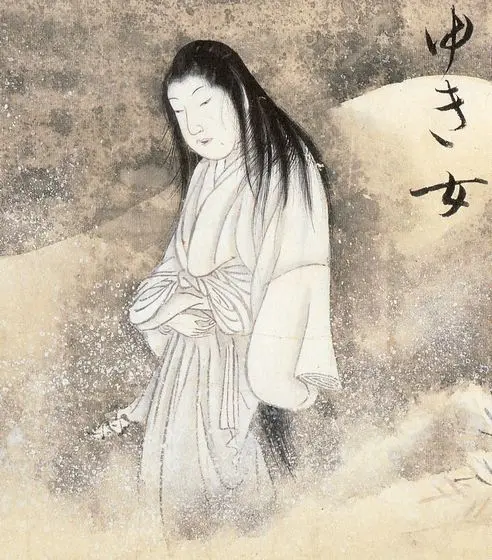
- c. 1737 Sawaki Suushi paints the yuki-onna in his Hyakkai Zukan, the illustrated scroll of monsters that supplies the picture on this page. She enters the bestiaries as a catalogued creature with a name, and Toriyama Sekien later gives her a plate of her own.
- 20 January 1904 Lafcadio Hearn dates the preface to Kwaidan in Tokyo. He credits "Yuki-Onna" to a farmer of Chōfu, in Musashi province, and writes: "Whether it has ever been written in Japanese I do not know." This is the first appearance in print of the plot the world now tells.
- 1910 Yanagita Kunio publishes Tōno Monogatari. Entry 103 gives the yuki-onna of Tōno, in Iwate: on the night of the Little New Year she comes out to play leading a great many children, and children are called home early because of her — "but few are those who say they have seen her". No death, no oath, no marriage.
- 1 January 1928 Fujisawa Morihiko surveys the snow monsters in the first issue of the folklore journal Tabi to Densetsu. He retells the Echigo sighting and records the creature the collectors actually met: one-legged in Akita, Niigata and Fukushima, her footprint a single dimple in a drift; shaped like an ubume in Aizu; and above all the woman who asks a traveller to hold her baby, and buries whoever does.
- May 1939 In the Niigata folklore journal Kōshiji, Nefu Zōkichi writes down the yuki-onna he was told about as a child: she walks at midnight in falling snow, there are drops of blood along her footprints, and whoever meets her is certain to be killed. The tale that a snow woman leaves no footprints is not this one.
- 18 March 1989 Ōtake Shūichi publishes a yuki-onna told by the Tōno narrator Suzuki Satsu: a father killed by her breath, a son sworn to silence, a beautiful wife, a slip of the tongue, and a woman who entrusts him with the children and leaves. It is Hearn's plot in a Japanese oral record, taken down eighty-five years after Kwaidan, and the only one of the twenty-one indexed records read for this article that carries it.
- 10 March 2002 A stone marked "the place connected with the Snow Woman" is set at the foot of the Chōfu Bridge in Ōme, Tokyo, inscribed by Hearn's grandson Koizumi Toki. The legend of the snow country acquires its only monument in a commuter town at the western edge of Tokyo, because that is where Hearn's informant came from.
Is there a rational explanation for Yuki-onna, the Snow Woman?
There is nothing to test here in the usual sense — nobody claims a specimen — so the honest work is dating the story rather than debunking the woman. Two things come out of that, and both cut against our own previous text.
The first is that the phrase "a much older oral tradition" is doing no work. It is probably true, and it is exactly the sort of statement that survives verification because there is nothing in it to verify: no work, no passage, no century. Replace it with the chain above and it turns into something citable — 1660, 1667, 1685 — and it also turns out to say something different from what we implied. What is attested in the seventeenth century is a name, a poetic topic and a sighting. The marriage, the oath and the betrayal are not there.
The second is a measurement. The Yōkai and Kaii Denshō database of the International Research Center for Japanese Studies indexes the folklore literature by creature name; a search on "Yukionna" returns 28 records, and of the 21 whose cards could be read, exactly one carries Hearn's plot. It is card 0010006: a tale told by the celebrated Tōno narrator Suzuki Satsu, taken down by Ōtake Shūichi and published in Aizu no Minzoku 19 in March 1989 — a father killed by her breath, a son sworn to silence, a beautiful wife, a slip of the tongue, and a woman who leaves the children and goes. That is Kwaidan's plot in a Japanese oral record dated eighty-five years after Kwaidan. The other twenty records are a different creature: in Akita, Niigata and Fukushima in 1928 she is one-legged, and a single dimple in a snowdrift is her footprint; in Aizu she takes the form of an ubume, the ghost of a woman dead in childbirth; the commonest plot by far is that she asks a passer-by to hold her baby, and whoever does is buried in the snow; in Chino, Nagano, in 1931 she is the spirit-woman of the snowpack and does no harm at all, laying felled trunks across a ravine overnight to make a bridge.
That record base also contradicts the trait our own text carried. "Gliding without footprints" is a modern encyclopaedic commonplace, and it is not what the Japanese collectors wrote down: in Niigata in 1939 the schoolteacher Nefu Zōkichi recorded a childhood bogey whose footprints have drops of blood along them, and in Kyoto in 1987 and 1994 the whole point of the story is that the woman vanishes and the footprints stay. She is footless in some painted scrolls, which is where the modern claim comes from; she is not footless in the collected tales.
The last check is the one Ōme itself has already failed honestly. When local researchers went looking for a village legend matching Hearn's, they did not find one — variants, yes; that story, no. And Yanagita Kunio's Tōno Monogatari of 1910 records the yuki-onna in the same district where the 1989 tale was told, with no death and no marriage in it: on the night of the Little New Year she comes out to play, leading a great many children, and the children are called home early because of her, "but few are those who say they have seen her". Two and a half centuries earlier, the 1667 verse had made the same joke. The one thing everybody agrees on is that nobody sees her.
Can you visit Yuki-onna, the Snow Woman?
The Yuki-onna has a book and a date before she has a place. The map pin falls on National Route 116 in Chūō ward, in the city of Niigata, capital of the prefecture that was the old province of Echigo, where the 1685 Sōgi Shokoku Monogatari sets Sōgi's sighting. The Nichibun database card for that episode (record 1230004, from Fujisawa's retelling of 1928) files it under Niigata Prefecture with no municipality, so the pin stands for the province as a whole.
In Ōme, at the western end of Tokyo and some 237 km south-south-east of the pin, a stone reading "Yuki-onna yukari no chi", the place connected with the Snow Woman, was set up in 2002 by the Chōfu Bridge over the Tama, on the Chigase-chō side. Chōfu, the village Hearn's preface names, is now part of Ōme. According to Nihon Denshō Taikan, its best-known river crossing was the Chigase ferry, which the first Chōfu Bridge, a suspension bridge, replaced in 1922. The inscription was brushed by Koizumi Toki, Hearn's grandson; a plaque on the back carries the Kwaidan preface passage about Chōfu in English and in Japanese. OpenStreetMap maps the stone as a memorial (node 5837864088) at 35.7843, 139.2650, in a small open square about 60 metres north-east of the middle of the bridge.
Four minutes on foot from JR Ōme station, the Shōwa Retro Products Museum at 65 Sumie-chō, in a converted timber furniture shop, gives its second floor to material on the Yuki-onna legend. The Ōme Tourist Association page, consulted on 23 September 2026, lists hours of 10:00 to 17:00, closure from Monday to Thursday, admission of 350 yen for adults and 200 yen for primary and middle-school pupils, and the telephone 0428-20-0234; on that listing the museum opens from Friday to Sunday.
Matsue, on the Sea of Japan side of Honshū, has the Lafcadio Hearn Memorial Museum at 322 Okudani-chō (postcode 690-0872, telephone 0852-21-2147). The Shimane prefectural tourism site, consulted on 23 September 2026, describes relics, first editions and handwritten manuscripts, with material on his wife Setsu, and lists daily opening from 9:00 to 18:00 between April and September and from 9:00 to 17:00 between October and March, last admission half an hour before closing, at 600 yen for adults and 300 yen for children. The Lake Line bus from JR Matsue station takes about sixteen minutes to the museum's stop. His former residence, a national historic site, stands next door.
Sources consulted
- Lafcadio Hearn, «Kwaidan: Stories and Studies of Strange Things» — Houghton Mifflin, Boston, 1904 book
- Sakagami Shōbee and Nishimura Hanbee (publishers), «宗祇諸国物語 (Sōgi Shokoku Monogatari), 5 vols., kana-zōshi, Kyoto, Jōkyō 2» — Waseda University Library, Japanese and Chinese Classics database, shelfmark ヘ13 04155, 1685 archive
- Fujisawa Morihiko, «スキーと雪と雪の怪 (Skiing, snow and the snow monsters), Tabi to Densetsu 1:1, pp. 38-43» — Sangensha; indexed as records 1230003-1231387 in the Yōkai and Kaii Denshō Database, International Research Center for Japanese Studies, 1928 archive
- Yanagita Kunio, «遠野物語 (Tōno Monogatari), entry 103» — Aozora Bunko full text, 1910 book
- Nefu Zōkichi, «郷土の伝説(四) (Legends of my home district, 4), Kōshiji 5:5 (issue 53), pp. 24-25» — Niigata Folklore Society; record 0780104 of the Yōkai and Kaii Denshō Database, International Research Center for Japanese Studies, 1939 academic
- Kitamura Nobuyo, «嬉遊笑覧 (Kiyū Shōran), p. 196, quoting the anthology Futokorogo of 1660» — Nihon Zuihitsu Taisei bekkan 9, Yoshikawa Kōbunkan 1979; record 5860069 of the Yōkai and Kaii Denshō Database, 1830 book
- Kitamura Koshun, «続山井 (Zoku Yamanoi), compiled by Kitamura Koshun, Kanbun 7» — Waseda University Library, Japanese and Chinese Classics database (Nakamura Shuntei collection), 1667 archive
- Sawaki Suushi, «File:Suushi Yuki-onna.jpg — Yuki-onna from the Hyakkai Zukan» — Wikimedia Commons, 1737 archive
- Ōtake Shūichi, «遠野の昔話を聴く (Listening to the folktales of Tōno), Aizu no Minzoku 19, p. 38; narrator Suzuki Satsu, Tōno, Iwate» — Aizu Folklore Research Society; record 0010006 of the Yōkai and Kaii Denshō Database, 1989 interview
- Nihon Denshō Taikan, «雪おんな縁の地碑 (The Yuki-onna yukari no chi monument, Chōfu Bridge, Ōme)» — japanmystery.com, 2002 web
- Ōme Tourist Association, «昭和レトロ商品博物館 (Shōwa Retro Products Museum, Ōme): hours, prices and access» — おうめ観光ガイド, 2026 web
- Shimane Prefecture Tourism Federation, «小泉八雲記念館 (Lafcadio Hearn Memorial Museum, Matsue): hours, prices and access» — しまね観光ナビ, 2026 web
Reviewed by V. Serrano on 2026-08-16 · How we verify our content
📎 Source: Enigma Atlas
💬 Field testimonies (0)
No testimonies yet. Add the first.
Add your testimony
🔒 Log in to add a testimony