🦶 CRYPTID SIGHTING · EXP. Nº0555
ACTIVE
Akkorokamui
Akkorokamui is the giant octopus said to be the lord of Uchiura Bay — Funka Bay, Volcano Bay: three names for one sheet of water in south-west Hokkaido.
Where and when was Akkorokamui sighted?
- Location
- Uchiura Bay, Hokkaido, Japan
- Date sighted
- Unknown
- Coordinates
- 42.349, 140.631
- Last updated
LOCATION
What is Akkorokamui?
The name is Ainu, at-kor-kamuy, the god that has cords, built on the everyday Ainu word for an octopus, atkoro-guru, which the missionary John Batchelor recorded in his dictionary of 1905. The oldest printed telling that can be dated is not Batchelor's, though. It is a page and a half by the Hokkaido schoolteacher Yoshida Iwao in the Journal of the Anthropological Society of Tokyo for October 1914, and Yoshida himself files it among the exaggerated tales. There the creature swallows cargo ships, capsizes the boats working the yellowtail grounds, makes the water where it lives glow red to the sky, and is met once, near Cape Ekori at Rebunge, by a man called Itakunep — as reported by his wife. The arms of a hundred metres and more, the sake left in coves, the power to heal limbs: none of that is in the Ainu record. It can be dated instead, edit by edit, to the internet between 2009 and 2013.
What is the history of Akkorokamui?
The word itself is not in dispute. In his An Ainu-English-Japanese Dictionary of 1905 the Anglican missionary John Batchelor set down an entry that reads, in full: "Atkoro-guru, アッコログル, 章魚. n. Octopod. Syn: Atuina." That is simply the Ainu noun for an octopus. Yoshida Iwao took it apart ten years later — at, a thin cord or strap; kor, to have; guru, thing — so that an octopus, in Ainu, is the creature that has straps. Put kamuy, god, where guru stands and you get at-kor-kamuy: the god that has cords.
What is in dispute is everything that has been hung on that word since.
The oldest printed appearance of the name that I have been able to date is October 1914. Yoshida Iwao, a schoolteacher who spent his working life in Hokkaido gathering Ainu material, published "Ainu no yōkai setsuwa (zoku)" — Ainu monster tales, continued — in Jinruigaku Zasshi, the journal of the Anthropological Society of Tokyo, volume 29, number 10, pages 397 to 409. The octopus of the bay occupies part of two columns on pages 407 and 408, and Yoshida introduces it with a warning of his own: it belongs among the kodai naru hanashi, the exaggerated tales.
What follows is short and specific. The lord of the bay is called Atsuina, or else Akkorokamui. It is about the size of a field of one chō — a chō is a shade under a hectare — and it is feared because it can swallow a bezaisen, the wooden coastal cargo sailer of the Edo period. Where the yellowtail school and the boats go after them, it surfaces and turns them over; the old Ainu, Yoshida writes, kept a large sickle ready against it. And the place where it lives glows red all the way up to the sky, so that it can be seen from far off and given a wide berth.
Then one report with a name attached. Near Cape Ekori at Rebunge, in Abuta District — the northern shore of the bay, in what is now the town of Toyoura — a man called Itakunep came across one. It was big enough to swallow a whale; it looked about twenty ken across, and a ken is 1.82 metres, so roughly thirty-six; and the tide all around it was boiling into foam. The witness is Itakunep. The informant is not. Yoshida closes the paragraph with four characters that are easy to skip: kare no tsuma ga katatta, "his wife told it".
That is the documented core, and what it lacks matters as much as what it holds. There is a colour, a sickle, a whale, a cargo ship and a named man reported at one remove in 1914. There is no sake poured into coves at dusk, no arm of a hundred metres, no power to knit a broken limb.
Batchelor, whom the English-language accounts still name as the authority, is not the source they take him for. He did publish a giant-cephalopod story, but it is in The Ainu and Their Folk-Lore of 1901, on pages 530 and 531, and it happened at Shiraoi — on the open Pacific coast, outside the bay entirely. Three men out after swordfish were confronted by a round sea-monster with large staring eyes that attacked the boat and gave off a dark fluid with a very powerful and noxious odour. They fled from the smell rather than the fright, Batchelor says, and were still in bed pale and trembling the following morning. The men themselves called it a devil. Batchelor added a footnote: "I am inclined to think from the description that it was really a 'devil-fish' or octopus." He gives the thing no name and no size, and he sets it nowhere near Uchiura Bay. The word Akkorokamui does not occur anywhere in that book — against sixty occurrences of kamui in the same text — and no such compound occurs in the 1905 dictionary either, where kamui appears 235 times and atkor- appears four.
Timeline: the documented record of Akkorokamui
- 1901 John Batchelor publishes The Ainu and Their Folk-Lore. On pages 530-531 he reports that at Shiraoi, on the open Pacific coast well outside Uchiura Bay, three men after swordfish were attacked by a round sea-monster with large staring eyes that emitted a dark, foul-smelling fluid. The men called it a devil; Batchelor's own footnote guesses "a 'devil-fish' or octopus". He gives it no name and no size, and the word Akkorokamui appears nowhere in the book.
- 1905 Batchelor's An Ainu-English-Japanese Dictionary records "Atkoro-guru … Octopod. Syn: Atuina" — the ordinary Ainu word for an octopus. There is no entry combining it with kamui, in a text where kamui appears 235 times.
- October 1914 The oldest printed appearance of the name that can be dated: Yoshida Iwao publishes "Ainu no yōkai setsuwa (zoku)" in Jinruigaku Zasshi 29(10), pages 397-409. On pages 407-408 he describes the lord of Funka Bay, Atsuina or Akkorokamui, explicitly filed among the exaggerated tales: the size of a one-chō field, able to swallow a bezaisen cargo sailer, capsizing boats over the yellowtail grounds, its lair glowing red to the sky, and the Ainu keeping a large sickle ready against it.
- 1914 (the Rebunge sighting) In the same article Yoshida records the only named encounter: near Cape Ekori at Rebunge, in Abuta District, a man called Itakunep met one big enough to swallow a whale and about twenty ken across — some thirty-six metres — with the tide foaming around it. Yoshida notes that his informant was Itakunep's wife, not Itakunep.
- March 1915 Yoshida publishes the etymology in Jinruigaku Zasshi 30(3), page 101: at-koro-guru, "cord-strip / has / thing", glossing the Ainu name for the octopus. It is the lexical footing on which the god's name rests.
- 18 January 2009 Brent Swancer publishes a guest post on Loren Coleman's Cryptomundo. It is the earliest text traced here that gives a length in metres — "up to 110 meters" — and the colour "likened to the reflection of the setting sun upon the water". It also attaches Batchelor's Shiraoi anecdote to the name and adds an unsourced eighty-metre sighting Swancer says he translated from Japanese. In the comments the same day he calls the sizes "very unlikely".
- 28 July 2010 An English Wikipedia editor using the name Cryptidsarereal inserts Swancer's figure into the article: "its enormous red body can reach sizes of up to 110 meters in length". Until this edit the article, created in October 2006, had given no size at all.
- 8 June 2011, 16:08 UTC An anonymous address changes 110 metres to 120 with no source and no edit summary. Another editor tags the figure as needing a citation at 17:33 the same afternoon. The 120 metres, tagged, stays in the article for fourteen years and is copied outward from there.
- 9 and 22 April 2013 Two anonymous addresses rewrite the article a fortnight apart. The first pastes in Swancer's version of the Batchelor quotation; the second writes the whole "In Shinto" section in a single edit — minor kami, purification, offerings, self-amputation and regrowth, and offerings that heal "ailments of the limbs or skin" — by importing the Takoyakushi-dō of Kyoto, a Buddhist temple a thousand kilometres away with no Ainu connection.
- 4 March 2018 An English Wikipedia editor removes the Batchelor quotation with the edit summary "No indication that quote is related to topic." The misattribution had stood for almost five years and survives on cryptid sites to this day.
- 23 and 27 July 2025 An editor tags the Shinto section for undue weight to fringe material, then deletes the 120 metres outright, noting that the underlying source gives an area of one chō — about a hectare — and not a length. Two days later the article is rebuilt from the Japanese-language sources, Yoshida among them.
Is there a rational explanation for Akkorokamui?
The most useful sceptic in this file is Yoshida himself. He filed the story under exaggerated tales in 1914 and never pretended otherwise.
The famous numbers are much younger than that, and they can be dated almost to the minute.
On 18 January 2009 Cryptomundo, Loren Coleman's cryptozoology blog, ran a guest post by Brent Swancer, writing from Japan. It is the earliest text I can find that gives the creature a length in metres: "reaching sizes of up to 110 meters in length", with a colour "often described as incandescent and sometimes likened to the color of the reflection of the setting sun upon the water". Swancer plainly knew some of the Japanese material — the sickles come straight out of Yoshida — but he also quoted Batchelor's Shiraoi passage as if it were about Akkorokamui, and added a second account, of an eighty-metre animal with tentacles as thick as a man's torso, which he says he translated from a nineteenth-century Japanese original and for which he names no source at all. In his own comment thread that same day he conceded that the sizes were "very unlikely" and had "probably become part of the folklore of the creature, or has been altered".
From there the trail runs through the English Wikipedia, and every step of it is timestamped in a public revision history that anyone can read. On 28 July 2010 an editor using the name Cryptidsarereal put Swancer's 110 metres into the article. On 8 June 2011, at 16:08 UTC, an anonymous address changed 110 to 120 with no source and no edit summary; a second editor tagged the figure as needing a citation eighty-five minutes later, and it survived, tagged, for fourteen years. On 9 April 2013 another anonymous address pasted in Swancer's version of the Batchelor quotation — already altered from the 1901 wording. Thirteen days later, on 22 April 2013, a third anonymous address wrote the entire "In Shinto" section in a single edit: the octopus as a minor kami, the purification ritual, the offerings, the ability to shed and regrow limbs, and the belief that offerings to it cure "ailments of the limbs or skin". That is where the healing comes from, and it is assembled by dragging in the Takoyakushi-dō in Kyoto — a Buddhist temple roughly a thousand kilometres from Hokkaido whose octopus name, by the temple's own account, comes from a monk who bought an octopus for his sick mother.
Wikipedia has since unpicked most of it, which is itself worth recording. On 4 March 2018 an editor removed the Batchelor quotation with the summary "No indication that quote is related to topic." On 23 July 2025 another tagged the Shinto section for giving undue weight to fringe material, and on 27 July 2025 deleted the 120 metres outright, noting that the source gives an area of one chō — about a hectare — and not a length at all.
As for the animal behind it: the giant Pacific octopus, Enteroctopus dofleini, genuinely lives in these waters, along the northern Pacific rim from Japan to Alaska. The Monterey Bay Aquarium gives it a body of around 60 cm and an arm span that often exceeds four metres, with the heaviest specimen on record at about 90 kg and close to six metres across. Met from a small open boat in a cold bay, that is a startling animal. It is also two orders of magnitude short of the figure the internet settled on.
Can you visit Akkorokamui?
Akkorokamui has neither a shrine nor a statue nor a marker anywhere in Hokkaido, and no festival is held for it. The thing the story attaches itself to is the bay.
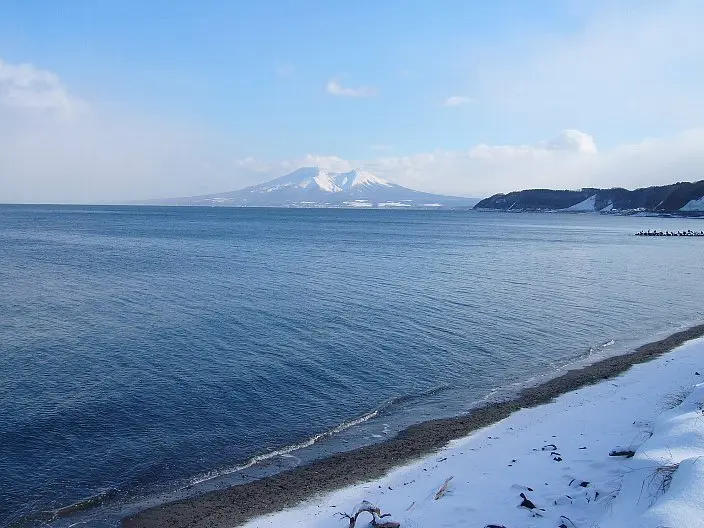
Uchiura Bay (also called Funka-wan or Volcano Bay) is the almost circular inlet of south-west Hokkaido enclosed by the Oshima Peninsula. Mount Komagatake stands at one end of it and Mount Usu at the other. The viewpoint used for the photograph on this page is the stretch of coast at Funka-wan Panorama Park, 368-8 Hamamatsu in the town of Yakumo, on the hills above the Hakodate main line. The Yakumo municipal site, consulted on 9 September 2026, gives the hours of the park building as 10:00 to 18:00. The photograph was taken here in December 2005, looking south across the water towards Komagatake.
Rebunge, the place Yoshida names in 1914, lies further round the northern shore in the town of Toyoura, Abuta District. It is a small coastal settlement on the JR Muroran main line, with a beach below the cliffs of the Rebunge coast; Cape Ikori is the headland there, and nothing on the ground marks the story.
The Ainu material is at Upopoy (the National Ainu Museum and Park at Shiraoi), which opened in July 2020 — the same Shiraoi where Batchelor's 1901 sea-monster episode happened, on the Pacific side of the isthmus rather than inside the bay. The address is 2-3-2 Wakakusa-chō, Shiraoi; the official ticket page, consulted on 9 September 2026, gives opening hours of 9:00 to 18:00 from 1 April to 31 October 2026 and closure on Mondays. Admission is 1,200 yen for adults and 600 yen for high-school students. Junior high school age and under goes free, and each rate drops by 200 yen for tickets bought online.
The Takoyakushi-dō, formally Eifuku-ji, is a free-standing temple in Kyoto at 503 Takoyakushi-higashigawa-chō, Shinkyōgoku, Nakagyō-ku. Its own site gives the gates as opening at 8:00 and closing at 17:00, and at 16:30 in winter. It has no connection to the Ainu or to this bay.
Sources consulted
- 吉田巖 (Yoshida Iwao), «アイヌの妖怪説話(続) [Ainu monster tales, continued]» — 人類学雑誌 (Jinruigaku Zasshi / Journal of the Anthropological Society of Tokyo) 29(10), pp. 397-409; Akkorokamui at pp. 407-408, 1914 academic
- 吉田巖 (Yoshida Iwao), «アイヌの動植物名について [On Ainu plant and animal names]» — 人類学雑誌 (Jinruigaku Zasshi) 30(3), pp. 100-102; at-koro-guru at p. 101, 1915 academic
- John Batchelor, «An Ainu-English-Japanese Dictionary (including a grammar of the Ainu language)» — Methodist Publishing House, Tokyo — s.v. Atkoro-guru, 'Octopod', 1905 book
- John Batchelor, «The Ainu and Their Folk-Lore» — The Religious Tract Society, London — the Shiraoi sea-monster episode, pp. 530-531, 1901 book
- Brent Swancer, «Akkorokamui (guest blog by Brent Swancer, posted by Loren Coleman)» — Cryptomundo — archived copy of 22 January 2009, 2009 web
- English Wikipedia contributors, «Akkorokamui: revision history, 2006-2026» — Public edit log consulted through the MediaWiki API (revisions 375934173, 433227948, 549520006, 551585483, 828782210, 1302188733, 1302826429), 2026 archive
- Monterey Bay Aquarium, «Giant Pacific octopus (Enteroctopus dofleini)» — Animals A to Z, 2026 web
- Upopoy National Ainu Museum and Park, «Tickets and admission» — Official visitor information, Shiraoi, Hokkaido, 2026 web
- 八雲町 (Town of Yakumo), «噴火湾パノラマパーク [Funka-wan Panorama Park]» — Official municipal site, 2026 web
- 蛸薬師堂 永福寺, «蛸薬師堂 永福寺 [Takoyakushi-dō Eifuku-ji]» — Official temple site, Shinkyōgoku, Kyoto, 2026 web
Reviewed by V. Serrano on 2026-08-14 · How we verify our content
📎 Source: Enigma Atlas
💬 Field testimonies (0)
No testimonies yet. Add the first.
Add your testimony
🔒 Log in to add a testimony