🦶 CRYPTID SIGHTING · EXP. Nº0555
ACTIVE
Nure-onna
Nure-onna (濡女, “wet woman”) circulates today as a three-hundred-metre sea serpent with a woman's head, who lures travellers with a baby that turns to stone and drinks their blood with a long tongue.
Where and when was Nure-onna sighted?
- Location
- Shimane Prefecture, Japan, Japan
- Date sighted
- Unknown
- Coordinates
- 35.201, 132.5
- Last updated
LOCATION
What is Nure-onna?
Almost none of that is old.
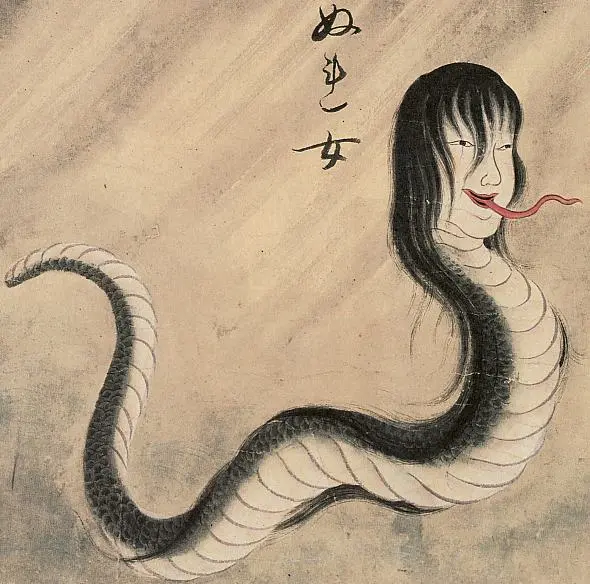
What is old is a painting. The Fukuoka City Museum holds the Hyakkai Zukan, a handscroll finished by Sawaki Sūshi in 1737: thirty creatures in a row, each with its name written beside it and no story attached. One of them is a snake-bodied woman labelled ぬれ女. Toriyama Sekien reprinted the figure in 1776, also without a line of text.
The story came from somewhere else. On the Iwami coast of Shimane, folklorists recorded a woman who appears on the shore, puts a baby in a passer-by's arms and vanishes — and then the ushi-oni, the ox-demon, comes. She is the decoy, not the monster. Its earliest datable printing is from 1933.
The 300-metre body comes from the 2008 English Wikipedia article, the blood-sucking tongue from a blog post of the same year, and her filing as a candidate animal from a 1994 dictionary of "unconfirmed creatures".
What is the history of Nure-onna?
Two different things are called nure-onna, and they did not arrive together. One is a painted body with no story. The other is a story in which she is not even the monster.
The painting is the part that can be inspected. The Fukuoka City Museum holds a handscroll catalogued under accession number 1993B03009: the Hyakkai Zukan (百怪図巻), ink and colour on paper, 36.5 cm high and 19.19 metres long, signed by Sawaki Sūshi (佐脇嵩之, 1707–1772) and dated 1737. Thirty creatures are painted one after another, each with its name written beside it and nothing else — no place, no witness, no incident. One of them is a woman's head and torso joined to a snake's body, labelled ぬれ女. The museum's own record adds a detail that is usually left out: Sūshi's colophon states that the scroll copies an older manuscript attributed to Kanō Motonobu, so 1737 is not where the image begins. It is where the image becomes datable.
Toriyama Sekien printed the same figure in the third volume (Fū) of the Gazu Hyakki Yagyō in 1776. The difference matters commercially rather than iconographically: Sūshi's scroll was a unique manuscript that a handful of people could ever have seen, while Sekien's was a woodblock book. But Sekien added nothing. Most entries in the Gazu Hyakki Yagyō carry no explanatory text at all; he only began writing commentaries in his later Konjaku Gazu Zoku Hyakki of 1779, and the nure-onna is not in that book. What the eighteenth century leaves behind is a labelled body and no narrative whatsoever.
The narrative comes from the other side of the country, and its earliest datable printing is of 1 May 1933. In the folklore journal Kyōdo Kenkyū (郷土研究) 7:5, pages 43–45, Okada Kenbun published "Iwami ushi-oni tales" (石見牛鬼譚). Two of its episodes are catalogued in the Nichibunken folklore database with their localities. In the first, at Ōda-chō in Ōda City, Shimane, a man walking home from night fishing meets a nure-onna, who puts a baby in his arms and disappears; he throws the bundle away and runs, an ushi-oni gives chase, and he saves himself by getting inside a farmhouse. In the second, at Asari-chō in Gōtsu City, a Shinto priest goes out to fish at night; the nure-onna hands him the baby and vanishes; he tries to throw it away and finds it has gone stone-heavy and will not leave his hand; the ushi-oni comes after him and is stopped when something bright flies through the air and lodges in its head — his own sword, come from his house.
In both episodes the nure-onna is the bait and the ushi-oni the predator, and the title of the article that records her is about the ox-demon. The generalised entry, the one with the practical advice, was printed in the Sōgō Nihon minzoku goi (綜合日本民俗語彙), volume 3, Heibonsha, December 1955, page 1163, compiled at the Institute of Folklore Studies under Yanagita Kunio's supervision: the baby is to be held with gloves on, and when the bearer runs, the gloves are thrown away with the baby still inside them.
That leaves the question of everything else she is said to do, and the answer is that the modern nure-onna is a composite of regionally separate beings. A name search on ヌレ in the Nichibunken database returns 26 records. Six are nure-onna — two of them the Shimane pair — and they describe five different creatures. Shimane, 1933: the ox-demon's decoy. Aso in Kumamoto, 1952 (Maruyama Manabu, in Minzoku 14, p. 4): a wet-haired woman at the water's edge who possesses people and drinks their blood, held locally to be a middle-aged woman with a snake's body, seen particularly at the Yakushi-dō across from Tochinoki hot spring. Ōtsuki in Kōchi, 1965 (Minzoku Saihō, p. 58): she stands where water seeps out at the foot of a hill with her hair soaked and shakes it at passers-by, and the water is fatal. Ainan in Ehime, 1985 (Suzuki Taisuke, in Iyo no Minzoku 39, p. 25): a woman in white with loose hair on a bad stretch of road who always asks passers-by to carry something, which grows heavy until they black out. Shizuoka, 1991 (prefectural history, materials volume 25, pp. 928–929): a soaking woman standing on National Route 150 at night, who is gone by the end of the lift and leaves the seat wet. The same database also files a nure-onago, a "wet girl", from the same corner of Ehime: in Iyo no Minzoku 37 (1985, pp. 28–29) and Jōmin 28 (1991, p. 100) she hands a passer-by a baby that turns stone-heavy.
So the blood-drinking is recorded folklore, from Kumamoto. The unbearable weight is recorded too: in the Ainan nure-onna it is whatever she asks to have carried, and in the nure-onago of Ehime it is a baby. None of the six nure-onna records gives her a length.
Timeline: the documented record of Nure-onna
- 1737 Sawaki Sūshi signs the Hyakkai Zukan, a 19.19-metre handscroll of thirty yōkai, each painted with its name beside it and no accompanying text. One is a snake-bodied woman labelled ぬれ女. The colophon says the scroll copies an older manuscript attributed to Kanō Motonobu.
- 1776 Toriyama Sekien prints the same figure in the third volume of the Gazu Hyakki Yagyō, moving her from a unique manuscript into a commercial woodblock book. Like most entries in that book, it carries no explanatory text.
- 1929 Fujisawa Morihiko publishes Yōkai gadan zenshū, Nihon-hen, jō, containing the Echigo–Aizu river story in which her tail reaches three chō — about 327 metres. He names no primary source. The Japanese Wikipedia article that retells the tale dates it 'Bunkyū 2 (1819)', an impossible pairing: Bunkyū 2 is 1862 and 1819 is Bunsei 2.
- 1 May 1933 Okada Kenbun publishes “Iwami ushi-oni tales” in Kyōdo Kenkyū 7:5, pp. 43–45, with two episodes from Ōda-chō (Ōda City) and Asari-chō (Gōtsu City), Shimane. In both, the nure-onna hands over a baby and vanishes and it is the ushi-oni that attacks. This is the earliest datable printing of the story we have found.
- 1 February 1952 Maruyama Manabu records in Minzoku 14 that in the Aso district of Kumamoto a wet-haired nure-onna at the water's edge possesses people and drinks their blood, and is held to be a middle-aged woman with a snake's body. The blood-drinking enters the record here — in Kyushu, and without a tongue.
- December 1955 The Sōgō Nihon minzoku goi, vol. 3 (Heibonsha, p. 1163), compiled under Yanagita Kunio's supervision, prints the generalised Iwami entry with its practical advice: hold the baby with gloves on and throw the gloves away with it when you run.
- 1965 In Kōchi, at Ōtsuki in Hata District, folklore fieldworkers record a wholly different nure-onna: she stands where water seeps from a hillside with her hair soaked and shakes it at passers-by, and the water is deadly. No snake, no baby, no blood.
- 30 November 1985 Suzuki Taisuke records in Iyo no Minzoku 39 a nure-onna at Shobo-shobo valley in Ainan, Ehime: a woman in white with loose hair who asks you to carry something, which grows heavy until you faint. The unbearable weight exists here without a child.
- 1991 The Shizuoka prefectural history files as nure-onna a modern road legend: a soaking woman standing on National Route 150 at night, gone before the end of the lift, leaving the car seat wet.
- 1994 Sasama Yoshihiko publishes Zusetsu Nihon mikakunin seibutsu jiten, a dictionary of “unconfirmed creatures” that sorts 114 yōkai by zoological class. The nure-onna appears at pp. 102–104, among the serpent and dragon transformations. This is the catalogue decision that turns a picture-scroll figure into a candidate species.
- 2000 Kyōgoku Natsuhiko and Tada Katsumi publish Yōkai Zukan (Kokusho Kankōkai), reproducing the Hyakkai Zukan in colour with commentary at pp. 145–146. Nearly every image and citation now in circulation online passes through this one volume.
- 10 February 2008, 11:30 UTC A user signing as Tobosha uploads to Wikimedia Commons a scan of the Hyakkai Zukan nure-onna taken from that 2000 volume. Two minutes later the same name, in its Japanese form, edits the Japanese Wikipedia article. That scan is the image on this page.
- 18 February 2008 The blog Pink Tentacle publishes “Edo-period monster paintings by Sawaki Suushi”, describing the nure-onna as a fast-swimming amphibious creature with beady eyes, claws and fangs, a baby that grows heavy, and “her long, powerful tongue to suck all the blood from her victim's body”. It is the earliest source we can date for the tongue.
- 16 April 2008, 05:39 UTC The English Wikipedia article is created by an editor signing as Torsodog, citing only that blog post and one fan page. It reproduces the blog almost verbatim and adds two things the blog does not say: that she is “300 m in length” and that she can crush trees with her tail. Four minutes later the same editor edits the Japanese article, where the tail “reaches” some 300 metres.
- 3 September 2019 The English article is replaced by a translation of the Japanese one, which is far better sourced but keeps the distortion: the tail that reaches three chō is now a tail “at least 3 chō long”.
Is there a rational explanation for Nure-onna?
The literature of cryptozoology has no candidate animal for the nure-onna, and the absence can be measured.
Searched in the Internet Archive's full-text index on 28 September 2026, the string "Nure-onna" returns 157 items: children's and young-adult fiction, popular yōkai reference such as Yoda and Alt's Yokai Attack!, dictionaries of mythology and folklore, a 1961 book on Japanese genre painting and several urban-legend miscellanies, and none of them has cryptozoology in its title. Run as a control in the same index on the same day, "Mokele-mbembe" — an animal that cryptozoology genuinely claims — returns 2,516 items, and 38 of the first 200 are cryptozoology titles, Loren Coleman's Cryptozoology A to Z among them. The Nichibunken database gives the same answer from the Japanese side: its 26 records under ヌレ come from folklore journals and prefectural histories, and none of them is a report of an unidentified animal.
What does exist is a catalogue decision. In 1994 Sasama Yoshihiko published Zusetsu Nihon mikakunin seibutsu jiten (図説・日本未確認生物事典, Kashiwa Shobō, 182 pp.), a dictionary of "unconfirmed creatures" — mikakunin seibutsu is the standard Japanese term for what English calls a cryptid — which arranges 114 yōkai by zoological class: humanoid forms, fish and turtle transformations, serpent and dragon transformations, beast, bird and amphibian transformations. The nure-onna is at pages 102–104, in the serpents. That is where a figure from a picture scroll is filed as a candidate species. The Japanese Wikipedia article, which is the best-sourced free account of her, credits Murakami Kenji's Nihon yōkai daijiten (Kadokawa, 2005, p. 250) with the observation that Sasama, like Fujisawa Morihiko before him and Yamada Norio in 1974, retells the story without naming a primary source for it.
The three-hundred-metre body is an arithmetic error with a date. The same Wikipedia article, citing pages 1–10 of Fujisawa Morihiko's Yōkai gadan zenshū, Nihon-hen, jō (Chūō Bijutsusha, 1929), retells a tale from the Echigo–Aizu border in which her tail reaches (届く) three chō ahead — about 327 metres — so that no one she has seen can escape her: the verb measures how far she can strike. On 16 April 2008 at 05:39 UTC the English Wikipedia article was created and rendered it as "she has been described as being 300 m in length"; the 2019 translation that replaced that text says her tail is "at least 3 chō (about 327 meters) long". The reach became a measurement and the measurement stuck.
The same Japanese article dates the tale "Bunkyū 2 (1819)". Bunkyū 2 is 1862; the year 1819 is Bunsei 2. Fujisawa's text is the opening chapter of the volume, headed 濡れ女, in the copy the National Diet Library has digitised (pid 1240641), which on 28 September 2026 was not open for online viewing; the page that would show which of the two readings is his is there.
None of the 26 Nichibunken records under ヌレ mentions a tongue (舌), including the Aso record of 1952, which has the blood-drinking and the snake's body. The tongue is in the Pink Tentacle blog post of 18 February 2008, which says that "in some stories, Nure-onna uses her long, powerful tongue to suck all the blood from her victim's body".
None of this makes the Iwami story false; it makes it a different kind of thing: a warning fastened to a dangerous stretch of coast, with an instruction attached about gloves.
Can you visit Nure-onna?
The nure-onna is not attached to a place. What can be seen are a painted handscroll, the coast where two tales were collected, and a bronze figure in a street of bronzes.
The scroll is the Hyakkai Zukan, accession 1993B03009, at the Fukuoka City Museum, 3-1-1 Momochihama, Sawara-ku, Fukuoka. Nineteen metres of handscroll can only be unrolled to a few scenes at a time, so it is not normally on view. It was among the highlighted works of the special exhibition "Ghost and Yōkai Paintings from the Fukuoka City Museum Collection", which ran from 19 July to 13 September 2026 in the special exhibition room and has now closed; the scroll has gone back to storage. As the museum's pages read on 22 September 2026, it opens from 9:30 to 17:30 with last entry at 17:00 and closes on Mondays and over the new year. The permanent display costs ¥200; high-school and university students pay ¥150 and middle-school pupils and younger go free. The catalogue record for the scroll, with dimensions, provenance and the note on the colophon, stays online whether or not the object is out.
The coast is the Iwami district of western Shimane, and specifically the two places named in the 1933 article: Ōda City and Asari-chō in Gōtsu City. Both sit on the JR West San'in Main Line along the Sea of Japan. Asari station has been unstaffed since 10 March 1990, and the Asari swimming beach is about a seventeen-minute walk from it, in season from the middle of July to the middle of August. Nothing on that coast commemorates the nure-onna and no local body promotes her.
The statue is the easiest of the three to find. Nure-onna is figure number 80 on Mizuki Shigeru Road in Sakaiminato, Tottori, some 800 metres of open street carrying 177 yōkai bronzes from Sakaiminato station to the Mizuki Shigeru Memorial Museum; there were 153 until the renewal of 2018 added twenty-four more. The street is free and always accessible. Its caption for her carries the Echigo and Aizu story, the tail of three chō or some 327 metres, while the Iwami material collected a prefecture away goes unmentioned.
The archive is open too: the Nichibunken Kaii Yōkai Denshō Database can be searched free online, and the 1933 records described in this file are there, with journal, volume, date, pages and locality.
Sources consulted
- Okada Kenbun (岡田建文), «Iwami ushi-oni tales (石見牛鬼譚), Kyōdo Kenkyū 7:5, pp. 43–45 — database records for the Ōda and Gōtsu episodes» — Kyōdo Kenkyū / Nichibunken Kaii Yōkai Denshō Database, 1933 academic
- International Research Center for Japanese Studies (Nichibunken), «Kaii Yōkai Denshō Database — name search on ヌレ (26 records)» — Online folklore database, 2026 archive
- Fukuoka City Museum, «Hyakkai Zukan (百怪図巻) — collection record 1993B03009» — Museum collection database, 2026 archive
- Institute of Folklore Studies, supervised by Yanagita Kunio, «Sōgō Nihon minzoku goi (綜合日本民俗語彙), vol. 3, p. 1163» — Heibonsha, 1955 book
- Murakami Kenji (村上健司), «Nihon yōkai daijiten (日本妖怪大事典), p. 250» — Kadokawa Shoten, 2005 book
- Sasama Yoshihiko (笹間良彦), «Zusetsu Nihon mikakunin seibutsu jiten (図説・日本未確認生物事典), pp. 102–104» — Kashiwa Shobō, 1994 book
- Fujisawa Morihiko (藤沢衛彦), «Yōkai gadan zenshū, Nihon-hen, jō (妖怪画談全集 日本篇 上)» — Chūō Bijutsusha, 1929 book
- Pink Tentacle, «Edo-period monster paintings by Sawaki Suushi» — Pink Tentacle (blog), archived copy, 2008 web
- English Wikipedia contributors, «Nure-onna — English Wikipedia, first revision (oldid 205961549) and revision history» — Wikipedia edit history, 2008 archive
- Wikimedia Commons, «File:Suushi Nure-onna.jpg — file description and upload history» — Wikimedia Commons, 2008 archive
- Wikimedia Commons, «File:SekienNureonna.jpg — Gazu Hyakki Yagyō, 1776» — Wikimedia Commons, 2007 archive
- Fukuoka City Museum / Nishinippon Shimbun, «Special exhibition: Ghost and Yōkai Paintings from the Fukuoka City Museum Collection (19 July – 13 September 2026)» — Exhibition press release, 2026 web
- Sakaiminato Tourism Association, «Nure-onna, bronze no. 80 on Mizuki Shigeru Road» — Mizuki Shigeru Road official site, 2026 web
- Hirokouji, «Nihon densetsu taikei (日本伝説大系) — full table of contents of the fifteen volumes» — Reference guide, 2008 web
- Kyōgoku Natsuhiko and Tada Katsumi (eds.), «Yōkai Zukan (妖怪図巻), pp. 145–146» — Kokusho Kankōkai, 2000 book
Reviewed by V. Serrano on 2026-08-14 · How we verify our content
📎 Source: Enigma Atlas
💬 Field testimonies (0)
No testimonies yet. Add the first.
Add your testimony
🔒 Log in to add a testimony