🦶 CRYPTID SIGHTING · EXP. Nº0555
ACTIVE
Each-uisge
In Gaelic tradition the each-uisge is not an unidentified animal. It is the deep, still loch, given four legs.
Where and when was Each-uisge sighted?
- Location
- Ord, Isle of Skye, Highland, United Kingdom
- Date sighted
- Unknown
- Coordinates
- 57.147, -5.94
- Last updated
LOCATION
What is Each-uisge?
The fullest account is John Gregorson Campbell's, gathered on Tiree between 1861 and 1891 and printed after his death in 1900: almost every lonely freshwater lake held one; it came as a horse, but also as a young man, a boy, a ring or a tuft of wool; a cow-shackle round its neck or a cap on its head made it the best horse on the farm, until the shackle slipped and only the livers came ashore next day. Campbell insisted it was not the kelpie, which belongs to streams. The reading of it as a candidate species is much younger and has an author every time: in 1862 John Francis Campbell offered wild cattle and great auks and left the question "to ethnologists and geologists"; a 2004 paper proposed a leatherback turtle; and in 2009 someone hung a cryptozoology template on its Wikipedia article, which in 179 revisions has never once used the word cryptid.
What is the history of Each-uisge?
The each-uisge is not a species that got away. In its own tradition it is the still, deep loch itself, walking about on four legs.
The fullest account was written by John Gregorson Campbell, minister of Tiree from 1861 until his death in 1891, and printed nine years after he died: chapter V, "The Water-Horse (Each Uisge)", pp. 203-215 of Superstitions of the Highlands and Islands of Scotland (Glasgow, James MacLehose and Sons, 1900). The volume is posthumous, and its prefatory note says who handled it. The Editor's Note is unsigned and dated August 1900. It says the book "is the result of many years' labour by the late Rev. John Gregorson Campbell", promises a second volume on witchcraft "in the editor's hands", and credits exactly one other person: "Mrs. Wallace, Hynish, Tiree, the author's sister, has kindly read the proofs." Nothing in the note claims to have added, rewritten or supplemented the text.
Campbell's own Preface sets a rule that almost no later writer on the each-uisge has kept. "It has been deemed advisable to derive information solely from oral sources. Books have been purposely avoided as authorities, and a rule has been laid down, and strictly adhered to, not to accept any statement in print regarding a Highland belief, unless also found current among the people." He explains why: writers without Gaelic "fill up with extraneous and foreign elements what seems to them gaps or blanks in beliefs they but imperfectly understand". Read in 2026, that sentence is a description of what would happen to his own chapter.
Here is what he recorded. "In olden times almost every lonely freshwater lake was tenanted by one, sometimes by several, of these animals" (p. 203). It looked like an ordinary horse and was constantly mistaken for one. It also came "as a young man, a boy, a ring, and even a tuft of wool (ribeag cloimhe)". There is no bird in Campbell's list of shapes. On Skye alone, he adds on p. 204, "it was said to have a sharp bill (gob biorach), or, as others describe it, a narrow brown slippery snout"; its colour was grey, black, or black with a white spot on the forehead, and opinion divided on whether that was ordinary horse-colouring or another change of shape.
The part that never survives retelling is the farming. "The cow-shackle round its neck, or a cap on its head, completely subdued it, and as long as either of these was kept on it, it could be as safely employed in farm labour as any other horse" (p. 203). In the Mull stories a strange horse joins the farm horses over winter and is caught in spring like the rest: "It is the best horse the farmer has, and is fat and sleek when the rest are lean and ragged. It works thus all spring, and in summer is employed to take home peats from the moor" (p. 205). Then the shackle slips off on the road to the peat moss. Campbell states the moral flatly on p. 204: "However much benefit the farmer might at first derive from securing one with the cap or cow-shackle he was ultimately involved by it in ruinous loss." That is not a monster hunt. It is a parable about labour too cheap to be true.
The livers are the signature of the tale, and they are more various than the versions in circulation. When the string of tethered horses is dragged in, "next day their entrails or livers come ashore" (p. 205). After the nine children of Sunart go into Loch na Dunach, "the liver of one of them came ashore next day" (p. 209); the survivor is the boy with a Bible in his pocket, who never mounts at all - "He touched the horse with his finger, and had to cut it off to save himself." And in the fourth of five variants of the death of the heir of Aros, the liver on the sand is the horse's own: "The horse's liver came ashore next day, the animal, it is supposed, having been killed by the other Water-horses tenanting the lake, when they felt the smell of a man off it" (p. 207). In the fifth variant, what washes up is a man's lungs.
Campbell also drew the line that later writers keep rubbing out. "The Kelpie that swells torrents and devours women and children has no representative in Gaelic superstition. Some writers speak as if the Water-horse were to be identified with it, but the two animals are distinctly separate. The Water-horse haunts lochs, the Kelpie streams and torrents" (p. 215).
A second, older trail runs beside Campbell's, and it explains a great deal. John Francis Campbell of Islay, in the "Mythology" postscript to volume IV of Popular Tales of the West Highlands (1862), notes that "the water-horse assumes many shapes; he often appears as a man, and sometimes as a large bird", and then prints an informant's measurements of that bird form: a neck "two feet eleven inches long" and "twenty-three in circumference", a bill "about seventeen inches long, and hooked like an eagle's at the end", short black legs, webbed feet "with tremendous claws", footprints covering "a space equal to that contained within the span of a pair of large antlers", and a "voice like the roar of an angry bull" (pp. 337-338). The collector's own verdict is in the very next sentence: "If that 'eye-witness' had only taken his long bow with him instead of his gun, I have no doubt he might have secured a specimen of the 'Boobrie.'" He keeps the creature in the book anyway, for a reason he states precisely: "he has a real existence in the popular mind".
The tradition also has a voice from inside it. In December 1896 Malcolm MacPhail published in Folklore a legend he says had "been well known to the writer from his earliest years": a water-horse in the shape of a young man falls asleep with his head in a herd-girl's lap; she finds his hair full of sand and mud, slips out of her skirt and escapes, and the creature shakes the empty skirt shouting the Gaelic tag that survives as a proverb, "Ma's duine tha'n so's aotram e, mu'n dubhairt an-t-Each-Uisge" - "If this be human it's light, as the water-horse said." MacPhail names the knoll, Cnoc-na-Beist on Lewis, beside Loch-a-Mhuileinn, and remembers sitting there as a boy arguing about the name, "never dreaming that it was 'a cock and bull story'."
Timeline: the documented record of Each-uisge
- 1862 John Francis Campbell of Islay prints the each-uisge's bird form in volume IV of Popular Tales of the West Highlands, with an informant's measurements — a bill "about seventeen inches long, and hooked like an eagle's at the end" — and his own verdict in the very next sentence: "If that 'eye-witness' had only taken his long bow with him instead of his gun, I have no doubt he might have secured a specimen of the 'Boobrie.'" On p. 344 he proposes that water-horses and boobries are the memory of wild cattle, horses and great auks, and hands the matter over: "I leave it to ethnologists and geologists to say whether this popular supernatural history has any bearing upon modern discoveries." It is the earliest datable conversion of the each-uisge into a candidate animal.
- December 1896 Malcolm MacPhail publishes in Folklore a Lewis version of a tale that had "been well known to the writer from his earliest years", names the knoll — Cnoc-na-Beist, beside Loch-a-Mhuileinn — and preserves the Gaelic tag the creature shouts at the empty skirt. He also records his own childhood verdict: he argued about the place-name as a boy "never dreaming that it was 'a cock and bull story'."
- August 1900 Superstitions of the Highlands and Islands of Scotland is published in Glasgow, nine years after John Gregorson Campbell's death. Chapter V, pp. 203-215, is still the fullest account of the each-uisge: the shapes it took (a young man, a boy, a ring, a tuft of wool — and no bird), the cow-shackle and the cap that made it a farm horse, the livers that come ashore next day, and the flat statement on p. 215 that the water-horse and the kelpie "are distinctly separate". The unsigned Editor's Note credits one other person: the author's sister, Mrs Wallace of Hynish, Tiree, who read the proofs.
- 1967 (claimed) The year given on the sign in the garden at Ord, Skye, for the stranding of the "specimen": "This specimen was stranded at an exceptionally low tide in 1967." The date falls squarely in the years when the MacInnes family were building the house and making the garden there.
- 1976 Katharine Briggs's An Encyclopedia of Fairies calls the each-uisge "perhaps the fiercest and most dangerous of all the water-horses" — a phrase confirmed word for word by full-text search in three separate editions — and, according to the citation that later carried it into general circulation, lists among its shapes an enormous bird such as a boobrie. J. G. Campbell, working only from oral sources, has no bird among its shapes and no boobrie anywhere in his book.
- March 2004 E. C. M. Parsons publishes "Sea monsters and mermaids in Scottish folklore: Can these tales give us information on the historic occurrence of marine animals in Scotland?" in Anthrozoos 17 (1), pp. 73-80. It is the paper later cited for reading the each-uisge's bill as a leatherback turtle's. Its title asks whether such tales can give information on the historic occurrence of marine animals in Scotland; its authorship, affiliation and pagination are in the Crossref record.
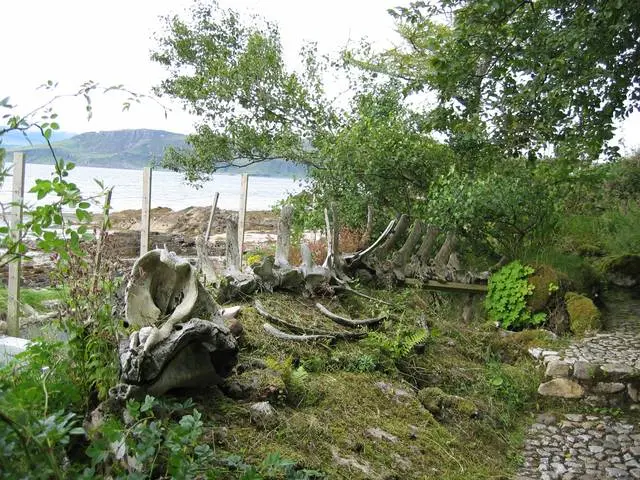
- 13 August 2006 John Allan photographs the "Each Uisge Earballach" skeleton in the garden at Ord for the Geograph project. The image reaches Wikimedia Commons on 31 January 2010 and is the one this file has been using: a set of real cetacean bones illustrating a creature that has never left any.
- 21 June 2009, 16:44 UTC An editor adds the Cryptozoology navigation box to the English Wikipedia article, edit summary "add template". Across the 179 revisions of that article between 2005 and 2026 it is the only cryptozoological marking it has ever carried: the word "cryptid" appears in none of them and no cryptid category has ever been applied. Control on the same method and the same day: the Cadborosaurus article carries Category:Aquatic cryptids and Category:Reptilian cryptids.
- 22 June 2010 An anonymous editor adds a section to the same article claiming the each-uisge is "speculated by some cryptologists to be the Loch Ness Monster". A Gaelic-speaking editor removes it eight minutes later, summary "rm, this is SO ludicrous you need a ref". The conversion is refused from inside the encyclopedia that is usually blamed for it.
- 4 August 2014 In a single day, one editor makes both of the additions that reached us. At 05:38 UTC an "Origins" section proposes the leatherback turtle, summary "add - ref to come"; at 05:45 the Parsons citation is attached to it; and at 13:22, summary "bird", the list of shapes changes from "or handsome man" to "handsome man or enormous bird", cited to Briggs.
- 25 November 2018 The World Cetacean Alliance publishes Clive Martin's identification of the Ord skeleton: a male Cuvier's beaked whale, settled by the configuration of the nasal bones and by the two tusk-like teeth at the tip of the lower jaw, and against the landowner's own guess of a minke whale.
- 15 April 2024 The leatherback turtle passage is deleted from the English Wikipedia article after nine years and eight months. The anonymous editor's stated reason, in full: "Removed irrelevant/non-verifiable statement attributed to an unknown person simply called 'George'. There is no reference to who George is in the rest of the page." The conversion had outlived any means of checking it.
- 31 July 2026 The each-uisge enters Enigma Atlas as a cryptid, from a seed file of fifty creatures written in a single day in which the label meant, in practice, "anything frightening". The neighbours it arrived with in that list include Krampus, the Squonk and the dahu. This is the fifth datable conversion, and it is ours.
Is there a rational explanation for Each-uisge?
Nobody disputes that the tradition exists. What has been falsified is the question put to it. Asking a Gaelic loch-spirit "which animal is this?" produces a candidate species, and that conversion has happened to the each-uisge five times, every one of them datable.
The first, in 1862, is the oldest and by far the least known, and it is signed by one of the great collectors. Closing volume IV of Popular Tales of the West Highlands, John Francis Campbell writes that he is persuaded of "the former existence of a race of men in these islands who were smaller in stature than the Celts... and were perhaps cotemporary with some species of wild cattle and horses, and great auks, which frequented marshy ground, and are now remembered as water-bulls, and water-horses, and boobries, and such like impossible creatures", and then hands the matter over: "I leave it to ethnologists and geologists to say whether this popular supernatural history has any bearing upon modern discoveries" (p. 344). Twelve pages earlier he had already offered a live animal: "there is a real sea-creature whose head may have suggested that there were real horses in the sea" (p. 337). The last confirmed great auks had been killed in 1844. That is the whole move in miniature, made by a folklorist: a spirit turned into a survival, and the question passed to natural science.
The second conversion, in 2004, is the one that reached the public. A paper by E. C. M. Parsons, then at George Mason University and at the University Marine Biological Station Millport, appeared in Anthrozoos 17 (1), pp. 73-80, in March 2004, under a title that asks a question: "Sea monsters and mermaids in Scottish folklore: Can these tales give us information on the historic occurrence of marine animals in Scotland?" On 4 August 2014 at 05:38 UTC an editor of English Wikipedia added a section headed "Origins", summary "add - ref to come": "The appearance of the Each Uisge on the Isle of Skye was described by Gordon in 1995 as having a parrot-like beak, and this, with its habit of diving suddenly, could be from real-life encounter with a sea turtle such as the leatherback turtle." Seven minutes later, at 05:45, the same editor attached the Parsons citation. The sentence stood for nine years and eight months. It was deleted on 15 April 2024 by an anonymous editor whose whole stated reason was that it was "attributed to an unknown person simply called 'George'"; the sentence had said Gordon, and nothing else in the article said who Gordon was.
The bird came the same day, from the same editor. At 13:22 UTC on 4 August 2014 the article's list of shapes changed from "or handsome man" to "handsome man or enormous bird", edit summary "bird", sourced to Katharine Briggs, An Encyclopedia of Fairies (1976), pp. 115-16. Today it reads "enormous bird such as a boobrie". The bird has a real source and a long route. In J. F. Campbell's own list of the material he received from John Campbell of Kilberry the boobrie is filed as three separate items ("98. The Boobrie. Large bird. 99. Boobrie as Water-Horse. 100. Boobrie as Water-Bull"), and what does not survive the journey is the collector's mockery of the man who measured it. J. G. Campbell, who worked only from oral sources, has no boobrie anywhere in his book and no bird among the each-uisge's shapes. The chain runs from 1862 through Briggs to Wikipedia. Briggs's each-uisge entry is in the full text of her encyclopedia, where she calls the creature "perhaps the fiercest and most dangerous of all the water-horses", and the boobrie appears in the same book; the words that put a bird among the each-uisge's shapes are known from the 2014 citation.
The fourth conversion, in 2009, added no animal at all: it is a filing decision. All 179 revisions of the English Wikipedia article between 1 October 2005 and 5 August 2026, retrieved through the MediaWiki API and read in order, show the same thing. The word "cryptid" appears in none of them, and no cryptid category has ever been applied: the categories have always been folklore ones (legendary creatures, water spirits, fairies, shapeshifters). The article's only cryptozoological marking is a navigation box added at 16:44 UTC on 21 June 2009, edit summary "add template". The Wikipedia article on Cadborosaurus, checked the same way on the same day, carries Category:Aquatic cryptids and Category:Reptilian cryptids. And one earlier attempt failed on the spot: on 22 June 2010 an anonymous editor added a section claiming the each-uisge is "speculated by some cryptologists to be the Loch Ness Monster", and a Gaelic-speaking editor removed it eight minutes later with the summary "rm, this is SO ludicrous you need a ref".
The fifth conversion is this site's. The each-uisge entered Enigma Atlas as a cryptid from a seed list of fifty creatures written in a single day, 31 July 2026, in which "cryptid" meant in practice "anything frightening". The neighbours it arrived with include Krampus, the Squonk (a lumberjacks' tall tale) and the dahu, a French hoax played on gullible visitors.
The photograph is a joke, and it argues better than the papers. This page is illustrated by a skeleton, which is the one thing this tradition has never produced. It was photographed at Ord on the Isle of Skye on 13 August 2006 by John Allan. The sign that stood beside it, as photographed in Geoff Holder's The Guide to Mysterious Skye and Lochalsh and transcribed by the Faery Folklorist blog in 2013, read: "Each Uidge Earballach, Hydro Equus Extendus, Long-tailed Water Horse. This is the only known example of this rare beast - a distant relative of the better known Monstra Nessium. Hydro E.E. is usually sighted only twice a year when it swims inshore to browse on whelks. This specimen was stranded at an exceptionally low tide in 1967." The bones are real. In November 2018 the World Cetacean Alliance published Clive Martin's identification: a male Cuvier's beaked whale, settled by the configuration of the nasal bones and by the two tusk-like teeth that erupt at the tip of the lower jaw, against the landowner's own assurance that it was a minke. The joke has better aim than the hypothesis: a beaked whale's skeleton, on Skye, the one island where Campbell's informants gave the water-horse a "sharp bill".
There is no missing species here, and there does not need to be one. The men who collected the stories said so first. J. G. Campbell called the most widespread of the tales "obviously a pious fraud to keep children from wandering on Sundays to play in lonely places, and from meddling with any horse they may find". Malcolm MacPhail, who grew up with the Lewis version, recalled in a scholarly journal in 1896 arguing about it as a boy "never dreaming that it was 'a cock and bull story'". Both of them printed the story anyway. The farming version, the least supernatural thing in Campbell's chapter, carries its own lesson: the horse that cost the farmer nothing works beautifully all spring, and ruins him in the end.
Can you visit Each-uisge?
The each-uisge was attached to almost any lonely loch in the Highlands and Islands, so no one site belongs to it. The pin on this entry is at Ord, on Skye, where the skeleton in the photograph stands, within about 70 metres of the grid reference of the 2006 Geograph photograph, NG 617 131; three other places carry specific stories in Campbell's and MacPhail's collections.
Ord, on the Isle of Skye, is a hamlet on the west coast of the Sleat peninsula, at the mouth of Loch Eishort, looking across to Blaven and the Cuillin. The Skye For All walking guide, last updated in June 2024, gives the approach as the Ord turning off the A851 Armadale–Broadford road and about 4 miles of single-track road to the bay. The skeleton stands in the walled garden of An Acarsaid, a private house. The same guide sends walkers along the track beside the white garden wall towards the Ord coral beaches and tells them to look for the "water horse skeleton" in the garden to the right. The owners' website, read on 23 September 2026, dates the first part of the house to 1960, with extensions until the mid-1970s, and says that the garden, "built from scratch" in that period, was opened to the public under the Scottish Gardens Scheme, raising funds for Crossroads Care and the RNLI, "until 2009". Eileen MacInnes died there in January 2010, a few weeks before her 98th birthday, and her sons Neil and Duncan have kept the house for holiday use; the website offers it to guests "on an informal basis to fit around use by family, relatives and friends". The sign in the garden gives 1967 as the year of the stranding, inside the years when the house was being extended and the garden made.
On Tiree, Campbell's "Loch Basibol", now Loch Bhasapol, is the second largest loch on Tiree, in the north-west of the island, and two stories in his chapter are set on it: the rider whose rein broke and who was carried into the water, and the water-horse who courted the sister of the six-fingered brothers at the farm of Baile nan Croganach. Tiree was Campbell's parish, where he collected between 1861 and 1891. The island's tourism site describes the loch as used today for fishing and water sports and says that two small islands in it may be crannogs. CalMac sails to Tiree from Oban by way of Coll, in about three and a half to four hours, and there are flights from Glasgow.
Loch Frisa, the largest loch on the Isle of Mull, is 5 miles (8 km) long according to the Gazetteer for Scotland, and its north-western end lies roughly halfway between Tobermory and Dervaig. It is the water of the best-known tale in Campbell's chapter, the drowning of the heir of Aros, which he prints in five incompatible versions before giving his own reading: "There seems to be this much truth in the story, that the young man was dragged into Loch Frisa by a mare which he was attempting to subdue and drowned." The loch is known today for eagle watching.
Cnoc-na-Beist, on the Isle of Lewis, is the knoll named in Malcolm MacPhail's note of 1896, beside the freshwater Loch a' Mhuileinn near Bragar and Shawbost on the west side of Lewis; the Gaelic name means the hillock of the beast.
The lochs in these stories are cold and deep, and most of them lie well away from houses. At Ord, the Skye For All guide warns that there is no mobile phone coverage on the walk to the coral beaches, and that the sand bar out to the coral island in Loch Eishort can be crossed only at an exceptionally low spring tide.
Sources consulted
- John Gregorson Campbell, «Superstitions of the Highlands and Islands of Scotland, chapter V: The Water-Horse (Each Uisge), pp. 203-215; Editor's Note and Preface, pp. v-x» — Glasgow: James MacLehose and Sons, 1900 book
- John Francis Campbell, «Popular Tales of the West Highlands, vol. IV: postscript 'Mythology', pp. 336-344, and the list of stories received from John Campbell of Kilberry (nos. 98-100, the Boobrie)» — Edinburgh: Edmonston and Douglas, 1862 book
- Malcolm MacPhail, «Folklore from the Hebrides. I. An-t-Each-Uisge» — Folklore, vol. 7, no. 4, pp. 400-401, 1896 academic
- English Wikipedia contributors, «Each-uisge: the complete revision history, 179 revisions from 1 October 2005 to 5 August 2026, retrieved in full through the MediaWiki API and read in chronological order» — Wikipedia, en.wikipedia.org (action=query&prop=revisions), 2026 archive
- E. C. M. Parsons, «Sea monsters and mermaids in Scottish folklore: Can these tales give us information on the historic occurrence of marine animals in Scotland? (Crossref record)» — Anthrozoos, vol. 17, no. 1, pp. 73-80, 2004 academic
- Katharine M. Briggs, «An Encyclopedia of Fairies: Hobgoblins, Brownies, Bogies, and Other Supernatural Creatures, entry 'Each Uisge', pp. 115-116» — Harmondsworth: Penguin Books, 1976 book
- John Allan, «Each Uisge Earballach: photograph of the skeleton in the garden at Ord, with the sign quoted in part in the caption, Isle of Skye (grid ref NG 617 131), taken 13 August 2006» — Geograph Britain and Ireland, image 218481; on Wikimedia Commons from 31 January 2010, 2006 archive
- Clive Martin, «The Mysterious Whale Skeleton of Skye» — World Cetacean Alliance, 2018 web
- Neil and Duncan MacInnes, «About An Acarsaid and Ord: history of the house and garden, and the garden's public opening under Scotland's Gardens Scheme until 2009» — An Acarsaid, Ord, Isle of Skye, 2026 web
- Skye For All, «Ord Coral Beaches: the turning off the A851, the single-track road, parking above the beach and the shore path past the wall of An Acarsaid» — skyeforall.co.uk, 2026 web
- Isle of Tiree, «Loch Bhasapol: the second largest loch on Tiree, its possible crannogs and its present use for fishing and watersports» — isleoftiree.com, 2026 web
- The Faery Folklorist, «The Water-horse Skeleton, Ord — full text of the sign, transcribed from the photograph on p. 60 of Geoff Holder's The Guide to Mysterious Skye and Lochalsh» — faeryfolklorist.blogspot.com, 2013 web
Reviewed by V. Serrano on 2026-08-14 · How we verify our content
📎 Source: Enigma Atlas
💬 Field testimonies (0)
No testimonies yet. Add the first.
Add your testimony
🔒 Log in to add a testimony