👻 HAUNTED PLACE · EXP. Nº9476
ACTIVE
Airth Castle
Airth Castle is not a haunted hotel any more, and the record suggests it was never a haunted castle.
Where is Airth Castle?
- Location
- Falkirk, Scotland, United Kingdom
- Type
- Castle
- Coordinates
- 56.062, -3.768
- Last updated
LOCATION
Why is Airth Castle said to be haunted?
It is a fire-damaged, empty Category A listed building on the hill above the village of Airth, closed since March 2023 and shut to the public.
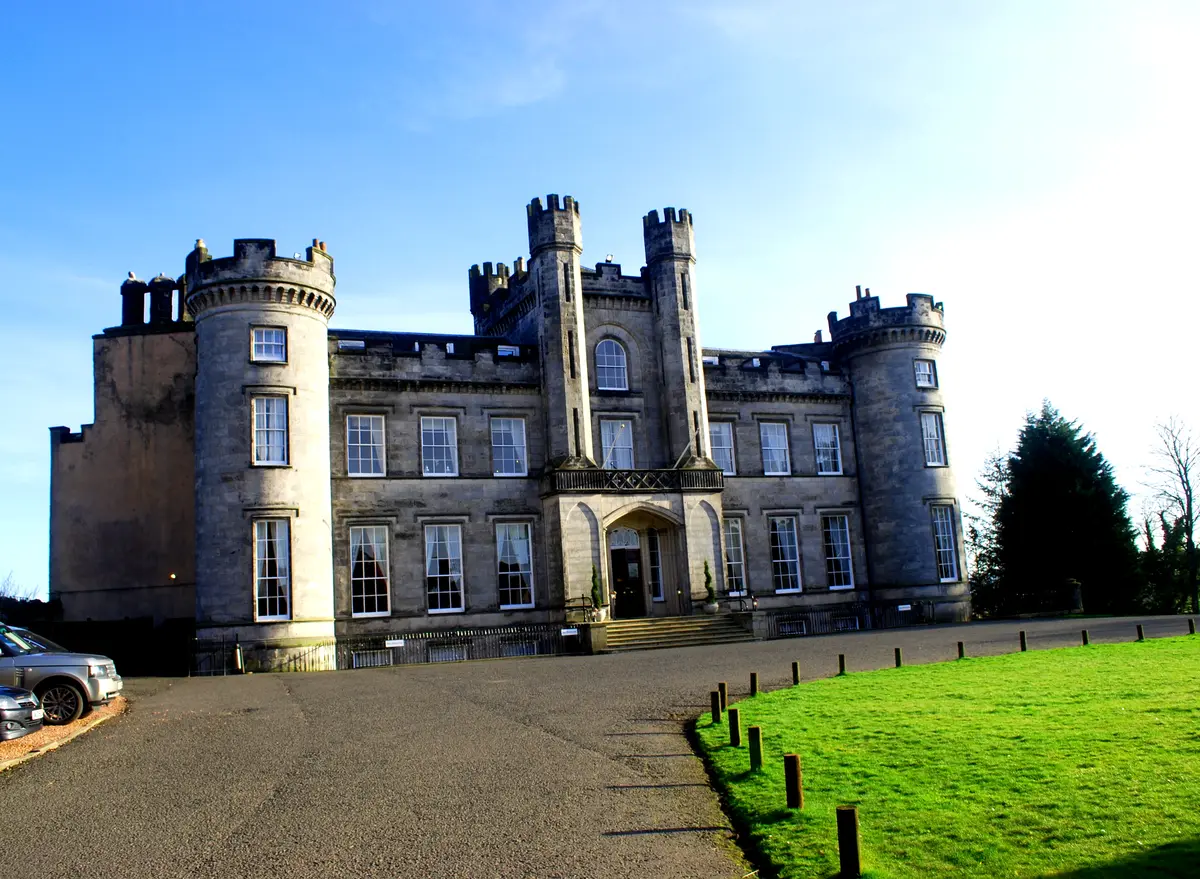
Its documented history is long and traceable: a de Erth stronghold recorded in 1309, burnt in the fighting around Sauchieburn in 1488, held by the Bruces until 1642, by the Elphinstones after them and by the Grahams from 1717 to 1920, and given its castellated front by the Glasgow architect David Hamilton early in the nineteenth century. Its ghost story is far shorter. The two ministers who wrote the parish's statistical accounts, in 1841 and in 1951, described the castle at length and recorded no ghost, no legend and no tradition attached to it. The castle became a hotel in the early 1970s. Ghost stories reach print by 1999, with a seventeenth-century housekeeper who neglected two children; by 2001 the same woman had been dated to the fifteenth or sixteenth century and by 2012 to the 1800s, and in 2005 the hotel itself was selling ghost tours of the castle.
What is the history of Airth Castle?
Airth Castle stands on the only rise in an otherwise flat parish. Both of the parish accounts written by its ministers open with the same explanation: the name comes from the Gaelic ard, a hill, and the hill in question is the ridge on whose south-east corner the castle sits. In 1841 the Rev. John MacGachen put it at about a hundred feet above the low-water mark of the Forth; in 1951 the Rev. T. Donaldson called it sixty. The river once came much closer, and the old village, the old kirk and the castle all stood together on the high ground.
The oldest story attached to the site is also the least secure. A raid by William Wallace in 1298, to free his uncle the priest of Dunipace from a wooden stronghold here, rests on a single source: Blind Harry's poem The Wallace, composed in the 1470s, roughly a hundred and eighty years after the event it describes. The south-west block of the present building is still called Wallace's Tower, but nobody dates the masonry that early. MacGibbon and Ross put the tower in the sixteenth century or possibly the late fifteenth; the statutory listing describes the castle as sixteenth to seventeenth century; Martin Coventry's gazetteer prefers the fourteenth. The three datings stand unreconciled, and no excavation or dendrochronology has been published to decide between them.
The documented sequence of lairds is clearer. The lands belonged to a de Erth family, from whom a stronghold here is recorded in 1309. They passed to the Bruces of Clackmannan stock through marriage to a de Erth heiress; gazetteers place that marriage around 1394 or around 1470, and the point is not settled. In 1488 the castle was burned in the fighting around Sauchieburn, and Robert Bruce of Airth received compensation from the crown towards rebuilding. The Bruces held Airth until 1642, when it passed by marriage to the Elphinstones, whose Richard Elphinstone of Airth is named in a parliamentary ratification of 1681. In 1717 the Grahams bought the estate and their descendants held it until 1920.
It is a Graham who commissioned the building most people recognise. The early nineteenth-century castellated front by the Glasgow architect David Hamilton masks most of the older work, and the New Statistical Account of 1841 records it as new: among the parish's principal modern buildings MacGachen lists "an elegant front addition to Airth Castle", then the seat of William Graham Stirling, Esq. of Airth. Beside it stands the roofless old parish kirk, where, Donaldson noted in 1951, members of the Bruce and Elphinstone families are buried and at least one parish family still held burial rights.
Historic Environment Scotland listed the castle Category A on 25 October 1972 (LB2102). The surveyor's note of the day reads, with hindsight painfully: "Empty but no signs of any vandalism. Grounds maintained as if house still inhabitted. Now a Hotel." The hotel and country club lasted from about 1971 to 2023.
Timeline: the documented record of Airth Castle
- 1309 A stronghold at Airth is recorded as held by Fergus de Erth, the family that gave the parish its name; a raid attributed to William Wallace in 1298 depends entirely on Blind Harry's poem, written in the 1470s.
- 1488 The castle is burned in the fighting around the battle of Sauchieburn. Robert Bruce of Airth receives compensation from the crown towards rebuilding, and the south-west block later called Wallace's Tower belongs to the work that followed.
- 1642 Airth passes by marriage from the Bruces to the Elphinstones; a parliamentary ratification of 1681 names Richard Elphinstone of Airth as holder of the tower, fortalice and manor place.
- 1717 The Graham family buys the estate. Their descendants hold Airth until 1920, and it is under them that the early nineteenth-century castellated front by David Hamilton is built.
- 1841 (published 1845) The Rev. John MacGachen finishes the parish's New Statistical Account. He lists the new front of Airth Castle among the principal modern buildings and names its owner, William Graham Stirling; he records no ghost, legend or tradition of any kind.
- 1951, revised 1961 The Rev. T. Donaldson writes the parish's Third Statistical Account. He devotes a paragraph to the castle and its ruined kirk, and prints local speculation about Clubb's Tomb, but records nothing supernatural about the building.
- 25 October 1972 Airth Castle is listed at Category A (LB2102). The surveyor's note records it as empty, with the grounds maintained as if still inhabited, and adds: "Now a Hotel."
- 22 October 2010 BBC Tayside and Central Scotland lists Airth Castle among the region's haunted places, "described as Scotland's most haunted hotel" — without saying by whom. The ghost had been in print since at least 1999, in Martin Coventry's Haunted Places of Scotland.
- 11 November 2012 The Daily Record publishes a photograph taken by best man Stuart White at Nigel and Jane Sleath's 2007 wedding in the castle's cocktail bar, presented as the castle's "green phantom" and commented on by Mark Turner of Ghostfinders Scotland.
- 15 March 2023 Airth Castle Hotel Limited stops trading, blaming pandemic closures and energy costs; 26 full-time staff and further part-time staff lose their jobs. Compulsory liquidation commences on 11 April 2023 and concludes on 18 September 2025.
- 23 September 2024 A well-developed fire destroys parts of the main building in the early hours; six appliances and a height vehicle attend and Police Scotland treats the fire as wilful, having already increased patrols in June after earlier fire-raising.
- 21 January 2026 Airth Castle Hotel Limited is dissolved. The building's owner, Airth Castle Limited, remains on the register; the castle stands empty, fire-damaged and closed to the public.
Is there a rational explanation for Airth Castle?
Two ministers of Airth wrote long descriptions of this parish, and neither of them recorded a ghost story about the castle.
The New Statistical Account entry, drawn up by the Rev. John MacGachen, revised in April 1841 and published in 1845, runs to about 3,225 words. It names Airth Castle four times and Dunmore fifteen; it lists the landowners, the state of the parish registers from 1660, the wages of a mason and the rent of an acre. Its "Civil History" section, the place where a minister would put whatever he considered the parish's most notable past event, is given over to the skeleton of a whale, traced "to the extent of 75 feet", dug up in 1817 when the Stirling road was cut. Searched for ghost, spectre, apparition, haunt, superstition, legend, tradition and tunnel, that account returns zero for every one of them. The control is in the same volume: across its 385,127 words, tradition appears 66 times, superstition and its derivatives 7, haunt 6, legend 2, fairy 2 and witch once. Ministers of the 1840s did write down local lore when they had it, and MacGachen's account of Airth contains none.
The Third Statistical Account entry, by the Rev. T. Donaldson, written in 1951 and finally revised in 1961, is about 3,715 words. Donaldson was not squeamish about local curiosities: he records the hollow thorn tree in the Callendar garden in which small meetings were once held, the smithy door shaped like a horseshoe, and Clubb's Tomb on the Pow burn, of which he writes that "whether Clubb was an eccentric, a murderer, a murdered man or a horse is a question which may be answered by one's personal selection from the available theories". He printed that, and his counts for ghost, haunt, spectre, legend, piper and tunnel are all zero.
The ghost arrives with the hotel. According to the hotel's own history page of 2005, the castle was sold in 1971 to the Forrester family, who refurbished it, and the listing surveyor noted in October 1972 that it was "Now a Hotel"; Travel & Leisure was listing the Airth Castle Hotel by June 1981. The earliest dated ghost story for the building found in the Internet Archive's full-text index, searched on 1 October 2026, is in Martin Coventry's Haunted Places of Scotland (Goblinshead, 1999), which says the castle "is said to be haunted by the ghost of a 17th-century housekeeper" who "neglected two children in her care"; his Wee Guide to Scottish Ghosts and Bogles of 2000 repeats it. In the same index "Airth Castle" occurs in 1,314 documents, from county inventories to hotel guides. Later notices follow the same commercial calendar: a Scotsman list of haunted hotels on 29 July 2010 and a BBC Halloween round-up on 22 October 2010, which describes Airth as "Scotland's most haunted hotel" without saying who described it so. The first account with named witnesses came on 11 November 2012, when the Daily Record published a photograph taken by the best man Stuart White at Nigel and Jane Sleath's 2007 wedding, with Mark Turner of Ghostfinders Scotland commenting on the image.
The stories do not agree on their own dating. Coventry's housekeeper belongs to the seventeenth century. John Spencer's Encyclopedia of Ghosts and Spirits (volume 2, 2001), which names the hotel's revenue management assistant as its source, calls her "Molly", a hostess "from the 15th or 16th century when the building was a private house", killed in the building with her two children. The Daily Record in 2012 made her a nanny "who died in a fire in the 1800s". Three versions place the same woman in three different centuries, and the hotel is named as the source of one of them.
The hotel sold the ghost itself. The 681 distinct pages of its website archived by the Internet Archive between 2005 and 2023, about 375,000 words in all, were read on 1 October 2026. The history page of 2005 tells the castle's past without a ghost. The same site in 2005 offered a "Ghost Presentation & Tour of the Castle" in its exclusive-use and house-party packages, listed "Ghost Tour Weekends" among its themed breaks, and gave its press room a section headed "Ghost Reports & Sightings". In later years the only ghost on the site is the Stirling Ghost Walk among local attractions, from 2012, and a Halloween party night in 2013 sold as "a ghoulish and ghostly night out".
Can you visit Airth Castle?
Airth Castle is closed, derelict and private. It is not a hotel, and nothing about it can be booked.
The address on Falkirk Council's own gazetteer is Airth Castle Hotel, Castle View, Airth, Falkirk FK2 8JF (UPRN 136035305). The operating company, Airth Castle Hotel Limited (SC271413), stopped trading on 15 March 2023 with the loss of 26 full-time jobs; a compulsory liquidation was petitioned and commenced on 11 April 2023, concluded on 18 September 2025, and the company was dissolved on 21 January 2026. The building itself belongs to a separate company, Airth Castle Limited (SC267043), which remains on the register and which said in 2023 that the castle would not be sold because of the operator's insolvency.
Since the closure the empty building has been broken into and stripped, and Police Scotland increased patrols in June 2024 after reports of antisocial behaviour and fire-raising. In the early hours of 23 September 2024 a well-developed fire destroyed parts of the main building; six appliances and a height vehicle attended, and the police treated the fire as wilful. Entering the site is trespass, and after the fire it is genuinely dangerous.
What a visitor can legitimately do is look. The castle is visible from the minor road that runs west of the A905 south of Airth village, and its silhouette on the hill is the point of the place. In the village itself the A-listed market cross stands in the High Street and carries the arms of the Bruces and the Elphinstones. The roofless old parish kirk in the castle grounds is a protected ruin with restricted access for safety. Dunmore Park and its eighteenth-century Pineapple are a short drive north.
Booking sites, ghost-tour listings and travel articles still describe Airth as an operating haunted hotel. As of August 2026 they are out of date.
Sources consulted
- Rev. John MacGachen, «Parish of Airth, County of Stirling» — The New Statistical Account of Scotland, vol. VIII (Dunbarton, Stirling, Clackmannan), 1845 book
- Rev. T. Donaldson, «Parish of Airth (Third Statistical Account of Scotland, County of Stirling)» — The Third Statistical Account of Scotland, 1961 book
- Historic Environment Scotland, «Airth Castle: listed building record LB2102 (Category A, listed 25 October 1972)» — Historic Environment Portal, 1972 report
- Companies House, «AIRTH CASTLE HOTEL LIMITED (SC271413): company record and insolvency case» — Find and update company information, GOV.UK, 2026 archive
- Daily Record, «Airth Castle's green phantom appears in wedding photo» — Daily Record, 2012 newspaper archive
- BBC News, «Halloween happenings in your area» — BBC Tayside and Central Scotland, 2010 newspaper archive
- STV News, «Airth Castle 'deliberately' set on fire as crews battle blaze through night» — STV News, 2024 newspaper archive
- Martin Coventry, «Airth Castle» — The Castles of Scotland (Goblinshead), online gazetteer, 2026 web
- Falkirk Council, «Airth Castle Hotel, Castle View, Airth, FK2 8JF (UPRN 136035305)» — Falkirk Council address gazetteer, 2026 report
- Scottish Financial News, «Airth Castle Hotel enters voluntary administration» — Scottish Financial News, 2023 newspaper archive
- Martin Coventry, «Haunted Places of Scotland — Airth Castle: the ghost of a 17th-century housekeeper who neglected two children» — Goblinshead, Musselburgh, 1999 book
- John Spencer, «Encyclopedia of Ghosts and Spirits, vol. 2 — Airth Castle Hotel: 'Molly', a hostess from the 15th or 16th century» — Headline, London, 2001 book
- Airth Castle Hotel & Spa, «The history of Airth Castle (hotel's own history page: 1971 sale to the Forresters, no ghost)» — airthcastlehotel.com (Internet Archive capture of 8 December 2005), 2005 archive
- Travel & Leisure, «Travel & Leisure, June 1981 — hotel listing: Airth Castle Hotel, Airth, Falkirk» — Travel & Leisure, vol. 11, no. 6, 1981 newspaper archive
- Airth Castle Hotel & Spa, «Exclusive use (hotel website, 2005): 'Ghost Presentation & Tour of the Castle' in the package» — airthcastlehotel.com (Internet Archive capture of 22 October 2005), 2005 archive
- Airth Castle Hotel & Spa, «Press room (hotel website, 2005): section 'Ghost Reports & Sightings'» — airthcastlehotel.com (Internet Archive capture of 7 December 2005), 2005 archive
Reviewed by V. Serrano on 2026-08-17 · How we verify our content
💬 Field testimonies (0)
No testimonies yet. Add the first.
Add your testimony
🔒 Log in to add a testimony