👻 HAUNTED PLACE · EXP. Nº9477
ACTIVE
Beaulieu Abbey
Beaulieu Abbey was founded by King John in 1204, after a false start at Faringdon in Berkshire the year before, and endowed for thirty Cistercian monks.
Where is Beaulieu Abbey?
- Location
- Hampshire, United Kingdom
- Type
- Church / religious site
- Coordinates
- 50.822, -1.449
- Last updated
LOCATION
Why is Beaulieu Abbey said to be haunted?
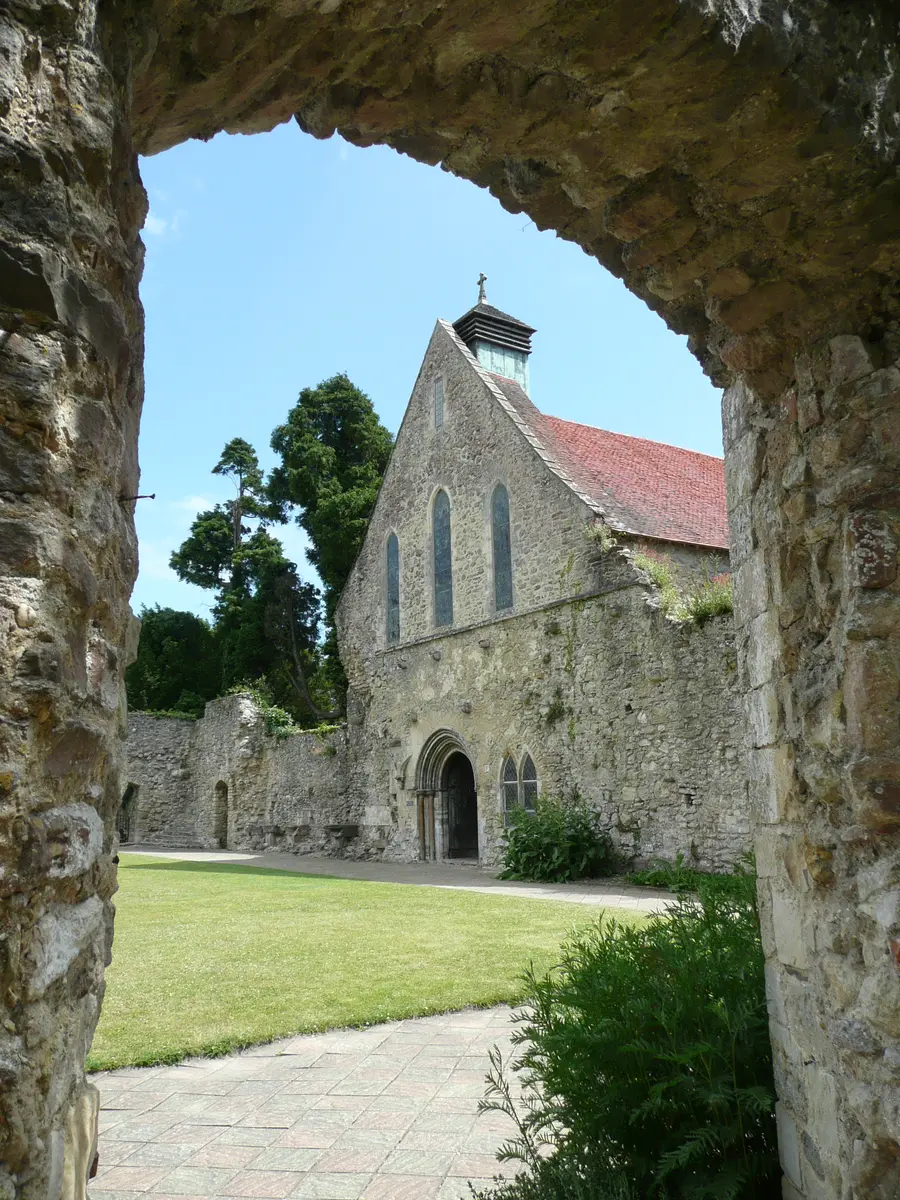
What the medieval records make it famous for is sanctuary: Innocent III extended the privilege over the whole precinct, and in 1471 the Countess of Warwick fled here after Barnet and stayed fourteen years, while in 1497 the pretender Perkin Warbeck was taken out of it and handed to Henry VII. On 2 April 1538 an abbot and twenty monks signed the surrender, and the stone and lead went to build Hurst and Calshot castles. The monks' refectory survived as the parish church and stands today. The ghost of Beaulieu is chanting: the earliest press report of it cited by the Society for Psychical Research's encyclopedia is the Daily Express of 27 June 1928, on Arthur Conan Doyle investigating with a medium — 390 years after the abbey fell, and 37 years after Doyle's own bestseller opened with the great bell of Beaulieu and its white-robed monks.
What is the history of Beaulieu Abbey?
Beaulieu did not begin at Beaulieu. On 5 July 1203 King John issued two writs about a colony of Cistercian monks already settled on the royal manor of Faringdon in Berkshire, and on 2 November of the same year he granted Faringdon by charter to "the Church of the Blessed Mary of Citeaux" so that an abbey might be built there. The Berkshire endowment proved too small, and in 1204 the community was moved to a nameless stretch of the New Forest above the tidal river. The Annals of Waverley record it flatly: "A.D. 1204 King John built an abbey of the Cistercian order, which he named Bellus Locus" — the beautiful place — "near the spot where William Rufus was killed". John, who had quarrelled violently with the Cistercians early in his reign, endowed it as a house for thirty monks, an unusually large complement when twelve was the norm.
In the records, the abbey's fame rests on the right of sanctuary. Pope Innocent III granted Beaulieu privileges that covered the whole precinct as well as the church, and the abbey used them. In 1427 the abbot was summoned to Westminster to produce his proofs. On 15 April 1471, days after the Earl of Warwick was killed at Barnet, Queen Margaret of Anjou, Prince Edward and the Countess of Warwick claimed sanctuary here; the countess stayed fourteen years, regaining her liberty only on the accession of Henry VII in 1485. In 1497 the pretender Perkin Warbeck fled here after his Cornish rising collapsed, and was taken out of sanctuary and delivered to Henry VII. Fowler calls him "the third distinguished fugitive to Beaulieu".
The end came on 2 April 1538, when Abbot Thomas Stevens signed the surrender. Fowler agrees with the writer who called Stevens "a time-serving wretch", and prints his letter to Thomas Wriothesley of 26 April complaining of "the detraction of his lewd monks which now, thank God, I am rid of". Thirty was the number the house had been endowed for; the Victoria County History says Stevens "induced twenty of the monks to do the like", and that seventeen monks obtained small pensions. The site went to Wriothesley, and its stone went to the coast. Fowler establishes from the correspondence that Hurst Castle, Calshot Castle and the two blockhouses at Cowes "were all constructed, at least in part, from materials taken from Beaulieu Abbey", and prints the Earl of Southampton's letter to Cromwell about the abbey's lead. The church that vanished was 336 feet from east to west and 186 feet across the transepts.
Not everything went. According to the estate's own history note, the refectory, the Domus and two gatehouses "were allowed to remain as long as they were converted to secular use", and the monks' refectory has been the parish church of Beaulieu since shortly after the abbey was destroyed. Fowler explains why its plan looks wrong for a church: it "was, it should be remembered, not built for a church, but as a dining hall for the monks; therefore it is not 'orientated' but has its long axis north and south." The lay brothers' Domus survives, as do two gatehouses; the greater of them became Palace House, which Wriothesley's descendants, the Montagus, still occupy.
Timeline: the documented record of Beaulieu Abbey
- 5 July 1203 King John issues two writs about the Cistercian monks he has settled at Faringdon in Berkshire, and on 2 November grants the manor by charter to the church of Citeaux so that an abbey may be built. The endowment proves too small and the colony is moved.
- 1204 The abbey is founded in the New Forest and named Bellus Locus Regis. The Annals of Waverley date it to 1204; Fowler and the Victoria County History agree it was endowed for thirty monks, against a Cistercian norm of twelve.
- 1427 The abbot is summoned to Westminster to produce his proofs of the right of sanctuary — the privilege, granted by Innocent III over the whole precinct and not merely the church, that made Beaulieu politically useful.
- 15 April 1471 Days after the Earl of Warwick falls at Barnet, Queen Margaret of Anjou, Prince Edward and the Countess of Warwick take sanctuary at Beaulieu. The countess remains fourteen years, regaining her liberty only on the accession of Henry VII in 1485.
- 1497 Perkin Warbeck, the pretender to Henry VII's throne, flees to Beaulieu after his Cornish rising collapses and claims sanctuary. He is taken out of it and delivered to the king; he was hanged in 1499.
- 2 April 1538 Abbot Thomas Stevens and twenty monks — not thirty — sign the deed of surrender. Stevens takes a pension of 66 pounds 13s 4d and writes to Thomas Wriothesley three weeks later that he is, thank God, rid of his lewd monks. Stone and lead go on to Hurst Castle, Calshot Castle and the Cowes blockhouses.
- 1891 Arthur Conan Doyle publishes The White Company, which opens at Beaulieu: "The great bell of Beaulieu was ringing", and the white-robed brothers trooping in to the cloister. It is the earliest datable mass-circulation text that puts pale-habited monks and the sound of Beaulieu's bell in the same picture, three decades before any named ghost witness.
- 1911 Sir James Kingston Fowler publishes A History of Beaulieu Abbey, written with the Montagu family papers and issued by the family's own press. In 67,864 words that name Beaulieu 518 times there is not one ghost story — and the vicar then alleged to converse with ghostly monks was in post.
- 27 June 1928 The Daily Express reports that Arthur Conan Doyle investigated Beaulieu with the help of a medium. Cited by Melvyn Willin for the Society for Psychical Research, it is the earliest press report of the Beaulieu haunting that he cites: 390 years after the abbey was suppressed.
- Before 20 July 1937 Latest possible date for the conversation in which the Hon. Elizabeth Douglas-Scott-Montagu (born at Beaulieu in 1909, later Mrs Varley) discussed her experience of repetitive singing with Guglielmo Marconi, a friend of her father. Her father died on 30 March 1929 and Marconi on 20 July 1937, placing the episode in the 1920s or 1930s.
- 1959 Michael Sedgwick, curator of the Montagu Motor Museum since 1958, reports hearing distinctive chanting twice and says he first took it for a radio. He is the second named witness on record to reach for a wireless set as the explanation.
- January 1994 Veteran members of the Ghost Club carry out what Willin calls a serious investigation at Beaulieu. It reveals no anomalous phenomena. Willin also lists public vigils by the Hampshire Ghost Club and an episode of Most Haunted recorded at the abbey on 30 November 2004.
- 24 November 2023 Beaulieu Enterprises Ltd publishes its own account of Conan Doyle's seance in the Palace House drawing room, prompted by Lucy Worsley filming there. The estate's Abbey attraction page, by contrast, contains no ghost material at all.
Is there a rational explanation for Beaulieu Abbey?
The published record of Beaulieu's ghosts is short and almost entirely twentieth-century, and the site's own historians have never carried it.
Sir James Kingston Fowler's A History of Beaulieu Abbey (1911) was written with the family papers that Lord Montagu, in Fowler's words, placed "at my disposal", and was published by the family's own imprint, The Car Illustrated. The Internet Archive's text of the book runs to 67,864 words and names Beaulieu 518 times, "monk" 197 times and "sanctuary" or "sanctuaries" 87. The vocabulary of haunting barely registers in it: one "ghost" (the Holy Ghost, in a letter of November 1538), one "haunt" (an OCR fragment of "merchant") and one "phantom", which is Fowler describing how the mast of a sea-going barge on the river "can often be seen, phantom-like, over the trees, before the boat itself comes into view". The Beaulieu History Society's 2016 talk on the abbey church, by Anthony Norris, has the same profile: 7,477 words, "Montagu" 37 times, "Powles" five, and no occurrence of ghost, apparition, spectre, phantom or chanting.
The named witnesses belong to the last century and a half. The Revd Robert Frazer Powles signed as curate of Beaulieu in 1882, was vicar from 1886 according to Melvyn Willin, and retired in 1939. Willin, citing J. A. Brooks's Britain's Haunted Heritage (1990), writes that Powles believed himself in regular contact with the "ghostly monks", to the extent of being able to name them individually. The oldest printed version of that claim returned by the Internet Archive's full-text search on 6 October 2026 is Diana Norman's The Stately Ghosts of England, first published in 1963, twenty-four years after his retirement: Powles, she writes, "was not only convinced that the monks of Beaulieu existed", and claimed to have struck up an acquaintance with them. The Hon. Elizabeth Douglas-Scott-Montagu, later Mrs Varley, born in 1909, described "the sound of many voices in repetitive singing, which faded and strengthened like the sound from a primitive wireless", and added: "At first I thought it was a wireless in the servants' hall." Willin records that she discussed it with Guglielmo Marconi, a friend of her father; her father died on 30 March 1929 and Marconi on 20 July 1937, which brackets that conversation to the 1920s or 1930s. Michael Sedgwick, curator of the motor museum in the grounds, reported chanting in 1959 and at first took it for a radio.
Of the three named witnesses to the monks, two reached first for a wireless set, and that is the strongest sceptical observation available. The monks' refectory, which opens off the cloister, is a working parish church, and Norris mentions ringing its bell, which dates from 1655; sung services, that bell and, from the 1920s, broadcast music are local and ordinary sources of the kind of sound described. The record does not agree on its other ghost either: Willin gives the eighteenth-century figure of Isabella, Countess Beaulieu, who died in 1786, as a "'blue' or 'grey' lady", and Mysterious Britain calls her a Grey Lady. Willin lists several investigations, "both for research and for commercial entertainment": public vigils by the Hampshire Ghost Club, which reported a coin moving and, in November 2011, paranormal movements in a table-turning experiment, and an episode of Most Haunted recorded on 30 November 2004 in front of five hundred guests. The one he calls serious, by veteran members of the Ghost Club in January 1994, "revealed no anomalous phenomena".
The estate keeps the séance and the ruins apart. Beaulieu Enterprises Ltd's news page of 24 November 2023 recounts Conan Doyle's séance in the Palace House drawing room, where, it says, "they spoke to the spirit of a man who had been convicted of a crime". Its Abbey attraction page, read on 6 October 2026, contains no ghost, haunting or apparition, and of the 1,076 addresses in the estate's sitemap that day, two contain the word "ghost": a half-term events page and a drama about the Rolls-Royce Silver Ghost.
Can you visit Beaulieu Abbey?
The abbey ruins belong to the Beaulieu estate, run by Beaulieu Enterprises Ltd, and are not sold on their own. The estate's ticket page, read on 24 September 2026, says that one inclusive ticket covers the National Motor Museum, We Had One Of Those, Palace House and Gardens, Little Beaulieu, Beaulieu Abbey, the Secret Army Exhibition and unlimited rides on the monorail.
The address is Beaulieu, New Forest, Hampshire SO42 7ZN, with visitor enquiries on 01590 612345. The estate's getting-here page sends drivers from junction 2 of the M27 along the brown tourist signs; parking is free for up to 1,000 cars, with a separate car park for disabled visitors near Visitor Reception. The same page says the estate is "currently unable to offer charging facilities for any electric vehicles" and names the nearest alternatives, at The Drift Inn by Beaulieu Road Station and at Tesco Applemore. Brockenhurst, on the London to Weymouth line, is the closest main-line station; the page puts a taxi from there at about £20 and the ride by bicycle at seven miles, some 11 km. The New Forest Tour's Green Route linked Beaulieu with the Hythe ferry, Lyndhurst, Brockenhurst and Lymington from 4 July to 13 September 2026, and morebus runs a limited Hythe to Lymington service on Tuesdays and Thursdays only.
According to the opening-times page, the estate opens at 10am every day of the year except Christmas Day. In 2026 it closes at 5pm until 22 May, at 6pm from 23 May to 13 September and at 5pm again from 14 September, with last admission half an hour before closing. The 2026 general admission prices on the same date were £31.50 for an adult (17 and over) on the day and £28.35 booked in advance; a child aged 4 to 16 paid £18.50 on the day or £16.65 in advance, and under-fours enter free. Disabled visitors pay a concessionary rate and their carer goes in free. A ticket allows a free return visit within the six days after the first, except on the major event days that the page lists.
The estate's abbey page describes the preserved foundations of the abbey church, the cloister with its herb garden, and the Domus of the lay brothers. The Domus holds an exhibition on the abbey and its monks, and its upper floor, "occasionally closed for weddings and functions", shows embroideries designed by Belinda, Lady Montagu. The same page's history note says the chapter house was demolished in 1538. What remains of it is its entrance: Historic England's list entry 1094429 (Grade I, first listed on 8 October 1959, amended on 10 June 1987) covers the outer walls of the cloister, roughly 42 metres square, and records on the east side "3 pointed arches on clusters of shafts" opening into the chapter house, with the foundations of the church "exposed 1900-10". The parish church is the monks' former frater, listed Grade I under entry 1156943. Its entry describes "the C13 reading pulpit on huge corbel bracket decorated with large stiff-leaf splays" and adds "Actual pulpit C19 restoration". The estate's page states that the church is open daily to visitors between 1pm and 3pm, subject to church services.
The accessibility page offers a limited number of manual wheelchairs and electric scooters free of charge, bookable on 01590 614646. Because some buildings are listed and cannot be altered, it says, staff offer visitors with restricted mobility "a substitute viewing experience".
Sources consulted
- Fowler, Sir James Kingston, «A History of Beaulieu Abbey, A.D. 1204-1539» — London: The Car Illustrated, 1911 book
- Doubleday, H. Arthur and Page, William (eds.), «Houses of Cistercian monks: The abbey of Beaulieu» — A History of the County of Hampshire, vol. 2 (Victoria County History), pp. 140-146, 1903 academic
- Willin, Melvyn, «Beaulieu Abbey» — Psi Encyclopedia, Society for Psychical Research (published 12 April 2015, last updated 2 September 2026), 2015 academic
- Historic England, «Church of the Blessed Virgin and Child, Beaulieu (NHLE 1156943, Grade I; listed 8 October 1959, amended 10 June 1987)» — National Heritage List for England, 1987 report
- Norris, Anthony, «The History of Beaulieu Abbey Church» — Talk given to the Beaulieu History Society, 20 May 2016, 2016 report
- Doyle, Arthur Conan, «The White Company» — London: Smith, Elder & Co., 1891 book
- Beaulieu Enterprises Ltd, «Sherlock Holmes and Arthur Conan Doyle investigation brings TV historian to Beaulieu» — beaulieu.co.uk, 24 November 2023, 2023 web
- Beaulieu Enterprises Ltd, «Beaulieu Abbey; Ticket prices; Opening times; Getting here; Accessibility» — beaulieu.co.uk, consulted 24 September 2026, 2026 web
- Mysterious Britain & Ireland, «Beaulieu Abbey» — mysteriousbritain.co.uk (published 18 November 2012, updated 29 December 2018; consulted 17 August 2026), 2012 web
- Historic England, «Remains of outer wall around cloister and foundations of Abbey Church, Beaulieu (NHLE 1094429, Grade I; listed 8 October 1959, amended 10 June 1987) — the cloister walls, about 42 m square, with the three-arched entrance to the chapter house, and the church foundations exposed in 1900-10» — National Heritage List for England, 1987 report
- Norman, Diana, «The Stately Ghosts of England — the chapter on Beaulieu, with Lord Montagu on the Revd R. F. Powles and the monks» — London: Frederick Muller (first published 1963; Internet Archive copy catalogued as 1972), 1963 book
Reviewed by V. Serrano on 2026-08-17 · How we verify our content
💬 Field testimonies (0)
No testimonies yet. Add the first.
Add your testimony
🔒 Log in to add a testimony