👻 HAUNTED PLACE · EXP. Nº9476
ACTIVE
Bedlay Castle
Bedlay stands on a rocky crag above the Bothlin Burn between Chryston and Moodiesburn, about eight miles north-east of Glasgow, and for most of its documented life it was called Bedlay House rather than a castle.
Where is Bedlay Castle?
- Location
- North Lanarkshire, Scotland, United Kingdom
- Type
- Castle
- Coordinates
- 55.906, -4.094
- Last updated
LOCATION
Why is Bedlay Castle said to be haunted?
The lands were episcopal rent, let out to tenants; the bishops of Glasgow kept their own country house three kilometres away at Lochwood, on the Bishop's Loch, where Bishop John Cameron died on Christmas Eve 1446. That distance matters, because the ghost Bedlay is actually known for is Cameron's, and the only documented link between the man and the house is a cartload of stone. Writing in 1878, John Guthrie Smith recorded that an old mausoleum on the Bedlay lawn had been built from stones taken out of Lochwood and dragged over the frozen loch one hard winter, and that this "eerie" tomb was what gave the mansion its "uncannie" reputation: the country people believed that at midnight its corridors carried unknown sounds, footsteps and the rustling of rich attire. The tomb came down about 1838. The story stayed. Bedlay is today a Category A listed private house, closed to visitors.
What is the history of Bedlay Castle?
Bedlay spent almost all of its documented life being called a house. It was listed in 1971 as "Bedley House", Victorian writers called it Bedlay House, and a 1961 letter quoted in the national record already had to gloss it as "Bedlay House now known as Bedlay Castle". The castle in the name is the most recent thing about it.
The lands of Bedlay and Mollins were church property. The fullest Victorian account, written by John Guthrie Smith and John Oswald Mitchell while the estate was still a working country seat, says they "formed part of the possessions of the Cathedral Church of Glasgow, having been gifted to the bishoprick by William the Lion in the twelfth century". But what the see held it let out. In 1507 Peter Colquhoun, of the family of Glins, was the rentaller under the Archbishop; shortly before 1535 George Colquhoun held it; and in 1535 the Diocesan Register of Glasgow records the tenancy passing to "Robert Boyde, the son and apperand ayre of Robert Boyde in Kylmarnock, in the landis of Baydlay, Molens, Cuynglaw, and Auch".
That distinction matters more than it looks, because it is where the ghost story goes wrong. From 1507 at the latest the see let Bedlay to tenants and drew rent from it. The house the bishops of Glasgow actually kept in the parish of Cadder stood about three kilometres to the south, at Lochwood on the shore of the Bishop's Loch.
Between 1572 and 1581 James Boyd of Trochrig, the first Protestant archbishop of Glasgow, alienated Bedlay and Mollins outright to his kinsman Robert, by then fourth Lord Boyd. The oldest surviving part of the building — a tower house of two storeys and an attic, set on the end of a rocky crag above the Bothlin Burn, with a square stair tower at the north-east corner — belongs to that generation, although the sources disagree on the builder. Guthrie Smith thought it "probably during the ownership of Sir Thomas Boyd of Bedlay, second son of the fifth Lord Boyd", and on an older foundation; modern castle gazetteers give the fourth Lord Boyd and a date soon after 1580. Historic Environment Scotland, which lists the building Category A, will commit only to "16-17th century. Remodelled around 1860."
The Boyds sold in 1642, under the pressure of a fine of GBP 15,000 that Guthrie Smith blames on Cromwell — an attribution that cannot be right at that date, and a useful reminder that even the careful Victorian sources slip. The buyer was James Roberton, advocate, raised to the bench in 1661 with the judicial title "Lord Bedlay" and dead in May 1664. His descendants held the place for five generations and 144 years, and they are the family that made it look the way it does: the turreted west end with its two round towers, the principal apartments, and the armorial bearings still on the eastern gable. There is also a concealed chamber reached through a panel in a window seat.
Bedlay was judicially sold in 1786 to James Dunlop of Garnkirk, sold on in 1793 to the Glasgow merchant John M'Kenzie, and bought in 1804 by James Campbell of Petershill, who lived in it until he died on 13 June 1829 aged eighty-nine. His second son Alexander died at Bedlay, unmarried, on 19 August 1852; the estate went to his niece Catherine Cameron Campbell, who died childless at Bedlay in 1854, and then to her husband's family, the Christies. The Campbells left two marks on the grounds: a family mausoleum, and the balustrade with urns along the garden terrace, which was carted here from their demolished Petershill House in Glasgow and is written into the statutory listing.
About 1838 the greater part of the oldest division of the house was pulled down. Bedlay went on the market in 2007 and again in November 2014, when CKD Galbraith offered it with 9.76 acres at offers over GBP 500,000, describing a building that needed complete refurbishment.
Timeline: the documented record of Bedlay Castle
- 24 December 1446 John Cameron, bishop of Glasgow since 1426, dies on Christmas Eve. The Dictionary of National Biography places the death at the castle of Glasgow and rejects the "legend of terror" attached to it; Guthrie Smith's 1878 footnote places it at Lochwood House by the Bishop's Loch and misdates it to 1436.
- 1507 Peter Colquhoun, of the family of Glins, holds Bedlay as rentaller under the archbishop of Glasgow.
- 1535 The Diocesan Register of Glasgow records the tenancy passing to "Robert Boyde, the son and apperand ayre of Robert Boyde in Kylmarnock, in the landis of Baydlay, Molens, Cuynglaw, and Auch".
- Between 1572 and 1581 James Boyd of Trochrig, first Protestant archbishop of Glasgow, alienates Bedlay and Mollins outright to his kinsman Robert, fourth Lord Boyd. The tower house on the crag above the Bothlin Burn dates from about this time.
- 1642 The Boyds sell Bedlay and Mollins to James Roberton, advocate, who is raised to the bench in 1661 as "Lord Bedlay" and dies in May 1664. His descendants hold the house for five generations and build the turreted west end.
- 1786 After 144 years the Roberton line loses Bedlay: the estate is judicially sold to James Dunlop of Garnkirk, who sells it on in 1793 to the Glasgow merchant John M'Kenzie.
- 1804 James Campbell of Petershill buys Bedlay and Mollins and lives in the house until his death on 13 June 1829, aged eighty-nine. The Campbells add a family mausoleum and bring the balustrade with urns from their demolished Petershill House in Glasgow.
- About 1838 The greater part of the oldest division of the house is pulled down, and with it an ancient mausoleum on the lawn built of stones carted from the bishops' old house at Lochwood across the frozen Bishop's Loch. Its stones are reused in the entrance lodge.
- 1878 John Guthrie Smith and John Oswald Mitchell print the oldest account of the haunting that can now be read: the demolished tomb was an "eerie" place that "added to the 'uncannie' reputation of the mansion house, in whose corridors, it was believed by the country people, that at midnight hour unknown sounds were heard, mingled with footsteps and the rustling of rich attire". No bishop, no friar, no lady.
- 1882-84 F. H. Groome's Ordnance Gazetteer of Scotland describes the parish of Cadder in 729 words, lists Bedlay among its principal mansions and devotes a passage to its chief antiquities, without one word about a ghost, a haunting, a legend or a tradition.
- 12 January 1971 The house is given Category A listed status under the name "Bedley House". The record, revised on 17 April 2018, dates the building to the 16th-17th century, notes a remodelling around 1860 and the Petershill balustrade, and gives the position as NS 69193 70056.
- 10 November 2014 Country Life advertises Bedlay as a restoration opportunity: 9.76 acres, barrel-vaulted store rooms and cellars, five further bedrooms, and a building requiring complete refurbishment. Within weeks the sale is being reported elsewhere as a haunted castle going for GBP 500,000.
Is there a rational explanation for Bedlay Castle?
The ghost Bedlay is actually known for is a bishop, and the popular version of the story cannot be true as told.
Websites that carry the tale say the castle is haunted by "Bishop Cameron", found dead face down in the water of a nearby loch "around the year 1350"; Medievalists.net, reporting the 2014 sale, says that "one of the bishops drowned in a nearby lake". John Cameron was bishop of Glasgow from 1426 to 1446, so the date is roughly a century out. The Dictionary of National Biography, which devotes an entry to him, has him dying on Christmas Eve 1446 at the castle of Glasgow and explicitly refuses the embroidery: it says there is no credit to be attached to "the legend of terror with which the story of his death has been embellished", gives George Buchanan as the source of that legend, and suggests apoplexy. Buchanan's version, in his history of Scotland of 1582, has no water in it. On Christmas Eve, asleep at his country house, the bishop hears a voice summoning him "to appear before the tribunal of Christ"; he wakes his servants, has them sit by him with lighted candles and takes up a book; the voice comes twice more, he gives a deep groan, "and on his attendants going up to his couch, he was found dead, with his tongue hanging out of his mouth". Buchanan adds that he will "neither rashly affirm nor dispute" it.
There is, though, a documented chain that explains how a bishop who died elsewhere ended up attached to this house, and it runs through a cartload of masonry. Guthrie Smith's 1878 footnote records that an ancient mausoleum once stood in a clump of trees on the Bedlay lawn, and that it had been built out of stones taken from the old house of Lochwood, the bishops' country seat — carted across the frozen Bishop's Loch during a severe winter. The same footnote adds, in the very next sentence, that it was at Lochwood House on Christmas Eve that John Cameron died. The building material of the bishop's death-place was physically moved to Bedlay; the story followed the stones. When the mausoleum was in its turn taken down, its stones went into the entrance lodge.
That 1878 chapter is the oldest printed account of the haunting among the sources of this file, and what it describes is much smaller than what circulates now. The old tomb, it says, was an "eerie" place, "an abode of the fitful owl", and "in some degree it added to the 'uncannie' reputation of the mansion house, in whose corridors, it was believed by the country people, that at midnight hour unknown sounds were heard, mingled with footsteps and the rustling of rich attire". No bishop is named, and nobody claims to have seen anything. The writers give the belief a cause, the tomb, and attribute it to "the country people".
The silence around it can be counted: that chapter runs to 1,219 words and is the most detailed description of the house published in the nineteenth century. In it, the words friar, monk, apparition, ghost, haunted, breathing and cold appear zero times, and so does any lady of any colour; the control is in the same file, where uncannie, eerie and footsteps each appear once and the owning families are named repeatedly (Boyd twelve times, Roberton four, Campbell six). F. H. Groome's Ordnance Gazetteer of Scotland, four years later, gives Cadder parish 729 words, lists Bedlay among the principal mansions and has a sentence on the parish's chief antiquities, Antoninus' Wall and the site of the house at Robroyston where Wallace was betrayed: ghost, haunted, legend and tradition all score zero there too. The bishop as a seen figure, and a phantom coach on the old Glasgow–Stirling road, belong to the modern ghost pages; medieval-castle.com dates the sightings to "as late as the 1970s" and names no witness.
The modern retellings follow the sales: when CKD Galbraith offered Bedlay in November 2014, Medievalists.net reported it under the headline "16th-century Haunted Castle for Sale in Scotland", with the drowned bishop in the text.
Can you visit Bedlay Castle?
Bedlay Castle is a private house. The DiCamillo database of British and Irish country houses, consulted on 24 September 2026, records it as a private home held by an individual or family trust and answers "No" to whether it is open to the public. When it was last marketed, in November 2014, Country Life reported that the building "now requires complete refurbishment to restore it to its former glory".
The house stands between Chryston and Moodiesburn in North Lanarkshire, beside the A80; the 2014 sale notice mentions direct access onto the northbound carriageway. Guthrie Smith and Mitchell put it "about eight miles north-east of Glasgow" in 1878, and the straight-line distance from George Square is 10.9 km (6.8 miles). Historic Environment Scotland gives its position as NGR NS 69193 70056, which converts to 55.9058 N, 4.0939 W, and OpenStreetMap records the postcode G69 9HP against the building. The house has been listed at Category A since 12 January 1971, when it was entered as Bedley House (LB4396, record revised on 17 April 2018). Two structures on the estate were listed at Category B on the same day: the former stables, now Bedlay Kennels (LB4397), and the ruined gateway in the garden (LB4398).
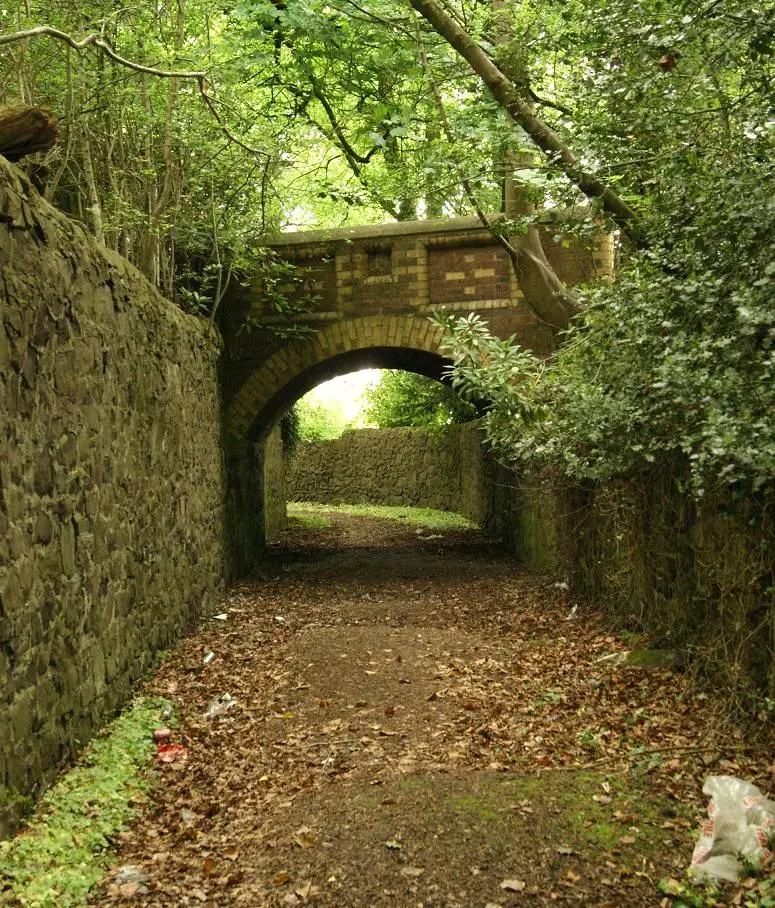
A photograph taken for the Geograph archive on 30 May 2010 shows a sunken path covered in leaves, running between stone walls and under a brick bridge; its contributor captioned it "a creepy old path which follows the outer perimeter wall of Bedlay Castle". OpenStreetMap maps a footway with a bridge about 35 m west-north-west of the house. About 60 m to the east-north-east it has a stone feature tagged as artwork under the name Bedlay Well, and Bedlay Cemetery lies about 560 m to the east.
Scotland's statutory right of responsible access under the Land Reform (Scotland) Act 2003 does not extend to "sufficient adjacent land" around a house to give the people living there reasonable measures of privacy (section 6(1)(b)(iv)).
Sources consulted
- Historic Environment Scotland, «Bedlay Castle, Chryston (LB4396) — listed building record» — Historic Environment Portal, 2018 report
- John Guthrie Smith and John Oswald Mitchell, «Bedlay» — The Old Country Houses of the Old Glasgow Gentry, 2nd ed., Glasgow: James MacLehose & Sons, 1878 book
- Francis H. Groome, «Cadder» — Ordnance Gazetteer of Scotland, 1884 book
- Dictionary of National Biography, «Cameron, John (d.1446)» — Dictionary of National Biography, 1885-1900, 1886 book
- Agnes Stamp, «Restoration opportunity: Bedlay Castle» — Country Life, 2014 newspaper archive
- Texas Radio and The Big Beat, «Footpath near Bedlay Castle (image 1885304, grid NS6970)» — Geograph Britain and Ireland, 2010 archive
- Medievalists.net, «16th-century Haunted Castle for Sale in Scotland» — Medievalists.net, 2014 web
- medieval-castle.com, «Haunted Castles Scotland - Bedlay Castle» — medieval-castle.com, 2020 web
- The DiCamillo Companion to British & Irish Country Houses, «Bedlay Castle (Bedlay House)» — thedicamillo.com, 2024 web
- OpenStreetMap contributors, «Bedlay Castle, way 259847422 (building outline, postcode G69 9HP)» — OpenStreetMap, 2026 web
- George Buchanan, «The History of Scotland, translated from the Latin by James Aikman, vol. 2, book XI — the legend of Bishop John Cameron's death: a voice summoning him to judgment, and the bishop found dead on his couch» — Glasgow: Blackie, 1827 (Rerum Scoticarum Historia, 1582); Internet Archive scan, 1827 book
Reviewed by V. Serrano on 2026-08-17 · How we verify our content
💬 Field testimonies (0)
No testimonies yet. Add the first.
Add your testimony
🔒 Log in to add a testimony