👻 HAUNTED PLACE · EXP. Nº9476
ACTIVE
Boleskine House
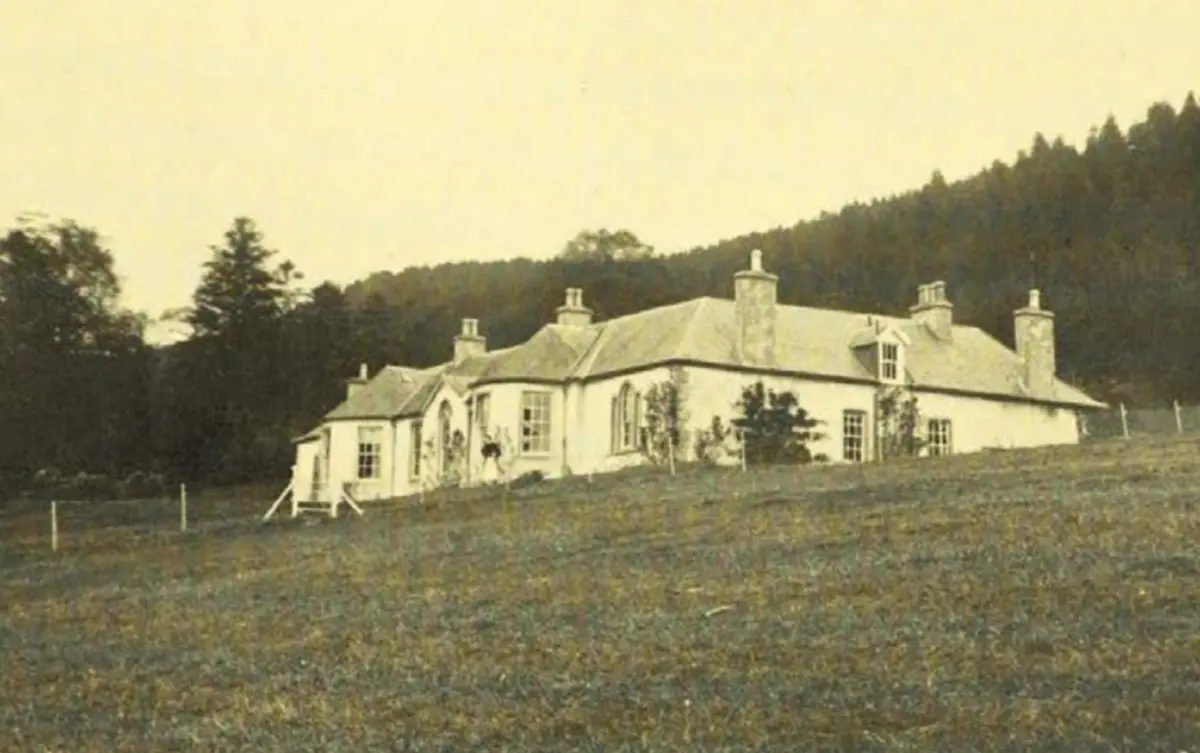
On the south-eastern shore of Loch Ness, above Foyers, stands a low pink-harled house built for Archibald Campbell Fraser of Lovat, whose father, the 11th Lord Lovat, was beheaded for treason in 1747.
Where is Boleskine House?
- Location
- Highland, Scotland, United Kingdom
- Type
- House / mansion
- Coordinates
- 57.265, -4.475
- Last updated
LOCATION
Why is Boleskine House said to be haunted?
It is famous because of the man who bought it in 1899: Aleister Crowley, who paid twice its value to obtain the seclusion the Operation of Abramelin demands, built the terrace and lodge the rite prescribes, and then, by his own account, postponed the working when the Golden Dawn split and never performed it there at all. He owned the house until 1913, styled himself Lord Boleskine, and left behind a claim that the ritual had let something loose. Jimmy Page bought it in the early 1970s for the Crowley connection and, according to the caretaker who lived there twenty years, spent no more than six weeks in it. Fires gutted the house on 23 December 2015 and again on 31 July 2019. The Boleskine House Foundation rebuilt it over seven years and opened it to the public on 10 April 2026. The story of a church burned with its congregation inside comes from a 1975 interview with Jimmy Page; the rolling head of Lord Lovat, from Crowley's own Confessions.
What is the history of Boleskine House?
The parish came first, and so did its dead. Boleskine was a church parish from around the thirteenth century, and the old Kirk of Boleskine stood, with its burial ground, on the shelf of land where the house was later built. Bishop Robert Forbes walked up to it after dinner during his 1762 visitation and left the closest description anyone made of it: "the poorest Edifice of any kind I ever looked upon, as is also the Manse. The Church-Yard is quite open, w[i]tout any walls, where you see plenty of human Bones above ground, and (horresco referens!) the Floor of the Kirk is over spread with them." Country people told him that dogs were sometimes seen carrying the bones off in their teeth. The kirk was low-walled and "poorly thatched with Heath", its seats cut from crooked wood, and its incumbent, Thomas Fraser, was ninety years old and blind.
That kirk was never destroyed. Under the ministry of Patrick Grant (1770-1800) church and manse were moved from Boleskine up to Drumtemple, where the parish church still stands; the New Statistical Account dates the surviving building to 1777. The old ground was left to the graves.
The house went up while the kirk was being abandoned. Archibald Campbell Fraser of Lovat (1736-1815) - British consul in Tripoli and Algiers, later MP for Inverness-shire, and second son of Simon Fraser, 11th Lord Lovat, beheaded for treason in London in 1747 - commissioned it as a hunting lodge in the late eighteenth century; the Boleskine House Foundation, which now owns the estate and has reconstructed its title history, dates completion to 1809. The Historic Environment Scotland listing (LB1849, category B since 5 October 1971) describes a building "begun late 18th century and continuously enlarged until circa 1830": a single-storey, irregular seven-bay house, pink harled, with bowed bays and Venetian windows turned towards the loch. The estate stayed with the Frasers until 1894.
In 1899 Aleister Crowley bought it; he was twenty-three, newly rich from an inheritance, and he wanted one specific thing from a house. The Operation of the Sacred Magic of Abramelin the Mage, from a manuscript S. L. MacGregor Mathers had found in the Bibliotheque de l'Arsenal in Paris and translated, requires a secluded property with a room whose door opens north onto a terrace of fine river sand, ending in a "lodge" where spirits may gather; the aspirant then undertakes months of purification aimed at the Knowledge and Conversation of his Holy Guardian Angel, and only afterwards at commanding spirits. The Boleskine House Foundation's history page calls it "this austere rite", a set of practices "involving devotion and prayer as a method to speak directly with God", and sets it against "popular opinion believing it was a black magic ceremony".
Crowley's own account is blunt about the purchase: "Not [till] the end of August 1899 did I find an estate which suited me. This was the manor of Boleskine and Abertarff, on the south-east side of Loch Ness... By paying twice as much as it was worth, I got it." He paid GBP 2,000, and the seller was Mary Rose Hill Burton (1859-1900), the Edinburgh painter who had campaigned, and lost, against the British Aluminium works opened at the Falls of Foyers four years earlier. He set apart the south-western half of the house, made his door, built the terrace and the lodge, and lined an oratory with mirrors brought from London.
He never performed the Operation there; through the winter of 1899-1900 he prepared - and recorded the disturbances he blamed on the work: a lodgekeeper who had been a total abstainer for twenty years drank for three days and tried to kill his family; a helper fled to London; while he inked talismans in the sunniest room he needed lamps at midday, "a darkness which might almost be felt", and "the lodge and terrace, moreover, soon became peopled with shadowy shapes". Then the Golden Dawn tore itself apart. Mathers wrote to Florence Farr on 16 February 1900 accusing a co-founder of forging the order's correspondence with its Secret Chiefs; Crowley offered Mathers himself and his fortune, and entered in his ritual book: "Therefore do I again postpone the Operation of Abra-Melin the Mage." He went to Paris, then to London as Mathers's envoy in April 1900, and in late June sailed for New York. "There was no point in my going back to Boleskine till the following Easter." He finally completed the Operation in 1906, on the road in Asia and then in Surrey, using an astral copy of the Boleskine temple.
He kept the house long after he stopped living in it. He fished, skied the moors behind Strath Errick, kept bloodhounds, and in about 1904 nailed up a signboard in a field across the road reading "This way to the Kooloomooloomavlock (does not bite)" - an invented animal that, he claimed with satisfaction, "created the greatest terror in the neighbourhood". Correspondents were still addressing him as "Lord Boleskine" in 1905. The BBC and The Observer date his ownership 1899-1913; the Foundation's title research says financial trouble forced him to sell "by 1918".
The estate then passed through Dorothy Priestly, Foyers Hotels Ltd (1944), D. S. C. Simpson (1946), J. R. R. Fullerton (1947), Mary Verite Grant (1960) and the conman Dennis Lorraine (1963), who ran a pig farm there as cover for the Cadco fraud; Halbert Kerr kept it as a guesthouse from 1967 to 1971. Then Jimmy Page bought it - in 1971 according to the Foundation, in 1970 according to most published accounts - and sent up a boyhood friend, Malcolm Dent, to run it. Dent found "a wreck... more or less abandoned. There'd been at least one fire there". He raised his children in the house and stayed roughly twenty years; Page, he said, spent no more than six weeks there in the whole period. Page sold to Ronald and Annette MacGillivray in 1992; in 2002 the house went to Dutch owners, Teunis Griffioen and Gertruida Bakker.
Fire took it twice: on 23 December 2015 the alarm was raised at 13:40 and crews from Foyers, Inverness, Beauly and Dingwall fought a blaze the Scottish Fire and Rescue Service said had destroyed a large part of the property; flames were visible from across the loch. The ruin was put on the market in April 2019 and sold that July. On Wednesday 31 July 2019, shortly before 16:00, a second fire ripped through what was left; the BBC has since reported it is thought to have been started deliberately. The buyers formed the Boleskine House Foundation, a Scottish charity led by Keith and Kyra Readdy, and spent seven years and thirty volunteers rebuilding from what Readdy called "burnt timbers collapsed into floors and stone everywhere collapsed into the building". The house received Building Control sign-off in January 2026 and opened to the public on 10-11 April 2026.
Timeline: the documented record of Boleskine House
- 1762 Bishop Robert Forbes visits the Kirk of Boleskine during his episcopal visitation and calls it "the poorest Edifice of any kind I ever looked upon", noting human bones on the church floor and in the unwalled graveyard, and dogs seen carrying them away. The kirk is standing and in use; no fire is mentioned.
- 1770-1800 Under the ministry of Patrick Grant, church and manse are moved from Boleskine to Drumtemple. The Rev. William Fraser's parish account records the replacement church as built in 1777 and in good repair.
- late 18th century - 1809 Archibald Campbell Fraser of Lovat, second son of the executed Simon Fraser, 11th Lord Lovat, commissions Boleskine House as a hunting lodge; the Boleskine House Foundation dates its completion to 1809. Historic Environment Scotland records a house "begun late 18th century and continuously enlarged until circa 1830".
- August 1899 Aleister Crowley buys the manor of Boleskine and Abertarff from the painter Mary Rose Hill Burton for GBP 2,000 - "by paying twice as much as it was worth", he wrote - to house the Operation of Abramelin. He builds the terrace and lodge the rite requires and lines an oratory with mirrors.
- February-June 1900 The Golden Dawn splits. Crowley records "Therefore do I again postpone the Operation of Abra-Melin the Mage", leaves for Paris at Mathers's call, acts as his envoy in London in April and sails for New York in late June. The Operation is never performed at Boleskine; he completes it in 1906, in Asia and Surrey, using an astral copy of the temple.
- 1913 or by 1918 Crowley disposes of Boleskine. The BBC and The Observer give his ownership as 1899-1913; the Foundation's title research says financial trouble forced him to sell "by 1918". He had effectively stopped living there after 1905.
- 5 October 1971 Boleskine House is listed at category B by what is now Historic Environment Scotland (LB1849). The same year, by the Foundation's account, Jimmy Page buys the house and sends his boyhood friend Malcolm Dent to live in it; most published sources date the purchase to 1970.
- 1975 In an interview quoted by The Observer, Page says the house had "two or three owners before Crowley" and that "on the site of the house there was also once a church that burned to the ground with the congregation inside", adding "the bad vibes were already there". This is the earliest datable appearance of the burnt-church story.
- 23 December 2015 Fire. The alarm is raised at 13:40 and crews from Foyers, Inverness, Beauly and Dingwall attend; the Scottish Fire and Rescue Service says a large part of the property has been destroyed. Flames are visible from the far shore of Loch Ness.
- 31 July 2019 A second fire rips through the ruin shortly before 16:00, three months after it was put on the market and in the month it was sold. The BBC later reports the blaze is thought to have been started deliberately. The buyers form the Boleskine House Foundation.
- 10-11 April 2026 After seven years of work by thirty volunteers, and Building Control sign-off in January, Boleskine House opens to the public with a gala evening and an open day. Visits are self-guided; the Foundation describes the house as a community hub for art, culture and education.
Is there a rational explanation for Boleskine House?
Two stories carry the whole legend, and both can be dated.
The first is that a church once burned on the site with its congregation trapped inside. It appears in a 1975 interview with Jimmy Page, quoted by The Observer: "The estate was owned by Aleister Crowley but there were two or three owners before Crowley moved into it. On the site of the house there was also once a church that burned to the ground with the congregation inside." The documentary record says something else. Bishop Forbes found the Kirk of Boleskine standing in 1762, thatched and ruinous but in use; church and manse were moved up to Drumtemple under Patrick Grant (1770-1800); the New Statistical Account of 1845 records the replacement church as built in 1777 and "at present in good repair". No burning, and no congregation.
The second is that the head of Simon Fraser, 11th Lord Lovat, beheaded in London in 1747, can be heard rolling along the floors. Crowley printed it in his Confessions as a scene of stage dialogue offered as a specimen of "the regular Highland superstitions": Fenella tells George that old Lord Lovat, beheaded "after the '45", "rolls his head up and down the corridors". Crowley then adds, in his own voice, that he "certainly used to hear the 'rolling of the head', but when I put in a billiard table, the old gentleman preferred it to the corridor and confined his amusements to the gunroom." Page told Rolling Stone in 1975, as Classic Rock quoted him in January 2026: "A man was beheaded there and sometimes you can hear his head rolling down. I haven't actually heard it, but a friend of mine, who is extremely straight and doesn't know anything about anything like that at all, heard it." The Inverness Courier, reporting the story in 2006, noted the flaw itself: the beheading happened in 1747, and the house dates only from the 1760s. Lovat was executed on Tower Hill, about 700 km away, and the man who built the house was his son.
That leaves Crowley's own framing claim: "Boleskine was already the centre of a thousand legends. Even before I came there there was a fine crop of the regular Highland superstitions." It does not survive a check against the local record. The minister of the parish, the Rev. William Fraser, wrote the New Statistical Account entry for Boleskine and Abertarff in the 1830s; under "Antiquities" he lists druidical circles, a cairn on Suidh-Chuiman and an ancient yew, and under "Modern Buildings" he says flatly that "the only buildings in the parish meriting the slightest notice are those of the garrison of Fort-Augustus." Boleskine House is not mentioned at all, haunted or otherwise. Charles Fraser-Mackintosh, the leading Inverness-shire antiquary, devoted a chapter of his Antiquarian Notes (second series, 1897) to this exact parish, and records nothing supernatural about the house. Neither man was squeamish about the subject: in the Internet Archive's text of the same volume of the Statistical Account, "superstition" or "superstitions" appears 23 times, "witch" or "witchcraft" six and "ghost" or "ghosts" three, and its Boleskine entry carries a footnote on a local charmer said to steal his neighbours' milk; Fraser-Mackintosh happily reports that the Macqueens of Corrybrough "were supposed to be on familiar terms and intimate with witches and fairies". They wrote about ghosts where they found them. They found none here.
Crowley's account comes from a book he himself subtitled an autohagiography. The claim that the working left something behind is his own: "During my absence, the reputation of the house had become more formidable than ever before. I have little doubt that the Abra-Melin devils, whatever they are, used the place as convenient headquarters." Whether anything was raised depends on accepting that the ritual was performed there at all, and by his own record it was not.
The Page years produced the best-known modern anecdote and also its solution, from the same man. Malcolm Dent, the caretaker, described himself as arriving "a total sceptic, to a degree I still am, but there are things at the house you can't explain". He told the Inverness Courier that seven chairs from the Cafe Royal, each with a nameplate - Crowley, Marie Lloyd, Billy Butlin, Rudolph Valentino, Jacob Epstein and others - kept changing places at the table after being repaired, until he worked out why: "the guy who did the repairs didn't know which plaque went with which chair and hadn't put them back on the right ones." He also reported slamming doors and rugs piled up during building work, and the stream of visitors he called "downright dangerous lunatics", drawn by the house's occult fame.
The honest version is that the darkest thing documented at Boleskine before Crowley is not supernatural at all. It is Bishop Forbes in 1762, appalled at a floor of human bones and dogs at work in an unwalled graveyard.
Can you visit Boleskine House?
Boleskine House opened to the public over the weekend of 10 and 11 April 2026, after almost seven years of restoration by the Boleskine House Foundation; the Inverness Courier counted more than six hundred visitors across those two days. Before that it had been a private home and then a ruin; the BBC reported fires at the house in 2015 and in 2019.
The address is Boleskine House, General Wade's Military Road, Inverness-shire IV2 6XT, on the south-eastern shore of Loch Ness above Foyers. The map point for this entry is 57.2653, -4.4747. The house is a category B listed building, LB1849 on the Historic Environment Scotland designation list, added on 5 October 1971. The record describes it as begun in the late eighteenth century and enlarged until about 1830. Parking on site is free and includes EV charging, with overflow space for coaches; the Highland Council local bus stops at the gates.
The standard visit is self-guided, through the restored period rooms and the 35 acres of ground that the Foundation has replanted with native wildflower meadow and hedgerow. The Foundation's Visit page gives tours daily from 09:30 to 18:00 with last entry at 15:00 and everyone off the grounds by 18:00, and states that opening days and times vary seasonally, with the calendar on the same page. Prices inclusive of VAT, as listed on 11 September 2026: adult 12.50 pounds; child aged 6 to 15, 6.50 pounds; concession for over-65s, military and students, 10.00 pounds; carers and tour guides free. The enquiry numbers are +44 7727 491016 and +44 1463 593380.
The filming rule is stricter than the photography rule. Personal photography is allowed on a paid visit, and the Foundation states that this "does not include the use of tripods, lighting, microphones, presenter-led filming, drones, filming other visitors or staff, or any commercial, monetised, promotional or organised shoot"; professional and commercial projects "must be approved in advance and will usually be subject to a location fee".
The old Boleskine burial ground lies immediately beside the house and is still a burial ground. Bishop Robert Forbes recorded the Kirk of Boleskine there on his visitation of 1762, a generation before the present house was finished. The Foundation holds the property as a charity staffed in large part by volunteers, and describes it as a community hub for art, culture and education.
Sources consulted
- Aleister Crowley (ed. John Symonds and Kenneth Grant), «The Confessions of Aleister Crowley: An Autohagiography» — Arkana / Penguin, 1989 book
- Robert Forbes (ed. J. B. Craven), «Journals of the Episcopal Visitations of the Right Rev. Robert Forbes, 1762 and 1770 (First Journal: the Kirk of Boleskin)» — Scottish History / Craven edition, 1886 book
- Charles Fraser-Mackintosh, «Antiquarian Notes, Historical, Genealogical and Social (second series): Inverness-shire, Parish by Parish - Parish of Boleskine and Abertarff» — A. & W. Mackenzie, Inverness, 1897 book
- Historic Environment Scotland, «Boleskine House, listed building record LB1849 (category B, listed 5 October 1971)» — HES Designations Portal, 1971 report
- Boleskine House Foundation SCIO, «Boleskine Estate's Story (ownership history of the estate)» — boleskinehouse.org, 2026 archive
- BBC News, «Firefighters called to historic Boleskine House on Loch Ness» — BBC News, Highlands & Islands, 2015 newspaper archive
- BBC News, «Boleskine House: New fire rips through Aleister Crowley's former home» — BBC News, Highlands & Islands, 2019 newspaper archive
- Benjamin Russell and Finlay Maclennan, «Boleskine House opens after seven-year renovation» — BBC News, 2026 newspaper archive
- C. Macleod, «A rock legend and black arts figured in Malcolm's life (interview with caretaker Malcolm Dent)» — The Inverness Courier, 3 November 2006, 2006 interview
- Paul Kelbie, «For sale on Loch Ness: Aleister Crowley's centre of dark sorcery» — The Observer, 19 April 2009, 2009 newspaper archive
- Rev. William Fraser, «United Parishes of Boleskine and Abertarff» — The New Statistical Account of Scotland, vol. XIV (Inverness-shire), 1845 book
- Alan Dawson, «An Account of the Kirk of Boleskine (extract), in the South Loch Ness community bulletin» — Boleskine Bulletin, 28 September 2004, 2004 archive
- Boleskine House Foundation SCIO, «Visit: tickets, prices, opening times and filming policy» — boleskinehouse.org, 2026 archive
- Fraser Lewry, «"A man was beheaded there and sometimes you can hear his head rolling down": The historic Loch Ness manor once home to Jimmy Page and Aleister Crowley is opening to the public (quotes Page's 1975 Rolling Stone interview, including "I haven't actually heard it, but a friend of mine ... heard it")» — Classic Rock / Louder, 23 January 2026, 2026 web
Reviewed by V. Serrano on 2026-08-11 · How we verify our content
💬 Field testimonies (0)
No testimonies yet. Add the first.
Add your testimony
🔒 Log in to add a testimony