👻 HAUNTED PLACE · EXP. Nº9477
ACTIVE
Bramshill House
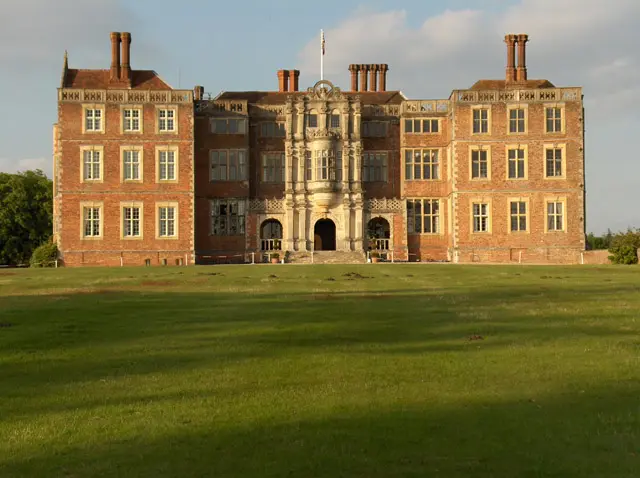
Bramshill House is a vast Jacobean prodigy house in north-east Hampshire, built between 1605 and 1612 for Edward la Zouche, 11th Baron Zouche, and listed Grade I since 1952.
Where is Bramshill House?
- Location
- Hampshire, England, United Kingdom
- Type
- House / mansion
- Coordinates
- 51.331, -0.912
- Last updated
LOCATION
Why is Bramshill House said to be haunted?
Its famous ghost story is the bride who hid in an oak chest on her wedding day and could not lift the lid: a tale Bramshill shares with Marwell Old Hall, Exton Hall, Bawdrip, Malsanger and several houses in Italy, and which Samuel Rogers had already put into verse in 1822 with the warning that "many old houses in England lay claim to it". The Cope family, who owned Bramshill from 1700 to 1935, conceded in print that the chest itself was an Italian coffer bought in Italy by the fifth baronet and brought to Bramshill only around 1800, and that it later left the house altogether. The event that really happened here is stranger: on 24 July 1621, hunting as Lord Zouche's guest, the Archbishop of Canterbury shot and killed a gamekeeper with a crossbow, and spent the rest of his life under a canonical cloud. The house was the national Police Staff College until 2015 and is now closed to the public.
What is the history of Bramshill House?
Bramshill stands on a low ridge in north-east Hampshire, on ground that has carried a great house since the fourteenth century. Thomas Foxley obtained a licence in 1347 to impark 2,500 acres of land and wood at Bramshill and Hazeley, and the Victoria County History has the house he built there between 1351 and 1360; its vaulted cellars survive beneath the present mansion.
The house people photograph today, however, belongs to one man and one decade. In 1605 Edward la Zouche, 11th Baron Zouche, a favourite of James I, bought the estate, demolished most of what stood on it and raised a Jacobean prodigy house: symmetrical elevations facing outwards around a narrow internal court, red brickwork in English bond with stone dressings, and a pierced stone balustrade running round three fronts. The Historic England list entry that made the house Grade I on 8 July 1952 dates the work without hedging — "1605-1612. A great Jacobean palace". Above the entrance porch sits a circle framing the Prince of Wales's feathers and a crown, the residue of a tradition that a house here had been intended for Henry Frederick, Prince of Wales, who died in 1612 at the age of eighteen.
Zouche's park is also the setting of the best-documented event in Bramshill's history, and it has nothing to do with ghosts. In the summer of 1621 Zouche invited his friend George Abbot, Archbishop of Canterbury, to Bramshill; the Victoria County History says Abbot had come down to consecrate a chapel for him and filled his leisure hunting in the park, where crossbows were being used. On 24 July 1621 Abbot loosed a bolt at a buck and hit a gamekeeper, Peter Hawkins, who had already been warned to keep clear of the huntsmen. Hawkins bled to death in under an hour. The coroner's jury returned a verdict of per infortunium suae propriae culpae — misadventure through the dead man's own fault — and James I remarked that none but a fool or a knave would think the worse of a man for such an accident.
England's clergy were less generous. Four bishops-elect were waiting to be consecrated: John Williams for Lincoln, John Davenant for Salisbury, Valentine Cary for Exeter and William Laud for St Davids. In August, Williams announced that he would not take consecration from Abbot, arguing that homicide made a prelate irregular under canon law; Laud sided with him. A royal commission was appointed — it included three of the bishops-elect — and the opinion of the Sorbonne was solicited; its professors, the Dictionary of National Biography records, "thrice discussed the question" and condemned him. The commission split evenly, the king read the result in Abbot's favour, and a formal pardon and dispensation was signed on 24 December 1621. The stain never came out. Abbot settled twenty pounds a year on Hawkins's widow and kept a monthly fast on a Tuesday, the weekday on which the man had died. On 27 June 1630 Laud christened the infant Charles II at St James's, and wrote in his diary why the duty had fallen to him: "my Lord's Grace of Cant. being infirm".
Sir John Cope bought Bramshill from Sir Andrew Henley's creditors for £21,500 in 1700, and his family held the house until 1935. It was a later Sir John Cope who kept the foxhounds that brought the writer Mary Russell Mitford to the park in October 1829 — a visit that turns out to matter for the ghost story. The Duke of Wellington looked the house over after Waterloo and chose Stratfield Saye instead.
The last private owner was Lord Brocket, who sold to the government. On 2 April 1953 the Home Office minister Sir Hugh Lucas-Tooth told the Commons that "the Government has acquired Bramshill House and part of the surrounding park for a permanent home for the Police College", then in temporary accommodation at Ryton-on-Dunsmore. The European Police College, CEPOL, later had its seat at Bramshill under an EU Council decision, alongside the College of Policing. In a written statement to Parliament on 31 March 2014 the policing minister Damian Green said that the Home Secretary had decided in December 2012 to sell the site, which cost £5 million a year to run, that CEPOL's occupation was guaranteed only until September 2014, and that the sale was on schedule to complete by March 2015.
Timeline: the documented record of Bramshill House
- 1347 Thomas Foxley obtains a licence to impark 2,500 acres of land and wood at Bramshill and Hazeley. A house attributed to him is built on the site between 1351 and 1360; its vaulted cellars survive under the present mansion.
- 1605 Edward la Zouche, 11th Baron Zouche, buys the estate and, almost immediately after the purchase, builds the present mansion. Historic England's list entry dates the work '1605-1612'.
- 24 July 1621 Hunting with crossbows as Zouche's guest, George Abbot, Archbishop of Canterbury, shoots at a buck and kills the gamekeeper Peter Hawkins, who bleeds to death in under an hour. The coroner's jury finds misadventure through the dead man's own fault.
- 24 December 1621 After a royal commission splits evenly and the Sorbonne condemns him, James I signs Abbot a formal pardon and dispensation. Three bishops-elect, among them William Laud, still refuse consecration at his hands.
- 1700 Sir John Cope buys Bramshill from Sir Andrew Henley's representatives and creditors for £21,500. His family will hold the house until 1935 and will be the source of almost every ghost story told about it.
- c. 1800 According to Sir William Cope's monograph on the house, as reported by Fitz-Gerald in 1901, the Bramshill chest was an Italian cassone bought in Italy by the fifth baronet and conveyed to Bramshill about the beginning of the nineteenth century. Joan Penelope Cope adds in 1938 that Sir Denzil Cope's widow then took it away from the house altogether; by 1901 a chest claimed as the original was at The Castle, Tiverton.
- 1822 Samuel Rogers publishes 'Ginevra' in his poem Italy, setting the bride-in-the-chest story in Modena, and notes: 'This story is, I believe, founded on fact; though the time and place are uncertain. Many old houses in England lay claim to it.'
- 30 October 1829 In a letter from Three-mile Cross, Mary Russell Mitford describes Bramshill after a day with Sir John Cope's hounds and mentions 'a chest where they say a bride hid herself on her wedding-day' — adding at once that 'this story, by the way, is common to old houses; it was told me of the great house at Malsanger'. It is the oldest dated attachment of the legend to Bramshill in the sources cited here; the letter was first printed in 1870.
- c. 1830 Thomas Haynes Bayly's ballad 'The Mistletoe Bough', set to music by Sir Henry Bishop, appears in the collection Songs of the Season with lines from Rogers's Italy as its motto. It becomes one of the most popular English songs of the century and a Christmas fixture.
- 1834 Charles Somerset stages The Mistletoe Bough; or, the Fatal Chest, a two-act melodrama, at the Garrick Theatre, Whitechapel. In his version the bride is stabbed in the chest by a rejected suitor.
- 1901 S. J. Adair Fitz-Gerald devotes a chapter of Stories of Famous Songs to the ballad and counts the rival claimants: Bramshill, Malsanger, a Hartopp house in Leicestershire, Marwell Old Hall, Exton Hall, Bawdrip, plus Modena and a castello in Florence. He records that 'it is denied that any Miss Cope ever met with such a fate'.
- 1938 Joan Penelope Cope, who grew up in the house and left it at nine, publishes her memoir Bramshill. She writes that the house 'claims' the Mistletoe Bride and that there are 'several versions', and describes instead a woman in pale grey with auburn hair and a scent of lilies whom she distinguishes from the bride. The phrase 'Grey Lady' never appears in the book.
- 8 July 1952 Bramshill House is listed Grade I (National Heritage List for England entry 1340025).
- 2 April 1953 Sir Hugh Lucas-Tooth tells the House of Commons that 'the Government has acquired Bramshill House and part of the surrounding park for a permanent home for the Police College'. The college is then in temporary accommodation at Ryton-on-Dunsmore.
- 16 January 2000 P. Lal publishes 'Playing Host to Many a Ghost' in The Tribune of Chandigarh, where a Chief Superintendent on the college staff gives the figure of fourteen spirits — the same man who had joked to an Indian trainee that "the only spirits at the Police College are those behind the bar". This article is the traceable origin of the 'fourteen ghosts' figure repeated online.
- 31 March 2014 In a written statement to Parliament, the policing minister Damian Green says that the Home Secretary decided in December 2012 to sell Bramshill, which costs the Home Office £5 million a year to run; that CEPOL, the European Police College, is guaranteed occupation only until September 2014; and that the sale is on schedule to complete by March 2015.
- 9 March 2021 The Court of Appeal decides City & Country Bramshill Ltd v Secretary of State for Housing, Communities and Local Government, upholding the refusal of some 235 new houses on the estate as isolated countryside homes harmful to the setting of the Grade I mansion and its registered park.
- 2022 Bramshill House appears as Crunchem Hall in Roald Dahl's Matilda the Musical, after Hart District Council granted temporary consent for the park's use as a filming site.
Is there a rational explanation for Bramshill House?
The bride in the chest is not a Bramshill story. It is a story that Bramshill, along with at least half a dozen other houses, has told about itself.
Its oldest printed form is literary. Samuel Rogers put it into verse as "Ginevra" in his poem Italy, published in parts from 1822, and set it in Modena. His own note is the first piece of evidence against every house that claims it: "This story is, I believe, founded on fact; though the time and place are uncertain. Many old houses in England lay claim to it." Rogers then goes further and confesses that "Ginevra" is one of only two passages in the whole book where he did not follow history or tradition, adding that he pointed the exceptions out "lest the reader should be misled by them".
The oldest dated attachment of the tale to Bramshill in the printed record cited here is a private letter, and it demolishes itself in its own sentence. Writing from Three-mile Cross on Friday 30 October 1829 — the date checks out; 30 October 1829 was a Friday — Mary Russell Mitford described a day with Sir John Cope's hounds in Bramshill Park and then the house: it has "a haunted room, shut up and full of armor; a chest where they say a bride hid herself on her wedding-day, and the spring-lock closing, was lost and perished, and never found until years and years had passed (this story, by the way, is common to old houses; it was told me of the great house at Malsanger)". The earliest witness for the Bramshill claim is also the earliest witness that it is a floating one. The letter was not published until 1870.
What made the tale famous came next: Thomas Haynes Bayly's ballad "The Mistletoe Bough", set to music by Sir Henry Bishop and printed in a collection called Songs of the Season around 1830 — with lines from Rogers's Italy used as its motto. Charles Somerset turned it into a two-act melodrama, The Mistletoe Bough; or, the Fatal Chest, at the Garrick Theatre, Whitechapel, in 1834. After that the song became a Christmas fixture in English homes, and the number of houses with the right chest multiplied.
By 1901, when S. J. Adair Fitz-Gerald tried to sort the claims out in Stories of Famous Songs, he had to deal with Bramshill; Malsanger, near Basingstoke; a Leicestershire house of the Hartopps; Marwell Old Hall near Winchester; Exton Hall in Rutland, where the family version is not hide-and-seek at all but a girl who died playing a corpse in amateur theatricals; and Bawdrip in Somerset, where a monument in the parish church commemorates Eleanor Lovell, who died — Fitz-Gerald transcribed the Latin — almost on her wedding day, and whose surname is also the bridegroom's name in Bayly's song. Add Rogers's Modena and a castello in Florence where "the identical chest" was shown to visitors, and the legend had at least eight simultaneous addresses. Two rival chests were on show in England alone: one at The Castle, Tiverton, and one sold on 10 February 1893 from Baskett's Fletchwood, which a witness said was Spanish mahogany rather than oak.
The Bramshill chest is the weakest link of all, and the evidence against it comes from the family. Sir William Cope, who owned the house and wrote a monograph on it in 1883, held that the chest was an Italian cassone — a bride's trousseau coffer — whose ornament was Italian work, bought in Italy by the fifth baronet, who lived there for many years, and conveyed to Bramshill only around the beginning of the nineteenth century. The chest did not even stay: his descendant Joan Penelope Cope, writing in 1938, records that Sir Denzil Cope's widow took it away to her own family "about a hundred and twenty years ago", and quotes the reply her great-grandfather received when he asked for it back: "My heart is in the right place — it is in my chest." A coffer that only reached Hampshire around 1800 cannot have killed a seventeenth- or eighteenth-century Cope bride at Bramshill, and by 1901 it was being shown at The Castle, Tiverton, in Devon. Fitz-Gerald reported flatly that "it is denied that any Miss Cope ever met with such a fate", and that no reliable data had ever been found.
That 1938 memoir also says something by omission: across 34,631 words, "Bramshill" appears 87 times and the phrase "Grey Lady" not once. The family's own formula is careful: "Bramshill also claims the scene of the famous tragedy of the Mistletoe Bride; and according to several versions of the legend, it was actually an ancestress of ours." Claims, and several versions. What Joan Cope does report first-hand is different: a woman in pale grey with flaming auburn hair and an overpowering scent of lilies, seen by her mother in a bedroom, and a figure watched from the terrace by her great-grandfather and the household. She explicitly separates that figure from the bride. The Long Gallery is mentioned three times in the book and never in connection with a ghost — so the familiar image of a Grey Lady gliding down the Long Gallery is not what the family recorded.
The "fourteen ghosts" that circulate online trace to a single newspaper article: P. Lal, "Playing Host to Many a Ghost", The Tribune of Chandigarh, 16 January 2000. The figure comes from a Chief Superintendent on the college staff, who "volunteered the information that the Bramshill House was haunted by no less than 14 spirits". He is the same man who, at lunch with an Indian trainee in October 1986, had greeted the trainee's account of a floral scent in the chapel drawing room with "The only spirits at the Police College are those behind the bar", and laughed.
Even the true story drifts. Joan Cope's 1938 version of the Abbot killing has the archbishop unable to baptise "the baby Prince of Wales" the next day, and building the Guildford almshouses in repentance. Neither survives a calendar. Charles II was born on 29 May 1630 and christened at St James's on 27 June 1630 by William Laud, nine years after the accident, and Laud's diary gives the reason the archbishop was absent: "my Lord's Grace of Cant. being infirm"; and the first stone of Abbot's Hospital in Guildford was laid on 5 April 1619, two years and three months before Peter Hawkins died. The detail that does survive is smaller and stranger: Abbot's monthly Tuesday fast fits, because 24 July 1621 in the Julian calendar then used in England did fall on a Tuesday.
Can you visit Bramshill House?
Bramshill House is listed building 1340025 on the National Heritage List for England, at Grade I since 8 July 1952, at grid reference SU 75876 59630 in the parish of Bramshill, in the Hart district of Hampshire. The list entry dates it to 1605-1612 and calls it "a great Jacobean palace". Its planning applications give the address as Bramshill House, Bramshill Park, Bramshill, Hook RG27 0JW. The house is private property.
The judgment of the Court of Appeal of 9 March 2021 in City & Country Bramshill Ltd v Secretary of State for Housing, Communities and Local Government describes the site as extending to about 106 hectares between the villages of Hazeley and Eversley. It had been a national and international police training college, and it contains the listed mansion and a Grade I registered park and garden. The developer's appeals had proposed converting the mansion to 16 apartments, to a single dwelling or to offices, and building 235 houses in place of some of the existing buildings. In her decision letter of 31 January 2019 the planning inspector allowed the appeals for a single dwelling and for offices and dismissed the one for the 235 houses, among others. The Court of Appeal dismissed City & Country Bramshill's appeal against that decision.
The conversion to a single dwelling is the one now going through the planning system. The list of recent planning applications on the Bramshill parish council website, read on 24 September 2026, includes applications under permission 23/01905/FUL, for the change of use of the house, the stable block, the Hazeley Lodges and the surrounding land to a single dwelling. Others fall under listed building consent 23/02577/LBC, for the internal and external works to the house. The latest of those, dated 18 May 2026, concerns a record of the stone floors; earlier ones in 2025 and 2026 cover an investigation into cracking, the removal of paint from panelling and the opening up of fireplaces. A separate application of 28 July 2025 sought prior approval to demolish the conference centre and the squash courts.
The house has opened on isolated occasions. Time Out reported on 3 January 2023 that it would be open for one day, Friday 10 February 2023, to members of English Heritage aged over 16 who had booked a slot. The same article named it as the house that stood in for Crunchem Hall in Matilda the Musical, with its south front in the opening sequence and its panelled entrance hall and staircase also on screen.
The mistletoe bough story is not attached to Bramshill alone. S. J. Adair Fitz-Gerald wrote in 1901 that "the same sad circumstance has been associated with at least four other houses", among them Marwell Old Hall near Winchester and a house near Bridgwater in Somerset. In the parish church of Bawdrip, which he placed "about three miles from Bridgwater", he described a monument to Edward Lovell, his wife Eleanor and their two daughters. He transcribed the date of the younger Eleanor's death as "Jun 14 1681" and remarked that "the month Jun. might easily be a mistake for Jan." Joan Penelope Cope's memoir Bramshill (1938), written by a girl who grew up in the house, is digitised in full on the Internet Archive. The Victoria County History of Hampshire covers the house in its account of the parish of Eversley (volume 4, 1911), including the death of the keeper Peter Hawkins, shot by Archbishop George Abbot.
Sources consulted
- Historic England, «Bramshill House, list entry 1340025 (National Heritage List for England)» — National Heritage List for England, 1952 report
- Samuel Rogers, «Italy: A Poem — 'Ginevra' and the author's note to it» — London: T. Cadell and E. Moxon, 1830 book
- A. G. L'Estrange (ed.), «The Life of Mary Russell Mitford, told by herself in letters to her friends, vol. II — letter of Friday 30 October 1829» — New York: Harper & Brothers, 1870 book
- S. J. Adair Fitz-Gerald, «Stories of Famous Songs, chapter V: 'The Mistletoe Bough'» — Philadelphia: J. B. Lippincott Co., 1901 book
- Sidney Lee, «'Abbot, George (1562-1633)', Dictionary of National Biography, vol. 1» — London: Smith, Elder & Co., 1885 book
- William Page (ed.), «'Parishes: Eversley' (with Bramshill), A History of the County of Hampshire, vol. 4, pp. 32-41» — Victoria County History, 1911 book
- Joan Penelope Cope, «Bramshill: being the memoirs of Joan Penelope Cope» — London: Constable, 1938 book
- P. Lal, «Playing Host to Many a Ghost» — The Tribune (Chandigarh), 2000 newspaper archive
- Sir Hugh Lucas-Tooth, «College (Permanent Site), HC Deb 2 April 1953» — Parliamentary Debates (Hansard), House of Commons, 1953 archive
- Court of Appeal (Civil Division), «City & Country Bramshill Ltd v Secretary of State for Housing, Communities and Local Government [2021] EWCA Civ 320» — The National Archives, Find Case Law, 2021 report
- City & Country, «Past Projects (site consulted 11 August 2026; no mention of Bramshill in 296 sitemap URLs)» — cityandcountry.co.uk, 2026 web
- Phil de Semlyen, «'Matilda the Musical''s Crunchem Hall is a real place – and you can visit it (Bramshill House open to English Heritage members on 10 February 2023)» — Time Out, 2023 newspaper archive
- Bramshill Parish Council, «Recent planning applications in Bramshill parish (conversion of Bramshill House to a single dwelling, 23/01905/FUL and 23/02577/LBC; consulted 24 September 2026)» — bramshill.parish.uk, 2026 web
- William Laud (ed. James Bliss), «The Diary of the Life of William Laud, entry for 27 June 1630 ('I had the honour, as Dean of the chapel, my Lord's Grace of Cant. being infirm, to christen Prince Charles at St. James's'), in The Works of William Laud, vol. III, p. 212» — Oxford: John Henry Parker, Library of Anglo-Catholic Theology, 1853 book
- Damian Green, Minister of State for Policing and Criminal Justice, «Council to relocate the European Police College (written ministerial statement: Bramshill to be sold, decision of December 2012; CEPOL occupation guaranteed until September 2014; sale due by March 2015)» — Home Office, GOV.UK, 2014 report
Reviewed by V. Serrano on 2026-08-11 · How we verify our content
💬 Field testimonies (0)
No testimonies yet. Add the first.
Add your testimony
🔒 Log in to add a testimony