👻 HAUNTED PLACE · EXP. Nº9476
ACTIVE
Chislehurst Caves
Chislehurst Caves are neither caves nor ancient. They are chalk and flint mines under the London Borough of Bromley, and the attraction that runs them sells “over 8,000 years of history” and “over 22 miles” of tunnel.
Where is Chislehurst Caves?
- Location
- London, United Kingdom
- Type
- Mine
- Coordinates
- 51.407, 0.058
- Last updated
LOCATION
Why is Chislehurst Caves said to be haunted?
The measured figures are smaller and far later: the earliest document is a deed of 1737, the mines were worked commercially from 1830 until roof falls closed them around 1860, and Arthur Bonner, who surveyed every yard of them in 1921, reported the passages as about three and a half miles. The Druid altar on the tour route was identified in 1904 as a shelf of chalk left for a miner to stand on, and the well beside it was sunk by a Victorian brick manufacturer about 1864. The ghost is real as a story: guides have been pointing out murder and a haunted pool since the mine opened as a show place in 1900, and the caves still advertise a White Lady there. When fourteen investigators spent the night underground in March 1987 they found nothing paranormal, and natural causes for most of the noises.
What is the history of Chislehurst Caves?
Chislehurst Caves are not caves, and on the evidence that can actually be read they are not very old either. They are chalk and flint mines cut into the hillside above the Kyd Brook, on the edge of what is now the London Borough of Bromley, and they survive as three separate sets of workings that everyone who has studied them calls the outer, middle and inner series.
The documentary trail is thin and late. Arthur Bonner, F.S.A., who had known the place since 1905 and completed a survey of it in 1921, could find no earlier mention than a local deed of 1737 referring to "the chalk cave" at the spot. What he did find was a mine in ordinary commercial life. It was leased in 1830 to a limeburner who sold lime and chalk and supplied gunflints to the Government. By about 1840 five limekilns were in regular use and chalk was also being sold to farmers to sweeten their land. The chalk from the middle and outer series was raised by winch through a shaft in each, and part of the machinery was still standing in the twentieth century; those two series were probably worked out by about 1850. The inner or remote workings had no shaft — the chalk was trolleyed out on the level to the face of the cliff — and ran until 1855-60, when a run of heavy roof falls blocked the headings and the mines were abandoned. The Ordnance Survey 25-inch sheet of 1862-63 records the place simply as a chalk pit, and marks an engine house and two surviving kilns.
Two of the features the modern tour treats as ancient belong to that last industrial phase. The spiral ascent out of the middle series, which ends almost vertically above its start in the garden of a Victorian house called Woodlands, was cut about 1860 by G. H. Baskcomb, a brick and tile manufacturer who owned part of the caves and the land above them and used a stretch of the workings as an underground garden. The shaft shown to visitors as the "Roman" well was made by Baskcomb too, about 1864.
The mine became a show place in 1900. Herbert Ryan, proprietor of the Bickley Arms Hotel, in whose grounds the entrance lay, had galleries cleared of the debris of decades and lit with coloured electric glow-lamps; a guide met visitors at the door, and beyond the reach of the lamps the party went on by candle. The attraction's own information page still states, without embarrassment, what the guides told the Victorians from the start: "the guides told the Victorians history of Romans, Druids and Saxons, Smuggling and Murder". The ghost story and the antiquity were part of the offer before either was investigated.
In 1903 W. J. Nichols, a vice-president of the British Archaeological Association who lived in Chislehurst, read a paper on the workings to the Association's Sheffield Congress on 10 August. He described chambers with "altar-tables" cut in the chalk, "within a point or two of true orientation", and an adjoining chamber "apparently intended for the officiating priest"; he wrote that "a hundred indications suggest that it was a subterranean 'Stonehenge'", and reasoned outward from there to Druids, then Romans, then Saxons, each adding galleries to the last. The three sections of the caves still carry those names and the tour still stops at a Druid Altar. Nichols also recorded, in the same paper and without seeing the contradiction, heaps of flint chips with "the piece of rock on which the worker sat — just as they were left more than one hundred years ago", and among the flakes "four or five gun and pistol-flints ready for use".
The reply came within six months. On 17 February 1904 the brothers T. E. and R. H. Forster read a paper to the same Association based on a proper mining survey. "That the caves have been a chalk mine, or rather a series of chalk mines, we have no doubt whatever," they wrote; the workings on their plan covered "an area of less than twenty acres". The middle series resembled old High Main coal workings near Newcastle so closely that they suspected an expert Tyneside pitman had managed it, and those workings were reckoned about two hundred years old. They explained the altar tables in one sentence: they are "evidently portions of the 'bottom canch' which have been left for the miner to stand on" while he worked the upper chalk. The beehive "altar recesses" come in pairs at right angles because that is how a miner opens a fresh pillar, and their domed ends follow the curve of a pick stroke. The well, they thought, was probably a "staple" — a subsidiary shaft sunk to prove the depth and quality of the chalk below — first used as a well when Baskcomb made his underground garden.
The argument reached The Times in March 1937, after Sir Arthur Keith wrote that "the evidence of prehistoric toil at Chislehurst is much greater than that to be seen at Avebury" and asked for information. Bonner answered on 12 March with the documentary sequence above and one detail nobody had published: in 1921 he had taken two of His Majesty's Inspectors of Mines round the workings, unofficially, and they dated them by the methods they promptly identified as nineteenth century, with features introduced in 1830 and later, "and they were amused at the idea of antiquity for them". The so-called deer-horn pick marks, Bonner added, "are fanciful".
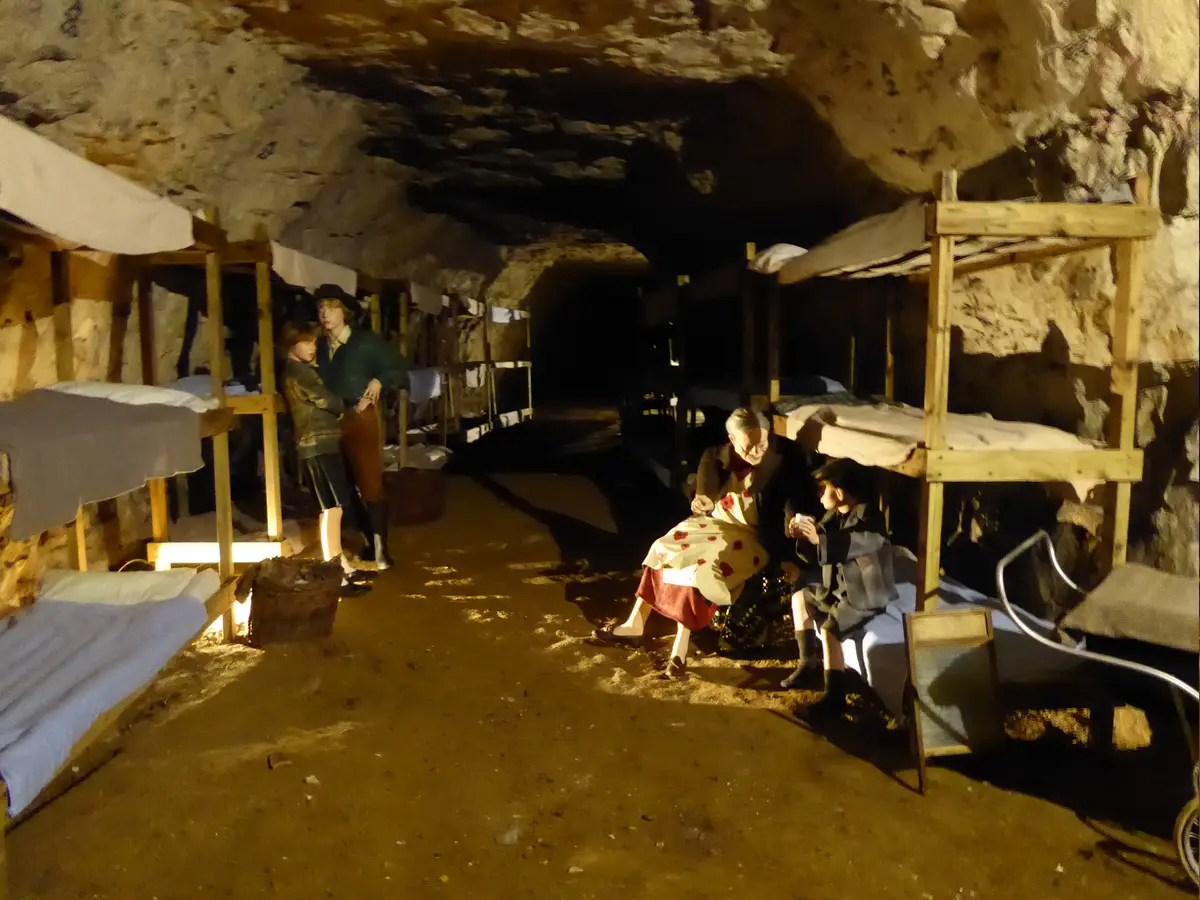
The twentieth century then gave the mine the history it actually has. In the First World War the tunnels held ammunition for the Royal Arsenal at Woolwich; in the 1930s they grew mushrooms, and Kent Mushrooms Ltd cut a new entrance tunnel through the falls of 1855-60. When the bombing of London began in September 1940 it was the mushroom growers who organised the caves as a shelter, and a nightly population of around 5,000 built something close to a town. Every fifty or so shelterers elected a shelter captain to enforce the rules; a sanitation squad emptying the chemical closets was paid one shilling and sixpence an hour and was helped, on occasion, by small ponies. The charge was a penny an adult, and a pitch was allotted like a market stall: you cleaned it, and you lost it if you left it empty four days running. In October 1940 the Rector of the parish appealed for volunteers — "Helpers are wanted for the canteen, where about 1,000 cups of tea are made each night" — while the police were chiefly worried about communist leaflets. Special trains brought families from central London, and stations sometimes had to post "Caves Full" signs. At the height of the raids a peak of 15,000 was reported, mostly women and children. There were toilets, washrooms, a hospital of seven wards including two isolation wards, a chapel, canteens, a barber's shop, a gymnasium and a dance floor; the nickname was "The Chislehurst Hotel".
On 1 January 1941 the European edition of the New York Herald Tribune carried a dispatch from a reporter who had gone down a cave shelter on New Year's Eve: "Ten thousand people, I was told by a shelter warden, were greeting the New Year in this one labyrinthine cave, 100 feet under the ground." A baby girl was christened in the cave chapel in 1941 with the name Cavena Wakeman, and changed her first name to Rose at eighteen, keeping Cavena as a middle name. The other side of the ledger is in a Medical Officer's report of 1944, which recorded the deaths of three babies from gastro-enteritis, put the shelter population at between eight and fourteen thousand, over half of them from London, and suggested closing the place temporarily until it could be improved. The shelter shut shortly after VE Day.
After the war the mine reopened as an attraction and, through the late 1950s and 1960s, worked as a skiffle and rock venue: Subterranea Britannica's site report names Jimi Hendrix, the Rolling Stones, Pink Floyd and David Bowie among those who played underground. The BBC filmed Doctor Who there in 1972. None of that needs a Druid.
Timeline: the documented record of Chislehurst Caves
- 1737 The earliest document Arthur Bonner could find on the site: a local deed referring to "the chalk cave" at this spot. Everything the attraction claims before this date is unsupported by any paper he or anyone since has produced.
- 1830 The caves are leased to a limeburner who sells lime and chalk and supplies gunflints to the Government. By about 1840 five limekilns are in regular use.
- 1855-60 A run of heavy roof falls blocks the headings in the inner workings and the mines are given up. The middle and outer series had probably been worked out by about 1850.
- 1862-63 The Ordnance Survey 25-inch sheet records the place as a chalk pit and marks an engine house and two remaining kilns — the mine still legible as a mine on the map.
- c. 1864 G. H. Baskcomb, a brick and tile manufacturer who owns part of the workings and the land above, sinks the shaft that visitors are shown as the "Roman" well. Around 1860 he had also cut the spiral drift up to his garden.
- 1900 The mine opens to the public as a show place. The attraction's own information page still records the patter: the guides told the Victorians a history of Romans, Druids and Saxons, smuggling and murder.
- 10 August 1903 W. J. Nichols, vice-president of the British Archaeological Association, reads his paper at the Sheffield Congress, describes chalk "altar-tables" and a "subterranean Stonehenge", and assigns the three sections to Druids, Romans and Saxons. The names have stuck for over a century.
- 17 February 1904 T. E. and R. H. Forster answer with a mining survey: less than twenty acres of workings, resembling High Main coal workings near Newcastle then thought about two hundred years old, and the altar tables identified as portions of the "bottom canch" left for the miner to stand on.
- 1921 Bonner completes his survey and privately takes two of His Majesty's Inspectors of Mines round the workings; they date them as nineteenth century, with features introduced in 1830 and later, and are "amused at the idea of antiquity for them".
- 12 March 1937 Bonner's letter in The Times answers Sir Arthur Keith, who had compared the site's "prehistoric toil" to Avebury. It gives the measured length of the passages as about three and a half miles and calls the deer-horn pick marks "fanciful".
- September 1940 With the bombing of London under way, the mushroom growers organise the mine as an air-raid shelter. A nightly population of around 5,000 elects shelter captains, pays a penny a head and is served by a sanitation squad on one shilling and sixpence an hour.
- 1 January 1941 The European edition of the New York Herald Tribune prints an eyewitness account of New Year's Eve in a cave shelter: "Ten thousand people, I was told by a shelter warden, were greeting the New Year in this one labyrinthine cave, 100 feet under the ground." The reporter names only "a suburban community not far from London"; the identification as Chislehurst is the Wartime Heritage Association's.
- 1944 A Medical Officer's report records the deaths of three babies from gastro-enteritis, puts the shelter population at between eight and fourteen thousand — over half of them from London — and suggests closing the caves temporarily until they can be improved.
- 1960s The disused mine works as a music venue; Subterranea Britannica's site report names Jimi Hendrix, the Rolling Stones, Pink Floyd and David Bowie among those who played underground.
- c. 1985 Two years before the ASSAP vigil, two tour guides take the caves' overnight challenge; one of them later describes a frightening experience. The challenge was withdrawn on safety grounds and no contemporary record of the night has been located.
- 14 March 1987 Fourteen ASSAP members spend the night underground with infra-red video, an EEG, geiger counters and EVP equipment. Nothing obviously paranormal is recorded; natural explanations are found for most of the sounds, and the caves prove so humid that people end up with wet clothes without going near water.
- 18 September 2024 The date of modification printed on the attraction's history page, the one that offers "over 8,000 years of history" and "over 22 miles" of passage. Its ghost-tour page, modified 7 May 2026, repeats both figures.
Is there a rational explanation for Chislehurst Caves?
Start with the two numbers on the ticket. The attraction's own history page, which carries a modification date of 18 September 2024, offers "over 8,000 years of history" and tunnels that "stretch for over 22 miles"; its ghost-tour page, modified 7 May 2026, repeats that the network "dates back over 8,000 years". Both figures fail on their own terms.
Eight thousand years takes you to about 6000 BC. English Heritage dates the British Neolithic to about 4000-2300 BC and says farming reached Britain around 4100 BC; the great flint mine at Grime's Graves was begun about 2600 BC. A flint mine 8,000 years old would predate farming in Britain by two millennia and the largest Neolithic flint mine in the country by three and a half. No document, no survey and no excavation supports it. The earliest paper on the caves that argued for antiquity, Nichols's of 1903, only claimed the Iron Age.
Twenty-two miles is not attached to any published survey either. Wikipedia and Subterranea Britannica both carry it (as 35.4 km), and Wikipedia's citation for it is a hobby website that has been dead since about 2015. The measurements that do exist are much smaller. The Forsters' 1904 plan covered "less than twenty acres". Bonner and his colleagues, who in 1921 "measured every yard and crawled over or along the heaps of debris in choky passages", reported that "the length of the passages in Chislehurst caves has been greatly exaggerated. The actual length is about 3 1/2 miles", with perhaps another mile and a half if the fully choked passages are counted to the nearest property line; the journal's editor added that after Kent Mushrooms cut its new tunnel, "a liberal estimate of total lengths is now a possible six miles". The lamp-lit tour itself covers about one mile.
The Druid altar and the well have documented, unromantic explanations, published in 1904 and 1937 respectively and never rebutted: a shelf of chalk left as a step for the miner, and a Victorian brick manufacturer's shaft of about 1864.
That leaves the ghost. The story now sold is a White Lady in the haunted pool chamber, and the version in print — in Neil Arnold's Haunted Bromley (The History Press, 2013) — is that around two centuries ago a woman was murdered there by her husband and her body thrown into the water weighted with stones. No inquest, burial, newspaper report or police record has been produced for that murder by anyone who tells it, and I could not find one. What can be dated is the telling: the caves' own information page says that when the mine opened as a show place in 1900 the guides gave the Victorians "Smuggling and Murder" along with the Romans, Druids and Saxons. The murder is as old as the ticket office, not as old as the mine.
The best single test of the site was made by people who wanted a result. On 14 March 1987 fourteen members of ASSAP, organised by Clive Seymour after months of historical and folklore research, went down at 4pm and did not come out until about 7am, with an infra-red video camera, an EEG, geiger counters and EVP equipment. Nothing obviously paranormal happened. Odd sounds were reported — a dog barking near the wartime hospital, a child crying, footsteps — and natural explanations were found for most of them; many hours of tape yielded nothing. Two details from that night are worth more than the vigil itself. The caves were cold and so humid that people ended up with wet clothes without going near any water, which is a plain mechanism for the clamminess visitors describe at the pool. And Maurice Townsend, writing the case up for ASSAP, recorded that years later a trainee told a man who had actually been there that the ASSAP investigation had witnessed amazing activity: the null result had turned, through friends of friends, into its opposite.
The commercial incentive is not a suspicion here, it is published. Admission was £6 for an adult in 2014; it is £10 in 2026, with a Twilight Terror Tour, a 90-minute Midnight Mystery Experience for over-16s and a family ghost tour on the menu. The same page that promises "genuinely unexplained phenomena documented over centuries" also explains the method: each guide "has mastered the art of storytelling", "knowing exactly when to shine the lantern and when to let darkness heighten your imagination", in a mine with no artificial lighting, a constant temperature Nichols measured at about 50 degrees Fahrenheit, and parties of up to forty people. That is a well-built theatre, and the attraction says so itself.
It is also worth noting where the site is more honest than its own marketing: the information page frames Romans, Druids, Saxons and murder as what guides told Victorians, while the history page sells them as events. The contradiction is on the same website.
Can you visit Chislehurst Caves?
Chislehurst Caves is run as a visitor attraction by a private company (company number 00274302, registered at Old Hill, Chislehurst). The entrance is in Caveside Close, off Old Hill, near the Bickley Arms public house; the operator gives BR7 5QX as the postcode for sat-nav and BR7 5NL as its postal address, and its telephone number is 020 8467 3264. The site lies in the London Borough of Bromley, about 16.9 km (10.5 miles) south-east of Charing Cross in a straight line. The operator's road directions leave the A222 at the railway bridge by Chislehurst station, follow Station Approach to its end and turn right twice into Caveside Close. Chislehurst station is a short walk away, with trains from London Bridge and Charing Cross; the operator puts the journey from London Bridge at 30 minutes on its visiting page and at 25 minutes on its ghost-tour page. Bus routes 269 and 162 serve the station.
Entry is by lamp-lit guided tour only, and the operator's reason is that the passages form "a labyrinth of dark mysterious passageways which you would be unlikely to find your way through unaided". The details below were read on the operator's website on 24 September 2026. Tours leave on the hour, last 45 to 50 minutes and are capped at 40 people at busy times. The visiting page, dated 24 June 2026, gives opening from Wednesday to Sunday, on bank holidays other than Christmas and New Year, and every day in local school holidays, with the first tour at 10am and the last at 4pm; the ghost-tour page, dated 7 May 2026, still gives the last tour as 3pm. Tickets are sold at the ticket office on arrival for the next tour with space, and the operator asks visitors to be there 10 to 15 minutes before it starts. The ticket office and the café open from 9am to 4pm and the gift shop from 9am to 4.30pm. Large groups are asked to book, and a booked group has a guide to itself.
Prices on the same date were £10 for an adult (16 to 63) and £8 for a senior (64 and over) or a child (3 to 15), with under-3s free on public tours; the operator states that it does not offer "any further discounts". A child must be accompanied by someone aged 18 or over.
The floor is natural chalk and uneven, "rather like cobbles" in the operator's words. Pushchairs and wheelchairs are allowed in, with the warning that it "can be quite hard work" and that someone in the party will also have to carry a lantern; guide dogs are permitted. The entrance building has toilets, among them an accessible toilet with baby change. Car and coach parking are free, and food eaten on the site has to be bought from the café. On the temperature, the operator says only that in summer the caves are "much cooler than outdoors"; W. J. Nichols recorded in 1903 that it was "about 50 deg. Fahrenheit throughout the year", which is 10°C.
The ghost-tour page lists evening tours on Friday and Saturday nights, with booking required: the 45-minute Twilight Terror Tour for ages 8 and up and the 90-minute Midnight Mystery Experience for 16 and up, beside a 30-minute family tour. The old challenge of spending a night in the caves for a reward is no longer offered. ASSAP's account of its 1987 vigil, published in 2021, says it "has long since been stopped on safety grounds", and a 2013 review of Neil Arnold's Haunted Bromley gives the reward as £5 and the reason as health and safety.
Sources consulted
- W. J. Nichols, «The Chislehurst Caves and Dene-holes» — Journal of the British Archaeological Association, new series IX(3), pp. 147-160, 1903 academic
- T. E. Forster and R. H. Forster, «The Chislehurst Caves» — Journal of the British Archaeological Association, new series X, pp. 88-102, 1904 academic
- Arthur Bonner, «The Chislehurst Cave Myth (letter to The Times, 12 March 1937)» — Yorkshire Ramblers' Club Journal 7(23), pp. 32-34, 1938 academic
- Chris Rayner, «Chislehurst Caves (site report)» — Subterranea Britannica, 2009 report
- Unsigned dispatch, «1941: Ringing In the New Year, Underground» — New York Herald Tribune, European edition, 1 January 1941, reproduced by the Wartime Heritage Association, 1941 newspaper archive
- Maurice Townsend, «Chislehurst Caves investigation (ASSAP vigil of 14 March 1987)» — Association for the Scientific Study of Anomalous Phenomena, 2021 report
- Lucya Starza, «Review: Haunted Bromley, by Neil Arnold (The History Press, 2013)» — A Bad Witch's Blog, 15 October 2013, 2013 web
- Chislehurst Caves, «Chislehurst Caves History (official site, page modified 18 September 2024)» — chislehurst-caves.co.uk, 2024 web
- Chislehurst Caves, «Spooky Tours Near London (official site, page modified 7 May 2026)» — chislehurst-caves.co.uk, 2026 web
- Chislehurst Caves, «Information / Plan Your Visit (opening times, prices and tour details)» — chislehurst-caves.co.uk, 2026 web
- English Heritage, «History of Grime's Graves Prehistoric Flint Mine» — english-heritage.org.uk, 2026 web
Reviewed by V. Serrano on 2026-08-17 · How we verify our content
💬 Field testimonies (0)
No testimonies yet. Add the first.
Add your testimony
🔒 Log in to add a testimony