👻 HAUNTED PLACE · EXP. Nº9476
ACTIVE
Craigdarroch
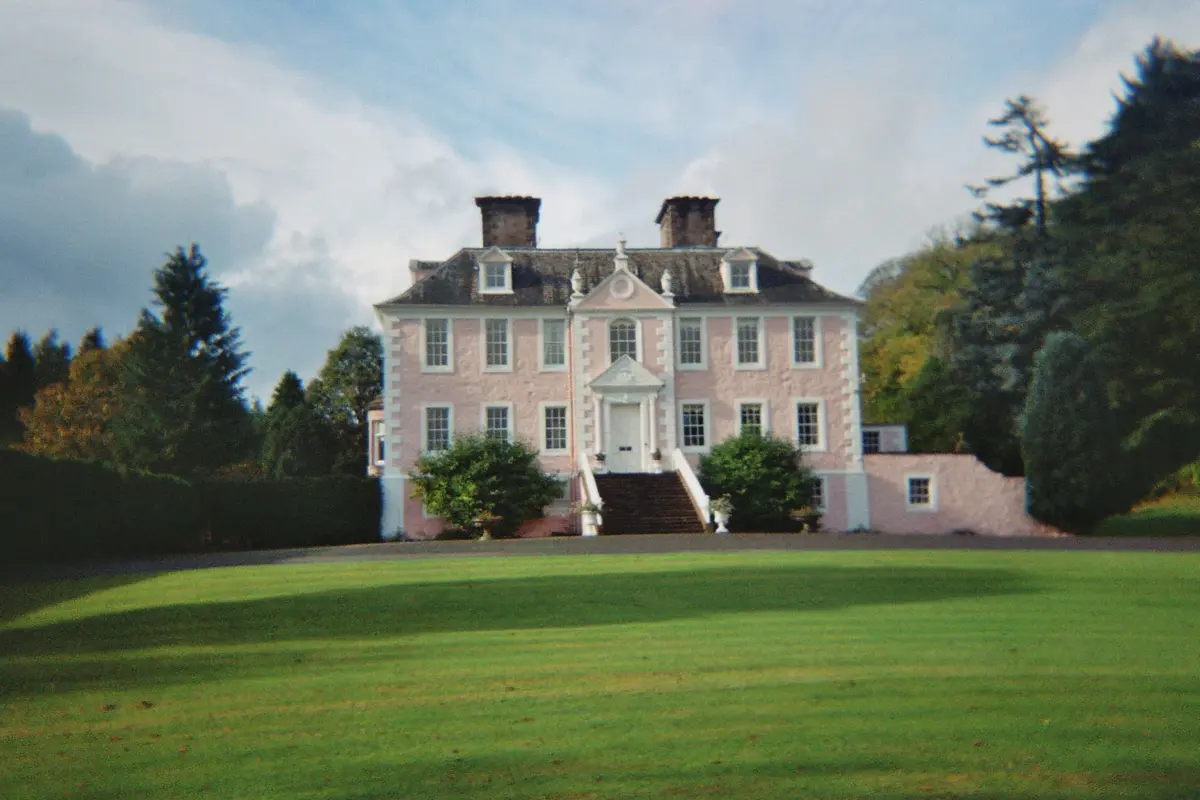
Craigdarroch, two miles west of Moniaive in Dumfriesshire, is a pink classical house built by William Adam in 1729 for Alexander Fergusson and his wife Anna Laurie — the Annie Laurie of the song.
Where is Craigdarroch?
- Location
- Dumfries and Galloway, Scotland, United Kingdom
- Type
- House / mansion
- Coordinates
- 55.196, -3.979
- Last updated
LOCATION
Why is Craigdarroch said to be haunted?
Its ghost story is far younger than the house, and younger still than the death behind it. On 27 July 1689 John Fergusson of Craigdarroch, lieutenant-colonel of Lord Kenmure's regiment, was killed at Killiecrankie fighting on the losing government side. The clan's own Records of 1895 tell what the family remembered: his horse came home without him, and his widow cursed the groom who had fled with it, wishing that he and his descendants might never see a horse again. There is no ghost in that account, none in the 1845 parish account, and none in John Corrie's 1910 annals of Glencairn, which devote a chapter to local superstition and name every haunted spot except this one. The tale of a wife haunting the saddle until a Jesuit laid the ghost in 1920 first appears, without a source, in a Wikipedia edit of 16 June 2006. The house is a Category A listed building and a private home.
What is the history of Craigdarroch?
Craigdarroch stands two miles west of Moniaive, in the parish of Glencairn, where the Craigdarroch Water comes down to join the Dalwhat and the Castlefairn. The Fergussons were there early. Nisbet, writing in the eighteenth century, had seen in the laird's own hands an undated charter from John of Crawford to John Fergusson, dominus de Craigdarroch, whose witnesses — the Stewarts of Dalswinton — place it in the reign of David II; he had also seen a sasine of the last day of April 1484 infefting another John Fergusson as son and heir of Matthew. John Corrie, the parish's annalist, took 1398 as the first authentic date. Carved stones from the old tower were built into the later house: one dated 1609 with the initials T. F. and J. M., another with A. F. and A. L., and the family motto, God send grace.
The man at the centre of the ghost story is real and his death is documented. John Fergusson, laird of Craigdarroch, was — in Corrie's words — "a devoted Presbyterian, and he fell fighting against Claverhouse at the Battle of Killiecrankie in 1689". The battle was fought on 27 July 1689 and the Jacobites won it. Fergusson was on the losing government side: the military historian Stuart Reid identifies him as Lord Kenmure's lieutenant-colonel, and writes that he "was slain and only half of the regiment" survived intact. Kenmure's was one of the newly raised regiments in Hugh Mackay's army, which lost around 2,000 men killed, wounded or missing — up to half its strength — against 600 to 800 Jacobite casualties. The clan's own 1895 Records are not consistent about his name: page 402 calls him John, an earlier page calls the Craigdarroch who fell at Killiecrankie Alexander.
What came home was the saddle. The 1895 Records describe it as "one of the treasured heirlooms of the family, and a curious piece of workmanship it is, full of cunningly contrived pockets and receptacles for various articles required during the campaign". The tradition attached to it, printed there in a footnote, is not a ghost story at all but a curse: "According to tradition the Laird of Craigdarroch lost his life owing to his servant making off with his horse, when the Lowland ranks broke before the fierce rush of Highlanders." The widow "turned on the unfortunate groom and cursed him in the words: 'May you and yours never see a horse again'; and that from that day to this total blindness, or serious defect of eyesight, has affected all his descendants."
The house John Fergusson knew was replaced by his son. Alexander Fergusson, who married Anna Laurie of Maxwelton in 1709 — the Annie Laurie of the song — commissioned William Adam; the present classical mansion is dated 1729, and Historic Environment Scotland records it as built "for Alexander Ferguson of Craigdarroch and Annie Laurie". Her holograph will, leaving everything to her husband and spelling her name Anna, was still kept at Craigdarroch in 1895. Their grandson Alexander won the drinking contest Burns turned into The Whistle; their descendant Robert Cutlar Fergusson became Attorney-General of Bengal and Judge-Advocate-General. The male line ended in 1904, when Robert Cutlar Fergusson died leaving twin daughters, Ella and Esme, born 12 October 1889. Ella married a Cunninghame of Caprington. The house passed out of the family: Clare Dubs bought it in 1923, Robert Sinclair Scott inherited it in 1943, Adam Dalzell bought it in 1957, and it was acquired again in 1962. It remains a private home.
Timeline: the documented record of Craigdarroch
- 30 April 1484 A sasine drawn by the notary Thomas Lockhart infefts John Fergusson as son and heir of Matthew Fergusson of Craigdarroch. Nisbet, who saw the family papers, traced from this John an unbroken descent to Annie Laurie's husband.
- 1609 A marriage stone with the date and the initials T. F. and J. M. is cut for the old tower of Craigdarroch. It survives, with the A. F. and A. L. stone and the arms and motto, built into the fabric of the later house.
- 27 July 1689 John Fergusson of Craigdarroch is killed at the battle of Killiecrankie, on the losing government side. Stuart Reid identifies him as Lord Kenmure's lieutenant-colonel and writes that he "was slain and only half of the regiment" came through. Mackay's army lost around 2,000 men against 600 to 800 Jacobites.
- 1729 The present house, by William Adam, is completed for Alexander Fergusson and Anna Laurie. Historic Environment Scotland's listing gives the date on the building and names both of them as the clients.
- 1808 John Finlay prints, in the preface to his Scottish Historical and Romantic Ballads, the orphan quatrain "Toom hame cam the saddle, / But never cam he", with its weeping mother and weeping wife, and states he knows of no poem it belongs to. The same lines are later attached to Craigdarroch.
- 1845 The New Statistical Account of Scotland for the parish of Glencairn names Craigdarroch House as one of the two chief seats of the parish, alongside Maxwelton. It records the parish antiquities in detail and says nothing whatever about a ghost.
- 1895 The clan's Records print the earliest datable version of the Craigdarroch tradition: the laird died because his servant made off with his horse, the empty saddle came home, and the widow cursed the groom — "May you and yours never see a horse again". The saddle is described as a treasured family heirloom. There is no ghost in it.
- 1904 Robert Cutlar Fergusson dies leaving no male heir, ending the family's tenure. His twin daughters Ella and Esme had been born on 12 October 1889; Corrie, writing in 1910, records Ella as "now of Craigdarroch".
- 1910 John Corrie publishes the annals of the parish, with a section on Customs and Beliefs noting that "many houses, woods, and bridges in the parish were supposed to be haunted". He names none, and the word ghost does not appear once in the book — against some ninety mentions of Craigdarroch.
- 1918 The saddle is said to leave Craigdarroch, where it had been kept at the top of the stairs, for Caprington Castle in Ayrshire. This is the fact that makes the story impossible: if the ghost haunted the saddle, whatever happened in 1920 did not happen here. We have found no source for the move other than the 2006 Wikipedia text.
- 1920 The date given for a Jesuit laying the ghost "with Bell, Book and Candle". A full-text search of Open Library for the phrase "laid by a Jesuit" returns zero hits, repeated; the control phrase "the ghost was laid" returns about 319 in the same corpus. No contemporary record of the event has been found.
- 3 August 1971 Craigdarroch House is listed Category A, reference LB10340. The statutory description is purely architectural: William Adam, dated 1729, chapel by John Starforth of 1889, earlier fabric including a spiral stair. No haunting is mentioned.
- 16 June 2006 The entire ghost passage — servant, saddle, Elizabeth, the Jesuit, Bell Book and Candle, 1920, and Elizabeth Maxwell as the likelier ghost — is added to the English Wikipedia article on Craigdarroch, unsourced, by the editor who had photographed the house in autumn 2005. The article was tagged as needing references in October 2007 and the tag has never been answered.
Is there a rational explanation for Craigdarroch?
The story we ourselves published — a wife haunting a saddle room, a Jesuit exorcism in 1920 "according to estate records" — does not survive contact with the printed record. We can say where every piece of it came from.
There is no ghost in the local sources. The New Statistical Account of Scotland for the parish of Glencairn (1845) lists Craigdarroch House as one of the two chief seats of the parish and says nothing else about it: no ghost, no saddle, no Killiecrankie legend. John Corrie's Glencairn: The Annals of an Inland Parish (1910) devotes a whole section to Customs and Beliefs, and states that "superstition was widespread. Many houses, woods, and bridges in the parish were supposed to be haunted, and very few cared to pass such places alone after nightfall" — and then names none of them. The word ghost does not occur once in Corrie's 256 pages. Craigdarroch occurs about ninety times. That is the control: the book talks about Craigdarroch constantly and about parish hauntings explicitly, and never joins the two.
The 1920 laying leaves no trace in print. A full-text search of Open Library for the phrase "laid by a Jesuit" returns zero results, repeated and with a second variant. The control search in the same corpus, "the ghost was laid", returns about 319. A zero next to a 319 is evidence; on its own it would be nothing.
"Bell, book and candle" is not an exorcism. It is the medieval Latin-Christian formula of excommunication by anathema — bell rung, book closed, candle dashed out — attributed to Pope Zachary in the eighth century, and Brewer's Dictionary of Phrase and Fable has carried it under that meaning for generations. A priest does not lay a ghost with the rite for cutting a living person out of the Church. The phrase is decoration.
The two Elizabeths are a ballad, not two chroniclers. The 1895 clan record attaches to Craigdarroch a scrap of verse — "Toom hame cam' the saddle / But never cam' he". Those lines were printed by John Finlay in 1808, in the preface to his Scottish Historical and Romantic Ballads, as an orphan fragment: "There is another fragment still remaining, which appears to have belonged to a ballad of adventure, perhaps of real history. I am acquainted with no poem of which the lines, as they stand, can be supposed to have formed a part." The full quatrain runs: "Saddled, and briddled, / And booted rade he; / Toom hame cam the saddle, / But never cam he. / Down cam his auld mither, / Greetin fu' sair; / And down cam his bonny wife / Wringin her hair." The fragment is associated with the ballad of Bonnie George Campbell (Child 210). It contains an old mother and a young wife, both weeping — precisely the two candidates the Craigdarroch ghost has never been able to choose between. And the 1895 Records know only one Elizabeth Maxwell: the wife of an Alexander Fergusson of Isle, a cadet branch, around 1659 — not the mother of the laird who died at Killiecrankie.
The story contradicts itself. In the version we copied, the ghost haunts the saddle, and the saddle left Craigdarroch in 1918 for Caprington Castle in Ayrshire. A laying performed in 1920 therefore cannot have happened at Craigdarroch at all. Our own text hid the contradiction by moving the haunting from the object to a "saddle room" that no source mentions.
Where our error came from. The whole passage — servant, saddle, Elizabeth, the Jesuit, Bell, Book and Candle, 1920, and the flourish "There is no doubt about the ghost, and no doubt about the laying of it" — was added to the English Wikipedia article on Craigdarroch on 16 June 2006, by an editor who had photographed the house the previous autumn and who supplied the photograph this page still uses. It carried no source then and carries none now; the article was tagged as needing references in October 2007 and the tag has never been answered. Everything else we printed was added on top by us: the "saddle room", the "estate records", the "formal exorcism", the "other chroniclers", and the closing claim that nothing has been reported since — a negation nobody has ever been in a position to make.
The documented tradition is better than the invented one: an officer killed in a rout, an empty saddle kept at the top of the stairs for two centuries, a widow cursing the groom who ran, and a family that believed for generations it could see the curse working in his descendants' eyes.
Can you visit Craigdarroch?
Craigdarroch is a private house. It is a Category A listed building, reference LB10340, listed on 3 August 1971 by what is now Historic Environment Scotland, at grid reference NX 74142 90903, in the parish of Glencairn, Dumfries and Galloway. The pin on this file, at 55.1961, -3.9792, lies about 40 m from that grid reference. The house stands some 120 m south of the B729, 3.7 km (2.3 miles) west of the centre of Moniaive as OpenStreetMap marks the village. The description in the listing record is architectural — "William Adam, architect. Dated 1729. Classical mansion; 2 storeys and attic over raised basement", with mid-nineteenth-century alterations, a private chapel by John Starforth added in 1889, and an interior that "incorporates earlier fabric, including spiral stair" — and its statement of special interest says the house was "Built for Alexander Ferguson of Craigdarrocch and Annie Laurie", and nowhere mentions a ghost.
Visits are by arrangement: the house is listed by the Historic Houses association under the address Moniaive, Dumfriesshire, DG3 4JB, and on 23 September 2026 its page read: "Contact 01848 200 202 for opening time information and to arrange a visit." The same page says that Historic Houses members pay for entrance here and that there are no toilets. English Wikipedia, in its version current on that date, says the house opens to the public throughout July from 2 to 4 p.m.; the Historic Houses page gives no fixed dates.
In Moniaive itself, open to anyone, the market cross was set up in 1638, according to the history trail published by the village. At the end of Cottage Row a signed footpath leads uphill to the monument to James Renwick, the last Covenanter executed in Edinburgh, whose inscription reads "Born Near this Spot. 15th Feby, 1662: and Executed at the Grassmarket Edinburgh 17th Feby, 1688" and records that it was "Erected by Subscription A.D. MDCCCXXVIII". Maxwelton, where Annie Laurie was born, lies about 4.5 km east-south-east of Moniaive and is also a private residence.
The saddle, according to English Wikipedia, was kept at the top of the stairs "until 1918 when it went to Caprington Castle where it still is"; the article gives no source for that sentence. Caprington, some 2 miles south-west of Kilmarnock in Ayrshire, is a Category A listed house, LB18517. The written record needs no visit: John Corrie's Annals of Glencairn (1910) and the clan's Records (1895) are out of copyright and fully digitised at the Internet Archive, and the listing record for LB10340 is open on Historic Environment Scotland's portal.
Sources consulted
- James Ferguson and Robert Menzies Fergusson (eds.), «Records of the Clan and Name of Fergusson, Ferguson and Fergus — Fergussons in Dumfries and Galloway, pp. 401-407, with the Killiecrankie footnote and the widow's curse at p. 402 n.; the conflicting 'Alexander' at p. 19; Elizabeth Maxwell of the Isle branch at p. 412 n.» — David Douglas, Edinburgh, 1895 book
- John Corrie, «Glencairn (Dumfriesshire): The Annals of an Inland Parish — ch. XI 'Historic Families: The Fergussons of Craigdarroch', pp. 100-103, and 'Customs and Beliefs', pp. 144-145. Full text searched: 'ghost' 0 occurrences, 'Craigdarroch' about 90» — Robert Gordon, Dumfries, 1910 book
- Ministers of the respective parishes, «The New Statistical Account of Scotland — parish of Glencairn, Dumfries-shire, pp. 331-332 (topography, antiquities, and 'Mansion-Houses', which names Craigdarroch House and says nothing more)» — William Blackwood and Sons, Edinburgh, 1845 book
- John Finlay, «Scottish Historical and Romantic Ballads — Preface, pp. xxxii-xxxiii, printing the orphan quatrain 'Toom hame cam the saddle, / But never cam he' with the author's note that he knows no poem it belongs to» — John Smith and Son, Glasgow, 1808 book
- Historic Environment Scotland, «Craigdarroch House, listed building record LB10340 — Category A, listed 3 August 1971, NGR NX 74142 90903; statutory description and statement of special interest» — Designations portal, 1971 report
- Stuart Reid, «Killiecrankie — 'John Fergusson of Craigdarroch, Lord Kenmore's lieutenant colonel was slain and only half of the regiment…' (literal verified by full-text search inside the book; the page itself was not consulted)» — read via Open Library full-text search book
- Wikipedia contributor Frglee, «Craigdarroch, English Wikipedia, revision 59020786 of 16 June 2006 — the earliest appearance we can date of the ghost, the saddle, the Jesuit and 'Bell, Book and Candle'; unsourced, and tagged 'refimprove' since October 2007» — en.wikipedia.org, 2006 web
Reviewed by V. Serrano on 2026-08-11 · How we verify our content
💬 Field testimonies (0)
No testimonies yet. Add the first.
Add your testimony
🔒 Log in to add a testimony