👻 HAUNTED PLACE · EXP. Nº9477
ACTIVE
Eastgate Hotel
The Eastgate Hotel is named after a gate that was pulled down in 1771, and it is said to be haunted by soldiers from a battle that was never fought.
Where is Eastgate Hotel?
- Location
- Oxford, England, United Kingdom
- Type
- Hotel / inn
- Coordinates
- 51.752, -1.249
- Last updated
LOCATION
Why is Eastgate Hotel said to be haunted?
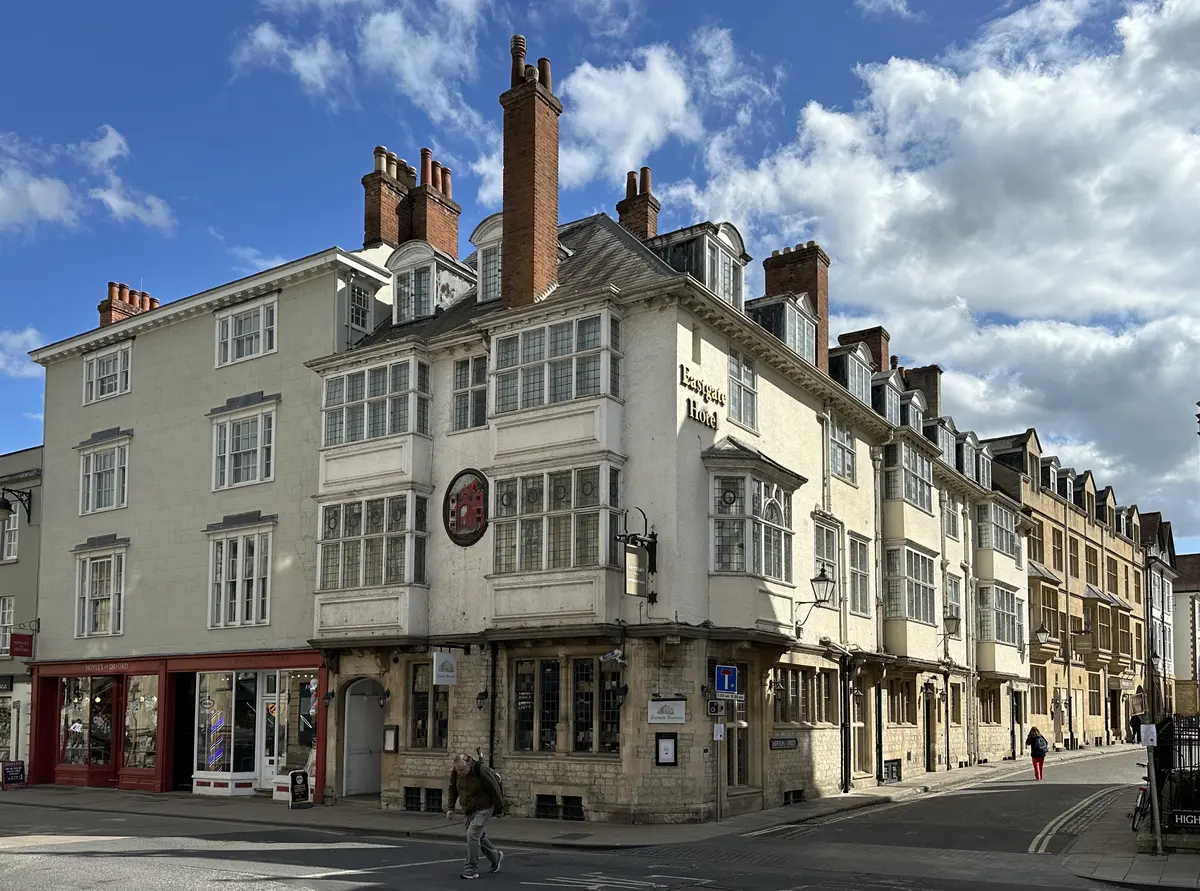
Its story is that guests hear men in armour and see English Civil War Royalists walking through the walls, explained by a surprise Parliamentarian attack on Oxford's east gate. Oxford was never stormed: Sir Thomas Fairfax negotiated, the Articles of Surrender were signed at Christ Church on 20 June 1646, and four days later the garrison marched out with full military honours. The medieval gate stood across the roadway of the High, not on this plot, and the walls anyone might walk through went up at the end of 1899, designed by Edward Prioleau Warren and built by Benfield & Loxley on a corner that had already been cleared and rebuilt once after 1771. The hotel — now the four-star Mercure Oxford Eastgate, still owned by Magdalen College — says nothing about a ghost anywhere. This is the file on a haunting with no gate, no battle and no named witness, and on the real history underneath it.
What is the history of Eastgate Hotel?
There is no gate at the Eastgate Hotel, and there has not been one for two and a half centuries. That absence is the whole story.
Oxford's defended area was pushed eastwards in the early 11th century to a point near where the hotel now stands, and a new East Gate was built to close the High Street at that spot. The medieval structure was substantial: a square gate tower flanked by two smaller square towers, with Holy Trinity Chapel in a room above the archway. The chapel was granted to St Frideswide's Priory in 1122 and passed to the Trinitarian Friars around 1310. Mayors coming back into the city stopped there to give thanks for a safe journey before being greeted outside by their fellow townsmen.
By the early 18th century the gate was decayed, and in 1711 the city council resolved to pull the old one down and make the passage there, in its own words, "hansome and ornamentall". What replaced it was the round-headed archway between two square towers that appears in 18th-century drawings — and, later, on the hotel's own facade. David Loggan's bird's-eye view of 1675 still shows the older pair of square towers.
The gate did not survive the Georgian rebuilding of the city. The Oxford Mileways Act of March 1771 authorised the removal of "the East Gate, and such Houses and Buildings near or adjoining to it", and the Paving Commissioners demolished both the East and North Gates that year. The High was widened to form a decent approach to John Gwynn's new Magdalen Bridge, and buildings had to respect the new line. No. 73 High Street, on the corner of what was then King Street and is now Merton Street, was rebuilt from the ground up. An inn had stood on the site since at least 1605; the rebuilt house became the Flying Horse.
It kept that name until about 1876, when it was renamed the Eastgate Hotel after the gate that was no longer there. Nineteenth-century censuses record the innkeepers: Mary Smith in 1841, Matthias Popple in 1851, Job Durran through the 1860s, Fred Birmingham in 1881, Henry Beechey from 1891. In June 1891 the hotel and the adjoining houses went to auction and were bought by Magdalen College, which owns the freehold to this day.
The present building is younger still. It went up at the end of 1899 to a design by Edward Prioleau Warren in a seventeenth-century style, built by the Oxford firm Benfield & Loxley; a drawing of it was published in Jackson's Oxford Journal on Saturday 9 December 1899, and a Historic England photograph shows it complete in 1901. Warren gave it mullioned and transomed windows, a tall brick chimney stack and two dormers, and set a cartouche between the first-floor windows showing the East Gate as it had looked in the 18th century — the building's one honest memorial to what it replaced. The 1911 census recorded 36 rooms. Extensions followed in 1964, into 23 and 25 Merton Street, and in 2017, when permission was granted for a separate block of seventeen more bedrooms.
One datable moment in the hotel's twentieth century is worth more than most of its ghost lore. On Wednesday 24 September 1952, C. S. Lewis came here for lunch and met, for the first time, the American writer Joy Davidman, whom he would later marry.
Timeline: the documented record of Eastgate Hotel
- 1122 Holy Trinity Chapel, in a room above the East Gate archway, is granted to St Frideswide's Priory; around 1310 the priory passes it to the Trinitarian Friars. Returning mayors of Oxford give thanks there before being greeted outside the gate.
- April–June 1643 The Royalist garrison begins the large hornwork at St Clement's, in front of Magdalen Bridge, and arms it in June. Anthony Kemp describes its purpose as guarding "against a surprise rush across the bridge" — the eastern front line lay well outside the East Gate.
- 24 June 1646 Oxford surrenders by treaty, not by storm. The Articles are signed by Fairfax and Sir Thomas Glenham at Christ Church on 20 June; four days later up to 3,000 of the garrison march out with full military honours and are disarmed and disbanded at Thame.
- 1675 David Loggan's bird's-eye view of Oxford still shows the medieval East Gate with its two square flanking towers.
- 1711 The city council resolves to demolish the decayed medieval gate and make the passage "hansome and ornamentall". The replacement is the round-headed arch between two square towers later copied onto the hotel's cartouche.
- March–1771 The Oxford Mileways Act authorises the removal of the East Gate and adjoining buildings; the Paving Commissioners demolish both the East and North Gates that year and the High is widened towards the new Magdalen Bridge.
- c. 1876 The inn rebuilt on the cleared corner of No. 73, which had traded as the Flying Horse, is renamed the Eastgate Hotel — after a gate that had been gone for a century. Stephanie Jenkins dates the change slightly later, to 1880.
- June 1891 The hotel and the adjoining houses are auctioned and bought by Magdalen College, which still holds the freehold.
- 9 December 1899 Jackson's Oxford Journal publishes a drawing of the new Eastgate Hotel, designed by Edward Prioleau Warren in a seventeenth-century style and built by Benfield & Loxley. It is the building that stands today; a Historic England photograph shows it complete in 1901.
- 24 September 1952 C. S. Lewis lunches at the Eastgate and meets the American writer Joy Davidman for the first time; they married in 1956.
- 2010 Ross Andrews publishes Paranormal Oxford (Amberley). Page 36 is the earliest datable printed source for the Eastgate ghost story that could be identified — at least 364 years after the Civil War it invokes.
- 2017 Planning permission is granted for a detached block of seventeen additional bedrooms, the latest of the enlargements that began in 1964 with 23 and 25 Merton Street.
Is there a rational explanation for Eastgate Hotel?
The story attached to this address is that guests and staff hear men in armour and see English Civil War Royalist soldiers passing through the walls, and that the cause is a surprise attack by Parliamentarian forces at the old east gate. Four things get in the way.
The walls are Edwardian. Whatever anyone sees passing through them is passing through brickwork raised by Benfield & Loxley at the end of 1899 to Warren's design, on a plot that had already been cleared and rebuilt once after 1771. There is no seventeenth-century fabric here for a seventeenth-century soldier to haunt, despite the "converted 17th-century coaching inn" line that the hotel's own booking pages and the Wikipedia article both carry.
The gate was not on this footprint. It stood across the roadway of the High, just east of the Merton Street junction — in what is now the carriageway, not in the hotel.
The attack never happened. Oxford did not fall by storm. Sir Thomas Fairfax chose negotiation over an assault: commissioners met from 18 to 23 May 1646, the Articles of Surrender were settled on 17 June and signed by Fairfax and Sir Thomas Glenham in the Audit House at Christ Church on 20 June, and on 24 June up to 3,000 of the garrison marched out with full military honours and were disarmed and disbanded at Thame. The nearest thing to the legend in the documentary record is a defence against an attack that never came: the military historian Anthony Kemp, writing in Oxoniensia in 1977, describes the large hornwork thrown up at St Clement's in front of Magdalen Bridge — begun in April 1643 and armed that June — as built "to guard against a surprise rush across the bridge". The Royalist front line on this side of Oxford was out at St Clement's, several hundred metres beyond the East Gate.
And the story itself is late and thin. The only source ever cited for it is Ross Andrews, Paranormal Oxford (Amberley, 2010), page 36, in a chapter on indoor venues in the city centre; the book is real and its bibliographic record checks out, but it has never been digitised and that page could not be consulted here. No earlier printed appearance of the Eastgate story has been located, which puts a gap of at least 364 years between the war and the first telling anyone can date. No witness is ever named. The hotel's own website, the Accor listing and the Oxford alumni page that promotes it say nothing at all about a ghost, and the story does not appear in the published itineraries of Oxford's ghost walks, whose Civil War material belongs to Dead Man's Walk on the other side of Merton.
Can you visit Eastgate Hotel?
The Eastgate trades as the Mercure Oxford Eastgate Hotel, a four-star Accor hotel at 73 High Street, Oxford OX1 4BE (+44 1865 248332), on the corner of Merton Street. Accor's page for it, read on 23 September 2026, gives check-in from 14:00 and check-out by 12:00, describes it as a 100 per cent non-smoking property that welcomes pets, names its restaurant as the Eastgate Brasserie and says it overlooks the Examination Schools and Magdalen Tower. The same page calls the building a "17th-century coaching-inn"; the present building was in fact put up at the end of 1899 to a design by Edward Prioleau Warren. Magdalen College has owned it since 1891.
On the High Street itself, Oxfordshire County Council's page on bus gates, read on 23 September 2026, says that from 07:30 to 18:30 only buses, taxis and licensed private hire vehicles, and emergency vehicles may pass the High Street gate, and that any vehicle may use it between 18:30 and 07:30. Cameras enforce it; the penalty is £70, reduced to £35 if paid within 21 days. Oxford railway station is about 1.4 km (0.9 miles) west of the hotel in a straight line.
On the High Street front, between the upper windows, a carved cartouche shows the East Gate as it looked in the eighteenth century, before it was demolished in 1771. The house is absent from the inventory of listed buildings on the High compiled by Stephanie Jenkins's Oxford History site, which lists its neighbours at 71-72 and 74-76 as Grade II.
The paranormal story is not part of the hotel's own offer: on Accor's page, searched on 23 September 2026, "ghost", "haunt" and "paranormal" return no matches, against one for "coaching". What the address is visited for is C. S. Lewis. The free C. S. Lewis audio tour of Oxford includes the Eastgate as a stop: Lewis first met Joy Davidman over lunch here on 24 September 1952, and he regularly met J. R. R. Tolkien here on Monday mornings.
Sources consulted
- Anthony Kemp, «The Fortification of Oxford during the Civil War» — Oxoniensia, vol. XLII, 1977 academic
- Malcolm Graham / Oxford Preservation Trust, «Oxford Heritage Walks, Book 6: On foot from the High to Trill Mill (footnoted text)» — Oxford Preservation Trust, 2024 report
- Victoria County History, «City Walls, Gates, and Posterns» — A History of the County of Oxford, vol. 4: The City of Oxford (British History Online), 1979 book
- Stephanie Jenkins, «The High, Oxford: No 73 (Eastgate Hotel)» — Oxford History, 2024 web
- Oxfordshire Blue Plaques Board, «Civil War Surrender of Oxford» — Oxfordshire Blue Plaques Scheme, 2013 web
- Ross Andrews, «Paranormal Oxford (chapter: Ghosts of Oxford City Centre – Indoor Venues, p. 36)» — Amberley Publishing, Stroud, 2010 book
- C. S. Lewis Tour, «Eastgate Hotel — C. S. Lewis Oxford audio tour» — cslewistour.uk (citing Walter Hooper, C. S. Lewis: Companion & Guide), 2024 web
- Oxfordshire County Council, «Bus Lane information – High Street» — Traffic Penalty Tribunal, core documents, 2020 report
- Accor, «Mercure Oxford Eastgate Hotel — official booking page» — all.accor.com, 2026 web
Reviewed by V. Serrano on 2026-08-12 · How we verify our content
💬 Field testimonies (0)
No testimonies yet. Add the first.
Add your testimony
🔒 Log in to add a testimony