👻 HAUNTED PLACE · EXP. Nº9476
ACTIVE
Hill House, Helensburgh
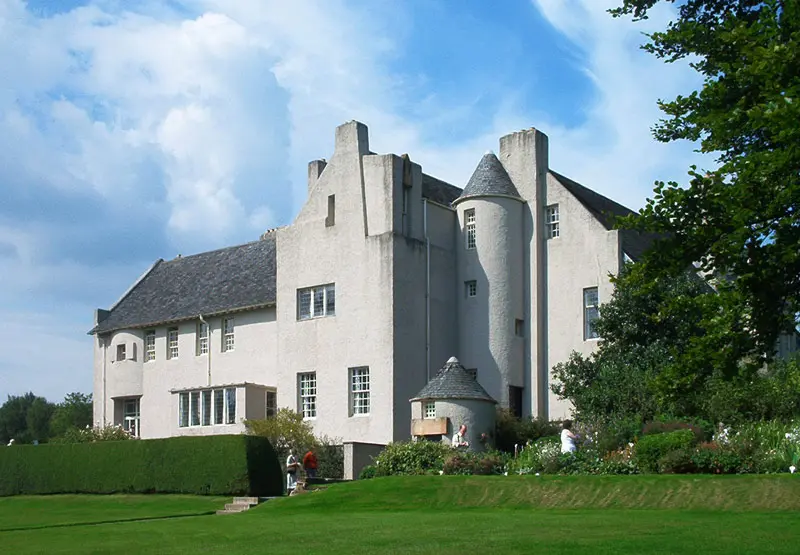
The Hill House was built in 1902-04 for the Glasgow publisher Walter Blackie, to designs by Charles Rennie Mackintosh and Margaret Macdonald Mackintosh, and its ghost story is unusual in one respect: the owner published it.
Where is Hill House, Helensburgh?
- Location
- Argyll and Bute, Scotland, United Kingdom
- Type
- House / mansion
- Coordinates
- 56.017, -4.728
- Last updated
LOCATION
Why is Hill House, Helensburgh said to be haunted?
On a National Trust for Scotland autumn campaign page in 2011, the house's retail manager, Karen Fenwick, relayed an account by the housekeeper, Elaine. During a winter closure Elaine was alone in the building, walking towards the stairs on the upper landing, when a tall, slender figure in a long black cape - the cape covering part of its face and head - came out of Mr Blackie's dressing room, went into the White Bedroom and vanished. She said it was not a frightening experience at all, and that she had often smelled pipe smoke in the library, which is where Blackie smoked his pipe. Everything else that now circulates was added later and can be dated: the figure became Blackie in a BBC piece of December 2018, the cigar was invented on Wikipedia in April 2023, and the word benevolent belongs to a magazine writer in 2021. Since June 2019 the house itself has stood inside a steel-and-chainmail box, drying out.
What is the history of Hill House, Helensburgh?
Helensburgh was founded in the second half of the 18th century by Sir James Colquhoun of Luss, and the arrival of the railway in 1857 turned it into an affluent commuter town for Glasgow money. Its upper town, opened up by a West Highland Line station in 1894, filled within fifteen years with large villas by leading architects. In the early spring of 1902 the Glasgow publisher Walter W. Blackie feued the highest plot in that upper town and commissioned Charles Rennie Mackintosh to build on it.
The introduction came from Talwin Morris, art director of Blackie & Son and a friend of Mackintosh. Blackie wrote his own account of the commission some forty years later; it was published posthumously in the Scottish Art Review in 1968 and is quoted at length in the Hunterian's catalogue of Mackintosh's architecture. He described putting to Mackintosh ideas that were "mostly negative, I may say": he disliked red-tiled roofs in the west of Scotland, did not want brick and plaster and wood beams, rather fancied grey rough cast for the walls and slate for the roof, and thought any architectural effect "should be secured by the massing of the parts rather than by adventitious ornamentation". Mackintosh agreed at once and sent the Blackies to see Windyhill at Kilmacolm; they came away, Blackie wrote, "convinced that Mackintosh was the man for us".
The paperwork runs fast. Drawings went to the Helensburgh Dean of Guild Court in March 1902 and were approved on 9 June; tenders for mason and joiner work were accepted on 3 May. On 5 January 1903 Mackintosh wrote to Hermann Muthesius that the house was roofed but not yet glazed, and that the walls would not be roughcast until May. The Blackies moved in in March 1904. The job book of Honeyman, Keppie & Mackintosh puts the cost at 6,652 pounds 3s 0d — rather more than the 5,000 pounds usually quoted in the press. On handing the house over, according to Blackie, Mackintosh said: "Here is the house. It is not an Italian Villa, an English Mansion House, a Swiss Chalet, or a Scotch Castle. It is a Dwelling House."
It was also, from the start, a house that let in water. The walls are of porous red sandstone which, in the words of the Hunterian's catalogue, "has not always been laid correctly", and Mackintosh sealed them under a roughcast bound with Portland cement rather than lime — innovative in 1903, and a trap, because cement holds moisture in instead of letting the wall breathe. In 1953 the then owner, T. Campbell Lawson, called in the Glasgow architect Margaret Brodie, who identified the great chimney stack on the west as the likeliest culprit; an infra-red thermographic survey in 2019 found damp in the same places. The National Trust for Scotland now describes the building as "dissolving like an aspirin in a glass of water".
Blackie lived in the house for forty-nine years and died in it on 14 February 1953. His executors offered it to the National Trust for Scotland, which did not take it; Lawson bought it instead and sold it again in 1971. The Royal Incorporation of Architects in Scotland bought it in 1972 and converted the service wing into flats to generate rent; the Landmark Trust took the top-floor flat in 1978. The Trust finally took over on 31 May 1982. Repairs ran from 1983 to 1986, and in 1989 the original stencilled decoration of the White Bedroom was uncovered. In 2019 the whole house was enclosed in a steel frame clad in stainless-steel chainmail — the Box, by the architects Carmody Groarke — so that the walls can dry out under cover. The conservation work behind it is expected to take up to fifteen years.
The ghost story belongs to that last chapter, and its origin is unusually well documented: the owner published it. On a National Trust for Scotland autumn campaign page of 2011, gathering staff accounts from across its properties, Karen Fenwick, retail manager at the Hill House, relayed what the housekeeper had told her. "Our Housekeeper, Elaine has been at The Hill House for a long time," the entry reads, and said that when the house was closed over the winter a couple of years earlier she was alone in the building, walking towards the stairs on the upper landing, "when a tall slender figure appeared from Mr Blackie's Dressing Room. He was dressed in black with a long black cape. The cape was covering part of his face and head. He went in to the White Bedroom and vanished." Fenwick adds that Elaine said "it was not a frightening experience at all", that she had often smelled pipe smoke in the library, and that the previous property manager had also had experiences there. Both rooms are real: the Hunterian's catalogue places Mr Blackie's dressing room on the first floor of the west front, lit by the canted bay window above the main entrance, and the White Bedroom is the room whose stencils the Trust recovered in 1989.
Timeline: the documented record of Hill House, Helensburgh
- 9 June 1902 Walter W. Blackie feus the highest plot in Helensburgh's upper town and commissions Mackintosh, introduced by Talwin Morris of Blackie & Son. Drawings go to the Helensburgh Dean of Guild Court in March and are approved on 9 June; tenders for mason and joiner work were accepted on 3 May.
- March 1904 The Blackies move in. The job book puts the cost at 6,652 pounds 3s 0d. Blackie later recalled Mackintosh handing the house over with the words: "Here is the house. It is not an Italian Villa, an English Mansion House, a Swiss Chalet, or a Scotch Castle. It is a Dwelling House."
- 14 February 1953 Walter W. Blackie dies in the house after forty-nine years there. His executors offer it to the National Trust for Scotland, which declines; T. Campbell Lawson buys it and calls in the architect Margaret Brodie over the water ingress, which she traces to the great west chimney stack.
- 31 May 1982 The National Trust for Scotland takes over the Hill House from the Royal Incorporation of Architects in Scotland, which had owned it since 1972 and converted the service wing into flats. Repairs run from 1983 to 1986; in 1989 the original stencilled decoration of the White Bedroom is uncovered.
- Autumn 2011 The earliest datable publication of the story. On its autumn campaign page "Ghosts linked to our properties", the National Trust for Scotland prints an account by Karen Fenwick, retail manager at the Hill House, of what the housekeeper Elaine told her: a tall slender figure in a long black cape, its face and head partly covered, came out of Mr Blackie's dressing room, went into the White Bedroom and vanished. Elaine said it was not frightening, and that she had often smelled pipe smoke in the library, where Blackie used to smoke.
- 4 October 2011 A Wikipedia editor adds the category "Reportedly haunted locations in Scotland" to the article on the house at 20:09 UTC and, eight minutes later, pastes in a condensed version of Elaine's account sourced to that Trust page. That category is why the house entered ghost gazetteers at all; the editor never names the witness.
- 11 December 2018 BBC Scotland publishes the story off the back of the Netflix series The Haunting of Hill House and, for the first time, names the figure: "the ghost of publisher Walter Blackie". The Trust's own account had identified only the room. The BBC reports pipe smoke.
- June 2019 The Box opens: a cross-braced steel frame clad in stainless-steel chainmail, designed by Carmody Groarke and built in six months, which shelters the house from rain while letting air through so the walls can dry. The conservation programme behind it is expected to run up to fifteen years.
- March 2020 Stuart McIntosh and Lanarkshire Paranormal are given access for an overnight investigation and report banging doors, tapping and clicking, EMF spikes, a name on a spirit box and, through dowsing rods, a man called James said to have died during construction. This is the origin of the doors and tapping that later circulate as staff reports.
- 16 July 2021 Spooky Isles publishes Christine Miller's account, which merges the housekeeper's sighting with the 2020 investigation, attributes the figure to Blackie, has him seen smoking a pipe, and calls the spirit "benevolent" — the writer's word, not a witness's.
- 12 April 2023 A Wikipedia editor adds "Witnesses have also smelled cigar smoke in the house" and cites the BBC page — which says pipe. The word cigar appears nowhere on it. Four months later another editor strips the dressing room and the White Bedroom from the article as uncited claims.
- 31 December 2025 The English Wikipedia article is tagged as suspected of containing AI-generated text, the editor citing the 2023 and 2025 rewrites of the ghost paragraph among the examples. A failed-verification tag follows in July 2026.
Is there a rational explanation for Hill House, Helensburgh?
The Hill House ghost has no printed pedigree. A full-text search of the Open Library book corpus, run on 20 August 2026 and repeated with the same counts on 25 September 2026, returned 240 passages for the exact phrase "The Hill House, Helensburgh" — the Mackintosh monographs, the furniture catalogues, the RCAHMS photographic surveys — and zero for "ghost of Walter Blackie". "Hill House is haunted" returns ten passages: seven are about Shirley Jackson's novel or its film, one about Cherry Hill House in Toronto and two about the Beverly Hills house of Virginia Hill, haunted, the entry says, by the gangster Bugsy Siegel; none is about Helensburgh. In that corpus, the literature that knows this building in extraordinary detail does not call it haunted.
What it does have is a datable chain, and each link added something the previous one did not say.
The Trust's own 2011 page never identifies the figure. It says a figure came out of "Mr Blackie's Dressing Room" and gives the figure no name. The identification arrives on 11 December 2018, when BBC Scotland ran the story off the back of the Netflix series The Haunting of Hill House and wrote that it was "the ghost of publisher Walter Blackie". The cigar arrives on 12 April 2023, when a Wikipedia editor added "Witnesses have also smelled cigar smoke in the house" and cited that BBC page — which says pipe. The word cigar does not appear on it, in the live version or in the Wayback capture of 2023; "pipe smoke" appears once. The word benevolent arrives on 16 July 2021, in a Spooky Isles article by Christine Miller, as the writer's own characterisation. No witness used it. The only witness on record said the opposite of unsettling: that it was not a frightening experience at all.
The pipe smell came with its explanation attached in the source that first published it. Elaine smelled it in the library, and the Trust's page says why: that is where Mr Blackie used to smoke his pipe. A man smoked a pipe in one room of a house he occupied for forty-nine years, and the original panelling, fitted bookcases, textiles and upholstery are still in it.
The banging doors and tapping that circulate as staff reports come from one night. In March 2020 Stuart McIntosh and Lanarkshire Paranormal were given access for an overnight investigation and reported doors banging, tapping and clicking, EMF spikes, a name on a spirit box and, through dowsing rods, a man called James said to have died during the building work. The Hunterian's catalogue follows the works through tenders, Dean of Guild approvals and job-book payments, and the only death in its chronology is Blackie's own, in the house, on 14 February 1953. That is an argument from silence; the claim it answers rests on a dowsing rod.
The Trust's page on the house, in the Internet Archive capture of 31 August 2026, does not mention a ghost; the Trust page that did was a seasonal marketing page in the autumn of 2011, and the Trust does sell Halloween at the site. The Helensburgh Advertiser reported "over 400" visitors over the Hallowe'en weekend of 2021 — the figure came from the Trust's visitor services supervisor, Taylah Egbers — with decorations, a trail and a walking theatre at night, and opened its report by calling the place "Helensburgh's most haunted house". On 25 and 26 October 2025, according to The Lochside Press, the Trust ran a graveyard trail in the garden with activities afterwards, at 4 pounds a ticket. Elaine's account appears in neither report.
The English Wikipedia article on the house has carried, since December 2025, a template warning that parts of it are suspected of being AI-generated. The two example edits it links, of 4 August 2023 and 22 June 2025, both rewrote the ghost paragraph along with other sections, and a separate failed-verification tag dates from July 2026.
Can you visit Hill House, Helensburgh?
The Hill House stands on Upper Colquhoun Street, Helensburgh G84 9AJ, on high ground in the upper town, about 1.6 km (1 mile) uphill from Helensburgh Central station and roughly 34 km (21 miles) north-west of Glasgow city centre. The National Trust for Scotland runs it as a house museum and publishes opening times and admission on its own visitor page, which could not be reached on 9 September 2026, so no figures are given here.
Historic Environment Scotland lists the house at Category A under reference LB34761, listed on 14 May 1971 as "8 Colquhoun Street Upper, the Hill House with Outbuildings, Boundary Walls and Gates", at grid reference NS 30043 83814. The designation describes a house "set in artistically arranged gardens on high ground in a villa suburb above Helensburgh and overlooking the Clyde Estuary beyond" — the view that no longer exists on site, because since 2019 the house has stood inside the Box, the steel-mesh shelter built by Carmody Groarke to dry the walls out. What the Box offers instead is a walkway around the house at garden level and a second one above the roof line, which show elevations from angles Mackintosh never had.
The conservation work is still running: on 31 August 2026 the Trust announced that the original cement roughcast had been stripped off in full after nearly six months of work by stonemasons, and its chief executive Phil Long called the completion "a significant moment in its conservation". A new roughcast is to follow under the Mackintosh Illuminated project; the Box holds planning permission until 2028.
The ghost story is absent from the interpretation the Trust publishes. Its description of the interior route, as the Internet Archive captured it on 6 March 2026, lists the rooms open to visitors: hall; drawing room; dining room; main bedroom; cloakroom; boot room; daughters' bedroom. Mr Blackie's dressing room and the White Bedroom are missing from that list. The seasonal Hallowe'en trail is a family activity in the garden, ticketed separately from the house.
Sources consulted
- National Trust for Scotland, «Ghosts linked to our properties (autumn campaign page)» — nts.org.uk, archived by the Internet Archive on 2 April 2012, 2011 archive
- The Hunterian, University of Glasgow, «M207: The Hill House — Mackintosh Architecture: Context, Making and Meaning» — University of Glasgow / Arts and Humanities Research Council, 2014 academic
- BBC Scotland, «There's an actual Hill House in the UK — and yes, it's haunted» — BBC, 2018 newspaper archive
- Christine Miller, «The Real Haunting of Hill House, Helensburgh» — Spooky Isles, 2021 web
- Helensburgh Advertiser, «The haunting of Hill House in Helensburgh - in pictures» — Helensburgh Advertiser, 2021 newspaper archive
- Wikipedia contributors, «Hill House, Helensburgh: revision history (264 revisions, 2005-2026)» — English Wikipedia, 2026 archive
- National Trust for Scotland, «The Hill House: planning your visit» — nts.org.uk, archived by the Internet Archive on 6 March 2026, 2026 web
- Architects' Journal, «Carmody Groarke completes see-through 'shield' over Mackintosh's Hill House» — The Architects' Journal, 2019 newspaper archive
- The Lochside Press, «Hallowe'en events at Hill House and Geilston — a graveyard trail in the Hill House garden on 25 and 26 October 2025, 11am to 3pm, at 4 pounds per trail» — thelochsidepress.com, 21 October 2025, 2025 newspaper archive
Reviewed by V. Serrano on 2026-08-20 · How we verify our content
💬 Field testimonies (0)
No testimonies yet. Add the first.
Add your testimony
🔒 Log in to add a testimony