👻 HAUNTED PLACE · EXP. Nº9477
ACTIVE
Jay's Grave
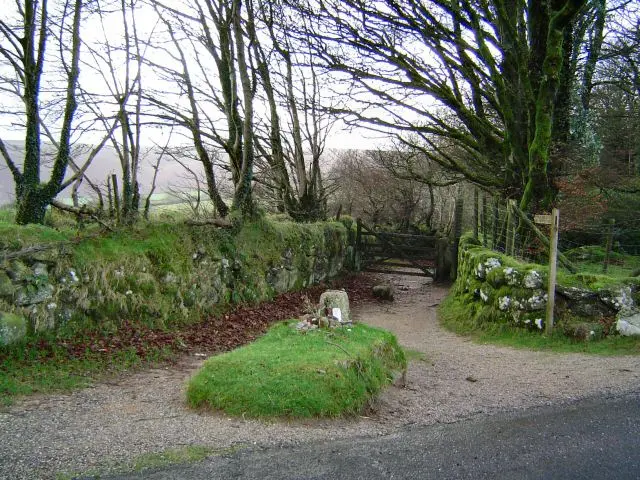
Beside a moorland lane a mile north-west of Hound Tor, where a green lane strikes off towards Natsworthy, stands a small turf mound with an uninscribed headstone: Jay's Grave, the burial place of a woman who, tradition holds, hanged herself in a nearby barn and was buried at the crossroads, as English custom required of suicides before 1823.
Where is Jay's Grave?
- Location
- Devon, England, United Kingdom
- Type
- Cemetery
- Coordinates
- 50.605, -3.793
- Last updated
LOCATION
Why is Jay's Grave said to be haunted?
The core of the story is unusually solid — a newspaper reported the grave's discovery in 1851, naming her Ann Jay, and around 1861 the landowner James Bryant had the bones examined by a surgeon, who declared them female, before reburying them under the present mound. Everything else has kept changing: she has been called Kay, Betty Kay, Jane, Kitty and Mary; the famous version — the workhouse orphan seduced and cast out — arrived only in the twentieth century, along with a dark kneeling figure said to keep vigil at the mound, and the fresh flowers that always seem to lie on the grave. The flowers' 'unknown hand' has a likely name, and therein lies the real story.
What is the history of Jay's Grave?
Jay's Grave is that rare thing among haunted places: a legend wrapped around a physical core that was examined by a doctor. The mound sits where a green lane known as Heytree Common Lane leaves the Manaton road towards Natsworthy, about a mile north-west of Hound Tor, and its earliest record is a newspaper item. On 23 January 1851 the North Devon Journal reported that men working for James Bryant of Hedge Barton, removing accumulated road soil, had uncovered a grave containing a skeleton, identified by local enquiry as the remains of 'Ann Jay', a woman who had hanged herself 'some three generations since' in a barn at Forder and been buried at Four Cross Lane, as the custom then was for suicides. Burying a suicide in the highway, sometimes with a stake through the body, was real English practice: it was only abolished by statute in 1823, which is consistent with a burial in the late eighteenth century.
Around 1861 Bryant had the mound opened deliberately, to test the local tradition. The fullest account was printed in Devon Notes and Queries in 1901 by P. F. S. Amery: the grave was opened in the presence of Bryant's son-in-law, J. W. Sparrow, a member of the Royal College of Surgeons; bones were found, examined and declared to be those of a female; the skull was taken to Hedge Barton house, then placed with the bones in a box and re-interred under a new mound with a headstone and footstone — the modest monument that stands today. Amery added the detail that gives the story its melancholy power: when the grave was opened, 'no one then living at Manaton could remember the occurrence'.
What the archive shows next is a name in constant motion. Robert Dymond in 1876 described the burial of 'a poor old woman, called Kay'. When F. B. Doveton asked about the grave in The Western Antiquary in October 1881, his guide had called it 'Jay's Grave', the resting place of a young woman; Amery's reply in the same issue called it 'Betty Kay's'. A map of 1905 labels it 'Jane's Grave'. William Crossing's Guide to Dartmoor, first published in 1909, fixed the now-famous form — 'Kitty Jay, as she used to be spoken of' — and the Widecombe author Beatrice Chase, in her 1914 book The Heart of the Moor, has an old neighbour declare that 'Mary Jay was the poor maid's name'. The Victorian accounts say much less about her: a poor old woman in 1876, a young woman in 1881, and, in the local tradition reported by the rector of North Bovey in 1901, a maidservant at Manaton Ford farmhouse. The familiar biography — the workhouse orphan sent to a farm as an apprentice, seduced or assaulted, pregnant and cast out — comes with the twentieth-century retellings.
The grave then passed into art. John Galsworthy's story 'The Apple Tree' (1916) opens and closes at a Dartmoor crossroads grave that always bears a flower — 'Maid's Grave, us calls et'. Martin Turner of Wishbone Ash turned a late-night visit into the song 'Lady Jay' (1974); David Rudkin's television play 'The Living Grave' followed in 1980; and Seth Lakeman's 2004 song and album 'Kitty Jay' made the story a fixture of the English folk revival.
Timeline: the documented record of Jay's Grave
- 1823 Parliament abolishes the burial of suicides in the public highway with a stake through the body; from now on they are to be buried at night, without Christian rites. The custom that created the grave belongs to the era before this act.
- 23 January 1851 The North Devon Journal reports that workmen employed by James Bryant of Hedge Barton, clearing road soil, have found a grave and skeleton, identified by enquiry as 'the remains of Ann Jay, a woman who hanged herself some three generations since in a barn at a place called Forder'.
- c. 1861 James Bryant has the mound opened to test the tradition, in the presence of his son-in-law J. W. Sparrow, M.R.C.S. The bones are examined and declared female, then re-interred in a box under a new mound with head and foot stones.
- 1876 Robert Dymond, in a book on Widecombe parish, describes the roadside grave of 'a poor old woman, called Kay', hanged by her own hand and buried without Christian rites — the earliest printed version of the story, with neither youth nor romance in it.
- October 1881 F. B. Doveton asks in The Western Antiquary about the grave his guide called 'Jay's Grave', that of 'a young woman who had hanged herself years ago in a barn at Manaton'. P. F. S. Amery replies in the same issue, calling it 'Betty Kay's' and dating Bryant's exhumation 'about twenty years ago'. Neither man mentions any ghost.
- 1901 In Devon Notes and Queries, W. H. Thornton, rector of North Bovey, asks who lies in Jay's Grave; Amery answers with the canonical account of the c. 1861 exhumation, on the testimony of a 74-year-old former workman of Bryant's — adding that no one then living at Manaton could remember the woman's death.
- 1909–1912 William Crossing's Guide to Dartmoor (first edition 1909) fixes the famous name — 'Kitty Jay, as she used to be spoken of' — dates the exhumation 'about 1861', and locates the hanging at Canna farm. Still no flowers and no ghost in his account.
- 1914 Beatrice Chase tells the story in The Heart of the Moor, naming the girl 'Mary Jay' and describing flowers laid 'by unknown hands'. According to the Dartmoor writer Bob Mann, it was Chase herself who then began the custom of leaving flowers on the grave.
- 1916 John Galsworthy writes 'The Apple Tree', framed by a Dartmoor crossroads suicide's grave on which 'there's always a flower' — the legend's first major literary transformation, in which the girl drowns herself, a detail later versions of the folk tale would echo.
- 1965 By the time folklorist Ruth St Leger-Gordon writes The Witchcraft and Folklore of Dartmoor, the grave is a major attraction where tourist coaches stop, and the mysterious flowers are a fixed part of every driver's telling.
- 1974 Wishbone Ash release 'Lady Jay' on There's the Rub; Martin Turner wrote the lyrics after visiting the grave late one night in the late 1960s. David Rudkin's BBC play 'The Living Grave' follows in 1980, and Seth Lakeman's song and album 'Kitty Jay' in 2004.
- 2007 The flowers have grown into votive offerings of every kind — coins, candles, shells, crosses and toys — and visitors queue to photograph the mound, now described as a modern-day shrine.
Is there a rational explanation for Jay's Grave?
The unusual thing here is which half of the story is verified. The bones were real, examined around 1861 by a surgeon, J. W. Sparrow, M.R.C.S., and declared female; the crossroads burial custom they imply is documented law, abolished in 1823. It is the biography that dissolves on inspection. Both accounts of the exhumation, Amery's in 1901 and Crossing's, say that no one then living at Manaton remembered the woman's death; her name shifts from Ann Jay (1851) to 'Kay' (1876) to 'Betty Kay' (1881) to 'Jane' (1905) to 'Kitty' (1909) to 'Mary' (1914), and even her age flips between tellings — Dymond in 1876 buried 'a poor old woman', Doveton's guide in 1881 a young one. The workhouse-orphan story is a twentieth-century layer, and the historian Patricia Milton has noted that by 1905 the grave was already in guidebooks, with coach drivers pointing it out to tourists.
The ghosts are younger still: the nearest thing to dread in the Victorian record is Dymond's general remark of 1876 about the suicides' graves of the district: "the country people shudder as they pass the whisht spots at night". Doveton's query of October 1881 asked for "any particulars as to her history and sad end", and Amery's reply in the same volume gave the exhumation and a second crossroads burial at Ashburton, with no apparition in either. The comparison that matters is on the same page: Doveton's very next query, number 183, asked for "well-authenticated instances" of spectral funeral processions on Dartmoor, so the one correspondent actively collecting ghosts did not attach one to this grave. Crossing's account of the exhumation, in the edition of his Guide prefaced in May 1914, is equally plain. A full-text search of the Project Gutenberg text of Sabine Baring-Gould's A Book of Dartmoor (1900), some 96,500 words with a chapter on Manaton and twelve mentions of Hound Tor, finds no reference to the grave. The kneeling, hooded figure 'in a thick, black cloak', of unknown sex, appears in modern retellings such as the Legendary Dartmoor account of 2008; versions in which the figure becomes a weeping woman, or Kitty herself on horseback, belong to still more recent ghost-hunting websites.
As for the 'mystery' of the fresh flowers, it has a name attached. The Dartmoor writer Bob Mann states that Beatrice Chase (1874-1955), after telling the story in The Heart of the Moor in 1914, began the custom of leaving flowers, and that "other locals and walkers took this up". He dates the supernatural reading of the flowers as well: with "the upsurge of interest in the occult in the 1960s and 70s, some writers began to imply" that there was something mystic about them; the pixie explanation is affectionate folklore. The grave sits beside a road on a popular tourist circuit; by 2007 visitors were leaving coins, candles, shells and toys, and a friend of Mann's who visits regularly has listed what he found on the mound since 2001, from potted plants and keys to a Paddington Bear and a dalek.
Can you visit Jay's Grave?
The grave lies on open moorland beside the minor road that runs north from Swallaton Gate (also called Swine Down Gate, near Hound Tor) towards Heatree Cross, at the point where the green lane to Natsworthy strikes off westward — about a mile north-west of Hound Tor, at Ordnance Survey grid reference SX 733 799. It is on the roadside verge, freely accessible at any hour with no ticket or gate. The Dartmoor National Park Authority added kerb stones around the mound in the 1970s to protect it from livestock. The nearest villages are Manaton and Widecombe-in-the-Moor; the roads here are narrow, single-track lanes with passing places, so park considerately — the Hound Tor area has recognised parking, and the walk to the grave along the lane or over the down is short. Visitors will almost always find flowers, coins and other small offerings on the turf: local custom is to look, photograph and leave them undisturbed. The headstone carries no inscription.
Sources consulted
- «County Intelligence» — North Devon Journal, 1851 newspaper archive
- F. B. Doveton and P. F. S. Amery, «A Dartmoor Tragedy (query and reply)» — The Western Antiquary, vol. 1, pp. 106–107, 114, 1881 academic
- W. H. Thornton and P. F. S. Amery, «Local Traditions, North Bovey / Jay's Grave» — Devon Notes and Queries, vol. 1, pp. 186–187, 251–252, 1901 academic
- William Crossing, «Guide to Dartmoor, Excursion 24, pp. 76-77 — first edition 1909, second 1912; the linked scan is the third edition in five parts, preface dated May 1914» — The Western Morning News, Plymouth, 1914 book
- Sabine Baring-Gould, «A Book of Dartmoor» — Methuen, London, 1900 book
- John Galsworthy, «The Apple Tree, in Five Tales» — William Heinemann, London, 1918 book
- «Kitty Jay» — Legendary Dartmoor (archived version), 2008 web
- Bob Mann, «The Mystery of Jay's Grave» — Dartmoor – the country magazine / Longmarsh Press, 2005 web
- «Felo de Se» — Encyclopædia Britannica, 11th edition, vol. 10, 1911 book
Reviewed by V. Serrano on 2026-08-17 · How we verify our content
💬 Field testimonies (0)
No testimonies yet. Add the first.
Add your testimony
🔒 Log in to add a testimony