👻 HAUNTED PLACE · EXP. Nº9477
ACTIVE
Knighton Gorges, Isle of Wight
Knighton is a handful of farms under Ashey Down, on the Isle of Wight, and the thing it is famous for is an absence.
Where is Knighton Gorges, Isle of Wight?
- Location
- Isle of Wight, England, United Kingdom
- Type
- Ruin / ancient site
- Coordinates
- 50.68, -1.201
- Last updated
LOCATION
Why is Knighton Gorges, Isle of Wight said to be haunted?
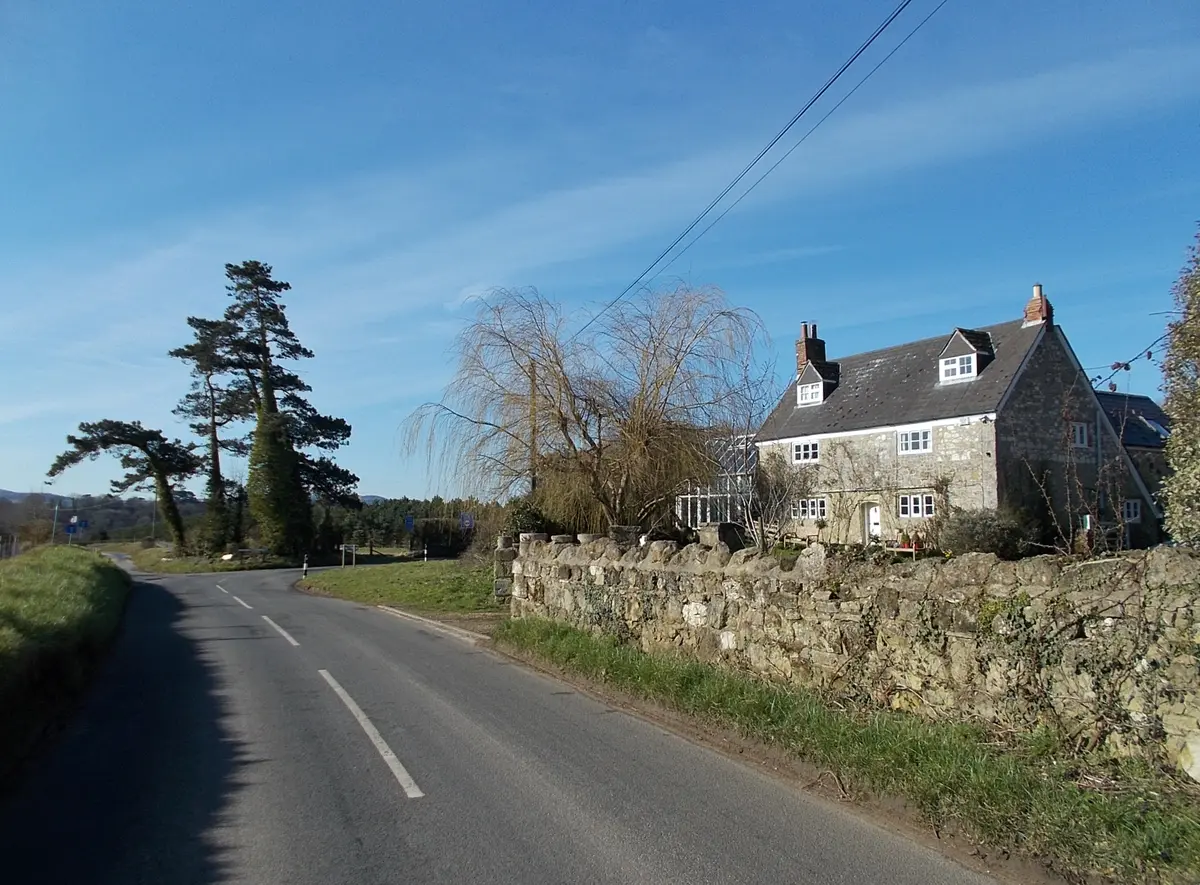
Two rusticated stone gate piers about ten feet high still stand on a rural lane, listed Grade II and described by Historic England as flanking "the carriage drive which led to the house named Knighton Gorges, demolished in 1821". Behind them there is nothing: the Tudor mansion of the Dillingtons was burnt and pulled down around 1820, and by 1823 a conveyance was already calling the place "the site whereon the capital messuage called Knighton House formerly stood". The stories attached to it are famous on the island. Sir Tristram Dillington, the last baronet, is said to have killed himself in 1721, his body strapped to his horse and driven into the mill-pond by a servant to disguise the suicide; the owner who demolished the house is said to have done it out of spite towards a daughter; and the house itself is said to come back whole on New Year's Eve. Each of those three can be traced, and each of them changes shape as you follow it back through the printed record.
What is the history of Knighton Gorges, Isle of Wight?
Knighton is a scatter of farms in the parish of Newchurch, under Ashey Down. What made it famous is not there any more. Two rusticated ashlar gate piers, about ten feet high, still stand on Knighton Shute where the carriage drive left the road. Behind them, until about 1820, stood Knighton Gorges, described by the Victoria County History in 1912 as "a remarkably good example of Tudor work".
The manor is the Domesday "Chenistone", held of Carisbrooke. Its double name comes from a marriage: when John (or Ivo) de Morville died in 1256 his daughter and heir Ellen was the wife of Ralph de Gorges, and the family name stuck to the place. It passed through the Gorges, Russell, Haket and Gilbert families until 1563, when George Gilbert sold it to Anthony Dillington of Poole. The Dillingtons held it for 158 years.
The last of them was Sir Tristram Dillington, 5th Baronet. He was a soldier before he was a landowner: ensign in the 1st Foot Guards in 1701, cornet in the 1st Dragoon Guards in 1703, present at Blenheim, lieutenant-colonel in the 17th Foot in 1708, in the Coldstream Guards in 1709, Governor of Hurst Castle in 1716. He sat for Newport in the Isle of Wight from 1707 to 1710 and again from 1717 until his death. He inherited in 1706, made his will on 11 June that same year, and never altered it. He died on 7 July 1721, aged forty-three, without issue, and was buried at Newchurch; the baronetcy died with him. (Cokayne's Complete Baronetage prints two dates for the extinction, 4 July in the section heading and 7 July in the entry itself.) His will was proved on 5 September 1721. Money had been going out before the end: E. Boucher James notes that Sir Tristram had already sold Mottistone, and the part of the manor of Ashey on which the town of Ryde now stands.
The estate went to his sisters Mary and Hannah, then to their nephew Lieutenant-General Maurice Bocland, and in 1765 to Bocland's grandson Maurice George Bisset, who was eight years old. Bisset is the reason Knighton appears in eighteenth-century scandal: in February 1782 his neighbour Sir Richard Worsley of Appuldurcombe sued him for criminal conversation with Lady Worsley and was awarded one shilling.
The house itself was rarely the family's home. On 12 August 1783 Bisset let "the capital messuage or mansion called Knighton House", with stables, coach house, gardens, orchards and a room-by-room schedule of furniture, to Richard Levensuch for seven years at eighty pounds a year. Under an earlier tenant, Mr Fitzmaurice, John Wilkes met David Garrick and his wife here. It was at Knighton that Legh Richmond, curate of Brading from 1797, met the servant Elizabeth Wallbridge, who died in 1801 and became "the Dairyman's Daughter" of his tract.
The end is documented in deeds. In June 1811 Bisset barred the entail created by Maurice Bocland's will, and the papers still describe "the capital messuage or manor house called Knighton House" as standing. In his will of 1 December 1818 he calls himself "late of Knighton within the parish of Newchurch, I.W., but now resident in Bath". The house was burnt and demolished — the Victoria County History says 1820, the statutory list and Pevsner say 1821. Bisset died in 1821; his will was proved in London on 25 May 1822. When the manor was sold in April 1823 the conveyance speaks of "the site whereon the capital messuage called Knighton House formerly stood".
Timeline: the documented record of Knighton Gorges, Isle of Wight
- 1256 John or Ivo de Morville dies holding the manor; his daughter and heir Ellen is married to Ralph de Gorges, and the Gorges name attaches itself to Knighton for good.
- 1563 George Gilbert sells the manor of Knighton to Anthony Dillington of Poole, Dorset. The family will hold it until 1721.
- 7 July 1721 Sir Tristram Dillington, 5th Baronet, MP for Newport, dies without issue aged forty-three and is buried at Newchurch; the baronetcy is extinguished. The will he had made in 1706 is proved on 5 September.
- February 1782 Sir Richard Worsley of Appuldurcombe sues the owner of Knighton, Maurice George Bisset, for criminal conversation with Lady Worsley. The jury awards Worsley one shilling.
- 12 August 1783 Bisset leases out "the capital messuage or mansion called Knighton House", with stables, coach house, gardens and a room-by-room schedule of furniture, to Richard Levensuch for seven years at eighty pounds a year. From this date the mansion is a let property.
- 30 May 1801 Elizabeth Wallbridge dies at thirty-one. Legh Richmond, curate of Brading, had met her while she was a servant at Knighton, and made her "the Dairyman's Daughter" of a tract read across the English-speaking world.
- 13–14 June 1811 Deeds executed to bar the entail created by Maurice Bocland's will still describe "the capital messuage or manor house called Knighton House" as standing, with barns, coach houses and stables.
- 1 December 1818 Bisset signs his will, describing himself as "late of Knighton within the parish of Newchurch, I.W., but now resident in Bath". It provides for his wife Harriat and for both daughters, Jane Harriet and Ann, by name.
- 1820 or 1821 The house is burnt and demolished. The Victoria County History (1912) dates it to 1820; the statutory list entries of 1988 and 1992 and Pevsner's guide say 1821. Bisset dies in 1821, at Lessendrum in Aberdeenshire; his will is proved in London on 25 May 1822.
- 14–15 April 1823 The manor "of Knighton alias Knighton Gorges" is sold. The conveyance describes "the site whereon the capital messuage called Knighton House formerly stood", with its lawns, gardens, coach houses and stables still there.
- 1848 Henry Richard Holloway publishes Walks round Ryde. It is the earliest datable printing of the suicide-and-horse story, 127 years after Dillington's death; W. H. D. Adams quotes it at length in 1884 and credits it by name.
- 1885 (published 1896) In a letter dated 6 June, the antiquary E. Boucher James calls the tale "a wild local tradition" taken from Canon Venables's Guide to the Isle of Wight (1860) and points out that it "is not borne out by what Sir Richard Worsley says in his History of the Isle of Wight".
- 1905 Hubert Garle devotes a chapter to Knighton: the villagers speak of a headless horseman and of sweet music, but "Mr. Hills, who farmed Knighton, could not corroborate this, though human bones have been dug up on the property". There is no mention of the house returning at New Year.
- 1912 The architect Percy Goddard Stone publishes the ballad "Sir Tristram's Weird" in Legends and Lays of the Wight. It adds the gambling ruin and names the horse Red Sorrel, and it is openly a poem, not a record.
- New Year's Eve 1913–14 Ethel C. Hargrove reports the first datable experience of the vanished mansion appearing at Knighton. Roger Clarke places it on New Year's Eve 1913–14; Paul Adams gives 1915. The story becomes standard in Isle of Wight ghost books from the 1970s on.
- 14 February 1992 The gate piers are listed Grade II, four years after the bowling green wall and garden alcove. The statutory description is the closest thing the site has to an official account of itself.
Is there a rational explanation for Knighton Gorges, Isle of Wight?
Everything told about Knighton Gorges has to survive one awkward fact: the building has not existed for two centuries, so there is nothing to investigate. What can be tested is the paperwork, and the paperwork does not go well for the stories.
The suicide legend has a motive, and the motive is impossible. The nineteenth-century versions — Holloway's Walks round Ryde (1848), quoted at length by W. H. D. Adams in 1884, and Canon Venables's Guide (1860), cited by E. Boucher James — all say Sir Tristram lost "his wife and all his children in rapid succession" and killed himself in despair, after which his steward tied the body to his horse and drove it into the mill-pond to avoid forfeiture. But Cokayne's Complete Baronetage records that he died sine prole, without issue, and lists no wife for him at all; the Victoria County History says the same, and his heirs were his two sisters. There was no wife and there were no children to lose. Nor was anything forfeited: the estate passed intact. James had already made that point in a letter of 1885, noting that the tale "is not borne out by what Sir Richard Worsley says in his History of the Isle of Wight".
The details keep changing, which is what invented details do. In 1884 the horse is simply "the horse his master usually rode"; in Percy Goddard Stone's ballad of 1912 it is a stallion called Red Sorrel; the name Thunderbolt, now repeated everywhere, is the version I can date no earlier than Paul Hyland's Wight: Biography of an Island (1997). Ruinous gambling is not in the Victorian versions either: it enters with Stone's 1912 poem, which is a work of literature and says so. What is documented is duller and sadder — Sir Tristram had sold land before he died.
The New Year's Eve reappearance, the story the site is now known for, is not old. I read eight Isle of Wight books published between 1839 and 1912 — about 4.2 million characters, including Abraham Elder's Tales and Legends (1839), which has a chapter of ghost stories and never mentions Knighton at all. Across that corpus "Knighton" occurs sixty-one times and "New Year" eight times, and not once do the two fall within three thousand characters of each other. Hubert Garle devoted a whole chapter to Knighton in 1905 and reported only a headless horseman and "sweet music" — adding, honestly, that "Mr. Hills, who farmed Knighton, could not corroborate this". The earliest claim of the vanished house returning that I can attach to a name and a date belongs to Ethel C. Hargrove, on New Year's Eve 1913–14 according to Roger Clarke, or 1915 according to Paul Adams; it becomes standard only from the 1970s.
The demolition story fails the same way. It is usually said that Bisset pulled the house down to stop a daughter who had married a clergyman from inheriting it. His will, dated 1 December 1818 and copied in the Isle of Wight Record Office, provides for both daughters by name, Jane Harriet and Ann, along with his wife Harriat; no one is cut off. He had also stopped living there long before, letting the mansion out from 1783 and writing from Bath in 1818.
Finally, Hugh de Morville. Modern accounts open Knighton's history with the knight who murdered Thomas Becket in 1170 taking refuge here. The Victoria County History, which is the source everyone is ultimately copying for the descent of the manor, names no Hugh and never mentions Becket; Jenkinson's guide of 1879 puts the first de Morville at Knighton in the reign of Henry III, which began in 1216. The Becket link looks like two families sharing a surname.
Can you visit Knighton Gorges, Isle of Wight?
Knighton Gorges was demolished in 1821 and nothing of the house stands. What survives is three listed fragments, all of them on private ground.
The two gate piers are on Knighton Shute in the civil parish of Newchurch, postcode district PO36, at national grid reference SZ 56591 87064 (50.6805 N, 1.2004 W), where the drive to Knighton Waterworks leaves the lane. Historic England listed them Grade II on 14 February 1992 as entry 1221135, describing "2 square rusticated ashlar gatepiers, about 10ft high, with moulded cornice over surmounted by a cap of state above each pier", which "flank the carriage drive which led to the house named Knighton Gorges, demolished in 1821". They are visible from the public road, which is the whole of the free view.
The other two fragments carry the same Grade II designation from 27 July 1988 and both sit inside private ground: the wall around the former bowling green (entry 1034320; SZ 56640 86978) and the 18th-century brick garden alcove with a beehive interior standing within that enclosure (entry 1221120; SZ 56624 86948); no part of Knighton is a scheduled monument.
The waterworks drive is itself mapped as a public bridleway; further public footpaths and bridleways climb onto Knighton Down and Ashey Down. Everything off those lines — the farms, the fields, the woods, the water treatment site, the houses, several of them listed in their own right — is private property, and some of it is lived in.
The lanes are single-track and unlit; there is nowhere to park and no pavement. Newchurch village lies 1.8 km (1.1 miles) west-south-west of the piers and Sandown 4.1 km (2.5 miles) south-east. Appuldurcombe House at Wroxall, PO38 3EW — the Worsley seat, now a roofless shell in the care of English Heritage — stands 6.8 km (4.2 miles) south-south-west.
Sources consulted
- Historic England, «Gatepiers at Knighton Waterworks (National Heritage List for England 1221135)» — National Heritage List for England, 1992 report
- Historic England, «Wall Surrounding Former Bowling Green to Knighton Gorges (National Heritage List for England 1034320)» — National Heritage List for England, 1988 report
- William Page (ed.), «Parishes: Newchurch — A History of the County of Hampshire, volume 5, pp. 177–187» — Victoria County History, 1912 book
- George Edward Cokayne, «Complete Baronetage, volume 2 (1625–1649), p. 56: Dillington of the Isle of Wight» — William Pollard and Co., Exeter, 1902 book
- Isle of Wight Record Office, «Attested copy of the will of Maurice George Bisset, late of Knighton within the parish of Newchurch, I.W., but now resident in Bath, dated 1 December 1818 (AC/90/50/12)» — The National Archives, Discovery catalogue, 1822 archive
- Isle of Wight Record Office, «Counterpart lease of the capital messuage or mansion called Knighton House (AC/90/50/44)» — The National Archives, Discovery catalogue, 1783 archive
- Isle of Wight Record Office, «Lease for a year and release, barring the entail created by the will of Maurice Bocland (AC/90/50/11)» — The National Archives, Discovery catalogue, 1811 archive
- Legh Richmond, «The Dairyman's Daughter and the life of Elizabeth Wallbridge» — Annals of the Poor, 1814 book
- Isle of Wight Record Office, «Bargain and sale and release of the manor or lordship of Knighton alias Knighton Gorges (AC/90/50/15)» — The National Archives, Discovery catalogue, 1823 archive
- Robert Pye Donkin (shorthand writer), «The Trial, with the Whole of the Evidence, between Sir Richard Worsley, Plaintiff, and G. M. Bissett, Defendant, for Criminal Conversation» — London, 1782 report
- E. Boucher James, «Letters Archaeological and Historical Relating to the Isle of Wight, volume 1, pp. 539–540: The Dillington Family» — Henry Frowde, London, 1896 book
- W. H. Davenport Adams, «The Isle of Wight: its History, Topography and Antiquities, pp. 165–167 (quoting Walks round Ryde)» — Smith, Elder & Co., London, 1884 book
- Hubert Garle, «A Driving Tour in the Isle of Wight, with Various Legends and Anecdotes, pp. 104–106: A Knighton Mystery» — Simpkin, Marshall, Hamilton, Kent & Co., London, 1905 book
- Percy Goddard Stone, «Legends and Lays of the Wight, pp. 70–77: Sir Tristram's Weird (1721)» — Simpkin, Marshall & Co., London, 1912 book
- Roger Clarke, «Ghosts: A Natural History — 500 Years of Searching for Proof» — St. Martin's Press, New York, 2014 book
- H. M. Gilbert, «Bibliotheca Hantoniensis: an attempt at a bibliography of Hampshire (entries for Holloway, Walks round Ryde, 1848, and Venables, A Guide to the Isle of Wight, 1860)» — Southampton, 1872 book
- Henry Irwin Jenkinson, «Jenkinson's Smaller Practical Guide to the Isle of Wight, pp. 62–63» — Edward Stanford, London, 1879 book
Reviewed by V. Serrano on 2026-08-12 · How we verify our content
💬 Field testimonies (0)
No testimonies yet. Add the first.
Add your testimony
🔒 Log in to add a testimony