👻 HAUNTED PLACE · EXP. Nº9477
ACTIVE
Lauriston Castle
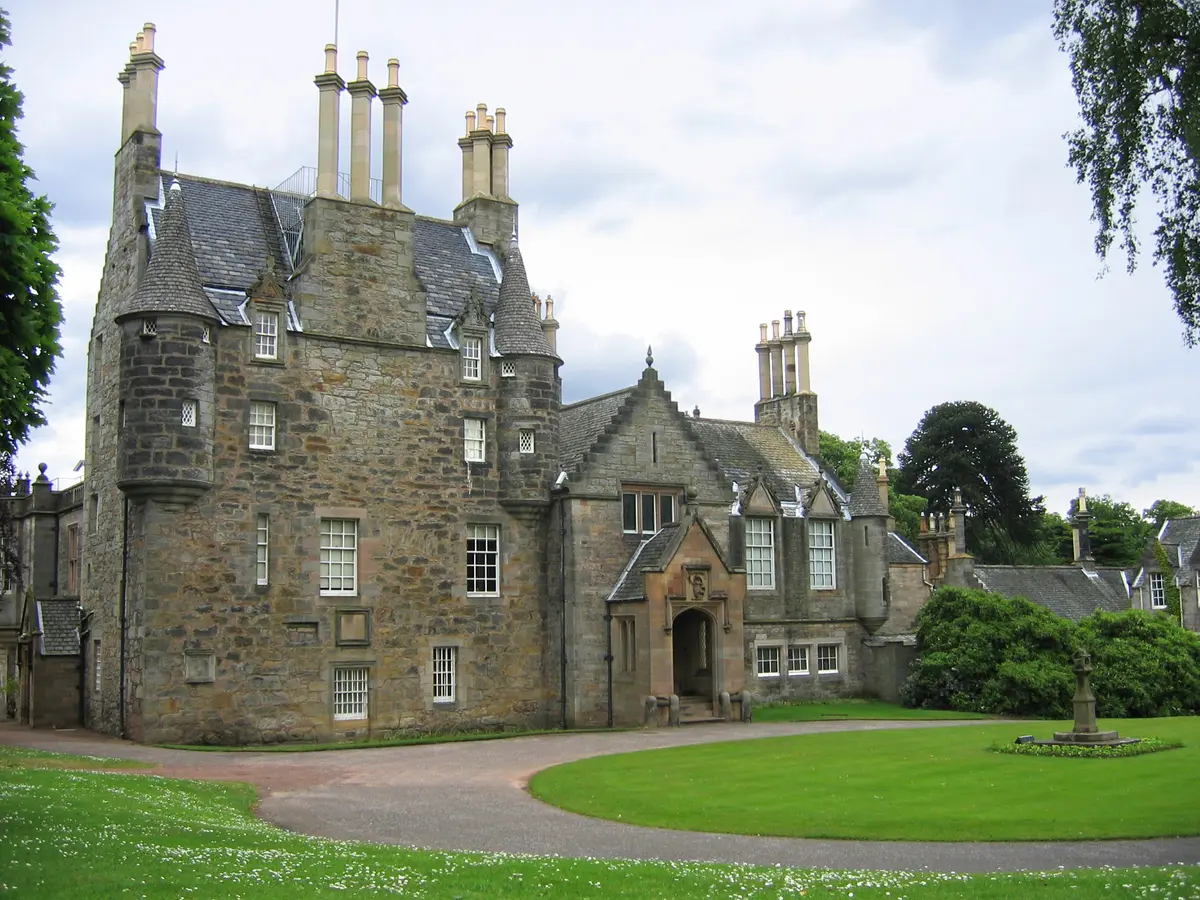
Lauriston Castle is the house almost nobody lived in. A tower house raised for Sir Archibald Napier after 1590, it was bought in 1683 by the goldsmith William Law and inherited by his son John Law, the financier behind the Mississippi scheme — who, Historic Environment Scotland states flatly, never lived there, nor did his successors, across 140 years without a record of tenancy.
Where is Lauriston Castle?
- Location
- Edinburgh, Scotland, United Kingdom
- Type
- Castle
- Coordinates
- 55.971, -3.278
- Last updated
LOCATION
Why is Lauriston Castle said to be haunted?
The one owner who loved it was Andrew Rutherfurd, Lord Rutherfurd, twice Lord Advocate. His wife Sophia Frances Stewart died on 10 October 1852 after thirty years of marriage, and he raised over her a red granite pyramid in the Dean Cemetery, inscribed in Latin to the wife he had outlived against his own prayer. He followed her into the same vault two years later. Our earlier entry turned that into a ghost of rustling silk and a farewell letter that no source contains; the oldest printed Lauriston ghost we can date, from 1995, is somebody else entirely — a shuffling figure in slippers, reported by a later owner. The council-run castle is open by guided tour, and sells no ghost.
What is the history of Lauriston Castle?
Lauriston is the castle that almost nobody lived in.
The estate changed hands constantly. Historic Environment Scotland, in the record that placed the grounds on the Inventory of Gardens and Designed Landscapes in 1987, counts thirty-two different lairds since 1290. In 1540 the lands passed from the family of Lawranstoun to the Forresters of Corstorphine, and in 1590 the Forresters sold to Sir Archibald Napier of Merchiston, who had just remarried. Napier commissioned the tower house that is still the core of the building; his initials were cut on a pediment above one window and his wife Dame Elizabeth Moubray's above another. The statutory listing, which made Lauriston a Category A building on 14 July 1966, dates the tower simply "Before 1600" — it does not give the year 1593 that circulates online, and neither does the Inventory, which says c.1590.
Then came the long emptiness. In 1683 the estate was bought by William Law, an Edinburgh goldsmith and financier, who died in the same year. His son inherited. That son was John Law, the man who would later found the Banque Royale in Paris and launch the Mississippi scheme that ruined thousands of investors — and the reason Lauriston is famous at all. The listing record's entire Statement of Special Interest reads: "Associations with John Law, founder of The Banque Royal de France and promoter of the Mississipi scheme."
It is worth being exact about what that association was, because it is routinely inflated into residence. The Inventory record is blunt: "His son, John, inherited but neither he nor his successors lived there and there are no records of any tenancy during the next 140 years." Law owned Lauriston; he did not live in it. Careful writers have always put it that way. When Sir Walter Scott came out to see the works on 3 December 1827 he called it "the old chateau, which once belonged to the famous Mississippi Law" — belonged to. Omond, writing Rutherfurd's life in 1914, called it "formerly the property of John Law, the notorious financier of the early eighteenth century". Popular guidebooks are where the slippage happens: one Edinburgh guide, located through full-text search, has Law coming to Edinburgh in 1703 "to live at Lauriston Castle and dream up the idea of bank notes".
The family kept the estate from abroad for well over a century, and it left an oddity in the record. J. G. Lockhart, annotating Scott's Journal, noted that Lauriston was "the ancient seat of the Laws, so famous in French history", that cadets of the family emigrated at the Revolution, and that one brother of the Marquis de Lauriston was styled — to the great amusement of Edinburgh — Le Chevalier de Mutton-hole, Mutton-hole being the old name of the village now called Davidson's Mains, at the castle gates.
The house only became a home again in 1823, when John William Law sold to Thomas Allan, banker and mineralogist. Allan hired William Burn to extend it in 1827, and it is to Allan that the building owes its survival. Scott's Journal entry of 3 December 1827 records the argument: "went with Tom Allan to see his building at Lauriston, where he has displayed good taste — supporting instead of tearing down or destroying the old chateau… Mr. Burn, architect, would fain have had the old house pulled down, which I wonder at in him, though it would have been the practice of most of his brethren." The tower stands because the client overruled his architect.
Allan died suddenly in 1833 without heirs. William Ramsay of Barnton bought the estate in 1835, detached three fields, and sold the castle on. In 1844 it went to Andrew Rutherfurd, Lord Rutherfurd (1791–1854) — Solicitor General for Scotland, twice Lord Advocate, Lord Rector of Glasgow, and from 1851 a judge of the Court of Session.
Rutherfurd is the one owner who genuinely loved the place, and the surviving detail is domestic and specific. He kept 9 St Colme Street in town and Lauriston in summer. He hung the library with copied portraits of nine Italians — Petrarch, Boccaccio, Poliziano, Michelangelo, Leonardo, Dante, Galileo, Machiavelli and Raphael — and shelved nine editions of the Decameron, from 1516 to Pickering's of 1826. Omond imagines the Whig veterans, Jeffrey over at Craigcrook and Cockburn down from Bonaly, "righting their battles over again in the dining-room at Lauriston, on a summer evening… while the ladies waited with early Victorian patience in the drawing-room till the sun went down beyond the windings of the Forth." In the summer of 1845 he lent the whole house to Lord John Russell's family, who were in Scotland for Lady John's health; they moved out of their Edinburgh hotel and stayed at Lauriston until the following spring, and it was from these visits north that Russell sent his Edinburgh letter declaring for total repeal of the corn laws.
On 10 April 1822, at Walcott Church in Bath, Rutherfurd had married Sophia Frances Stewart, youngest daughter of Sir James Stewart of Fort Stewart, Ramelton, County Donegal. They had no children. She died on 10 October 1852, after thirty years of marriage — a day, Wilson's daughter recalled, of "startling sorrow".
What he did next is the reason this ficha exists, and it is not a ghost story. In the Dean Cemetery he raised a pyramid of red granite over a vault, for her and for himself. Charles Rogers transcribed the inscription for his 1871 survey of Scottish monuments, and Omond transcribed it again in 1914; the two published readings differ by a single letter. Rogers gives: "Uxori desideratissimae contra votum superestes moerens posuit Andreas Rutherfurd, et sibi, MDCCCLII." — to his most longed-for wife, surviving her against his own prayer, Andrew Rutherfurd, grieving, set this up, and for himself, 1852. The phrase contra votum superstes is not original to him; it is a standing funerary formula that turns up on other European monuments. He chose it anyway.
His friends noticed that his health was seriously affected by her death. He was dangerously ill for months and died during the night of 13 December 1854 at St Colme Street — not at Lauriston — and was buried on 20 December in the vault beneath the pyramid he had built two years earlier, close to the graves of Jeffrey and Cockburn. His Lauriston library was auctioned in Edinburgh by T. Nisbet on 22 March 1855 and the "ten following lawful days".
The rest is quieter. Thomas Macknight Crawfurd bought Lauriston in 1871 and furnished house and grounds with ornament carted from his family seat at Cartsburn, including the lectern sundial of 1684 that still stands on the lawn. In 1902 the cabinet-maker William Robert Reid and his wife Margaret bought it, filled it with the Edwardian collection that is still there, and left it to the nation on condition that it be preserved unchanged. Reid died in 1919; Margaret in 1926, when the house passed to the city. 2026 is the centenary, and the council's programme has been built around it.
Timeline: the documented record of Lauriston Castle
- 1590 The Forresters of Corstorphine sell Lauriston to Sir Archibald Napier of Merchiston, who has just married Dame Elizabeth Moubray. Napier commissions the tower house that is still the core of the building; his initials and his wife's are cut on window pediments. The statutory listing dates the tower only to "Before 1600", and the garden Inventory to c.1590 — neither supports the date of 1593 that circulates online.
- 1683 William Law, an Edinburgh goldsmith and financier, buys the estate and dies the same year. His son John Law — later founder of the Banque Royale and promoter of the Mississippi scheme — inherits. Historic Environment Scotland states plainly that "neither he nor his successors lived there and there are no records of any tenancy during the next 140 years".
- 10 April 1822 Andrew Rutherfurd marries Sophia Frances Stewart, youngest daughter of Sir James Stewart of Fort Stewart, County Donegal, at Walcott Church in Bath. The marriage produced no children.
- 1823 John William Law sells the estate, ending well over a century of absentee ownership by the Law family. The buyer is Thomas Allan, banker and mineralogist, who commissions William Burn to extend the house.
- 3 December 1827 Sir Walter Scott records in his Journal a visit to the works with "Tom Allan", praising him for "supporting instead of tearing down or destroying the old chateau, which once belonged to the famous Mississippi Law", and noting that "Mr. Burn, architect, would fain have had the old house pulled down". The tower survives because the owner overruled his architect.
- 1844 Lauriston passes to Andrew Rutherfurd, Lord Rutherfurd, twice Lord Advocate for Scotland. He keeps 9 St Colme Street in town and Lauriston in summer, and fills the library with Italian books and copied portraits of nine Italian writers and artists.
- Summer 1845 to spring 1846 Rutherfurd lends the whole house to Lord John Russell's family, in Scotland for Lady John's health; they leave their Edinburgh hotel and live at Lauriston until the following spring. It was during these trips north that Russell sent his Edinburgh letter declaring for total repeal of the corn laws.
- 10 October 1852 Sophia Frances Rutherfurd dies after thirty years of marriage. The Dictionary of National Biography gives the date and places it "at Lauriston Castle, Kincardineshire" — the county is wrong, Rutherfurd's Lauriston being in Midlothian, and no source found here specifies a room. Omond records that the day was one of "startling sorrow" to their friend John Wilson.
- 1852 (the monument) Rutherfurd raises a pyramid of red granite over a vault in the Dean Cemetery, for his wife and for himself. Charles Rogers transcribed the inscription in 1871: "Uxori desideratissimae contra votum superestes moerens posuit Andreas Rutherfurd, et sibi, MDCCCLII" — to his most longed-for wife, surviving her against his own prayer. Omond transcribed it again in 1914; the two published readings differ by a single letter, and the phrase itself is a standing funerary formula found on other European monuments.
- 13 December 1854 Rutherfurd dies during the night at 9 St Colme Street, Edinburgh — not at Lauriston — after months of illness that his friends attributed to his wife's death. He is buried on 20 December in the vault beneath the pyramid, close to the graves of Jeffrey and Cockburn. His Lauriston library was auctioned by T. Nisbet from 22 March 1855 over the "ten following lawful days".
- 1871 Thomas Macknight Crawfurd buys Lauriston and brings ornament from his family seat at Cartsburn, including the lectern sundial of 1684 that still stands on the lawn. He owned the house until 1902 — and it is to "Captain Crawfurd" that the only published account of a Lauriston ghost would later be attributed.
- 1926 Margaret Reid dies seven years after her husband, the cabinet-maker William Robert Reid, and the house and grounds pass to the City of Edinburgh, bequeathed to the nation on condition that they be preserved unchanged. That condition is why the interior remains an Edwardian time capsule.
- 1995 The oldest datable printed account of a Lauriston ghost appears in Elisabeth Fraser's Tales from Scottish Lairds. It is not a lady in silk: according to Captain Crawfurd, the Lauriston ghost "takes the form of a shuffling figure in slippers". The passage points to a manuscript account held in the Edinburgh Room of Edinburgh Central Library, which has not been consulted here.
- 16 April and 23 October 2020 The Museums & Galleries Edinburgh site announced on 16 April 2020 that its venues "will be closed until the end of April", and on 23 October 2020 that the City Art Centre had reopened by pre-booking while "all other venues are temporarily closed". Lauriston Castle was shut for most of 2020 — the year in which our previous entry claimed a visitor had photographed a figure at a window.
- 23 October 2021 The council's own museums service stages "Family Special Event: Ghosts of the Castle – Hallowe'en Horrors" at Lauriston Castle as part of the Edinburgh Horror Festival, and a Halloween Terror Trail the same morning. The Terror Trail's ticket record still carries a sale window of 3 March to 25 October 2020, the signature of an event cancelled by the pandemic and re-staged a year later.
- 2026 The centenary of the Reid bequest. The castle interior is open by guided tour only, from 12 August to 1 November 2026, and the year's programme — lectures, film screenings, costumed events, a 1920s scavenger hunt — contains no ghost tour.
Is there a rational explanation for Lauriston Castle?
The ghost in our own previous text does not survive contact with the sources, and the ghost that does exist is a different one.
Our earlier entry said the castle was haunted by Sophia Frances Stewart, who "reportedly died in a castle bedroom after writing her husband a letter to be opened only after her death", and that visitors and staff had long reported footsteps and the rustle of silk skirts. The woman is real and she did die in October 1852; her husband did own Lauriston. Everything after that failed verification.
There is no letter. No source I reached mentions one. What exists is a document going the other way: a message written by the husband, after her death, cut in Latin into a granite pyramid in the Dean Cemetery, and independently transcribed by Charles Rogers in 1871 and George Omond in 1914. If a romantic artefact seeded this story, that is the likeliest candidate — and our version had it reversed, wife to husband instead of husband to wife.
She may not even have died in the house. The Dictionary of National Biography, the most-copied source on Rutherfurd, says she died "at Lauriston Castle, Kincardineshire". There are two Lauriston Castles in Scotland, and Rutherfurd's was in Midlothian, outside Edinburgh. The county in that sentence is wrong, which is a warning about how much weight the sentence can bear. Omond and Rogers give the year but not the room. "Died in a castle bedroom" is a detail no source I found supplies.
Dating the story, not the death. The oldest printed account of a Lauriston ghost I have been able to date is from 1995: Elisabeth Fraser's Tales from Scottish Lairds (Jarrold), whose Lauriston chapter runs from page 91 and whose ghost passage sits on page 98. It does not describe a lady in silk. It reports that, according to Captain Crawfurd — Thomas Macknight Crawfurd, who owned the house from 1871 to 1902, that is, nineteen years after Sophia Rutherfurd died — the Lauriston ghost "takes the form of a shuffling figure in slippers", and it points the reader to a manuscript account held in the Edinburgh Room of Edinburgh Central Library. A shuffling man in slippers and a rustling woman in silk are not the same apparition. I have not seen the Edinburgh Room manuscript and make no claim about what it says.
The control positive, because a negative result proves nothing on its own. I searched two full public-domain texts of the classic haunted-Britain literature. In Elliott O'Donnell's Scottish Ghost Stories (1911), 327 KB, "Lauriston" appears on 0 lines and "Cramond" on 0; in the same file the controls return 22 lines containing "Edinburgh", 30 containing "Glamis" and 58 containing "haunted". In John H. Ingram's The Haunted Homes and Family Traditions of Great Britain (1897 printing), 1.13 MB, "Lauriston" appears on 0 lines; the controls return 38 for "Edinburgh", 47 for "Glamis" and 442 for "haunted". Both books range freely over Scottish haunted houses. Lauriston is not in either. Note also that full-text search proved unreliable in both directions during this work: the query "the Lauriston Castle ghost" returned 0 results and then 2 for the identical string minutes later, so single zeros were re-run before being trusted.
The 2020 photograph. Our text said the legend resurfaced in 2020 when a visitor photographed a human figure in a window of the supposedly empty building. I could find no such photograph, and no report of one. What is documented about Lauriston in 2020 is the opposite kind of fact, and it is dated. On 16 April 2020 the Museums & Galleries Edinburgh site carried the notice that its museums and galleries "will be closed until the end of April". On 23 October 2020 the same site said the City Art Centre had reopened by pre-booking and that "all other venues are temporarily closed". Lauriston Castle was one of those venues. The building really was empty in 2020 — because it was shut — and no visitor was walking round it photographing windows.
The 2020 date does correspond to something real, though not to an apparition. The council's own event record for the Halloween Terror Trail at Lauriston Castle carries a ticket sale window opening 3 March 2020 and closing 25 October 2020, while the event date on the page reads Saturday 23 October 2021 — the signature of a 2020 event cancelled by the pandemic and re-staged the following year.
Who is telling the story matters here. The City of Edinburgh Council owns and runs Lauriston, and it is not a disinterested party: on 23 October 2021 its museums service staged "Family Special Event: Ghosts of the Castle – Hallowe'en Horrors" at the castle as part of the Edinburgh Horror Festival, and a Halloween Terror Trail the same morning. A family Halloween show is not evidence of a haunting; it is a programming decision. Set against that, the two national heritage records say nothing supernatural at all: the Category A listing offers only the John Law association, and the Inventory entry, which describes the site at length, never mentions a ghost. The castle's current programme, read on 12 August 2026, contains lectures, film screenings, forest bathing, costumed events and a 1920s scavenger hunt, and no ghost tour.
What is left is worth more than the apparition: a house that stood untenanted for 140 years under a famous absentee owner, a tower that survives because its owner refused his architect's advice to demolish it, and a widower who buried his wife under a Latin sentence saying he had outlived her against his own prayer, and followed her into the same vault two years later.
Can you visit Lauriston Castle?
Lauriston Castle is at 2a Cramond Road South, Edinburgh EH4 6AD, on 0131 336 2060, [email protected], and belongs to the City of Edinburgh Council. Everything dated below was read on the operator's pages on 22 September 2026.
The gardens are free and open all year. Historic Environment Scotland added the designed landscape to the Inventory on 1 July 1987 and records that the castle "lies within 37 acres (15ha)". The lectern sundial on the lawn is listed separately at category B, is dated 1684 and has 26 hollow and facet dials; it came from Cartsburn, the family seat Thomas Macknight Crawfurd left when he bought the estate in 1871. The Edinburgh-Kyoto Friendship Garden, a hectare laid out by the London-based designer Takashi Sawano, opened in August 2002.
The interior is seen only on a guided tour. The Lauriston Castle Highlights Tour is listed from 13:30 on Wednesday 12 August 2026 to 15:00 on Sunday 1 November 2026. Tickets are "from £12, including all fees"; the concession ticket for a senior, a student or a child under 16 is £8; the family tickets are £17 for one adult with up to three under-16s and £27 for two adults with up to three under-16s. The operator's own line on advance sales is: "We strongly recommend buying in advance. There is very limited time prior to the start of the tour to process any door sales."
The access statement is blunt about the limits: "The main entrance has 4 steps. Due to the historic nature of the building, there is no lift and no ramp." There is level access from the main entrance to the outdoor accessible toilets, the dining table and the gardens. The first floor and the mezzanine floor that holds the library are reached by steps. Parts of the interior are dimly lit. Display information comes in large print and more can be printed in advance on request through [email protected]. Blue-badge holders may park in front of the castle.
The castle sits between Davidson's Mains and Cramond, about 6 km from the city centre. Bus 47 runs to Davidson's Mains and buses 16, 27, 29 and 37 to Silverknowes Terminus, each about ten minutes' walk away. Haymarket is the nearest station and Waverley the better one for the buses; a taxi from the centre takes about 25 minutes. Cycle routes NCR75 and NCR1 lead to Davidson's Mains, and there are racks in the grounds. On-site parking is limited and the council asks visitors to be considerate of the neighbours.
The interior is an Edwardian time capsule kept as the Reids left it under the terms of their bequest, with their furniture, ceramics and personal belongings. The venue page says: "In 2026 we celebrate the centenary of the Castle being left to the nation by the Reids", and the year's programme has a 1920s theme.
There is a ghost tour. The same listing carries "Ghosts! - Tales of Terror at Lauriston Castle", advertised as "A unique tour of the castle, mixed with tales of terror, ghosts stories, and the bizarre", at 15:00 on Saturday 26 September 2026, £14 a head, for ages 14 and over and with limited numbers; a Halloween Magic School is listed for 25 October. Comparable Hallowe'en events ran here in October 2021.
The Rutherfurd pyramid is somewhere else and is free. Andrew and Sophia Rutherfurd lie in a vault under red granite in the Dean Cemetery, off Dean Path, several kilometres west of Lauriston. Francis Jeffrey's monument stands beside theirs and Cockburn is buried nearby.
Sources consulted
- Historic Environment Scotland, «Lauriston Castle, Cramond Road South (LB28019) — Category A listed building record, listed 14 July 1966. Dates the tower house "Before 1600"; its entire Statement of Special Interest is the John Law association.» — Designations portal, 1966 report
- Historic Environment Scotland, «Lauriston Castle (GDL00255) — Inventory of Gardens and Designed Landscapes, added 1 July 1987. Source for the ownership sequence and for the statement that John Law "nor his successors lived there" over 140 years.» — Designations portal, 1987 report
- George W. T. Omond, «The Lord Advocates of Scotland, second series, 1834–1880 — chapter II, Andrew Rutherfurd; the purchase of Lauriston, the library, the Russell loan, the death of Mrs Rutherfurd and the Dean Cemetery inscription (pp. 101, 120–125)» — William Green & Sons, Edinburgh, 1914 book
- Charles Rogers, «Monuments and Monumental Inscriptions in Scotland, vol. 1, pp. 130–131 — The Dean Cemetery: independent transcription of the Rutherfurd pyramid inscription, 43 years before Omond's» — Grampian Club, London, 1871 book
- Walter Scott, «The Journal of Sir Walter Scott, entry for 3 December 1827, with J. G. Lockhart's notes — the visit to Thomas Allan's building works, Burn's wish to demolish the old house, and the "Chevalier de Mutton-hole"» — Project Gutenberg ebook 14860 (David Douglas edition), 1827 archive
- Elisabeth Fraser, «Tales from Scottish Lairds — Lauriston Castle chapter, from p. 91; the ghost passage on p. 98 attributes to Captain Crawfurd a "shuffling figure in slippers" and cites a manuscript in the Edinburgh Room. Consulted through Internet Archive full-text search, which returns the passage; the volume itself was not read in full.» — Jarrold Publications, 1995 book
- Museums & Galleries Edinburgh (City of Edinburgh Council), «Family Special Event: Ghosts of the Castle – Hallowe'en Horrors, Lauriston Castle, Saturday 23 October 2021 (Edinburgh Horror Festival); and Halloween Terror Trail, same date, whose ticket sale window runs 3 March to 25 October 2020 — archived event pages» — edinburghmuseums.org.uk, Wayback Machine capture of 23 June 2021, 2021 archive
- Museums & Galleries Edinburgh (City of Edinburgh Council), «Museums & Galleries Edinburgh homepage, archived 16 April 2020 ("closed until the end of April") and 23 October 2020 ("all other venues are temporarily closed") — the documented state of Lauriston Castle in 2020» — edinburghmuseums.org.uk, Wayback Machine, 2020 archive
- Culture Edinburgh (City of Edinburgh Council), «Lauriston Castle and Gardens — venue page, access statement and Highlights Tour ticketing; read 12 August 2026» — cultureedinburgh.com, 2026 web
- George Fisher Russell Barker, «Rutherfurd, Andrew, Lord Rutherfurd (1791–1854) — Dictionary of National Biography, vol. 50. Gives the marriage of 10 April 1822 and Sophia Frances's death on 10 October 1852, but misplaces Lauriston Castle in Kincardineshire and gives a birth date that conflicts with Omond's 21 June 1791.» — Smith, Elder & Co., London, 1897 book
- Elliott O'Donnell, «Scottish Ghost Stories — control corpus for the absence test: 327 KB of Scottish haunting narratives with 0 occurrences of "Lauriston" and 0 of "Cramond" against 22 lines for "Edinburgh", 30 for "Glamis" and 58 for "haunted"» — Kegan Paul, Trench, Trübner & Co., London, 1911 book
- John H. Ingram, «The Haunted Homes and Family Traditions of Great Britain — control corpus for the absence test: 1.13 MB with 0 occurrences of "Lauriston" against 38 lines for "Edinburgh", 47 for "Glamis" and 442 for "haunted"» — Gibbings & Co., London, 1897 book
Reviewed by V. Serrano on 2026-08-12 · How we verify our content
💬 Field testimonies (0)
No testimonies yet. Add the first.
Add your testimony
🔒 Log in to add a testimony