👻 HAUNTED PLACE · EXP. Nº9476
ACTIVE
Lumley Castle
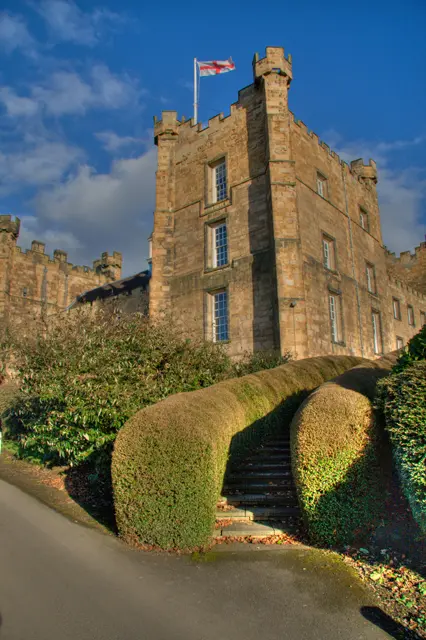
Lumley Castle stands above the Lumley Park Burn at Chester-le-Street, County Durham: a quadrangular castle with four angle towers, licensed by the Bishop of Durham in 1389 and by Richard II in 1392 for Sir Ralph Lumley, who was killed in January 1400 fighting to put the deposed king back on his throne.
Where is Lumley Castle?
- Location
- County Durham, United Kingdom
- Type
- Castle
- Coordinates
- 54.855, -1.553
- Last updated
LOCATION
Why is Lumley Castle said to be haunted?
It is listed Grade I, was remodelled around 1721 in work Historic England attributes to Sir John Vanbrugh, and has been a hotel since the 1970s. Its ghost is Lily of Lumley, said to have been Ralph's first wife, murdered by two priests for her Wycliffite faith and thrown down a well while they told her husband she had entered a convent. The family's own historian, Edith Milner, wrote in 1904 that no such woman can be traced in any Lumley pedigree, and that the first-wife version came from a Victorian romance. The legend reached the sports pages in 2000 and 2005, when West Indian and Australian cricketers staying here made headlines — though the West Indies captain blamed a team-mate with a bedsheet.
What is the history of Lumley Castle?
The Lumleys were at Lumley long before there was a castle there. William Fordyce, writing his county history in 1857, took the manor house to have been raised by Sir Robert Lumley in the reign of Edward I and reckoned the castle proper the work of his descendant Sir Ralph. Ralph came into the inheritance early: his elder brother Robert died young and unmarried, and Ralph, still under age, was brought up by his widowed mother, according to Edith Milner, who wrote the family's own records in 1904 with the muniments in front of her.
He made his name on the Scottish border in the retinue of Henry Percy, Earl of Northumberland. Milner has him on the expedition into Scotland in 1386, Governor of Berwick-upon-Tweed in 1387, a prisoner of the Scots in 1388 and Deputy-Governor of Berwick under Percy in 1391; Fordyce dates his summons to Parliament as a baron to 1385. The licence that turned the manor house into a castle is the one date that has been garbled for a century and a half. Fordyce printed "the 16th year of Richard II., 1389", which cannot be right both ways, because the sixteenth year of Richard II began in June 1392; Milner gives 1392 alone; Historic England's list entry records licences to crenellate of 1382 and 1392. The clearest statement is the hotel's own, on the version of its website archived in May 2000: Ralph "obtained permission from the bishop in 1389 and from the king (Richard II, a friend of Lumley) in 1392". He married Eleanor, daughter of John, Lord Neville of Raby and sister of the first Earl of Westmorland.
He did not keep his castle long. In January 1400 he joined Thomas Holland, Earl of Kent, and other lords in the rising to put the deposed Richard II back on the throne. Fordyce says Lumley was a standard-bearer and was slain in the field; Milner, who calls him luckier than his companions, says he was in his thirty-ninth year, and that twenty-eight other leaders were overpowered by the inhabitants of Cirencester and taken to Oxford, where Henry IV had them executed. Lumley was attainted and his lands seized. His son John was restored in blood by act of Parliament in the thirteenth year of Henry IV and was killed at Bauge Bridge on Easter Eve, 13 April 1421, beside Thomas, Duke of Clarence; it was Ralph's grandson, Sir Thomas Lumley, who obtained the reversal of his grandfather's attainder on the accession of Edward IV. The timeline the hotel has published since at least 2006 tells this differently, giving 1421 for the recovery of the castle and 1461 for the peerage.
The castle's proudest years belonged to John, Lord Lumley, who died in 1609: collector, genealogist and assembler of the ancestor gallery that Fordyce still found in the Great Hall in 1857 — seventeen portraits larger than life, the pedigree written in gold letters, and Liulph the Saxon on horseback at the end of the room above fifteen couplets of Latin verse "ringing all possible changes on the word mundus". Most of them, Fordyce thought, were painted to order for Lord Lumley rather than from life. James I was entertained here on his accession, and Fordyce preserves the king's interruption when Bishop James began reciting the family descent: "O mon, gan na further, let me digest the knowledge I hae gained; for, by my saul, I did na ken Adam's name was Lumley."
In the Civil War Richard Lumley garrisoned the castle for the king, served under Prince Rupert and compounded for his estate at 1,955 pounds 10 shillings. Around 1721 the interior was remodelled; Historic England attributes the work to Sir John Vanbrugh, including the groin-vaulted library on the ground floor of the south-west tower that later became the hotel's restaurant, and dates the state-room plasterwork to about 1730-45, with the Garter Room of c.1745 "probably by Pietro La Francini".
Then the family moved out. Fordyce, in 1857: "For a long period the castle has been dismantled of its furniture, deserted by its owners, and uninhabited except by housekeepers, one of whom, who died a few years ago, had lived within its walls 65 years, during which four Earls of Scarborough possessed the place." The site of the private chapel licensed by Bishop Langley in 1432 was by then unknown. Half a century later Milner found it lived in again: Frederica, Countess of Scarbrough, who had married Richard Lumley, the future ninth Earl, in October 1846, spent winter and spring there and had gathered old carved settles and tables for the Barons' Hall.
The hotel came last, and its own site has given the date two ways: the page online in 2000 said "Lumley Castle opened in 1984 as No Ordinary Hotel", while the page published from 2006 to 2019 said No Ordinary Hotels became tenants in 1976. Companies House shows the operating company incorporated on 13 April 1971 as Historic Productions (Durham) Limited and renamed Lumley Castle Hotel Limited on 3 October 1985. Throughout, the freehold has stayed with the Earls of Scarbrough.
Timeline: the documented record of Lumley Castle
- 1385 Ralph Lumley is created a parliamentary peer by summons and builds the eastern front of the castle, according to Fordyce's county history.
- 1389 and 1392 Permission to fortify the manor house: from the Bishop of Durham in 1389 and from Richard II in 1392, as the hotel's own website set it out in 2000. Historic England records licences to crenellate of 1382 and 1392; Fordyce printed the contradictory '16th year of Richard II, 1389'.
- January 1400 Lumley is killed in the rising for the deposed Richard II, standard in hand; twenty-eight other leaders are seized by the townspeople of Cirencester and executed at Oxford. He is attainted and the estate forfeited.
- 13 April 1421 Ralph's son Sir John Lumley, restored in blood under Henry IV, is killed at Bauge Bridge beside the Duke of Clarence. The reversal of the attainder is obtained later by his son Sir Thomas, on the accession of Edward IV.
- 1603 James I is entertained at Lumley by John, Lord Lumley, on his accession. Fordyce, who is careful to say it may have happened on this visit or on a later progress, records the king cutting short a recital of the family pedigree: 'I did na ken Adam's name was Lumley.'
- c. 1721 The interior is remodelled in work Historic England attributes to Sir John Vanbrugh; the state rooms are decorated c.1730-45, the Garter Room probably by Pietro La Francini.
- 1857 Fordyce describes the castle room by room and finds it 'dismantled of its furniture, deserted by its owners, and uninhabited except by housekeepers'. In some forty-five thousand characters on the castle and the family he never mentions a ghost, a well or a murdered lady.
- 1886 William Brockie's collection of County Durham legends and superstitions mentions Lumley once, for Sir John Duck's hospital, and Lily not at all.
- 1904 Edith Milner, writing the family's records, reports 'a legend of a murdered Lady of Lumley, who cannot be traced in any of the genealogical tables', and attributes the first-wife version to the author of a romance called The Lily of Lumley, dedicated to Frederica, Countess of Scarbrough.
- 2000 Three West Indies players, including the captain Jimmy Adams, leave the hotel during a one-day international at the Riverside. Adams told the Telegraph in 2009: 'There were a few funny goings-on, but we put them down to Franklyn Rose running around under a bedsheet.'
- June 2005 The Australian squad stays at the castle before a match against England at the Riverside. Media officer Belinda Dennett describes seeing 'a procession of white people'; Shane Watson sleeps on Brett Lee's floor and later says he saw nothing and had been wound up by the team's bus driver.
- 2019-2024 The hotel runs a page titled 'Lily, the Ghost of Lumley', with a Lily-themed escape room. In this telling the well has moved from the basement to the castle grounds and Wycliffe has vanished from the story.
- 26 September 2023 Lumley Castle Hotel Limited, the operating company incorporated in 1971, goes into administration; it passes into creditors' voluntary liquidation on 16 September 2025. A new company under the Scarbrough estate had been incorporated on 6 September 2023.
- 23 January 2026 The rebuilt hotel website publishes a sitemap of thirty-nine pages with no page about the ghost, the escape room or the castle's history. The only surviving trace is one clause in the guided-tour blurb.
Is there a rational explanation for Lumley Castle?
The story as it usually reaches the internet cannot be true as told, and the giveaway is the word "Reformation". Sir Ralph Lumley was killed in January 1400; the English break with Rome came in the 1530s. Nobody could abandon Catholicism in the 1390s because there was nothing else in England to abandon it for. The versions told at the castle itself do not make that mistake: the 2000 page said Lily, like her husband, was "an ardent follower of Wycliffe, the church reformer", which puts the tale in the world of Lollardy, not the Reformation.
That framing is itself a clue about where the story comes from. Milner, in 1904, records the family tradition that Sir Ralph "leaned strongly to the doctrines of Wycliffe" and wonders whether Richard II ignored the rumours because his queen, Anne of Bohemia, had similar leanings. In the same paragraph she disposes of Lily: "There is also a legend of a murdered Lady of Lumley, who cannot be traced in any of the genealogical tables. This is taken advantage of by the author of 'The Lily of Lumley,' a romance of this period mingling fact with fiction, in which the murdered lady is made the first wife of Ralph of Lumley." The family's own historian, with the pedigrees in front of her, says the woman is not in them, and that the first-wife version is a novelist's.
The romance can be dated only within a range. Milner quotes its dedicatory sonnet, addressed to Frederica, Countess of Scarbrough, who married into the family in October 1846 and was still wintering at the castle when Milner wrote. So the earliest printed telling I can fix is Victorian or later — some four and a half centuries after the events it describes.
Before that, the silence is measurable. Fordyce's county history of 1857 gives Lumley Castle and the Lumley family about forty-five thousand characters, room by room and generation by generation; in that whole stretch the words lily, ghost, haunt, apparition, spectre, nun and priest do not appear once. The control matters more than the zero: the same volume prints, at length, the Chester-le-Street ghost story from Glanvill's Saducismus Triumphatus, the Cauld Lad of Hylton with the 1609 inquest that goes with it, and the Lambton Worm. Fordyce published the local supernatural when he had it. William Brockie's Legends and Superstitions of the County of Durham (1886) has 59 occurrences of "ghost" and 14 of "Lambton" in 329,000 characters, and exactly one of "Lumley" — Sir John Duck's hospital — and none of Lily. The second volume of the Denham Tracts (1895), 686,000 characters of northern folklore with 65 "ghost" and 66 "legend", contains the word Lumley zero times.
The modern evidence is better attested and less impressive than it looks. In 2000 three West Indies players, including the captain Jimmy Adams, left the hotel during a one-day international at the neighbouring Riverside ground. Asked about it nine years later by Simon Briggs of the Daily Telegraph, Adams said: "There were a few funny goings-on, but we put them down to Franklyn Rose running around under a bedsheet." In June 2005 the Australian squad stayed here before an England match at the Riverside on 23 June; the team's media officer, Belinda Dennett, told the Sun that she had seen "a procession of white people walking past" her window, and the Sun reported that Shane Watson had abandoned his room to sleep on Brett Lee's floor. Dennett corrected herself the same week — "I know what I thought I saw. I think perhaps the shadows and the moonlight were playing tricks on my mind" — and Watson told the Sydney Morning Herald that he had seen nothing at all: "Geoff Goodwin, our bus driver, started to wind me up massively about the place being haunted... Then I went back to my room, and it was a tiny little room, and I had to walk through a dungeon to get there, so I got a bit spooked out."
The commercial interest is not hidden, and the story has moved while under the hotel's care. In 2000 the well was in the basement, the substitute corpse went to a convent near Finchale, and Lily was Ralph's first wife. By 2019 the page said she had been "secretly married to Ralph Lumley before he met his wife Eleanor Neville", the well had moved to "the castle grounds", Wycliffe had dropped out entirely, and the page ended by recommending "our Lily of Lumley themed escape room". Then it stopped. The site was rebuilt, and the sitemap the hotel published on 23 January 2026 lists thirty-nine pages — every bedroom type, every wedding package, the privacy policy — and not one about the ghost, the escape room or even the castle's history. What survives is a single clause in the blurb for the guided tour, which promises "the history and ghostly goings on from days gone by". A legend that changes its premises every few years, and that its own custodian has quietly stopped selling, is not being remembered. It is being managed.
Can you visit Lumley Castle?
Lumley Castle is open and trading, but its ownership changed hands quietly and recently, and that is worth knowing before booking. Companies House records that Lumley Castle Hotel Limited — the No Ordinary Hotels operating company, incorporated in 1971 — went into administration on 26 September 2023 and into creditors' voluntary liquidation on 16 September 2025. A new company, Lumley Castle Limited, was incorporated on 6 September 2023 at the Scarbrough estate office at Sandbeck Park, Maltby, with the Earl of Scarbrough among its two directors. The hotel has been rebranded and its website rebuilt since; the restaurant that was the Black Knight is now the Knights Restaurant.
The address is Ropery Lane, Chester-le-Street, County Durham DH3 4NX, telephone +44 (0)191 389 1111. The castle stands above the Lumley Park Burn on the east side of the town, immediately beside the Riverside cricket ground, a short drive from the A1(M) and a walk from Chester-le-Street station on the East Coast Main Line.
There are 72 bedrooms, split between the castle itself and the courtyard range, plus three suites — the King James, the Queen Anne and the Bishop's. It is not a museum and there is no general admission: the building is a working hotel and a Grade I listed one. The way in without a room is to eat or drink there — the Knights Restaurant, the Library Bar and afternoon tea all take table bookings — or to book one of the ticketed events: medieval banquets with a piper, murder-mystery dinners, or the guided tour advertised as "Bastions & Brews", which is led by a resident guide called Phil and ends with a hot drink and something sweet. Prices change every season; check the current listing rather than trusting any figure quoted elsewhere.
Access is the real constraint and the hotel says so itself. Some bedrooms are reached only by spiral staircases or steep flights, and the tour warns of uneven floors and spiral stairs "typical of a castle". Anyone with mobility problems should call before booking rather than after. A limited number of dog-friendly rooms exists but has to be arranged directly. The hotel's own website blocks some automated clients with a 403 error, so if a page will not load, telephone.
Sources consulted
- Edith Milner, «Records of the Lumleys of Lumley Castle» — G. Bell & Sons, London, 1904 book
- William Fordyce, «The History and Antiquities of the County Palatine of Durham, vol. II (Chester Ward: Lumley Castle, pp. 610-618)» — A. Fullarton & Co., Newcastle, 1857 book
- William Brockie, «Legends and Superstitions of the County of Durham» — B. Williams, Sunderland, 1886 book
- Michael Aislabie Denham, ed. James Hardy, «The Denham Tracts: a collection of folklore, vol. II» — Folklore Society, London, 1895 book
- Historic England, «List entry 1120960: Lumley Castle, Little Lumley (Grade I, first listed 4 June 1952)» — National Heritage List for England, 1952 report
- Lumley Castle Hotel, «Welcome to Lumley Castle - No Ordinary Hotel (history.asp, archived 30 May 2000)» — lumleycastle.com via the Internet Archive, 2000 archive
- Lumley Castle Hotel, «Lily, the Ghost of Lumley (archived 16 July 2019)» — lumleycastle.com via the Internet Archive, 2019 archive
- BBC Sport, «Aussies spooked» — BBC Sport, 22 June 2005, 2005 newspaper archive
- Simon Briggs, «England v West Indies: Preview» — The Daily Telegraph, 13 May 2009, 2009 newspaper archive
- Martin Williamson, «Rewind to 2005: 'Scared dinkum' and dead-drunk Australians» — ESPNcricinfo, 15 June 2013, 2013 newspaper archive
- Companies House, «LUMLEY CASTLE HOTEL LIMITED (company 01007671): insolvency record and company overview» — Find and update company information, UK Government, 2025 report
- Companies House, «LUMLEY CASTLE LIMITED (company 15120144): officers and persons with significant control» — Find and update company information, UK Government, 2023 report
- Newcastle University Library, Special Collections, «Conjurations, inchantments and witchcrafts - Haunted Castles: Lumley Castle (exhibition, 2004)» — ncl.ac.uk via the Internet Archive, 2004 archive
- Lumley Castle, «page-sitemap.xml and Events pages (39 pages, generated 23 January 2026)» — lumleycastle.com via the Internet Archive, 2026 web
Reviewed by V. Serrano on 2026-08-12 · How we verify our content
💬 Field testimonies (0)
No testimonies yet. Add the first.
Add your testimony
🔒 Log in to add a testimony