👻 HAUNTED PLACE · EXP. Nº9476
ACTIVE
Minsden Chapel
Minsden Chapel is a roofless flint shell in a Hertfordshire wood, and the paper trail behind it is unusually complete: a chapel of ease to Hitchin, first recorded in a will of 1487, stripped of its bells by thieves in 1725, host to its last wedding in 1738 and slowly falling down ever since.
Where is Minsden Chapel?
- Location
- Hertfordshire, United Kingdom
- Type
- Church / religious site
- Coordinates
- 51.907, -0.26
- Last updated
LOCATION
Why is Minsden Chapel said to be haunted?
Its most-repeated ghost story is far younger than the ruin. A book of Hertfordshire church traditions published in 1886 and a walker's account written inside the ruins in 1902 both describe Minsden in detail and mention no ghost at all. The first datable first-hand account is a Halloween vigil held in 1923 by the ghost-hunter Elliott O'Donnell, who reported that nothing happened which could not be explained naturally, and whose host that night showed him the famous photograph of a spectral figure — a nun, in the version told then. The photographer, Thomas William Latchmore, is said to have admitted in 1930 that the picture was a deliberate double exposure. The local historian Reginald Hine, who leased the ruin and whose ashes were scattered there in 1949, never disowned it.
What is the history of Minsden Chapel?
Minsden Chapel took four hundred years to die, and almost every stage of the decline is documented.
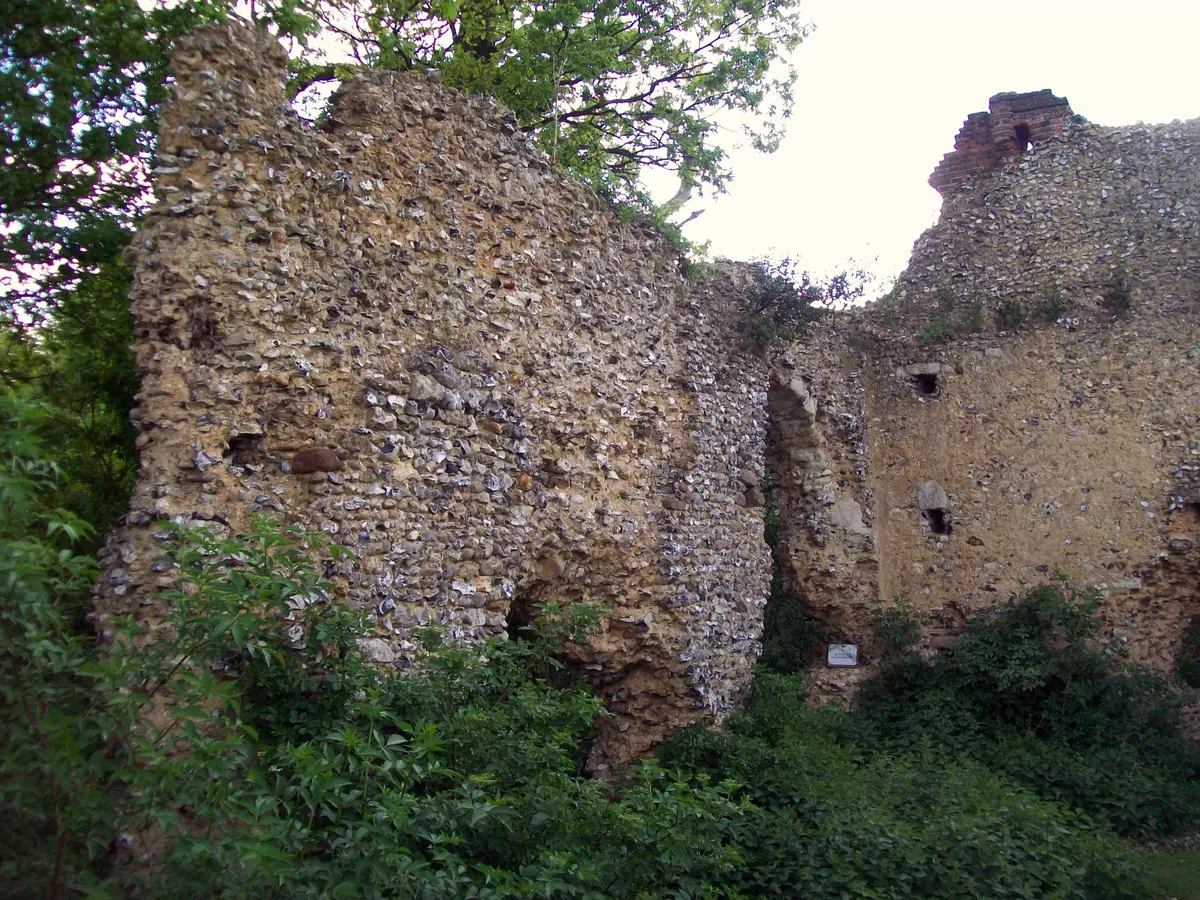
The standing fabric — flint rubble with stone dressings, a nave and a narrow square-ended chancel — is normally dated to the 14th century, but the earliest documentary trace is later. In 1487 John Pulter left 3s 4d to the chapel of St Nicholas at Minsden; in 1517 someone left the same sum again. Those two wills, recorded in the Prerogative Court of Canterbury and printed by the Victoria County History in 1912, are the only medieval records of the place the VCH editors could find. Nathaniel Salmon, writing his history of the county in 1728, called it "the church at Menlesdene, a chapel of ease to Hitchin" — a satellite building for people who lived too far from the parish church, never a parish in its own right.
What killed it was money. In 1650 the Commonwealth commissioners reported that Minsden had paid nothing to the vicar of Hitchin for many years and was already in decay. The chapel kept being used anyway, and the record of that use is mostly a record of trouble. In 1701 Daniel Skingle, ejected from the livings of Essendon and Little Hadham, was imprisoned at the instigation of Francis Bragge, vicar of Hitchin, for having preached at Minsden although he was only "a mere layman and in a lay habit"; John Heath, warden of the chapel, was made to apologise openly in Hitchin church for letting him do it.
The bells went next. An Edwardian inventory of church goods taken in 1552 lists at Minsden "ij bell[es] in the steple" and "ij hande bell[es]". The antiquary Thomas North, compiling The Church Bells of Hertfordshire in 1886, recorded on the authority of John Edwin Cussans that there were afterwards three bells, that two of them were stolen in 1725, and that the third was taken away shortly afterwards. North also noted, in one flat sentence, that "there appears to have been a marriage celebrated in this chapel as late as 1738". By 1902, when the topographer Herbert W. Tompkins walked up from Chapel Foot for his Highways and Byways in Hertfordshire, that wedding had acquired names: Enoch West and Mary Horn. Tompkins wrote that the chapel, "like King Charles II., was an unconscionable time dying". His companion on the series, the artist Frederick L. Griggs, drew the ruins for the book.
In the 20th century the ruin was effectively adopted by one man. Reginald Leslie Hine (1883–1949), a Hitchin solicitor and the town's historian, visited constantly and obtained a lifetime lease from the vicars of Hitchin. He published a famous warning to trespassers, promising that after his death he would "endeavour, in all ghostly ways, to protect and haunt its hallowed walls". On 14 April 1949, facing disciplinary proceedings from the Law Society, Hine took his own life by stepping in front of a train at Hitchin station. He was cremated at Golders Green and his ashes were scattered at Minsden. His family set a memorial stone there; vandals damaged it in the early 1980s and it was re-laid flat. It is still legible: REGINALD … HISTORIAN OF HITCHIN … 1883 – 1949 … REQUIESCAT IN … . Hine is commemorated at Minsden, but he is not buried there.
The ruin has kept shrinking. Its best-known arch collapsed in 2008. In 2017 the Church Commissioners for England, who owned the site, circulated documents proposing to close it formally for public worship and sell it to a neighbouring landowner. Stabilisation work on the walls, funded by Natural England with Historic England, began in March 2022.
Timeline: the documented record of Minsden Chapel
- 1487 John Pulter leaves 3s 4d to the chapel of St Nicholas at Minsden. It is the earliest documentary mention of the chapel that the Victoria County History editors could trace; a second, identical bequest follows in 1517.
- 1552 An inventory of church goods records at Minsden "ij bell[es] in the steple" and "ij hande bell[es]", transcribed by Thomas North in 1886 from the Augmentation Office records.
- 1650 Commonwealth commissioners report that Minsden has paid nothing to the vicar of Hitchin for many years and is already in decay — the first official record of the chapel's collapse as an institution.
- 1701 Daniel Skingle is imprisoned at the instigation of Francis Bragge, vicar of Hitchin, for preaching at Minsden as "a mere layman and in a lay habit". John Heath, warden of the chapel, is made to apologise publicly in Hitchin church.
- 1725 Two of the chapel's three bells are stolen, and the third is taken away shortly afterwards — the documented origin of the later legend that the stolen bells can still be heard ringing.
- 1738 The last recorded wedding in the chapel. North (1886) knows only that a marriage "appears" to have taken place; by 1902 Tompkins names the couple as Enoch West and Mary Horn.
- 1902 Herbert W. Tompkins devotes a page and a half to the ruin in Highways and Byways in Hertfordshire, illustrated by Frederick L. Griggs. He records the Temple Dinsley tunnel legend but no ghost of any kind.
- 31 October 1923 Elliott O'Donnell keeps an All Hallows' Eve vigil in the ruins with the local photographer and three men from the Daily Express, which publishes an account on 2 November. O'Donnell's own conclusion: nothing happened that could not be explained physically.
- 1925 O'Donnell prints the episode in Ghostland. In this earliest first-hand account the Minsden ghost is a nun, not a monk, and the photographer says the figure appeared on the plate by accident.
- 14 April 1949 Reginald Hine, facing Law Society disciplinary proceedings, takes his own life at Hitchin railway station. His ashes are scattered at Minsden and his family sets a memorial stone there, still legible: "1883 – 1949 … REQUIESCAT IN …".
- 2008 The chapel's best-known arch collapses. By 2012 much of the north wall has gone as well.
- May 2017 The Comet reveals that the Church Commissioners for England intend to close the ruin for public worship and sell it to a neighbouring landowner. Consolidation of the walls, funded by Natural England with Historic England, begins in March 2022.
Is there a rational explanation for Minsden Chapel?
The ghost of Minsden is younger than almost everything else about the place, and the people who put it into circulation are the ones who took it back.
Start by dating the story rather than the ruin. Thomas North's Church Bells of Hertfordshire (1886) is a 251-page book whose own subtitle promises "founders, inscriptions, traditions, and peculiar uses"; the word "tradition" appears in it 34 times. It gives Minsden a paragraph, including the theft of the bells. It contains no ghost: "ghost", "haunt", "apparition" and "spectre" appear zero times in the whole volume. Tompkins in 1902 stood in the ruins and filled a page and a half — Salmon's name for it, the 1650 report, Skingle's imprisonment, the West–Horn wedding, even the local legend of a tunnel running from Temple Dinsley to the chapel. He reports no ghost either. Nor does the Victoria County History of Hertfordshire in 1912, which describes the chapel and prints an engraving of it.
The earliest first-hand ghost narrative that can actually be dated comes in 1923, and it is not the story now told. The ghost-hunter Elliott O'Donnell went to Hitchin in late October 1923 because he had heard the ruins were haunted, and called on a local gentleman — a photographer — who told him the site was locally believed to be haunted by the ghost of a nun, and showed him a photograph. According to the account the photographer gave O'Donnell then, he had taken it without thinking about the ghost at all and only found "a queer impression" resembling a shadowy nun when he developed the plate. O'Donnell held an All Hallows' Eve vigil in the ruins with him and three men from the Daily Express, which ran a piece on 2 November 1923. In his own book Ghostland (1925) O'Donnell published the verdict himself: "no ghost came, and nothing happened that we could not account for on the grounds of the absolutely physical and natural." The thrills, he wrote, were "weird but natural effects" exaggerated by gloom and loneliness.
The photograph is now generally accepted as a fake. Richard Whitmore, Hine's 2007 biographer, reports that in 1930 the photographer — Thomas William Latchmore, Hine's friend — told O'Donnell that the picture had been a deliberate experiment in double exposure. That is a different story from the accidental discovery Latchmore described in 1923, which is itself reason enough to distrust both. Hine reprinted the image in The History of Hitchin in 1929 and never disowned it.
The later reports behave the same way when you check them. Peter Underwood, who spent a night at the chapel in the 1940s and knew Hine personally, recorded seeing a glowing cross on a wall — and wrote in the same breath that it may have been a trick of the moonlight, with a full moon coming down through the trees. The "ringing of the stolen bells" turns out to have a documentary root rather than a supernatural one: bells really were taken from Minsden in 1725. And the nun of 1923 has since become a monk climbing a staircase that no longer exists, at midnight on Halloween — a story that has grown more specific as the evidence for it has grown weaker. Asked by the Comet in 2017, a Hitchin ghost-hunter, Stewart Scott, summed up the local experience: "My friends and I used to visit the site as teenagers to see if we could spot a ghost or two. Alas we never did — but it was very spooky."
Can you visit Minsden Chapel?
Nothing at Minsden Chapel is laid on for visitors: there is no gate; no ticket office; no signage; nobody on site.
The ruin stands at the north-east corner of Minsden Plantation, a small wood in the fields on the west side of Whitwell Road, in the civil parish of Langley, North Hertfordshire, postcode district SG4. Historic England's mapped grid reference for the listed building is TL 19820 24580 (51.9069 N, 0.2596 W), about 4.9 km (3.1 miles) south-south-east of Hitchin town centre and 2.2 km (1.4 miles) from St Ippolyts, whose Church of England parish it lies in. A public footpath runs past it; the Comet described the ruin in 2017 as "an important feature on a popular walking route". The farmland around is private; that footpath is both the way in and the way out.
Two designations overlap on the same standing masonry. It is a scheduled monument, National Heritage List entry 1003543, mapped in Historic England's open data as a plot of 0.0968 hectares centred on TL 19833 24590 with no scheduling date recorded; the 1968 listing calls it simply "Scheduled Ancient Monument (Herts No.14)". It is also a Grade II listed building, entry 1347462, listed on 27 May 1968 under the title "Minsden Chapel at North East Corner of Minsden Plantation Grid Reference TL 1982 2458". Scheduling makes it an offence to damage the fabric or to use a metal detector there without consent.
That list entry sets out what survives: "Much of S wall of nave stands to full height and W wall with put log holes at 3 levels. N wall more fragmentary." The chancel is down to "Half-metre high walls" with a tall angle pier at its south-east corner. Historic England carried the monument on its Heritage at Risk Register in 2021 and in 2022 under the name "Minsden Chapel, Whitwell Road"; it appears in neither the 2024 nor the 2025 register, checked in Historic England's open data on 9 September 2026. There is no lighting and no made path, and the ground turns heavy after rain. Reginald Hine's memorial slab lies flat in the chancel, inscribed "IN MEMORIAM/ REGINALD L HINE/HISTORIAN/OF HITCHIN/1883-1949/REQUIESCAT IN PACE"; his ashes were scattered here, so the slab marks a scattering rather than a grave.
Sources consulted
- Thomas North, «The Church Bells of Hertfordshire; their founders, inscriptions, traditions, and peculiar uses (Minsden entry, p. 200)» — Elliot Stock, London, 1886 book
- Herbert W. Tompkins, illustrated by Frederick L. Griggs, «Highways and Byways in Hertfordshire (Minsden Chapel, pp. 188-190; Temple Dinsley tunnel, p. 195)» — Macmillan and Co., London, 1902 book
- William Page (ed.), Victoria County History, «A History of the County of Hertford, Volume 3: Hitchin — priory church and charities (Minsden chapel and the Pulter bequest)» — Constable, London / British History Online, 1912 book
- Elliott O'Donnell, «Ghostland, chapter 'Some more recent cases' (the All Hallows' Eve 1923 vigil at Minsden, pp. 232-235)» — Philip Allan, London, 1925 book
- Peter Underwood, «No Common Task: the autobiography of a ghost hunter (Minsden vigil and conversations with Reginald Hine, p. 53)» — George G. Harrap & Co., London, 1983 book
- Layth Yousif, «Are church plans to sell off 14th century Grade II-listed 'haunted chapel' near Hitchin an own ghoul?» — The Comet (Hitchin), 11 May 2017, 2017 newspaper archive
- Historic England, «Minsden Chapel — scheduled monument record 1003543 (legacy ref. HT 14) and listed building record 1347462, Grade II» — National Heritage List for England, 2021 report
- Wikimedia Commons user Jack1956, «Photograph of Reginald Hine's memorial stone at Minsden Chapel, taken 16 December 2016 (source for the surviving inscription)» — Wikimedia Commons, 2016 archive
Reviewed by V. Serrano on 2026-08-13 · How we verify our content
💬 Field testimonies (0)
No testimonies yet. Add the first.
Add your testimony
🔒 Log in to add a testimony