👻 HAUNTED PLACE · EXP. Nº9477
ACTIVE
Netley Abbey
Netley Abbey is not a ruin of the Reformation, and that is the point everyone misses.
Where is Netley Abbey?
- Location
- Hampshire, England, United Kingdom
- Type
- Church / religious site
- Coordinates
- 50.879, -1.358
- Last updated
LOCATION
Why is Netley Abbey said to be haunted?
Cistercian monks settled here in 1239, on the shore of Southampton Water; Henry VIII's commissioners suppressed the house in 1536 and on 3 August granted it to Sir William Paulet, who did not pull it down but moved in, turning the church and cloister into a Tudor courtyard mansion. The church kept its roof for another 168 years. It came off in 1704, when Sir Berkeley Lucy sold the fabric for building material to Walter Taylor, a carpenter of Southampton — and Taylor was killed when the whole body of a window fell on him as he prised stones from the wall beneath it. Browne Willis printed the story in 1718, adding that Taylor had been troubled beforehand by frightful dreams and, "as some say", by the apparition of a person in the habit of a monk. Every teller since has changed it: the window moves from west to east, one dream becomes three, and by 1769 George Keate was already calling the whole thing a fable — while crediting the fable with saving the building.
What is the history of Netley Abbey?
Netley was a late and modest foundation. Peter des Roches, the powerful Bishop of Winchester, acquired the land and meant to found the house, but died in 1238; the actual foundation was carried out the following year by Henry III, who took the patronage and the dedication with it — to the Virgin, as every Cistercian house was, and to his own patron saint Edward the Confessor. The monks came from Beaulieu, King John's abbey a few miles west along the same water.
Then very little happened for three centuries, and the Victoria County History is blunt about it: Netley produced no scholars, no churchmen and no wealth. Its income was assessed at £81 2s. in 1291 and at £160 2s. 9½d. in 1535, which put it among the lesser monasteries suppressed first. What the house was known for was where it stood. The commissioners who came to close it in 1536 wrote that it was a "large buyldinge and situate upon the Ryvage of the Sees", giving "to the Kinge's Subjects and Strangers travelinge the same Sees great Relief and Comforte" — a hostel for sailors, in effect. That sentence in a suppression report is the nearest thing the abbey has to an obituary.
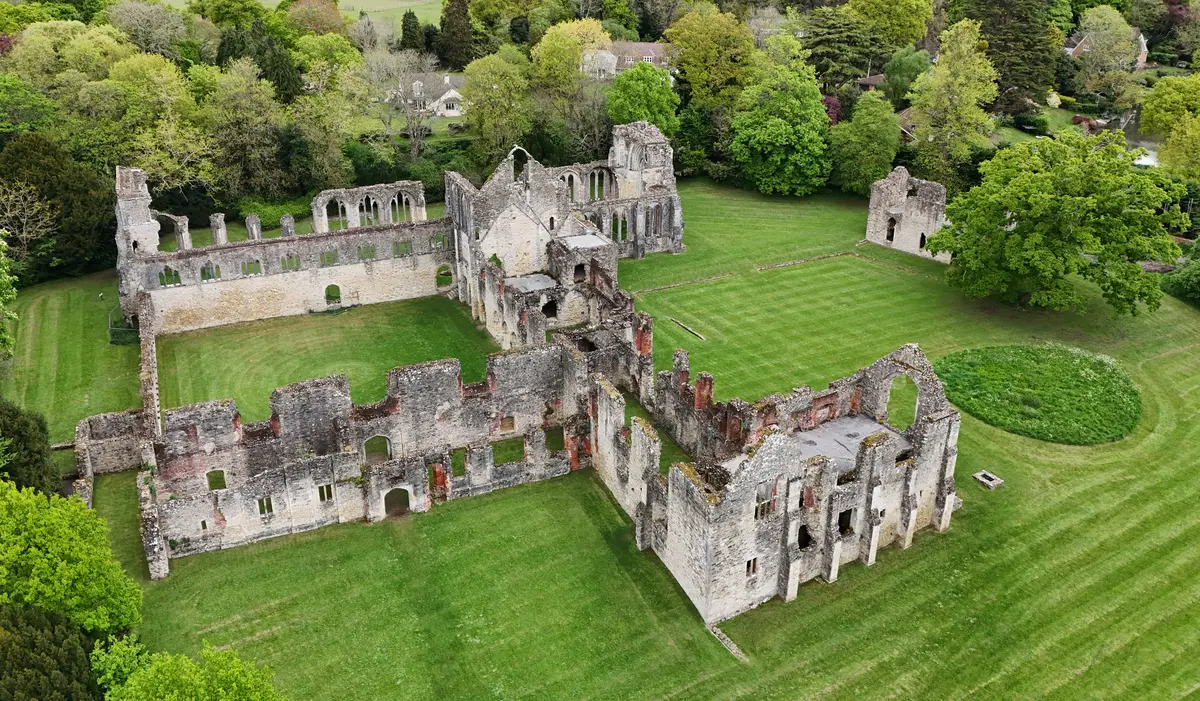
On 3 August 1536 Henry VIII granted the site and buildings to Sir William Poulett, his Lord Treasurer. Here is the fact that most accounts of Netley get wrong, this one included until today: Paulet did not pull the abbey down. He moved into it. The nave became a great hall with kitchens, the cloister walks came down to open a courtyard, the refectory was cleared to make room for a turreted entrance range, and the fabric was patched in Tudor brick — still there, red against the grey stone, in the walls of the south range. The church kept its roof.
It kept it under the Earl of Hertford and under the Earl of Huntingdon, who fitted up part of the church as a kitchen, and it kept it through the whole of the seventeenth century. Netley stopped being a house in 1704. Sir Berkeley Lucy — "Sir Bartlet Lucy" in the old guidebooks — sold the fabric of the church for building material to a Southampton carpenter named Walter Taylor, and Taylor, in Browne Willis's words, "took off the Roof (which was entire till then) and pull'd down great part of the Walls". He did not finish. A window came down on him and killed him. It is his death, and not the Reformation, that turned Netley into the ruin visitors walk today — and it is why this is the most complete Cistercian monastery left standing in southern England.
After Taylor the abbey went to Henry Clift, then to Thomas Dummer, then to the painter Nathaniel Dance, who as Sir Nathaniel Holland married Dummer's widow; Lady Holland stripped off the ivy that had made the place famous, which Philip Brannon in 1851 called the thing in Netley's history that had "excited severer animadversions" than any other. Then came the Chamberlaynes, who cleared the rubble, charged an entrance fee from the 1860s and let tea be sold in the nave. The ruins passed into State care in the early twentieth century — 1922 is the date usually given, which I have not been able to confirm in a heritage record — and English Heritage keeps them now.
Timeline: the documented record of Netley Abbey
- 1238 Peter des Roches, Bishop of Winchester, acquires the site and intends a Cistercian house there, but dies before building begins.
- 1239 Henry III carries out the foundation, populating it from Beaulieu and dedicating it to the Virgin and to Edward the Confessor. Netley is never rich and produces no notable scholars or churchmen.
- 3 August 1536 After the suppression, Henry VIII grants the site and buildings to Sir William Poulett. The commissioners' report had praised the abbey as a "large buyldinge" on "the Ryvage of the Sees" giving relief to travellers. Paulet converts it into a Tudor courtyard mansion; the church keeps its roof.
- 1704 Sir Berkeley Lucy sells the fabric of the church to Walter Taylor, a Southampton carpenter, who takes off the roof — "entire till then" — and pulls down much of the walls. Taylor is killed when the whole body of a window falls on him as he prises stones from the wall below it.
- 1718 Browne Willis prints the story under the heading "LETTELEY alias NETTLEY", saying he has no account of the abbey and is filling the entry with a history "transmitted to me out of Hamshire". His version has frightful dreams and, "as some say", the apparition of "a Person in the Habit of a Monk" — and states that the demolition was afterwards completed by others.
- 1755 Horace Walpole describes the ruins to Richard Bentley: "they are not the ruins of Netley, but of Paradise". The abbey becomes a fixture of picturesque tourism.
- 1769 George Keate's elegy on Netley records an older sacrilege story — a Jacobean Puritan crushed while directing his workmen — and dismisses it: "Superstition made its proper Use of this Fable, and was very probably the Means of protecting the Fabric." He adds that neighbours said all the tradesmen who bought materials around 1700 were "visited by Judgments".
- 1795 Richard Warner publishes Netley Abbey: a Gothic Story, a two-volume novel set in the ruins, with a woman shut in a dungeon beneath the abbey and a female shriek heard from within its walls. The previous year William Pearce's operatic farce Netley Abbey had opened at Covent Garden.
- 1800 John Bullar's visitor guide tells the Taylor story with no monk and no apparition, explains the dream as the effect of his relations' warnings, has him die of a surgeon's slip rather than the stone, and adds a footnote doubting the tale's own detail: the east window "remains to this day more entire than most parts of the ruin".
- 1842 Richard Harris Barham's "Netley Abbey. A Legend of Hampshire" appears in the second series of the Ingoldsby Legends, dedication dated 16 December 1842. It invents the walled-up nun, sources her in a footnote to a Southampton cab-driver's grandmother, and ends by revealing the ghostly moan to be a ginger-beer bottle at the tea stall.
- 1867 Adams's Guide quotes Willis at length and grafts on the surgeon's slip and the identification of Taylor's confidant as "the father of Dr. Isaac Watts" — a name Willis had left blank. The same guide contains not one ghost or spectre in its own voice.
- 1904 Charles G. Harper points out that Barham's poem blames "Ruthless Tudor" for a ruin that happened "quite a hundred and sixty years later", that Netley has no towers for the poem's "roofless tower", and that a nun has no business in a Cistercian monastery.
- August 2026 Theatre of Dark Encounters advertises an evening ghost tour inside the ruins for £7–£15, promising the phantom monk "Blind Peter" and "the deadly curse that struck down the Tudor builder who dared to demolish the church". English Heritage's own history page for the site mentions the demolition worker's death but no ghost.
Is there a rational explanation for Netley Abbey?
The odd thing about Netley is that its ghost story has been under attack, in print, for longer than most sites have had one.
George Keate got there first. In the notes to his elegy of 1769 he records an older version of the same tale: a Jacobean Puritan who defaced the ornaments, meant to pull the whole building down, and "while he was giving Orders to his Workmen, was crushed to Death by the Fall of Part of the Building", the heap of stones he was supposed to lie under still being pointed out. Keate's verdict is one sentence long: "Superstition made its proper Use of this Fable, and was very probably the Means of protecting the Fabric." He adds that around 1700 Lucy sold materials not to one man but to "Masons, Plumbers, Carpenters, &c.", and that the neighbours said all of them had been "visited by Judgments, proportioned to the different Degrees of their imagined Sacrilege". The punished sacrilegious workman is a motif at Netley, used at least twice on different men, and Keate had already noticed it.
The tellings do not agree with each other. In Browne Willis (1718) Taylor dreams once, of a large stone from one of the windows; there are frightful dreams and, "as some say", apparitions, "in particular of a Person in the Habit of a Monk"; he is prising stones from the bottom of the west wall when "the whole Body of the Window fell down suddenly upon him, and crushed him in pieces". In John Bullar's guidebook of 1800 there is no monk and no apparition at all: the dream is of the arch keystone of the east window, and Bullar explains it as the product of his relations' warnings, which "dwelt on his mind"; nor does the stone kill him, since the wound "was not deemed to be mortal" and he dies only when a surgeon's instrument slips while extracting a splinter. Bullar then undercuts his own story in a footnote: "what east window ... we know not. The east window of Netley church remains to this day more entire than most parts of the ruin." It is still standing in the photograph on this page.
The tidy modern ending — that nobody dared touch the abbey again, which is why it survives — is contradicted by the earliest source. Willis says the ruin of the fabric, "which the principal Undertaker did not live to finish", had "been since compleated", and that chapel and abbey were by 1718 "both now quite destroy'd".
The visitors' ghosts are younger than the guidebooks. Netley's three nineteenth-century guides — Bullar 1800, Philip Brannon 1851 and Adams's Guide of 1867 — between them use the words ghost, spectre and nun exactly nought times and apparition once, of a treasure dream, against 152 mentions of Netley and 106 of monks. The walled-up nun that everyone repeats is Richard Harris Barham's, printed in the second series of the Ingoldsby Legends, and Barham himself sourced her, in a footnote, to "James Harrison, a youthful but intelligent cab-driver of Southampton, who 'well remembers to have heard his grandmother say that "Somebody told her so."'" Charles Harper put the obvious question in 1904: "The curious, too, might ask what the nun was doing in a Cistercian monastery." And Barham's poem itself ends by hearing the moan of the immured woman and finding that it is the popping of a ginger-beer bottle at the tea stall in the nave.
Last, there is a live commercial interest. Netley is free to enter by day; the tours after dark are not. Theatre of Dark Encounters sells an hour inside the ruins for £7–£15, promising "the legend of the phantom monk 'Blind Peter' guarding his hidden treasure, and the deadly curse that struck down the Tudor builder who dared to demolish the church". Taylor was not a Tudor builder: he was a Dissenter working in 1704, 168 years after the Dissolution. Neither the name Blind Peter nor a treasure-guarding monk appears in any of the five historic texts read for this entry.
Can you visit Netley Abbey?
Netley Abbey stands at Abbey Hill, Netley, Hampshire SO31 5FB, close to the shore of Southampton Water. English Heritage places it four miles (6.4 km) south-east of Southampton, with Netley railway station a mile away, and lists First bus service 6. On the National Heritage List for England it is scheduled monument 1001960, at grid reference SU 45324 08974. The list entry, in a capture of January 2025, records that the abbey has been in state guardianship since 14 August 1922 and that its standing ruins were listed at Grade I after the Second World War.
English Heritage runs the site through its South Volunteer and Engagement Team, and entry is free. Its page for the abbey, read on 24 September 2026, gives the opening hours as 10am to 4pm every day except 25 December. The same page carried a notice that the abbey would be closed from 27 September until 10 October and would reopen on the 11th. According to the directions page, the free car park on site holds 10 to 12 cars and often fills in summer; there is more parking beside the Abbey Hall recreation ground, from where visitors have to cross a busy main road. The car park is locked at 4pm, when the abbey closes. There are no toilets on site, and English Heritage points instead to the shops and places to eat in Netley village. Dogs on leads are allowed.
English Heritage calls Netley "the most complete surviving Cistercian monastery in southern England" and says that almost all the walls of its thirteenth-century church still stand, together with many of the monastic buildings. Its history page adds that the alterations Sir William Paulet made after 1536, when he turned the abbey into a house, were largely in brick, and that they are difficult to see today because most were removed in the later nineteenth century. The ruins have steps and uneven surfaces throughout, although English Heritage states that wheelchair access is possible for most of the site. Climbing on the ruins is prohibited, as are smoking, vaping, barbecues and naked flames. English Heritage warns that ticks carrying Lyme disease may be present and asks that visitors keep to the defined paths. A downloadable audio tour begins at the car park, and filming or photography at the site goes through an enquiry form.
Evening ghost-story tours inside the ruins are run on set dates by Theatre of Dark Encounters, a company that has held ghost walks on the south coast since 2004. They are not English Heritage events. Its listing for Wednesday 14 October 2026, read on 24 September, gives the evening as 7.30pm to 10.30pm and the ticket price as £7 to £15. The same page says that the tour "runs just over one hour", with two tours at 7.30pm and 9pm in winter and one at 9pm in summer, and that it is not suitable for children under 12.
Sources consulted
- Browne Willis, «The History of Abbies, vol. II — 'LETTELEY alias NETTLEY'» — London, 1718 book
- George Keate, «Netley Abbey. An Elegy (2nd edition, corrected and enlarged), with its prefatory account of the abbey» — London, 1769 book
- John Bullar, «A Companion in a Visit to Netley Abbey» — Southampton, 1800 book
- Philip Brannon, «The Stranger's Guide and Pleasure Visitor's Companion to Netley Abbey» — Southampton, 1851 book
- Eustace Hinton Jones, «Adams's Guide to Netley Abbey» — Southampton, 1867 book
- Richard Harris Barham ('Thomas Ingoldsby'), «'Netley Abbey. A Legend of Hampshire', in The Ingoldsby Legends, second series (text from the 1889 collected edition, Project Gutenberg)» — Richard Bentley, London, 1842 book
- Richard Warner, «Netley Abbey: a Gothic Story, in two volumes» — Southampton, 1795 book
- William Page (ed.), «'Houses of Cistercian monks: The abbey of Netley', in A History of the County of Hampshire, vol. 2» — Victoria County History / British History Online, 1903 academic
- Charles G. Harper, «The Ingoldsby Country: Literary Landmarks of the 'Ingoldsby Legends' — chapter on Netley Abbey» — A. & C. Black, London, 1904 book
- English Heritage, «History of Netley Abbey / Visit Netley Abbey» — english-heritage.org.uk, 2026 report
- Theatre of Dark Encounters, «Ghost Stories from Netley Abbey (event listing)» — ghost-walks.com, 2026 report
- English Heritage, «Directions to Netley Abbey (parking for 10 to 12 cars, Abbey Hall recreation ground, bus and train access)» — english-heritage.org.uk, 2026 web
- Historic England, «Netley Abbey, list entry 1001960 (Scheduled Monument; guardianship since 14 August 1922)» — National Heritage List for England, 2025 report
Reviewed by V. Serrano on 2026-08-18 · How we verify our content
💬 Field testimonies (0)
No testimonies yet. Add the first.
Add your testimony
🔒 Log in to add a testimony