👻 HAUNTED PLACE · EXP. Nº9477
ACTIVE
New College Lane
New College Lane, the narrow medieval passage in central Oxford beside New College, is threaded with ghost stories built on centuries of student life and war.
Where is New College Lane?
- Location
- Oxford, England, United Kingdom
- Type
- Road / bridge
- Coordinates
- 51.754, -1.253
- Last updated
LOCATION
Why is New College Lane said to be haunted?
Locals tell of flickering blue lights along the lane after dark, said to be the restless souls of plague victims buried nearby. Another legend traces to the English Civil War, when Prince Rupert is said to have mustered volunteers here for a raid on a Parliamentarian pay convoy; people passing at night have reported hearing clattering hooves and the clank of armour, which some link to a "stone tape" imprint of that night. The lane also carries one of Oxford's grimmer student tales, of a 15th-century New College undergraduate who met a ghastly end during a late-night visit to the toilets, and locals describe an ethereal choir sometimes heard drifting from the college on quiet evenings. Ghost tour guides still walk the lane regularly to retell these stories.
What is the history of New College Lane?
New College Lane takes its name from New College, which William of Wykeham, Bishop of Winchester, founded in 1379 as The College of St Mary of Winchester in Oxford; it soon became known as New College to distinguish it from Oriel, an earlier Oxford college also dedicated to the Virgin Mary.
The Victoria County History of Oxford sets out how the site was assembled. On 30 June 1379 the king licensed Wykeham to acquire plots from Oseney Abbey, St John's Hospital, St Frideswide's, the city, Godstow and Queen's College, and from private owners. A road that ran through the site a few feet from the town wall was granted to him by the city, with power to close it, on 2 August 1379. The site had been in decay even before 1349, and certificates issued in 1415 by the mayor and by the chancellor asserted that in 1379 it was uninhabited, a place of gravel-pits and sand-pits where robbers lurked.
The foundation stone was laid on 5 March 1380, and the society took formal possession of its buildings on 14 April 1386. The same history calls New College "the first example—in Oxford at any rate—of a quadrangle planned to comprise all the buildings required for the life of the society". The accounts for 1402 show the Warden's barn, which stands across Queen's Lane, still being built. In the Civil War, the college records, Oxford was the headquarters of the Royalist forces, and when the Royalists returned the college became part of the arsenal and the cloisters a munition store.
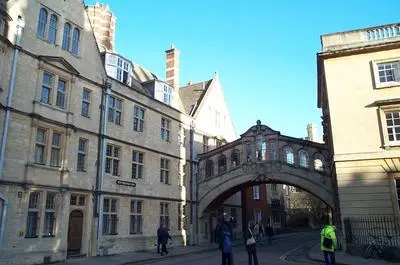
The best-known structure on the lane belongs to Hertford College. In 1901 T. G. Jackson designed new buildings for Hertford on the opposite side of New College Lane, and the split site was joined in 1913 by the unveiling of his bridge across the lane, known as the Bridge of Sighs although the Venetian bridge it most resembles is the Rialto. It was listed at Grade II on 29 January 1968.
Nos. 6 and 7 New College Lane were once a single building owned by New College, known as Stable Hall. Edmond Halley, appointed Savilian Professor of Geometry in January 1703/4, is believed to have moved into No. 7 two months later, and an observatory was built for him on the house in 1705. A slate plaque installed on the gate-post in 2019 replaced an earlier wooden one that spelt his first name Edmund.
Timeline: the documented record of New College Lane
- 1379 William of Wykeham, Bishop of Winchester, receives the king's licence (30 June 1379) to acquire plots for New College from Oseney Abbey, St John's Hospital, St Frideswide's, the city, Godstow, Queen's College and private owners. Certificates issued in 1415 describe the site as uninhabited in 1379, a place of gravel-pits and sand-pits.
- 1380 The first stone of New College is laid on 5 March 1380. The buildings are planned as a quadrangle comprising everything the society needs, and the society takes formal possession of them on 14 April 1386.
- 1402 College accounts show the Warden's barn, which stands across Queen's Lane, still being built in 1402.
- 1642-1646 During the English Civil War, Oxford serves as the Royalist capital. New College becomes part of the Royalist arsenal, with its cloisters used as a munition store. A later legend, given by Wikipedia from Ross Andrews's Paranormal Oxford (2010), places in the lane the muster for Prince Rupert's raid on a Parliamentarian pay train.
- 1703 Edmond Halley is appointed Savilian Professor of Geometry at the University of Oxford, a prestigious mathematical post he held alongside his roles as Royal Society fellow and later Astronomer Royal. Halley, who lived at 7 New College Lane, where a slate plaque installed in 2019 replaced an earlier wooden one, had an observatory built on the house in 1705.
- 1913 The Bridge of Sighs, a covered bridge connecting two parts of Hertford College across New College Lane at its northwestern end, is unveiled. T. G. Jackson designed it to join the two parts of the college site, which his buildings of 1901 had extended across the lane.
- 5 June 1968 The student newspaper Isis reports a phantom horse and carriage sighting in New College Lane. The report is known through Marilyn Yurdan's Unexplained Oxford and Oxfordshire (2002, p. 20), as cited by Wikipedia.
- 1974 Publication of 'The Buildings of England: Oxfordshire' by Jennifer Sherwood and Nikolaus Pevsner (Penguin Books, 1974).
Is there a rational explanation for New College Lane?
The best-known story told about New College Lane rests on a raid that did take place. According to the Battlefields Trust, Prince Rupert left Oxford on 17 June 1643 with 1,100 horse, 500 infantry and 350 dragoons, encouraged by knowledge that a parliamentary pay convoy of £21,000 would be in the vicinity. He missed the payroll, and the raid ended the next morning in the action at Chalgrove, where the parliamentarian Colonel John Hampden was mortally wounded. The Trust's account begins at Oxford and names no street in the city. The lane enters the story through the legend that the Wikipedia article on it takes from Ross Andrews's Paranormal Oxford (2010): that Rupert gathered volunteers in the lane for an unsuccessful mounted raid on a Parliamentarian pay train, and that the sounds of hooves and men in armour reported there have been linked to that night through the Stone Tape theory. The college's own history records the war around the lane: Oxford was the headquarters of the Royalist forces, and New College became part of the arsenal, with its cloisters used as a munition store.
Sharon Hill, in a 2017 post on her Spooky Geology blog, traces the name to The Stone Tape, a 1972 BBC drama by Nigel Kneale, and the idea behind it to older notions of psychometry and place-memory. Her verdict is that "the STT isn't a scientific theory, it's speculation", and that "there has never been demonstrated a way to record, preserve or play events in natural environmental substances as proposed".
The second story told about the lane has a single dated source: according to the same Wikipedia article, which cites Marilyn Yurdan's Unexplained Oxford and Oxfordshire (2002, p. 20), the Oxford student magazine Isis reported a phantom horse and carriage in the lane on 5 June 1968.
Can you visit New College Lane?
New College Lane runs from Catte Street, opposite the Sheldonian Theatre, to Queen's Lane at its south-eastern end, where a gate in the road prevents through traffic. The pin of this file, 51°45′16″N 1°15′12″W, is the coordinate given by the Wikipedia article on the lane; it falls about 40 metres east of the Bridge of Sighs and 0.4 km north-east of Carfax, measured between coordinates.
The bridge that crosses the lane at its north-western end is Historic England list entry 1046725, "Hertford College, Bridge over New College Lane", Grade II, first listed on 29 January 1968, at national grid reference SP 51609 06462. The entry dates the bridge to 1903, attributes it to Sir Thomas Jackson and calls it a "Famous and popular 'landmark' in Oxford" of the "'Bridge of Sighs' type, but arched over the lane".
The Halley plaque is on the gate-post of 7 New College Lane. The Oxford History site of Stephanie Jenkins describes it as dark Cumbrian slate under a comet motif, installed in 2019 to replace a wooden plaque that spelt the astronomer's name "Edmund"; it records that Halley is believed to have moved into the house in 1704 and that an observatory was built for him on it in 1705, still visible on the roof. The same page says that Nos. 6 and 7 were once a single building owned by New College, and that No. 7 is still a New College house.
New College's own visiting page, consulted on 24 September 2026, sends tourists to the Visitors' Entrance on New College Lane. From 10 March to 31 October 2026 the college opens daily from 10:00 to 17:00, with last entry at 16:30. From 1 November to 9 March it is closed on Mondays; it opens from 13:30 to 16:30 on the other weekdays and Sundays, and from 10:00 to 16:30 or dusk on Saturdays. Admission, in force since 1 August 2025, is £12 for adults and £11 for concessions, with a family ticket at £32; payment is by card only, and children under 7 enter free, as do permanent residents of the city of Oxford. Tourism enquiries go to 01865 279544, a line the page gives as staffed from 10:00 to 16:00.
A small alley at the north-western end leads past a surviving stretch of the city wall to the Turf Tavern.
Sources consulted
- Jennifer Sherwood and Nikolaus Pevsner, «The Buildings of England: Oxfordshire» — Penguin Books, 1974 book
- Geoffrey Tyack, «Oxford: An Architectural Guide» — Oxford University Press, 1998 book
- Ross Andrews, «Ghost Walk - The Free One» — Paranormal Oxford (Amberley, Chalford), pp. 29-31, 2010 book
- Marilyn Yurdan, «Unexplained Oxford and Oxfordshire» — The Book Castle, 2002 book
- Wikipedia contributors, «New College Lane, Local Legends section (citing Marilyn Yurdan, Unexplained Oxford and Oxfordshire, 2002, p. 20, for a phantom horse and carriage reported by Isis on 5 June 1968)» — Wikipedia, 2026 web
- Wikipedia contributors, «New College Lane» — Wikipedia, The Free Encyclopedia, 2025 web
- Historic England, «Hertford College, Bridge Over New College Lane» — National Heritage List for England, 1968 archive
- Wikipedia contributors, «Edmond Halley» — Wikipedia, The Free Encyclopedia, 2025 web
- C. R. L. Fletcher (ed.), «Collectanea, First Series — the scan at this address is this volume, although the Internet Archive catalogues it as Salter's Oxford City Properties» — Oxford Historical Society, 1885 book
- Stephanie Jenkins, «Oxford Inscriptions: Halley's Observatory, 7 New College Lane — the 2019 slate plaque, Halley's tenancy from 1704 and the 1705 rooftop observatory» — Oxford History (oxfordhistory.org.uk), consulted 24 September 2026, 2026 web
- New College, Oxford, «Visiting the College — visitors' entrance on New College Lane, 2026 opening hours and admission charges» — Official site (consulted 24 September 2026), 2026 web
- H. E. Salter and Mary D. Lobel (eds.), «New College — Victoria County History of Oxford, vol. 3: site assembled in 1379 (royal licence of 30 June, lane granted by the city on 2 August), foundation stone 5 March 1380, possession 14 April 1386, Warden's barn across Queen's Lane still building in 1402» — A History of the County of Oxford: Volume 3, the University of Oxford (London, 1954), pp. 144-162, via British History Online, 1954 book
- New College, Oxford, «New College history — foundation in 1379 as The College of St Mary of Winchester in Oxford, the first quadrangle of its type, and the Civil War arsenal and munition store in the cloisters» — Official site, 2026 web
- The Battlefields Trust, «Battle of Chalgrove — Rupert's raid from Oxford of 17-18 June 1643, the missed £21,000 parliamentary pay convoy and the mortal wounding of John Hampden» — UK Battlefields Resource Centre, 2026 web
- Sharon A. Hill, «The Stone Tape theory of hauntings: a geological perspective — the name from Nigel Kneale's 1972 BBC drama and the idea's roots in psychometry and place-memory» — Spooky Geology (sharonahill.com), 2017 web
- Hertford College, Oxford, «College history — T. G. Jackson's buildings across New College Lane (1901) and the unveiling of his 'Bridge of Sighs' in 1913» — Official site, 2026 web
Reviewed by V. Serrano on 2026-08-23 · How we verify our content
💬 Field testimonies (0)
No testimonies yet. Add the first.
Add your testimony
🔒 Log in to add a testimony