👻 HAUNTED PLACE · EXP. Nº1189
ACTIVE
Old Rectory, Epworth
Old Rectory, Epworth is a location reputed to be haunted in Epworth, Lincolnshire, GB. Its reputation comes from reported apparitions, unexplained phenomena and eyewitness accounts gathered over time.
Where is Old Rectory, Epworth?
- Location
- Epworth, Lincolnshire, GB
- Type
- House / mansion
- Coordinates
- 53.523, -0.817
- Testimonies
- 0
- Last updated
LOCATION
Why is Old Rectory, Epworth said to be haunted?
The Old Rectory at Epworth is the brick house Samuel Wesley built in 1709, after fire destroyed the thatched rectory his family had occupied since 1697, and the childhood home of his sons John and Charles Wesley. From 2 December 1716 to the end of January 1717 the household reported groans, knocking that answered back when knocked to, footsteps on empty stairs and a bed lifted with a girl sitting on it. Emily Wesley named the thing Jeffrey. The case is unusual because the paperwork survives: letters written while the noises were still going on, the rector's own diary, statements John Wesley took from his mother and five of his sisters in 1726, and the narrative he printed himself in 1784. Joseph Priestley published the family papers in 1791, called them the best-authenticated story of the kind extant, and concluded that the servants had done it. The house is Grade I listed and has been a Methodist museum since the 1950s. Its guides tell the Wesleys, and Old Jeffrey appears nowhere in the museum's own published material.
What is the history of Old Rectory, Epworth?
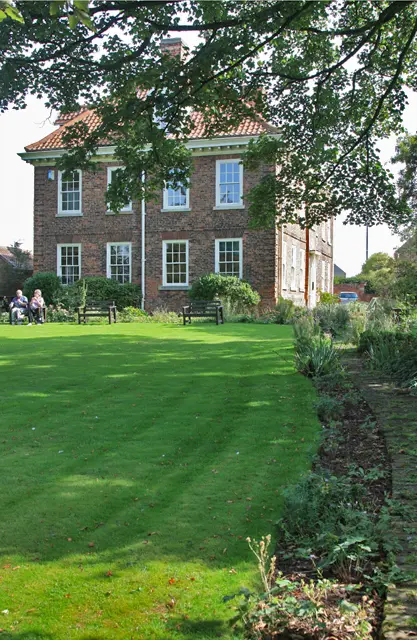
Samuel Wesley was presented to the living of Epworth in 1697 and moved his family into a rectory of timber and thatch, described in a survey the museum quotes from G. J. Stevenson's Memorials of the Wesley Family as "five baies, built all of timber and plaister, and covered with straw thatche". Fire took two thirds of the house in 1702 and the whole of it on 9 February 1709, the night his five-year-old son John was lifted out of an upper window. Samuel rebuilt in brick, spent £400 of his own money on it and stayed in debt afterwards. The building still stands on Rectory Street and holds list entry 1068805 on the National Heritage List for England, Grade I since 27 September 1951, described there as "Rectory, now house and museum. 1709 with later minor alterations; renovations of 1956-7", with a pantile roof, the south front in Flemish bond and the west garden front in English garden wall bond.
The noises ran, in John Wesley's own summary of 1784, "from the second of December to the end of January". The first to hear anything was the maid Nanny Marshall, who came into the dining room with a bowl of butter in her hand and reported groans "as of a dying man" — in the hall, in Molly Wesley's account of 1726; at the dining-room door, in their mother's letter of January 1717. The household took them for Mr Turpine, a neighbour who had the stone and used to groan so. Susanna Wesley wrote to her eldest son on 12 January 1716-7 that they had tried to laugh the girl out of her fears, and that two or three nights later "several of the family heard a strange knocking in divers places, usually three or four knocks at a time, and then stayed a little". She settled on rats, and sent for a horn because a neighbour called John Maw had driven rats out of his own house by blowing one. Her verdict on that experiment is the sharpest sentence in her letter: "from that night they began to blow, the noises were more loud, and distinct, both day and night, than before".
The rector heard nothing for a fortnight and treated the whole thing as a fright the girls were giving each other. His diary entry for Friday 21 December records the change in a line — "Knocking I heard first, I think, this night" — and he was woken a little before one by "nine distinct very loud knocks" with a pause at every third stroke. On the 26th he went down and knocked with his stick against the kitchen joists; the answer came back as often and as loud, until he tried the irregular seven-stroke knock he always used at his own gate, "but this puzzled it, and it did not answer, or not in the same method". He walked the house by day and by night, with lights and without, spoke to the noise and got "only once or twice two or three feeble squeaks, a little louder than the chirping of a bird, but not like the noise of rats, which I have often heard". Clergymen advised him to leave. His son printed the refusal: "No: let the devil flee from me: I will never flee from the devil."
The knocking kept time with the liturgy. His daughter Susannah wrote that it began when her father reached "Our most gracious Sovereign Lord", and the rector's own journal notes that "some of the family called it a Jacobite". He ran a test on it. On mornings when he shortened family prayers and left out the confession, the absolution and the petitions for King George and the Prince, nothing knocked, so "I therefore used them one morning for a trial; at the name of king George, it began to knock, and did the same when I prayed for the prince" — and ten people in the room said afterwards that they had heard it. Emily Wesley read the affair as witchcraft, on two grounds she set out herself: there had been a disturbance at a town nearby "that was undoubtedly witches", and her father had spent several Sundays preaching against consulting cunning men. Her sisters grew casual. "Jeffrey is coming: it is time to go to sleep", they told each other; and when it sounded by day they called the youngest child, "Hark, Kezzy, Jeffrey is knocking above", and she "would run up stairs, and pursue it from room to room, saying she desired no better diversion".
The case survives because Samuel Wesley junior, then teaching at Westminster, kept asking for detail and kept what came back. He put the questions a hostile lawyer would put — "Was there never a new maid, or man, in the house, that might play tricks? ... Could not cats, or rats, or dogs, be the sprights?" — and his mother answered them one at a time. His father promised him the full account and joked that "It would make a glorious penny book for Jack Dunton; but while I live I am not ambitious for any thing of that nature". In August and September 1726 John Wesley went to Epworth and took statements from his mother, from Emily, Molly, Sukey, Nancy and Kezzy, from the manservant Robert Brown and from Mr Hoole, the rector of Haxey who had sat up in the house. The heading on the manuscript reads "My Father's Journal, or Diary, transcribed by my Brother Jack, August 27. 1726, and from him by me, February 7. 1730-1". The papers stayed with Samuel junior's daughter and granddaughter, who would not hand them to John Wesley, "being offended at his conduct", on the assumption "that he would have suppressed them", and reached Joseph Priestley through the Rev. Samuel Badcock. Priestley printed them at Birmingham in 1791, the year John Wesley died.
Timeline: the documented record of Old Rectory, Epworth
- 1697 Samuel Wesley is presented to the living of Epworth and moves his family into a timber-framed, thatched rectory of five bays.
- 9 February 1709 Fire destroys the rectory; five-year-old John Wesley is taken out of an upper window. Samuel rebuilds in brick and the family move in by December, spending £400 of his own money.
- 1 December 1716 The maid Nanny Marshall reports groans at the dining-room door "as of a dying man". Molly Wesley, writing in 1726, says she had always thought it was November.
- 21 December 1716 Samuel Wesley hears it for the first time: "nine distinct very loud knocks", with a pause at every third stroke. His diary that day: "Knocking I heard first, I think, this night".
- 28 December 1716 Mr Hoole, rector of Haxey, sits up in the house at the family's invitation. The noise leaves along the south side, "sounding fainter and fainter, till it was heard no more".
- 12 January 1716-7 Susanna Wesley writes to her eldest son the earliest surviving account, and reports that the horn blown against the supposed rats made the noises louder.
- 24-27 January 1717 The knocking returns at the prayers for King George and the Prince. Samuel Wesley omits those prayers and hears nothing, then restores them "one morning for a trial" and the knocking comes back before ten witnesses.
- 27 March 1717 Sukey Wesley reports her father's trencher dancing on the table, and mentions that Emilia and Hetty are writing accounts of their own. Hetty's has not survived.
- 27 August - 16 September 1726 John Wesley takes signed statements at Epworth from his mother, five of his sisters, the manservant Robert Brown and Mr Hoole, and transcribes his father's journal.
- October-December 1784 John Wesley prints "An Account of the Disturbances in my Father's House" in three instalments in the Arminian Magazine, and offers his father's broken vow over the prayers for King William as "a key to this circumstance".
- 1791 Joseph Priestley prints the family papers at Birmingham, the year John Wesley dies, and concludes in his preface that the affair "was a trick of the servants, assisted by some of their neighbours".
- 1820 Robert Southey reprints the entire file in the Notes and Illustrations to his Life of Wesley and rejects Priestley's explanation.
- 1894 Andrew Lang records that Dr Salmon had blamed Hetty Wesley and objects that no one supporting the thesis will "hazard a guess as to the modus operandi".
- 1908 H. Addington Bruce sorts the evidence into three dated strata and shows that the marvels belong to the later ones; he names Hetty Wesley as the agent.
- 27 September 1951 The Old Rectory is listed Grade I, list entry 1068805, and later described as "Rectory, now house and museum. 1709 with later minor alterations; renovations of 1956-7".
- 1954 The Church of England sells the rectory to the British Methodist Church, with financial support from the World Methodist Council.
- 1957 The house opens as a museum and guest house. It gains Accredited Museum status in 2009 and becomes a registered charity in 2011.
- 2026 season The museum opens from 2 April to 31 October, Thursday to Saturday, 10.30am to 3.30pm, and closes for maintenance for the other five months.
Is there a rational explanation for Old Rectory, Epworth?
Priestley published the papers and disbelieved them in the same volume. His preface calls the collection "perhaps the best authenticated, and the best told story of the kind, that is any where extant" and grants that the witnesses "seem to have been sufficiently void of fear, and also free from credulity". Four pages later comes the verdict: "What appears most probable at this distance of time, in the present case, is that it was a trick of the servants, assisted by some of their neighbours, and that nothing was meant by it, besides puzzling the family, and amusing themselves." Robert Southey answered him in 1820, in the Notes and Illustrations where he reprinted the whole file, holding that many of the circumstances "cannot be explained by any such supposition, nor by any legerdemain, nor by ventriloquism, nor by any secret of acoustics".
Suspicion later moved indoors, to Hetty Wesley, whom her brother placed a year younger than Molly, "then about twenty years of age", sat up nightly on the garret stairs waiting to take her father's candle, and had the knocking closest to her. Andrew Lang, writing in 1894, named the man who had argued it and objected in the same breath: "Dr. Salmon, who supports this thesis, does not even hazard a guess as to the modus operandi", and on that reading "Hetty must have been familiar with almost the whole extent of psychical literature, for she scarcely left a single phenomenon unrepresented". H. Addington Bruce restated the case against her in 1908 and rested part of it on her silence: four of the seven sisters appear in the correspondence, and the one who wrote verse all her life is missing, which Bruce found "distinctly puzzling". Sukey's letter of 27 March 1717 undercuts that step. She tells her brother she will add nothing "because my sisters Emilia and Hetty write so particularly about it". Hetty did write an account; what survives is a collection that lost it.
Bruce's other argument is the strongest thing in the sceptical literature on this case, because it sorts the evidence by date. The letters written in December 1716 and January 1717 give knocks, groans, tinglings, squeaks, crashings and footsteps. The hand-mill spinning by itself, the bed lifted with Nancy sitting on it and the invisible shoves given to the rector appear only in the statements taken nine years later and in the narrative of 1784, "nearly seventy years after the event". That narrative is unsteady about its own date: John Wesley wrote "When I went down thither, in the year 1720, I carefully enquired into the particulars", while the depositions he took are dated 27 and 31 August and 1, 10 and 16 September 1726.
The naming moved as well. Emily wrote in 1717 that she had laughed at a household "striving half a day to fright away Jeffrey, for that name I gave it, with a horn". By 1784 the name arrives in her brother's print from a servant's mouth and comes with an origin story: "Old Jefferies is coming; (that was the name of one that died in the house) for I hear the signal."
John Wesley offered a cause of his own and said so plainly. Announcing "I think it my duty to furnish the serious reader with a key to this circumstance", he traced the knocking at the prayer for the king to a vow his father had sworn "the year before king William died", when Susanna would not say amen for King William because she did not believe the Prince of Orange was king: Samuel "vowed he would never cohabit with her till she did", rode away for a twelvemonth, came back and lived with her as before, "But I fear his vow was not forgotten before God."
One negative result sits inside the family's own file, dated Epworth, 31 August 1726: "John and Ketty Maw, who lived over against us, listened several nights in the time of the disturbance, but could never hear any thing."
The museum takes no side, because it never raises the subject. A sweep of the 67 pages and posts published at epwortholdrectory.org.uk on 7 September 2026 — 49,976 words — returned no instance of Jeffrey, ghost, haunting, poltergeist, supernatural or disturbance, against 364 of Wesley and 39 of Susanna. Its exhibition on the year itself is titled At Home With the Wesleys 1716. The nearest the site comes is a note on charms found in the fabric of the building: "rowan loops were discovered at Epworth Old Rectory when the hearth in the Fore Kitchen was restored", along with a concealed shoe, and the remark that "There is no evidence that the Wesleys were superstitious". The loops carry no date on that page. The Fore Kitchen is the room where Emily Wesley heard, on the first night she believed any of it, "a noise, like a person throwing down a vast coal in the middle of the fore kitchen", and where Robert Brown was leaning on the chimney with the tongs in his hands when something came out "like a white rabbit".
Can you visit Old Rectory, Epworth?
The Old Rectory stands at 1 Rectory Street, Epworth, North Lincolnshire DN9 1HX, a short walk from the market place on the Isle of Axholme. The museum states its season as "open from April 2nd to 31st October in 2026 on Thursdays, Fridays & Saturdays 10.30am to 3.30pm (last admissions at 3pm)", with guided tours on Thursdays and Fridays and on Saturdays for pre-booked groups only. It shuts for five months a year: "The Old Rectory is closed November, December, January, February and March for essential maintenance works." Admission on 7 September 2026 was £4.00 for a self-guided visit for anyone aged five or over; a guided tour, which includes the self-guided visit, cost £8.00 for an adult, £7.00 for a student, £4.00 for a child of seventeen or under and £22.00 for a family of six, with under-fives free. The gardens cost nothing at all and are open when the house is not: the museum describes them as "open all year round and free for everyone to enjoy". They are also what the photograph on this page shows, from the west garden front of 1709. A ramp reaches the front door and the ground floor is accessible with some small changes of level, though the site states that "Unfortunately the first floor of the house is not wheelchair accessible"; there are two accessible toilets, parking can be arranged close to the house and guide dogs are welcome. The telephone number is 01427 872268 and the museum is registered charity 1165387. Old Jeffrey appears nowhere in the museum's published material, so the whole documentary record has to be read elsewhere — free, in Priestley's edition of 1791 and in volume 7 of the Arminian Magazine, both digitised on archive.org.
Sources consulted
- Joseph Priestley (ed.), «Original Letters, by the Rev. John Wesley, and his Friends, illustrative of his early history, with other curious papers... To which is prefixed, an Address to the Methodists (preface pp. xi-xv; "Letters concerning some supernatural disturbances at my father's house, at Epworth", pp. 117-166)» — Birmingham: printed by Thomas Pearson, 1791 book
- John Wesley, «An Account of the Disturbances in my Father's House (three instalments, October-December 1784, pp. 548-550, 606-608, 654-656)» — The Arminian Magazine, vol. 7, 1784 newspaper archive
- Robert Southey, «The Life of Wesley; and the Rise and Progress of Methodism, vol. 1, ch. 1 and "Original Accounts of the Disturbances, by Jeffery, at Epworth", Notes and Illustrations, pp. 432-469» — London: Longman, Hurst, Rees, Orme and Brown, 1820 book
- Andrew Lang, «Cock Lane and Common-Sense (pp. 119-120 on the Hetty Wesley thesis; pp. 346-347 on the imposture theory)» — London: Longmans, Green, and Co., 1894 book
- H. Addington Bruce, «Historic Ghosts and Ghost Hunters, ch. 3, "The Haunting of the Wesleys", pp. 36-55» — New York: Moffat, Yard and Company, 1908 book
- Historic England, «The Old Rectory, Rectory Street, Epworth - National Heritage List for England, list entry 1068805, Grade I, first listed 27 September 1951, amended 10 September 1987» — National Heritage List for England, 1951 report
- Epworth Old Rectory, «Visit the Old Rectory - opening season, times, admission prices and access (consulted 7 September 2026)» — epwortholdrectory.org.uk, 2026 web
- Epworth Old Rectory, «The History of Epworth Old Rectory - the first rectory, the fire of 1709, the rebuilding, and the sale to the Methodist Church in 1954» — epwortholdrectory.org.uk, 2026 web
- Epworth Old Rectory, «What was life like in the 18th century? - rowan loops and a concealed shoe found in the Fore Kitchen hearth» — epwortholdrectory.org.uk, 2023 web
Reviewed by V. Serrano on 2026-09-07 · How we verify our content
💬 Field testimonies (0)
No testimonies yet. Add the first.
Add your testimony
🔒 Log in to add a testimony