👻 HAUNTED PLACE · EXP. Nº9477
ACTIVE
Pluckley
Pluckley, a hilltop village of round-headed Dering windows in the Weald of Kent, is routinely called the most haunted village in England, usually on the authority of the Guinness Book of Records.
Where is Pluckley?
- Location
- Kent, England, United Kingdom
- Type
- Village / settlement
- Coordinates
- 51.176, 0.758
- Last updated
LOCATION
Why is Pluckley said to be haunted?
The entry is real and far more modest than its reputation. Under a heading that ends in a question mark, Most haunted village?, the 1989 edition says only that Pluckley in Kent is generally thought to be the most haunted village in England boasting at least twelve spiritous inhabitants: a report of common opinion, hedged twice, printed beside a Dorset ghost on the B3081. The tally has never held still. Twelve in Guinness, thirteen in Arthur Eperon's Travellers' Britain of 1981, fourteen in John Brooks's Good Ghost Guide of 1994, and twelve, possibly thirteen or fourteen, on the village's own website. Older Kent topography is stranger yet: around 1905 Charles Igglesden gave Pluckley six pages in a series that advertised local legends as a selling point, opened with a railway traveller who, asked what the village was famous for, would answer brickmaking, and recorded not one ghost. The stories can be followed back to the printed page where they first appear, and to villagers who would rather Halloween did not happen.
What is the history of Pluckley?
Pluckley is a hilltop parish in the Weald of Kent, some five miles west of Ashford, and for most of its recorded history it belonged to one family. The Derings held the manor of Surrenden, east of the village, from the Middle Ages onward; the south chapel of the parish church of St Nicholas is still called the Dering chapel, and Historic England dates it, with the south aisle and porch, to the fifteenth century, the chancel, nave and tower being fourteenth-century work.
The family left a signature on the whole parish: the round-headed brick window, in pairs and threes, that guidebooks call the Dering window. The story attached to it is that a Royalist Dering escaped Parliamentarian besiegers through such a window during the Civil War, and that the shape was thereafter treated as lucky. Charles Igglesden already recorded that tradition in his Pluckley chapter, and the village's own history page today calls the escape "a popular myth", explaining that the windows were added to most or all of the Dering-owned houses during the romantic Victorian era. The repeated window that gives the village its look is, on that account, a nineteenth-century estate fashion.
The Dering century ended in 1928, when the estate was sold; Geoffrey Keynes, tracing a portrait of William Harvey, dates it by "the sale of the family effects at Surrenden-Dering in Kent in 1928". The house then became a boys' school. On 10 October 1952 it burned. Bob Ogley's chronicle of twentieth-century Kent records the day: Surrenden Manor, "once the home of the famous Dering family - who ruled the village for hundreds of years - and more recently a school, has been destroyed by fire. Only the stables remain." Ogley adds, drily, that some locals said the blaze was the work of ghosts. By 1973 Antony Hippisley Coxe's Haunted Britain could point only to "the site of the manor house burned out in 1952".
The ghost catalogue, by contrast, is a twentieth-century construction, and it is possible to watch it being assembled. Frederick Saunders - spelled Sanders by some of his citers, and the author of a book whose title claims the village as his childhood playground - published a natural history of Mundy Bois in 1937, a privately printed Psychical Research in Haunted Kent in 1946, and Pluckley Was My Playground, dated 1955 by John Fraser and 1956 by the International Authors and Writers Who's Who entry that lists all three. W. H. Johnson places him in the churchyard at night, peering through the grille: "Fifty years or so ago, the experienced ghosthunter Frederick Sanders paid a night-time visit to the churchyard."
From there the tally travels. Peter Underwood compiled the first Gazetteer of British Ghosts in 1971 and toured Pluckley with The Ghost Club in 1976. Hippisley Coxe gave it twelve ghosts in 1973; Arthur Eperon's Travellers' Britain gave it thirteen in 1981; John Brooks's Good Ghost Guide listed fourteen in 1994. The Guinness Book of Records took the superlative up in its 1989 edition and still carried it in the 1998 edition, which Derek Acorah cites by page. Then television arrived twice over: Yorkshire Television filmed The Darling Buds of May here, and Steve Clark's location guide records that "the sleepy village of Pluckley in Kent had never expected the attention that it suddenly received in the summer of 1991". Ghost-hunting programmes followed, and with them the crowds the village now spends every October trying to manage.
Timeline: the documented record of Pluckley
- 15th century The south or Dering chapel, the south aisle and the Parvis porch are added to the fourteenth-century church of St Nicholas, according to its Historic England list entry; Igglesden records that the family chancel was rebuilt by a Richard Dering in the fifteenth century.
- 20 May 1772 A churchyard headstone transcribed by Igglesden records that Jesse Spicer was "killed by a Ninepin Bowl, 20th of May, 1772, aged 22 years"; the accident happened in the old Black Horse Inn. It is the oldest dated violent death the village can actually document, and no ghost is attached to it.
- 1876 Francis Haslewood publishes his Genealogical Memoranda Relating to the Family of Dering of Surrenden-Dering, in the Parish of Pluckley - a full antiquarian treatment of the family, with no ghost lore in it.
- c. 1905 Charles Igglesden writes the Pluckley chapter of A Saunter Through Kent with Pen and Pencil, volume one. He opens with a railway traveller who, asked what the village is famous for, "will probably answer, 'brickmaking'", describes church, tombs, Surrenden and the Dering windows across six pages, and records no ghost at all - in a series that advertised local legends as a feature.
- 1928 The Dering estate is sold and Surrenden Dering becomes a boys' school. Geoffrey Keynes dates a portrait's provenance by "the sale of the family effects at Surrenden-Dering in Kent in 1928".
- 1946 Frederick Saunders, who had published a natural history of Mundy Bois in 1937, privately publishes Psychical Research in Haunted Kent. W. H. Johnson cites it, and places Saunders in Pluckley churchyard at night around this period.
- 10 October 1952 Surrenden Manor is destroyed by fire while in use as a school. Bob Ogley's chronicle records that only the stables remain, and that some locals said the blaze was the work of ghosts.
- 1955 or 1956 Pluckley Was My Playground appears. John Fraser calls it "the first mention I am aware of" of the village's ghosts and dates it 1955; the International Authors and Writers Who's Who entry for Frederick Saunders dates it 1956. Fraser adds that a local man has claimed he invented extra tales for journalists during the 1950s.
- 1971 Peter Underwood compiles the first Gazetteer of British Ghosts. He will later call the most-haunted-village title a "doubtful honour" and point out that Bramshott in Hampshire has been awarded it too.
- 1973 Antony Hippisley Coxe's Haunted Britain prints the count that Guinness would later repeat: "The most haunted village in Kent can boast of twelve ghosts in and around it", and can already only offer readers the site of the manor house burned out in 1952.
- 1976 Underwood spends a long visit in Pluckley with The Ghost Club, touring "all the allegedly haunted sites" and talking with every local who claimed to have seen a ghost or experienced phenomena.
- 1981 Arthur Eperon's Travellers' Britain, published by Pan with the BBC, gives Pluckley thirteen ghosts - one more than Hippisley Coxe eight years earlier.
- 1989 edition The Guinness Book of Records, edited by Norris McWhirter and Donald McFarlan, carries the entry under the heading "Most haunted village?": "Pluckley in Kent is generally thought to be the most haunted village in England boasting at least twelve spiritous inhabitants." The 1990 edition repeats it with the figure written as 12.
- Summer 1991 Yorkshire Television's The Darling Buds of May turns Pluckley into a destination. Steve Clark's location guide records that the village "had never expected the attention that it suddenly received in the summer of 1991".
- 1994 John Brooks's The Good Ghost Guide raises the tally again, opening its entry with "Its fourteen ghosts are: a White Lady at the site of the old Manor House; another White Lady in the...".
- June 1997 The Woodland Trust buys Dering Wood, the ancient woodland two kilometres south-west of the village that ghost tours market as the Screaming Woods.
- 1998 edition The claim is still in the book: Derek Acorah cites page 228 of the 1998 Guinness Book of Records as naming Pluckley, while adding that two villages compete for the title and that he doubts there is much to choose between them.
- 23 October 2016 Parish council chairman Chris Housman tells KentOnline the council is worried about the effect of ghost-hunting on residents' lives, and asks police for a presence over Halloween and extra patrols on the night.
- September 2021 The Woodland Trust closes the Dering Wood car park after litter and vandalism; regional director Jenny Scholfield cites "additional costs to clear rubbish and repair vandalism", and Smarden Parish Council's clerk Kat Hoyle reports camping, fires, ghost tours and raves peaking at Halloween.
Is there a rational explanation for Pluckley?
The Guinness claim is the place to start, because it is the load-bearing citation for everything else, and it does not say what it is quoted as saying. The 1989 edition, edited by Norris McWhirter and Donald McFarlan, prints the entry under a heading with a question mark - "Most haunted village?" - and reads: "Pluckley in Kent is generally thought to be the most haunted village in England boasting at least twelve spiritous inhabitants." The 1990 edition repeats it with the figure as "12". That is a report of hearsay, hedged twice over by "generally thought" and "at least"; in the 1990 edition it sits immediately after a Dorset ghost said to frequent the B3081 near Sixpenny Handley. Guinness did not verify twelve ghosts; nobody could. The village's own site is franker than most retellings: it says Pluckley is "reputed to have twelve (possibly thirteen or fourteen) ghosts".
The count changes from book to book: Hippisley Coxe gave twelve in 1973, Eperon thirteen in 1981 and Brooks fourteen in 1994, and the village website now prints all three numbers in one sentence.
Charles Igglesden's A Saunter Through Kent with Pen and Pencil gave Pluckley six pages in volume one - the church, the tombstones, the Dering windows, Surrenden, the fairs, the brickworks - and the series advertised itself with the line "Local traditions and legends are a feature of the work". Igglesden duly tells ghost stories in the same volume: a white lady and a spectre coach at Kennington, a headless rider at Chilham, a Christmas Eve reenactment near Marden, the Fordwich rector's apparition. His Pluckley chapter opens with a railway traveller who, asked what the village is famous for, "will probably answer, 'brickmaking'", and it runs from the station to the brickworks without naming a single ghost.
John Fraser, of the Society for Psychical Research, reaches the same conclusion from the other direction: "the first mention I am aware of is as late as 1955 in the book Pluckley Was My Playground by Frederick Saunders. This only mentioned some of the ghosts, and a local man has apparently claimed that during the 1950s he invented some additional tales for journalists." The claim is second-hand, and Fraser reports it as such.
The writers closest to the material are the least impressed. Peter Underwood, who compiled the first British gazetteer in 1971, calls the title a "doubtful honour" and notes that Bramshott in Hampshire has been awarded it too; he toured every alleged site in 1976 with The Ghost Club and interviewed everyone in the village who claimed an experience. Sarah Hapgood writes that Pluckley "has earned itself the questionable title". Reader's Digest opens its entry with "There seems to be no particular reason why the pretty village of Pluckley" should be singled out. Derek Acorah, no sceptic, notes that two villages compete for the title and adds that he doubts "whether there is much to choose between" them.
The village's own history page calls the Dering-window escape "a popular myth" and says the windows were added to the family's houses "during the romantic Victorian era". The pub that carries the family name repeats the superlative more loosely than its source. The history page of the Dering Arms, built by the station in the 1840s as a hunting lodge for the Derings, says the village "has featured in the Guinness World Records book as the most haunted village in Britain", where the 1989 entry said England, carried a question mark and reported only what was "generally thought"; the same page, read on 8 October 2026, adds that "some say they have witnessed ghostly figures in the bar, including an old lady dressed in 19th century clothes".
Can you visit Pluckley?
Pluckley is a working village of private houses, not an attraction, and that is the single most useful thing to know before going. The parish council has said so publicly. On 23 October 2016, reacting to plans to film Celebrity Haunted Hotel Live nearby, chairman Chris Housman told KentOnline: "Everyone knows the reputation the village has, but we are just worried of the effect it has upon our residents' lives." Neighbourhood Watch coordinator Martin Chambers added that the broadcast "will describe how we're the most haunted village in England which will bring in extra ghost-hunters". The council asked police for a presence over Halloween and extra patrols on the night itself. If you visit in late October, expect that context.
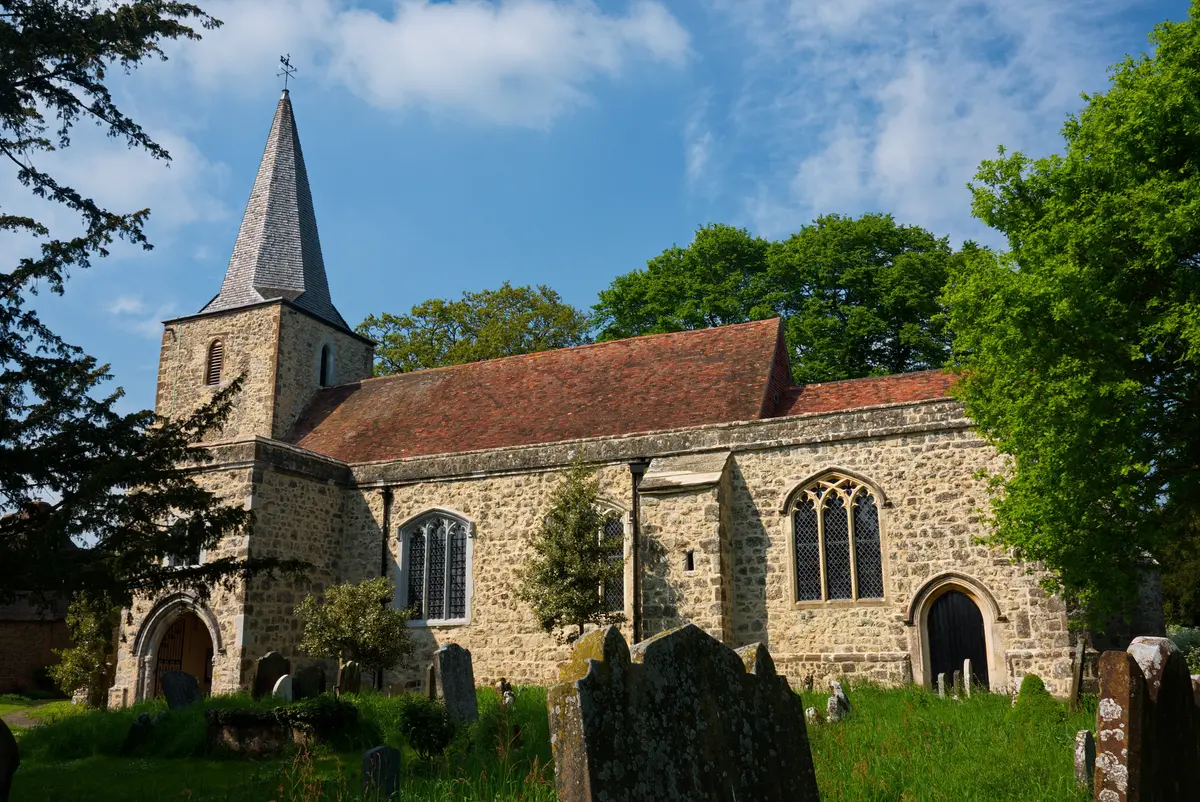
The church of St Nicholas, on The Street, is the one place plainly open to the public. It is Grade I listed, first designated on 14 February 1967 (National Heritage List for England entry 1362688), with a fourteenth-century chancel, nave and west tower carrying a broached shingled spire, a fifteenth-century Dering chapel, south aisle and Parvis porch, a crown-post nave roof, a piscina, double sedilia and box pews. The churchyard is worth the walk on its own: eighteenth-century chest tombs, early eighteenth-century headstones with crudely incised skull and crossbones, and later stones with cherubs, hourglasses, sunrays and the reaper. National grid reference TQ 92669 45351.
The Screaming Woods of the ghost tours is Dering Wood, and it is not in the village: the Woodland Trust, which bought it in June 1997, places it about 2 km south-west of Pluckley and 10 km west of Ashford. It runs to 125.56 hectares (310.26 acres) of ancient semi-natural woodland mentioned in Domesday, with six entrances, an all-access kissing gate at the main one, unsurfaced and often muddy paths, two waymarked trails of 1.6 km and 2.9 km, and a small free car park. Dogs are welcome. Behave: in September 2021 the Trust's regional director Jenny Scholfield said that "at Dering Wood we have additional costs to clear rubbish and repair vandalism", the car park was closed in response, and Smarden Parish Council's clerk Kat Hoyle described "camping, fires, ghost tours, and even raves" plaguing the community all year and peaking at Halloween.
Pluckley has its own railway station on the line into Ashford, about a mile downhill from the village and with a car park. Walking up the hill is the classic approach - Igglesden was recommending it a century ago, when the station-bound traveller assumed the village was famous for brickmaking - and takes roughly twenty minutes. Beside the station, the Dering Arms (The Grove, Pluckley TN27 0RR) serves Tuesday to Saturday 11.30-15.30 and 18.00-23.00 and Sunday lunchtime only, closed Sunday evening, all Monday and bank holidays, with food from 12.00 to 14.00 and 18.30 to 20.00.
Do not look for Surrenden Dering. The house burned down on 10 October 1952 and only the stables survived; the site is private land with nothing to see.
Sources consulted
- Norris McWhirter and Donald McFarlan (eds.), «The Guinness Book of Records 1989 (entry "Most haunted village?")» — Guinness Publishing, Enfield, 1989 book
- Donald McFarlan and Norris McWhirter (eds.), «The Guinness Book of Records 1990 (same entry, "at least 12 spiritous inhabitants")» — Guinness Publishing, 1990 book
- Charles Igglesden, «A Saunter Through Kent with Pen and Pencil, volume I: Pluckley, pp. 41-46 (4th ed., text as originally written c. 1905)» — Kentish Express, Ashford, 1925 book
- Antony Hippisley Coxe, «Haunted Britain: a guide to supernatural sites frequented by ghosts, witches, poltergeists and other mysterious beings» — Hutchinson, London, 1973 book
- Bob Ogley, «Kent: A Chronicle of the Century, vol. 3, 1950-1974 (entry for 10 October 1952)» — Froglets Publications, Westerham, 1998 book
- John Fraser, «Ghost Hunting: A Survivor's Guide (Pluckley, Kent)» — The History Press, Stroud, 2010 book
- Peter Underwood, «The Ghost Hunter's Guide» — Javelin Books, London, 1988 book
- W. H. Johnson, «Kent Stories of the Supernatural» — Countryside Books, Newbury, 2000 book
- Historic England, «National Heritage List for England, entry 1362688: Church of St Nicholas, Pluckley (Grade I, listed 14 February 1967)» — National Heritage List for England, 1967 report
- Derek Acorah, «Ghost Hunting with Derek Acorah» — HarperElement, London, 2005 book
- Steve Clark, «The British Television Location Guide (The Darling Buds of May, Pluckley)» — Seaspite, Southsea, 1993 book
- Woodland Trust, «Dering Wood, Pluckley - site information» — woodlandtrust.org.uk, 2026 web
- Francis Haslewood, «Genealogical Memoranda Relating to the Family of Dering of Surrenden-Dering, in the Parish of Pluckley, Kent» — privately printed, 1876 archive
- Geoffrey Keynes, «The Portraiture of William Harvey (Thomas Vicary Lecture 1948): the 1928 sale of family effects at Surrenden-Dering» — Royal College of Surgeons of England, 1949 academic
- Arthur Eperon, «Travellers' Britain (Pluckley: thirteen ghosts)» — Pan Books with the BBC, London, 1981 book
- John Brooks, «The Good Ghost Guide (Pluckley: fourteen ghosts)» — Jarrold, Norwich, 1994 book
- KentOnline, «Pluckley residents haunted by ghost-hunter influx fears as Celebrity Haunted Hotel Live visits» — KentOnline (Kentish Express), 2016 newspaper archive
- Fox News (from wire reporting), «Famously haunted town in England begs ghost hunters to stop littering» — foxnews.com, 2021 newspaper archive
- Pluckley village website, «Ghosts and History (official village website): "twelve (possibly thirteen or fourteen) ghosts"» — pluckley.net, 2026 web
- Sarah Hapgood, «500 British Ghosts and Hauntings (Pluckley: "the questionable title")» — Foulsham, London, 1993 book
- Reader's Digest Association, «The Most Haunted and Mysterious Places in Britain (Pluckley entry)» — Reader's Digest, London, 2009 book
- Melrose Press, «International Authors and Writers Who's Who (Frederick Saunders: Natural History of Mundy Bois 1937; Psychical Research in Haunted Kent 1946; Pluckley Was My Playground 1956)» — Melrose Press, Cambridge, 1976 book
- Richard Jones, «Walking Haunted London (the White Lady in an airtight lead coffin with a single red rose on her breast)» — Passport Books, Lincolnwood, 1999 book
- The Dering Arms, «The Dering Arms, Pluckley - opening hours and address» — deringarms.com, 2026 web
- Pluckley village website, «History (official village website): the Dering window escape "a popular myth" that led to Dering windows on the family's houses "during the romantic Victorian era"; the 1928 sale and the boys' school» — pluckley.net, 2026 web
- The Dering Arms, «History - The Dering Arms Pub and Restaurant: a Dering hunting lodge built in the 1840s; Pluckley "known for its haunted status" and "the most haunted village in Britain"; "ghostly figures in the bar"» — deringarms.com, 2026 web
Reviewed by V. Serrano on 2026-08-13 · How we verify our content
💬 Field testimonies (0)
No testimonies yet. Add the first.
Add your testimony
🔒 Log in to add a testimony