👻 HAUNTED PLACE · EXP. Nº9476
ACTIVE
Raynham Hall
Raynham Hall, the Townshend seat in Norfolk, is where the most reproduced ghost photograph ever taken was made: on 19 September 1936 Captain Hubert C. Provand and Indre Shira, on a commission from Lady Townshend, exposed a plate of the great staircase, and Country Life printed the result on 26 December 1936 alongside Harry Price's verdict that only collusion between the two men could explain it.
Where is Raynham Hall?
- Location
- Norfolk, United Kingdom
- Type
- House / mansion
- Coordinates
- 52.797, 0.79
- Last updated
LOCATION
Why is Raynham Hall said to be haunted?
The figure is usually called Dorothy Walpole, sister of Sir Robert Walpole, who married the 2nd Viscount Townshend in July 1713 and died on 29 March 1726. But order the story by the date of each telling and it comes apart. The earliest printed trace of "the Brown Lady" is four sentences in Catherine Crowe's book of 1848, with the house hidden behind an initial. The famous sightings by Colonel Loftus cannot be dated closer than 1835-1849 and were not printed until 1878. And the fullest Victorian account, Ingram's of 1884, ends flatly: there is no known legend attached to her at all. No Walpole, no Marryat. The name arrives in 1936 — in a book written by the family, the same year as the photograph.
What is the history of Raynham Hall?
Raynham Hall's ghost is older than the name attached to it, and the gap between the two is the most interesting thing in the case.
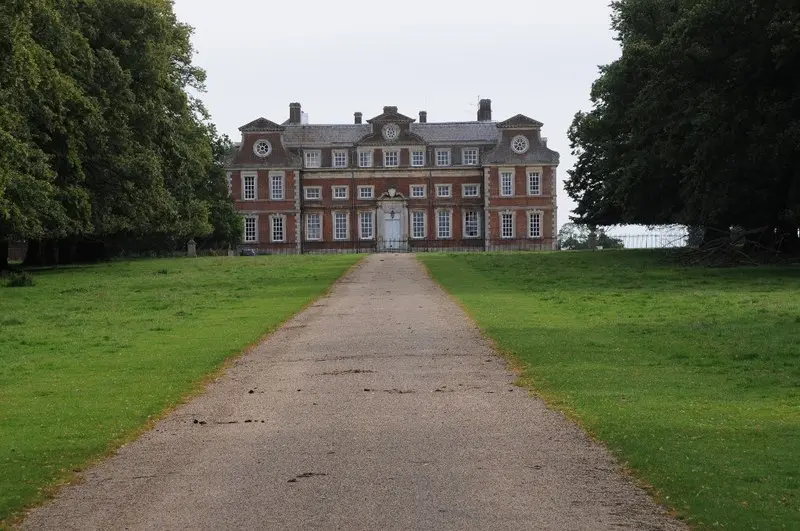
The house came first. Sir Roger Townshend began building on the estate in 1619, abandoned that start and began again on a different site in 1622, working with the mason William Edge; by his death in 1637 the building was structurally complete. The Historic England listing describes the result as a hybrid — Mannerist detail married to the Palladianism of Inigo Jones — in red brick with stone dressings on an H-plan. Then, between roughly 1725 and 1732, William Kent was let loose on the interior for Charles Townshend, 2nd Viscount Townshend, producing the double-height Marble Hall, the great staircase and a service wing around 1731. That date matters more than it looks: the interior through which the Brown Lady is said to walk was being rebuilt in the very years the woman she is now identified with died.
That woman is Dorothy Walpole. The printed genealogy of the family states it flatly: Charles Townshend "married, secondly, in July 1713, Dorothy, daughter of Robert Walpole, of Houghton, in Norfolk, Esq., and sister to Sir Robert Walpole, first Earl of Orford, who left him a widower, March 29, 1726, by whom he had issue four sons and two daughters." She was his second wife — Elizabeth Pelham had died in 1711 — and the marriage ran twelve years and nine months, in which she bore six children. Her brother is conventionally called Britain's first prime minister, but the office did not formally exist in his lifetime; the label is retrospective.
The ghost, by contrast, arrives in print anonymously and late. The earliest appearance this file has been able to date is Catherine Crowe's "The Night Side of Nature" of 1848, in the chapter on haunted houses, and it is four sentences long: "The story of the Brown Lady at the Marquis of T.'s, in Norfolk, is known to many. The Hon. H. W. told me that a friend of his, whilst staying there, had often seen her, and had one day enquired of his host, 'Who was the lady in brown that he had met frequently on the stairs?'" Crowe adds that two gentlemen resolved to intercept the figure, that she eluded them by turning down a staircase, and that many persons have seen her. She names no house, no family and no dead woman.
The fullest early account was written by Lucia C. Stone and printed in the anthology "Rifts in the Veil" in 1878. John Henry Ingram reproduced it in "The Haunted Homes and Family Traditions of Great Britain", first published in 1884, and it is from him that every later version descends. Stone said she had it from an eye-witness and offered, as proof, that all the names were given in full; Ingram warned that "the time of the incidents, however, cannot be given any nearer than between 1835 and 1849."
In that account a large party gathered at Raynham for Christmas. Lord and Lady Charles Townshend were host and hostess; among the guests were Colonel and Mrs Loftus, Miss Page, and a Mr Hawkins. Loftus and Hawkins sat up late over chess, and as they said goodnight Hawkins asked: "Loftus, who is that standing at your sister's door? How strangely she is dressed." Loftus, who was short-sighted, put up his glass and followed the figure until he lost it. On a second night he cut her off from a staircase and saw, in full light, "a stately lady in her rich brocade, a sort of coif on her head, the features clearly defined; but where there should have been eyes were nothing but dark hollows." He sketched her afterwards, and Stone says she saw the sketch. Miss Page asked Lord Charles whether he believed in the apparition; he answered, "I cannot but believe, for she ushered me into my room last night."
What happened next is the part later retellings drop. The servants gave notice one after another, and Lord Charles Townshend — suspecting a trick by somebody in the house — had bolts and locks altered, and then brought down officers of the London police force and dressed them in his own livery. They found nothing during their stay.
The most quoted episode is later still. Florence Marryat published it in "There Is No Death" in 1891, as a story about her father, the novelist Captain Frederick Marryat, who spent the last fifteen years of his life at Langham in Norfolk and knew the Townshends as county neighbours. She gives no year and no season. In her telling the Hall had just changed hands and been "re-papered, painted, and furnished" throughout; her father, who thought the haunting was a smuggler's trick, slept three nights in the affected room with a pistol. On the third night, walking a dark corridor with two young men, he met a figure carrying a lamp who stopped, "holding the lighted lamp she carried to her features, grinned in a malicious and diabolical manner at him." He "sprang into the corridor with a bound, and discharged the revolver right in her face"; the bullet "passed through the outer door of the room on the opposite side of the corridor, and lodged in the panel of the inner one." There was no body.
By 1930, when C. J. S. Thompson summarised the case in "The Mystery and Lore of Apparitions", he wrote of it in the past tense: Raynham "was at one time associated with an apparition known as the 'Brown Lady'." Six years later it became the most reproduced ghost photograph ever taken.
Timeline: the documented record of Raynham Hall
- 1619-1637 Sir Roger Townshend begins Raynham Hall, abandons the first start and begins again on a different site in 1622 with the mason William Edge; the house is structurally complete by his death in 1637.
- July 1713 Charles Townshend, 2nd Viscount Townshend, marries Dorothy Walpole, sister of Sir Robert Walpole, as his second wife; his first, Elizabeth Pelham, had died in 1711.
- c. 1725-1732 William Kent remodels the interior for the 2nd Viscount, producing the Marble Hall, the great staircase and a service wing around 1731 — so the interior the ghost is said to walk was under reconstruction in the year Dorothy Walpole died.
- 29 March 1726 Dorothy Walpole dies, leaving her husband a widower after twelve years and nine months of marriage and six children. The family genealogy records the date and nothing else: no confinement, no unexplained circumstance.
- Christmas, between 1835 and 1849 At a Christmas gathering hosted by Lord and Lady Charles Townshend, Mr Hawkins points out a strangely dressed woman at a bedroom door; Colonel Loftus, short-sighted, follows her and on a second night sees a lady in brown brocade with a coif and "nothing but dark hollows" where her eyes should be, and sketches her. Asked whether he believes, Lord Charles replies: "I cannot but believe, for she ushered me into my room last night." Recorded by Lucia C. Stone from an eye-witness; her source could date it no closer than 1835-1849.
- Afterwards, between 1835 and 1849 The servants give notice one after another. Suspecting a trick by someone in the house, Lord Charles Townshend has the bolts and locks altered and then brings down officers of the London police force dressed in his own livery. They find nothing during their stay — the first recorded investigation of the case, and it came from the family.
- 1848 Catherine Crowe prints the earliest appearance of the story this file could date, four sentences long, in The Night Side of Nature: "the Brown Lady at the Marquis of T.'s, in Norfolk". She names no house, no family and no dead woman, and credits an informant she calls only "the Hon. H. W." — 122 years after Dorothy Walpole died.
- 1878 Lucia C. Stone's detailed account, "The Brown Lady of Rainham", is printed in the anthology Rifts in the Veil — roughly forty years after the events it describes, and the origin of every later version.
- 1884 John Henry Ingram reproduces Stone's account and closes it: "There does not seem to be any known legend connected with the appearance of the apparition of 'the Brown Lady.'" Neither Walpole nor Marryat appears anywhere in his book. (Text quoted here from a later reissue.)
- 1891 Florence Marryat publishes her father's encounter in There Is No Death: three nights with a pistol, a figure that grins by lamplight, a shot, and a bullet in a door panel. She gives no year and no season — the Christmas Eve framing attached to this episode by later retellings is not in her text.
- 1930 C. J. S. Thompson summarises the case in the past tense — Raynham "was at one time associated with an apparition known as the 'Brown Lady'" — and, like Ingram, names no Dorothy Walpole.
- 19 September 1936 Working from eight in the morning on a commission from Lady Townshend, Captain Hubert C. Provand and Indre Shira reach the great staircase at about four in the afternoon. Provand's head is under the focusing cloth; Shira alone sees "an ethereal, veiled form" and shouts "Quick, quick, there's something! Are you ready?" They bet five pounds on the plate, and find the figure on the negative in the darkroom with a chemist's manager as witness.
- 1936 (before September) Gwladys, Dowager Marchioness Townshend, publishes True Ghost Stories with Maude Ffoulkes. It is the earliest source this file could date that identifies the Brown Lady as Dorothy Walpole, and it tells of her son George and a friend, as small boys, meeting a lady on the staircase through whom they could see the stairs.
- 26 December 1936 Country Life publishes the photograph full size as "The Ghost of Raynham Hall: An Astonishing Photograph", with Shira's signed statement and, beside it, Harry Price's report: "I could not shake their story, and I had no right to disbelieve them. Only collusion between the two men would account for the 'ghost' if it is a fake."
- 4 January 1937 The American weekly Life reprints the photograph under the headline "Has Raynham Hall a Ghost?", which is how the image reached a world audience.
- 30 November 1951 Raynham Hall is listed at Grade I, the highest of the three grades for listed buildings in England (list entry 1049270).
- 1987 and 2012 John Fairley and Simon Welfare note that in the plate "a patch of reflected light at the top of the right-hand banister appears twice"; Joe Nickell repeats the observation in his own survey of spirit photography and reads the image as a double exposure.
- 13 August 2026 The Raynham Estate website describes the Hall, Kent's staircase and the family's history without mentioning the Brown Lady, the photograph or a ghost, and says only that "Hall tours and events will return in 2026".
Is there a rational explanation for Raynham Hall?
Order the story by the date of each telling, rather than by the date of the events, and the case changes shape.
Dorothy Walpole died on 29 March 1726. The earliest print appearance of "the Brown Lady" that this file could date is Crowe's, in 1848 — one hundred and twenty-two years later, with the house hidden behind an initial. The Loftus sightings are placed by their own source no closer than 1835-1849, and were not printed until "Rifts in the Veil" in 1878, roughly forty years after the fact. Florence Marryat's account of her father appeared in 1891; she was not present, gives no date, and her father had died in 1848.
More telling is what the Victorian sources do not say. Ingram, who gave the case its fullest treatment, closes the chapter with a flat sentence: "There does not seem to be any known legend connected with the appearance of the apparition of 'the Brown Lady.'" The words "Walpole" and "Marryat" do not occur anywhere in the edition of his book consulted here — a searched text of 1.1 MB in which "Crowe" appears eighteen times and "Rainham" five, so the zero is not a failed search. Thompson's 1930 chapter names no Walpole either. In other words, the identification of the Brown Lady with Dorothy Walpole cannot be traced, from here, further back than 1936, when the Dowager Marchioness Townshend published "True Ghost Stories" with Maude Ffoulkes — a book by the family, in the same year as the photograph.
The costume points the same way. Marryat described the portrait the ghost resembled as showing "a brown satin dress with yellow trimmings, and a ruff around her throat"; Stevens, summarising in 1945, called it "the sixteenth-century gown and ruff of the Brown Lady of Raynham". A ruff is Elizabethan and Jacobean dress, out of fashion long before 1700. The figure in the story is dressed roughly a century earlier than the woman it is now said to be.
Then the photograph. It was taken on 19 September 1936 by Captain Hubert C. Provand, a professional photographer of thirty years, with Indre Shira of the firm Indre Shira Ltd, Court Photographers of Piccadilly — and, importantly, they were at Raynham on a commission from Lady Townshend, photographing the house. Provand had his head under the focusing cloth; Shira, holding the flashlight, saw what he later described as "an ethereal, veiled form" and shouted "Quick, quick, there's something! Are you ready?" Only Shira saw anything. Provand, on being asked, thought the whole thing funny, and the two bet five pounds on the plate.
That plate was not obviously faked, and the first person to say so was not a believer's ally. Country Life sent it to Harry Price, who was consulted precisely for his knowledge of trick photography. His report ran beside Shira's: "I could not shake their story, and I had no right to disbelieve them. Only collusion between the two men would account for the 'ghost' if it is a fake. The negative is entirely innocent of any faking." Note the sentence Price left standing. Collusion between two men who worked together, on a commissioned shoot, in their own darkroom, is exactly the hypothesis a negative cannot rule out.
Later analysts went to the image instead. Joe Nickell, writing on spirit photography, quotes the observation of John Fairley and Simon Welfare that in the plate "a patch of reflected light at the top of the right-hand banister appears twice" — the signature of two exposures laid over one another rather than one event. Looking at the print directly supports the more basic objection: the bright form has no features, no hands and no hem, the nosings of the treads run straight through it without interruption, and it spans eight or nine steps, far more than a woman standing on that flight would occupy. Stevens said as much in 1945, and he was sympathetic to the case: "Face and hands cannot be made out". A long, diffuse smear of light on a stair, in a house being lit by flash, is what a flare or a second exposure looks like.
One last thing worth stating plainly, because it is a negation and negations expire. This file could not date a single documented sighting after 1936. Thompson had already written in the past tense in 1930. And the Raynham Estate's own website, consulted on 13 August 2026, describes the Hall's architecture, Kent's staircase and the family's history at length without mentioning the Brown Lady, the photograph or a ghost of any kind.
Can you visit Raynham Hall?
Raynham Hall is a private family home and it is not open to the public on any general basis. This is the single most useful thing to know about it: there is no ticket office, no visitor centre and no ghost tour, and the drive up which most photographs of the house are taken crosses private land.
The Hall stands at East Raynham, near Fakenham in west Norfolk, in a park of some eight hundred acres, and remains the seat of the Townshend family, whose lands here go back to the twelfth century. Tom Townshend, 9th Marquess Townshend, has run the estate since 2016. The house is listed at Grade I on the National Heritage List for England (list entry 1049270, "Raynham Hall, North East Service Wing and Wall", first listed on 30 November 1951); the park has its own separate entry on the Register of Parks and Gardens (1001015). Grade I is the highest of the three grades for listed buildings in England — worth stating precisely, because the case attracts inflated designations it does not hold.
What the estate does open is not the Hall. As of 13 August 2026 the official Raynham Estate site advertises glamping at Wild Meadow, seasonal dining at The Copse, grass-fed beef from the farm and hire for private events, and states only that "Hall tours and events will return in 2026", directing prospective visitors to a newsletter. No dates, prices or booking route for those tours were published at the time of writing, so anyone hoping to get inside should check the estate's own site rather than rely on this page. Whether the great staircase itself forms part of any tour is not stated anywhere the estate publishes.
Two practical warnings. First, do not turn up: the Hall is a lived-in house on a working estate, and arriving unannounced means trespassing on a private drive. Second, the staircase in the 1936 photograph is inside that private house; it cannot be seen from the park, from the road or from any public footpath. The photograph itself is the accessible object here — it is in the public domain and reproduced widely — and reading Shira's statement and Harry Price's report alongside it in the Country Life issue of 26 December 1936 is the closest thing to a visit the case allows.
Sources consulted
- Catherine Crowe, «The Night Side of Nature; or, Ghosts and Ghost Seers, vol. II, pp. 73-74» — T. C. Newby, London, 1848 book
- John Henry Ingram, «The Haunted Homes and Family Traditions of Great Britain: 'Rainham', pp. 202-204 (reproduces Lucia C. Stone's account from Rifts in the Veil, 1878)» — Gibbings & Co., London, 1884 book
- Florence Marryat, «There Is No Death, chapter I, 'Family Ghosts'» — Griffith, Farran, Okeden & Welsh, London, 1891 book
- C. J. S. Thompson, «The Mystery and Lore of Apparitions, pp. 155-156» — Harold Shaylor, London, 1930 book
- Indre Shira, «The Ghost of Raynham Hall: An Astonishing Photograph (Shira's signed statement and Harry Price's report)» — Country Life, 26 December 1936, 1936 newspaper archive
- William Oliver Stevens, «Unbidden Guests: A Book of Real Ghosts, pp. 2-4 and 296-299 (reproduces Shira's statement and Harry Price's report)» — Allen & Unwin, London, 1945 book
- Margaret Tagliapietra (comp.), «Townsend--Townshend, 1066-1909: the history, genealogy and alliances of the English and American house of Townsend» — New York, 1909 book
- Historic England, «National Heritage List for England, list entry 1049270: Raynham Hall, North East Service Wing and Wall, Grade I, first listed 30 November 1951» — National Heritage List for England, 1951 report
- Raynham Estate, «The Hall / History (official estate website, consulted 13 August 2026)» — raynham.co.uk, 2026 web
- Joe Nickell, «The Science of Ghosts: Searching for Spirits of the Dead (quoting John Fairley and Simon Welfare on the doubled banister highlight)» — Prometheus Books, 2012 book
- Countryside Books, «The Brown Lady of Raynham Hall (extract from Supernatural England, citing Gwladys, Marchioness Townshend, True Ghost Stories, 1936)» — countrysidebooks.co.uk, 1936 web
Reviewed by V. Serrano on 2026-08-13 · How we verify our content
💬 Field testimonies (0)
No testimonies yet. Add the first.
Add your testimony
🔒 Log in to add a testimony