👻 HAUNTED PLACE · EXP. Nº9477
ACTIVE
Ringlestone Inn
The Ringlestone Inn stands alone on a lane over the Kent North Downs, at a crossroads known locally as the Black Post.
Where is Ringlestone Inn?
- Location
- Kent, England, United Kingdom
- Type
- Hotel / inn
- Coordinates
- 51.27, 0.693
- Last updated
LOCATION
Why is Ringlestone Inn said to be haunted?
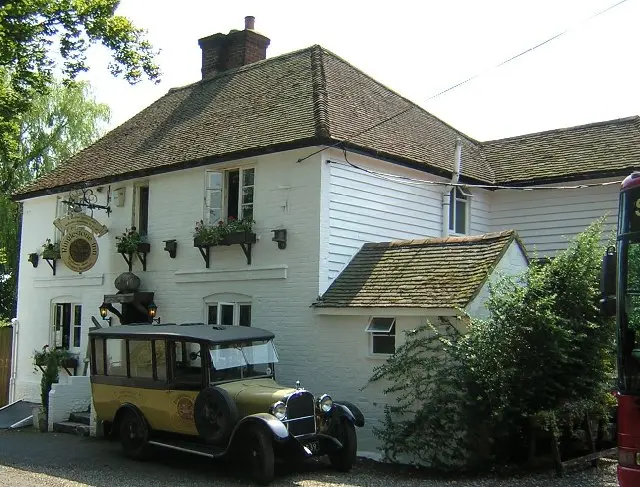
Its own website has said since at least 2007 that it was built in 1533 as a hospice for monks; the statutory list entry drawn up when the building was protected in 1986 calls it a public house of the late 18th or early 19th century, in painted brick with a flint plinth, which is what the photograph shows. Its ghosts have a single documented source: Jane Horder, the inn's manager, who supplied them to the writer Janet Cameron for Haunted Kent in 2005. She described an elderly couple who drink by the inglenook and then vanish, a figure that stamps up the cellar steps and drops a single boot, children who move toys and keys, and a landlord's son said to have been bricked into a cellar fireplace to hide him after he stole a sheep. Cameron argued from the building's age, and the age is the disputed part. Wikipedia deleted the whole account in 2023 as unsupported, and the owners who reopened the pub in 2019 mention no ghost at all.
What is the history of Ringlestone Inn?
The Ringlestone stands alone on a lane over the North Downs, at the crossroads local people call the Black Post, roughly midway between Hollingbourne, Harrietsham and Wormshill. Almost everything printed about it descends from a single document: a history page the inn itself published, which the Wikipedia article that carried the pub's fame credits openly to "research by a number of previous owners".
That page, archived on 22 February 2007, is where the famous dates come from. It says the building went up in 1533, that it was "originally a hospice for monks", and that it "became one of the early 'Ale Houses' around 1615". The current owners still print the first two claims on their homepage.
The statutory record says something else: the building was listed Grade II on 21 October 1986 as National Heritage List entry 1060802, and the inspector's description opens: "Public house. Late C18 or early C19. Painted brick in Flemish bond to front elevation, weatherboarded gable ends. Plain tile roof. 2 storeys on painted flint plinth." It closes with "Interior not inspected" — so the entry describes what can be seen from the road and does not rule out an older core behind it. But what it describes is exactly what the photograph on this page shows: painted brick, a weatherboarded gable, a hipped plain-tile roof, and a central panelled door up four steps; nothing Tudor is visible.
The monks are not baseless, only misplaced. The manor of Hollingbourne belonged to the prior and convent of Christ Church, Canterbury, until the Dissolution; Hasted records Richard de Ripple holding land in the parish from them in the thirtieth year of Edward I. But Hasted's account of Hollingbourne never mentions Ringlestone and never uses the word hospice, and the Kent Archaeological Society's own journal has nothing on the hamlet either.
The later chain is thinner still: a will of 1588 in which Julius Papworth Quiller ordered "my house at Rongoston" sold to pay his debts; the cooper Septimus Hepplewhite who bought it at auction; his son Oliver, who began selling ale around 1615; the sign that read Renglestone from 1822 and Ringlestone Inn only from 1867 — all of it comes from that same owners' page, and none of it has ever been produced as a document. The Kent Archaeological Society's transcription of the Hollingbourne tithe apportionment names the parish's drinking houses plainly where they exist — a Windmill Inn, a Kings Head Inn, a public house, a beer shop — and lists "Ringlestone" only as an orchard with a yard, outbuildings and gardens.
The one object that anchors the claimed antiquity has moved, and its story has changed three times. The inn's own 2007 page said "the oak dresser behind the bar with the carved welcome inscription is dated 1632 and believed to have been a wedding present to Elizabeth Sackville-West", and elsewhere quoted the carving: "A Ryghte Joyouse and welcome greetynge too ye all." Elizabeth Sackville-West cannot have received it: that surname did not exist until 1843, when a royal licence allowed Elizabeth Sackville and her husband to join the Sackville name to their own of West. Then, on 26 December 2018 — the inn shut, its contents heading for sale — an editor rewrote the Wikipedia article to say the piece was "now located at Knole" and was "the wedding chest" of John Tufton, Earl of Thanet. A week later, on 2 January 2019, the same editor changed it to a sideboard "inscribed with the names John Tufton, Earl of Thanet and Margaret Sackville (his wife) of Knole"; neither version cited a source. Tufton did marry Lady Margaret Sackville, daughter of the 3rd Earl of Dorset of Knole, on 21 April 1629, which at least fits an object dated 1632.
The best-attested century here is the twentieth: Florence "Ma" Gasking and her daughter Dora took the inn in the 1950s, turned away anyone they disliked at the wrong end of a shotgun and admitted regulars by a system of knocks; the East Kent Gazette reported on 12 March 1964 that the story had reached an Australian newspaper as the pub with no beer.
Timeline: the documented record of Ringlestone Inn
- 21 April 1629 John Tufton, 2nd Earl of Thanet, marries Lady Margaret Sackville, daughter of the 3rd Earl of Dorset of Knole. Their two names are the ones later said to be carved on the inn's oak sideboard.
- 1632 The date the inn's own website gives for the carving on its oak sideboard, reading "A Ryghte Joyouse and welcome greetynge too ye all" — a century after the 1533 the same page claims for the building.
- 1843 A royal licence lets Elizabeth Sackville and her husband join the Sackville name to their own of West, creating the surname Sackville-West — which the inn's website would later give to the supposed 1632 bride.
- 12 March 1964 The East Kent Gazette reports that the fame of Ma and Dora Gasking, who locked the doors and served only chosen regulars, has reached an Australian newspaper as "the pub with no beer".
- 11 March 1977 The Kent Messenger publishes the account of the Gaskings' years that every later retelling of the inn's twentieth century depends on.
- 21 October 1986 The building is listed Grade II (entry 1060802). The inspector describes it as a public house of the late 18th or early 19th century, in painted brick with a flint plinth, and notes that the interior was not inspected.
- November 2004 A customer tells the manager that several presences filed past her into a wall, and that she has "the third eye". It is the only dated sighting at the inn attributed to anyone but the staff.
- September 2005 Janet Cameron's Haunted Kent is published by Tempus. Its Ringlestone chapter, whose 2016 adaptation thanks manager Jane Horder for additional information, fixes in print the elderly couple, the single boot on the cellar stairs, the children and the walled-up boy.
- 14 September 2009 A Wikipedia editor removes the article's mention of the inn's hotel because it is "now closed", and on the same day corrects the transcription of the sideboard inscription.
- 28 March 2018 KentOnline reports that Kevin de Young and Christina Warren are giving up the tenancy after eleven years, blaming low footfall, rising costs and hostile social media. The inn shuts for eighteen months.
- 26 December 2018 With the inn closed and its contents heading for sale, an editor adds to Wikipedia, without a source, that the sideboard is "now located at Knole" and is Tufton's wedding chest; a week later the same editor rewrites it as an inscribed sideboard.
- 23 August 2019 The Ringlestone reopens as a free house under Dalton Hopper and Paolo Rigolli, who met at catering college and ran a charcuterie business.
- 1 February 2023 A Wikipedia editor deletes the article's entire paranormal section as "uncited/unsupported ghost stuff", leaving a heading with nothing beneath it — the state in which this entry's source text was harvested.
- 19 November 2025 The Food Standards Agency inspects the Ringlestone Inn as a working pub and bar and awards it a hygiene rating of 5 — the most recent official record that the business is trading.
Is there a rational explanation for Ringlestone Inn?
Every ghost at the Ringlestone comes from one person, and she is named.
The whole roster — an elderly couple who drink by the inglenook and then vanish, a figure that stamps up the cellar steps and drops a single boot, mischievous children who move toys and keys, a small boy who died in the upstairs room, and a landlord's son bricked into a cellar fireplace to hide him from the law after he stole a sheep — was supplied by the inn's manager, Jane Horder. The ghost-hunting site Ghosts.org.uk, in a page archived in December 2007, introduces the list with "The manager of the Ringlestone Inn, Jane Horder, provided the following information", and adds that "she insists on pointing out that all of these ghosts are friendly and none of them has ever done harm to anyone". The writer Janet Cameron put the same roster into Haunted Kent (Tempus, 2005); when she republished the chapter on her own blog in December 2016, as "adapted from Haunted Kent", she credited the photograph to Horder and thanked her "for additional information".
The reasoning is printed at the top of both versions. Cameron: "Since the pub is so old, it's unsurprising there are so many sinister occurrences." The inn's own website put it more briefly: "A 16th century inn is bound to have a ghostly past." The premise is the age of the building — and the age of the building is exactly what the 1986 list entry disputes.
The commercial layer can be dated. The same website advertised that the Ringlestone had been "voted most haunted pub in Kent in 2004", without saying by whom, and linked to the Kent Paranormal Group's account of a night spent at the inn. The only other witness anyone has produced is an unnamed customer who told the manager, in November 2004, that several presences had walked past her into a wall and that she had "the third eye".
The cellar story carries its own seal against checking: in the version Wikipedia carried for years, flagged as "a story promoted by previous owners", the wall "has supposedly not been disturbed since" the boy's parents left the inn. On 1 February 2023 an editor deleted the entire section as "uncited/unsupported ghost stuff", leaving a heading with no text under it.
The cleanest test is the business itself. The inn closed in 2018 and reopened in 2019 under owners with no link to the old tenancy. Their website sells food, beer and an asado grill; on 4 October 2026 none of its six pages (home, restaurant, bar, menus, asado grill and contact) used the words ghost, haunted or paranormal, while all six named the Ringlestone, and the words do not appear either in KentOnline's March 2018 report of the closure.
Can you visit Ringlestone Inn?
The Ringlestone Inn is trading; its website on 9 September 2026 gave the address as Ringlestone Road, Harrietsham, Maidstone, Kent ME17 1NX; the telephone number is 01622 290 300 and the email [email protected].
The hours published there that day ran: closed Monday and Tuesday; Wednesday and Thursday 12–3 and 6–10.30pm; Friday and Saturday 12–3 and 6–11pm; Sunday 12–5pm. Food is served 12–2.30pm and 6–9pm, with a single Sunday sitting of 12–3.30pm. The Food Standards Agency register, queried the same day, records the inn under FHRS ID 1158762 with the top hygiene rating of 5 from an inspection on 19 November 2025; the three component scores — hygiene, structure, confidence in management — were 5 apiece.
The building is Grade II listed as National Heritage List entry 1060802 (21 October 1986), and Historic England's open data puts it at national grid reference TQ 87911 55764. The postcode sits in the civil parish of Wormshill, though the postal address reads Harrietsham.
No accommodation is offered now: the three en-suite rooms once let at Ringlestone House, across the garden, had gone by September 2009. Nothing on the current owners' site refers to the hauntings. That site describes the building as "a beautiful grade II listed building dating back to 1533, originally used as a hospice for monks", a dating the statutory list entry does not carry. The dining room is small and tables are booked by telephone.
The inn stands alone on the North Downs — 11.6 km (7.2 miles) east of Maidstone, 3.1 km (1.9 miles) north-north-east of Harrietsham village — on single-track lanes without pavement or bus service to the door. Its own directions put it about five minutes from junction 8 of the M20.
Sources consulted
- Department of the Environment / Historic England, «Listed Building: The Ringlestone Inn (NHLE 1060802), Grade II, listed 21 October 1986» — National Heritage List for England, via the Kent Historic Environment Record, 1986 report
- Ringlestone Inn, «Ringlestone History» — ringlestone.co.uk, archived by the Internet Archive on 22 February 2007, 2007 archive
- Janet Cameron, «Haunted Kent» — Tempus Publishing (ISBN 9780752436050), 2005 book
- Janet Cameron, «The Sinister History of the Inn near the Black Post Crossroads» — Grim Histories, the author's own adaptation of her Haunted Kent chapter, 16 December 2016, 2016 web
- Ghosts.org.uk, «The Ringlestone Inn» — ghosts.org.uk, archived by the Internet Archive on 10 December 2007, 2007 archive
- Alan Smith, «Couple to leave Ringlestone Inn» — KentOnline, 28 March 2018, 2018 newspaper archive
- Downs Mail, «Popular rural pub The Ringlestone Inn to re-open this week» — Downs Mail, 21 August 2019, 2019 newspaper archive
- Edward Hasted, «Parishes: Hollingborne, in The History and Topographical Survey of the County of Kent, volume 5» — Canterbury, 1798; British History Online, 1798 book
- Kent Archaeological Society, «Tithe Apportionment for Hollingbourne (transcription)» — KAS Records, Transcriptions, 2024 archive
- Wikipedia contributors, «Ringlestone Inn: revision history» — English Wikipedia, edits of 14 September 2009, 26 December 2018, 2 January 2019 and 1 February 2023, 2023 web
- Food Standards Agency, «Food hygiene rating: The Ringlestone Inn, Ringlestone Road, Harrietsham (FHRSID 1158762)» — Food Hygiene Rating Scheme, inspection of 19 November 2025, 2025 report
- Lewes Priory Trust, «John Tufton, 2nd Earl of Thanet (1608-1664)» — lewespriory.org.uk, 2020 web
- National Trust, «The women of Knole» — nationaltrust.org.uk, 2024 web
- Paul Skelton, «Ringlestone Inn, Ringlestone: transcribed press cuttings, including the East Kent Gazette of 12 March 1964» — Dover Kent Archives, 2018 archive
Reviewed by V. Serrano on 2026-08-18 · How we verify our content
💬 Field testimonies (0)
No testimonies yet. Add the first.
Add your testimony
🔒 Log in to add a testimony