👻 HAUNTED PLACE · EXP. Nº9476
ACTIVE
Skipness Castle
Skipness Castle is in this catalogue because of a label, and the label can be dated to the second.
Where is Skipness Castle?
- Location
- Argyll and Bute, Scotland, United Kingdom
- Type
- Castle
- Coordinates
- 55.768, -5.336
- Last updated
LOCATION
Why is Skipness Castle said to be haunted?
At 18:34:43 UTC on 19 July 2011 a Wikipedia editor added one sentence about a Green Lady, sourced to a bare link to a ghost-tourism site; eighteen seconds later the same editor added the category for haunted locations in Scotland. On 15 July 2024 another editor deleted the sentence with the summary "does not look like a reliable source" and left the category behind. It has been orphaned there ever since, and the site it pointed to now returns a 404.
A tradition does exist. Martin Coventry's castle gazetteer records that Skipness is said to have a gruagach, a Green Lady as small as a child but dressed in green and with golden hair, who tidied the house, fed the hens and once scattered an attacking force by spreading confusion. But nothing older has been found: John Gregorson Campbell's 1900 collection of Highland belief names the resident spirits of five castles and Skipness is none of them.
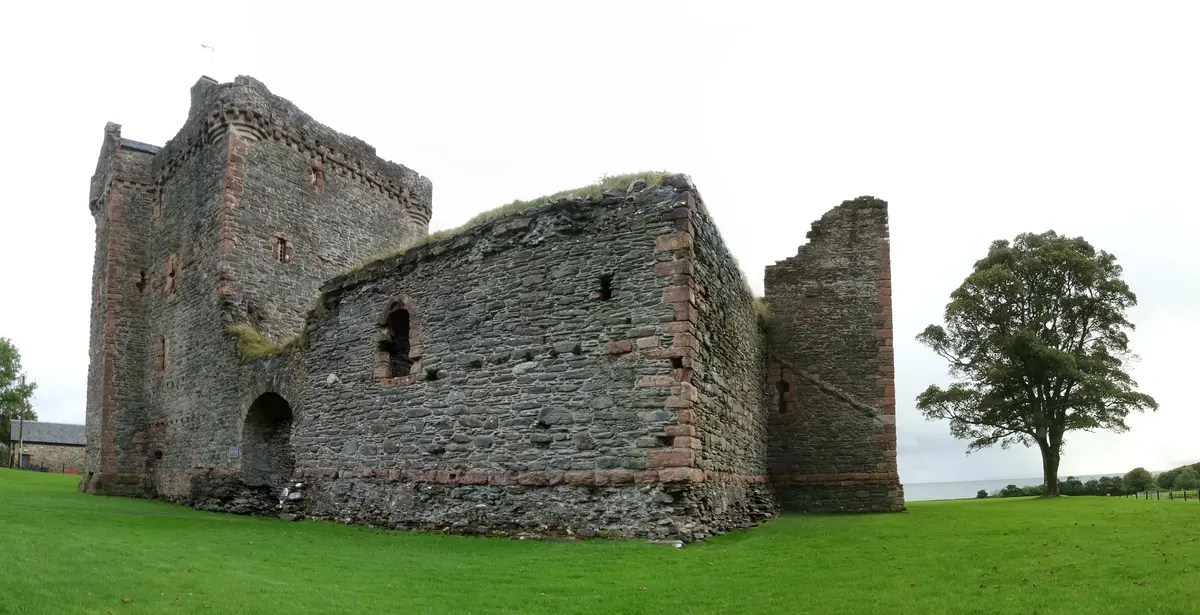
What is beyond doubt is the building: a MacSween stronghold begun in the early 1200s, among the oldest standing castle buildings in Scotland, and free to walk into half the year.
What is the history of Skipness Castle?
Skipness was never meant to be a lonely ruin on a lawn. It was a working seat of power, and for four hundred years it changed hands with the politics of the western sea.
Historic Environment Scotland records the castle first in 1261, when it formed part of the lordship of Knapdale and belonged to Dugald MacSween — by which time he had probably already built the hall-house and the chapel and thrown an earth and timber rampart round the site. Skipness was not the family's chief seat; that was Castle Sween, on the Knapdale coast. The MacSweens also built the hall-house castle at Lochranza on Arran, five miles across the water, and the two of them faced each other across the Kilbrannan Sound like a pair of gate posts.
The MacSweens backed the wrong side. Argyll was ruled from Norway in the 1200s, and when Hakon IV was beaten by the Scots at Largs in 1263 and his successor handed the Hebrides back to Scotland in the Treaty of Perth three years later, the family was forced out. Walter Stewart, Earl of Menteith, had already acquired the castle in 1262.
Around 1300 the place was rebuilt into something formidable. The hall-house and the chapel were swallowed by a high curtain wall studded with crosslet arrow slits; the chapel was secularised and converted into a gatehouse with a portcullis and machicolations, and a new chapel — Kilbrannan, dedicated to St Brendan the Navigator — was put up by the shore a few hundred metres away. HES notes that it is unclear whether this work was done by Sir John Stewart of Menteith, possibly with money from Edward I of England, or by the MacDonalds. Either way it is a reminder of how far English influence reached into Argyll.
The castle and lordship passed to the MacDonald Lords of the Isles in 1325 and stayed with them until their forfeiture in 1493, when both reverted to the Crown. Archibald Campbell, second Earl of Argyll, was granted the estate in 1502, and it remained Campbell property until the middle of the nineteenth century. Soon after 1502 the north-east tower was raised three storeys; later in the sixteenth century the rest of the east range was pulled down to leave the tower-house standing free.
Its last military moment came in the mid-seventeenth century, when — in the words of the HES assessment — it "withstood a siege by the MacDonalds during raids in Kintyre", and was repaired shortly afterwards. Popular accounts date this to 1646 and to the Kintyre campaign of Alasdair Mac Colla; that identification is plausible but I have not been able to confirm it in a primary source, and HES does not make it.
The end was administrative rather than violent. A warrant was issued for the "razing down" of the castle soon after Argyll's Rebellion in 1685. The laird petitioned successfully against it — and then abandoned the building anyway. It became a farmstead: the courtyard ranges were cleared away except the tower, and lean-to sheds were built against both faces of the curtain wall. Those sheds came down in 1898, when the owner of the new Skipness House began to treat the ruin as an antiquity rather than a byre. Worries about the walls in the 1950s and 60s brought it into state guardianship in 1973, and a campaign of repair ran until 1995.
Timeline: the documented record of Skipness Castle
- 1261 Skipness is first recorded, as part of the lordship of Knapdale and in the possession of Dugald MacSween, who had probably already built the hall-house and chapel and enclosed the site with an earth and timber rampart.
- 1262 Walter Stewart, Earl of Menteith, acquires the castle.
- 1263-1266 Hakon IV of Norway is defeated by the Scots at Largs, and three years later his successor returns the Hebrides to Scotland in the Treaty of Perth. The MacSweens, who had backed Norway, are forced out of Skipness.
- About 1300 The hall-house and chapel are swallowed by a high curtain wall with crosslet arrow slits and projecting towers. The chapel is secularised and rebuilt as a gatehouse with portcullis and machicolations, and a new chapel dedicated to St Brendan goes up by the shore.
- 1325 The castle and lordship pass to the MacDonald Lords of the Isles, who hold them until their forfeiture in 1493, when both revert to the Crown.
- 1502 Archibald Campbell, second Earl of Argyll, is granted the estate; it stays in Campbell hands until the mid-nineteenth century. Soon afterwards the north-east tower is raised by three storeys.
- 1685 A warrant is issued for the 'razing down' of the castle soon after Argyll's Rebellion. The laird petitions successfully against it, but abandons the building anyway; it becomes a farmstead.
- 1898 The lean-to farm sheds built against both faces of the curtain wall are removed and steps are taken to preserve what remains of the castle.
- 1900 John Gregorson Campbell publishes Superstitions of the Highlands and Islands of Scotland, gathered entirely from oral sources. It gives named sections to the resident spirits of Dunstaffnage, Sleat, Dunolly, Mearnaig and Breacacha castles. Skipness is not mentioned once in some 82,500 words.
- 1973 After concern about the stability of the walls through the 1950s and 60s, the castle is taken into state guardianship. A campaign of repair and consolidation runs until 1995.
- 19 July 2011 At 18:34:43 UTC a Wikipedia editor adds 132 bytes to the article - one sentence about a Green Lady, sourced to a bare link to a ghost-tourism site. Eighteen seconds later, at 18:35:01, the same editor adds 54 bytes more: the category 'Reportedly haunted locations in Scotland'.
- 7 February 2013 Skipness Castle and Kilbrannan Chapel are re-scheduled as a single monument, SM13225, replacing a 1962 designation whose protected area was judged inadequate.
- 20 September 2016 The fullest version of the Green Lady story - the gruagach 'as small as a child but dressed in green and with golden hair' - is already present, word for word, in the archived copy of Martin Coventry's castle gazetteer. It is the oldest datable appearance of the full account found in this review.
- 29 September 2017 The popular listicle that most later retellings follow is titled 'These 4 Scottish & Welsh Castles Feature A Green Lady Ghost' in its archived copy, and does not mention Skipness at all. The fifth castle is added later.
- 15 July 2024 A Wikipedia editor deletes the entire 'Castle ghost' section, 361 bytes, with the edit summary 'does not look like a reliable source' - and leaves the haunted-locations category in place. It has been orphaned there ever since.
Is there a rational explanation for Skipness Castle?
This entry exists because of a label, and the label can be dated to the second.
At 18:34:43 UTC on 19 July 2011 a Wikipedia editor added 132 bytes to the Skipness Castle article: one sentence — "The Green Lady of Skipness Castle is said to be haunt the location" — sourced to a bare link to hollowhill.com, a ghost-tourism site. Eighteen seconds later, at 18:35:01, the same editor added 54 bytes more: the category "Reportedly haunted locations in Scotland". In 2018 a bot tidied the bare link into a formatted citation with a Wayback copy, which made it look like a reference. On 15 July 2024 a different editor deleted the whole "Castle ghost" section, 361 bytes, with the edit summary "does not look like a reliable source" — and left the category in place. It has been orphaned there ever since: today's article carries the haunted-locations label and not one word of ghost, haunt, spirit or apparition in its body.
The source that started it is gone twice over. The hollowhill.com page returns 404 today, and the Wayback Machine's index holds no capture of that page or of the whole domain, while a control query for bbc.co.uk in the same session returns rows normally.
The tradition itself is real, but it is younger and thinner than it looks, and it does not come from Skipness. The fullest version is Martin Coventry's castle gazetteer, which says Skipness "is said to have a gruagach, a 'Green Lady', described as being as small as a child but dressed in green and with golden hair", who cleaned, tidied and fed hens, once nearly killed a man it believed was sleeping in the wrong bed, and thwarted an attack by spreading confusion among the besiegers. That text was already on Coventry's site in the archived copy of 20 September 2016. It spread from there: the popular listicle that most later retellings follow was headed "These 4 Scottish & Welsh Castles" in its archived copy of 29 September 2017, with Skipness not in it at all; the fifth castle was added afterwards.
Go back further and Skipness disappears. John Gregorson Campbell's Superstitions of the Highlands and Islands of Scotland (1900), the standard collection of exactly this material and gathered entirely from oral sources, runs to some 82,500 words and mentions Skipness zero times — and Kilbrannan zero times, and "Green Lady" zero times. The controls in the same file are emphatic: gruagach 32, glaistig 90, brownie 24, Argyll 18, Arran 16, and Cantyre — the period spelling of Kintyre — 5. Campbell devotes named sections with their own index entries to the resident spirits of five castles: Dunstaffnage, Sleat, Dunolly, Mearnaig and Breacacha. Skipness is not one of them.
Several of the details told about the Skipness spirit turn out to belong to Campbell's neighbours. Tidying the house at night is the Glaistig of Dunolly Castle, of whom he writes: "During the night she tidied up the house and swept the floors." Putting the house in order before strangers arrive is the Brownie of Càra, an islet off the west of Kintyre. And the milk offering is not a Skipness custom but the standard rite of the whole type across Argyll: a portion set aside every evening in a hollowed stone, without which "no milk was got at next milking".
The two institutional voices are unusually clean here, and they point the same way. Historic Environment Scotland's Statement of Significance for the castle contains no ghost, haunting, gruagach, legend or folklore in 1,764 words — controls in the same document: castle 38, tower 14, chapel 12 — and its "Spiritual Overview" states plainly: "There are no modern spiritual associations with the castle (as opposed to the chapel)." The 2013 scheduled monument record is the same: nothing paranormal in 2,797 words, against castle 56, chapel 35, burial 10. And there is no commercial motive to weigh against them. Skipness is unstaffed and free, there is no ticket office, no shop and no ghost tour, and the site is closed from 1 October to 31 March — which means it is shut at Halloween.
Two things are worth saying in the spirit's defence. Campbell notes that a glaistig's attachment "was not to the family but to the site or stance", and that she stayed on "even after the building was deserted and had become a nesting place for wild birds" — so an empty roofless ruin is not, in the logic of the tradition, an objection. And he is firm that these beings were not frightening: the glaistig and the brownie, he writes, are "among the most harmless". A helpful house spirit at Skipness would not be a Scottish rarity. It would be the ordinary case.
Can you visit Skipness Castle?
Skipness Castle and Kilbrannan Chapel have been in state guardianship since 1973 and are cared for by Historic Environment Scotland. Its visitor page, read on 24 September 2026, gives the season as 1 April to 30 September, daily from 9.30am to 5.30pm with last entry 30 minutes before closing, and closure from 1 October to 31 March, and says the site "is free to visit". The address on the page is Skipness, Kintyre, PA29 6XT, and the castle lies south of the village on the east coast of Kintyre, off the B8001. The same page prints the national grid reference NO 169 115, which falls in eastern Scotland and does not match the site; the scheduling record gives NR 90805 57779, and the pin on this file sits within a few metres of that point.
The scheduling record, SM13225 of 7 February 2013, places Kilbrannan Chapel 330 metres south-east of the castle, close to the shore; the visitor page rounds the walk to about 300 metres. The record describes the chapel as a single chamber of 25 by 8 metres with red Arran sandstone dressings at its openings, and counts "a significant group of five, late medieval, recumbent tombstones" in the chapel and its graveyard. That graveyard "is still in use as a burial ground today", and the scheduled area leaves out the active burial lairs.
HES states that the site sits on working farmland and links its page to the Scottish Outdoor Access Code. Martin Coventry's gazetteer describes the sixteenth-century tower house as rising to "four storeys and a garret", illustrates a view of Arran taken from the battlements, and warns that the walk to the chapel "may be muddy"; the postcode he gives, PA29 6XU, differs by one letter from the HES one.
Lochranza Castle, the other hall-house the MacSweens built, stands across the Kilbrannan Sound on Arran. HES lists it among the places near Skipness at 5 miles and marks it "Closed Autumn/Winter".
Sources consulted
- Historic Environment Scotland, «Statement of Significance: Skipness Castle (Property in Care ID PIC101)» — Historic Environment Scotland, 2019 report
- Historic Environment Scotland, «Skipness Castle and Kilbrannan Chapel: scheduled monument record SM13225» — HES Designations Portal, 2013 archive
- John Gregorson Campbell, «Superstitions of the Highlands and Islands of Scotland» — James MacLehose and Sons, Glasgow, 1900 book
- Martin Coventry, «Skipness Castle and Chapel» — The Castles of Scotland (Goblinshead), 2016 web
- Wikipedia contributors, «Skipness Castle: article and revision history» — English Wikipedia, 2026 web
- Historic Environment Scotland, «Skipness Castle and Chapel: history and stories, and plan your visit» — historicenvironment.scot, 2026 web
- Icy Sedgwick, «These 5 Scottish & Welsh Castles Feature A Green Lady Ghost» — icysedgwick.com, 2020 web
Reviewed by V. Serrano on 2026-08-20 · How we verify our content
💬 Field testimonies (0)
No testimonies yet. Add the first.
Add your testimony
🔒 Log in to add a testimony