👻 HAUNTED PLACE · EXP. Nº9476
ACTIVE
St Bartholomew-the-Great
In June 1866, with the Victorian restoration under way, somebody opened Rahere's tomb from behind.
Where is St Bartholomew-the-Great?
- Location
- London, United Kingdom
- Type
- Church / religious site
- Coordinates
- 51.519, -0.1
- Last updated
LOCATION
Why is St Bartholomew-the-Great said to be haunted?
The parish's own historian, E. A. Webb, recorded what came next: the founder's remains lay exposed in a wooden coffin with sandals on the feet, and a piece of one sandal — together with a fragment of the coffin — was "abstracted and hidden". It took twenty-four years to recover them, in November 1890, traced to a house on the site of the north transept with the help of a freemason. They are still in the cloister, in a glass case. That documented theft is the likely seed of the later story that Rahere walks his own church searching for his missing sandal, found in a London guide of 1990. The haunting itself is older and began inside the church: Elliott O'Donnell's Haunted Churches (1939) opens with a Daily Express article in which the rector, the Rev. W. F. G. Sandwith, described a figure that vanished near the Lady Chapel, and records that the church was traditionally said to be haunted by its founder. What the twelfth-century Book of the Foundation does tell is stranger and far better attested: a courtier who fell ill in Rome, vowed a hospital for the poor, recovered, and was then ordered by a vision on the road home to build a church at Smithfield. Both are still standing, nine hundred years later.
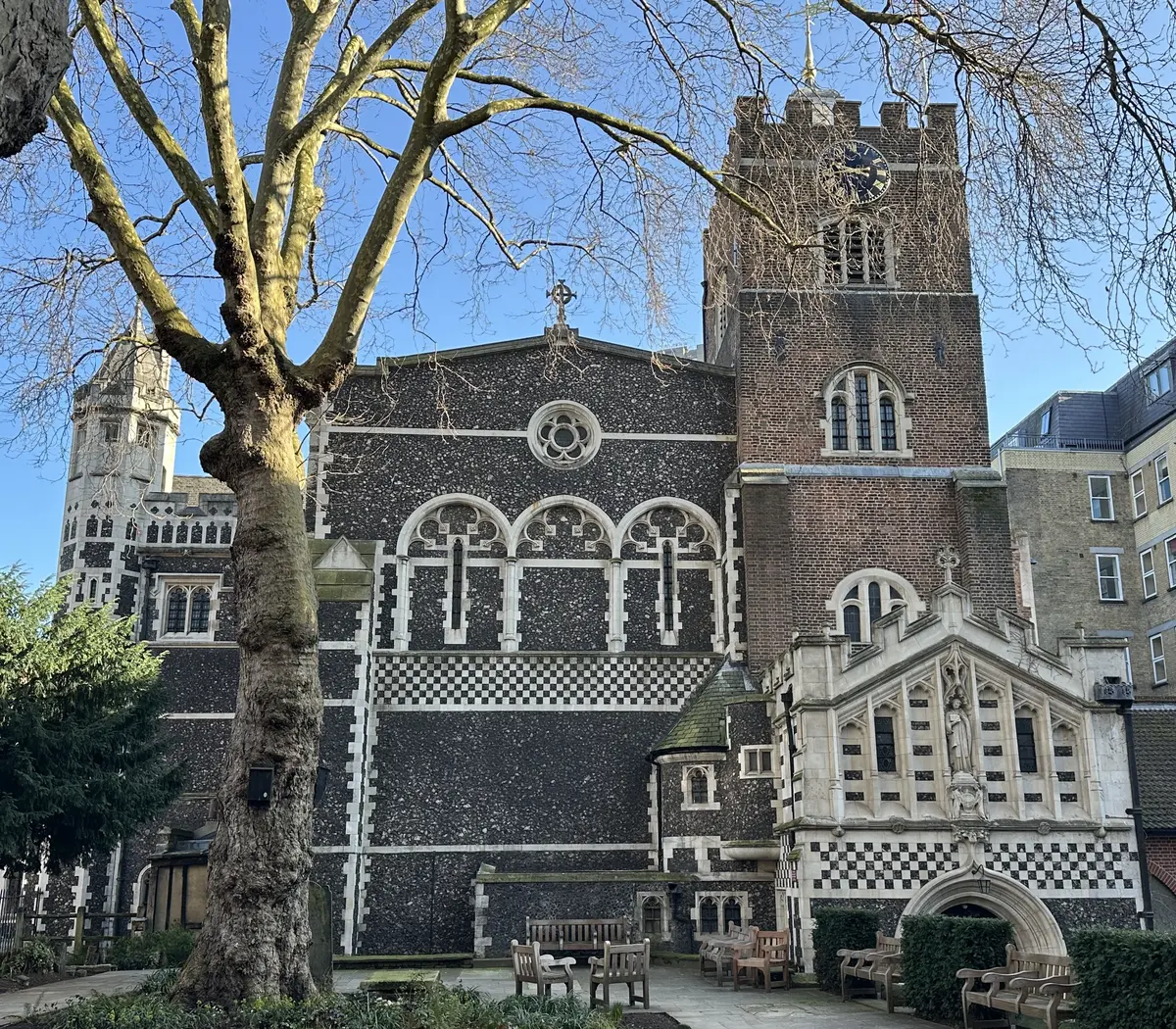
What is the history of St Bartholomew-the-Great?
Everything known about Rahere comes from one book, and the book belonged to the priory itself. The Liber fundacionis ecclesie sancti Bartholomei Londoniarum — the Book of the Foundation — was written in Latin at Smithfield in the twelfth century; the manuscript survives as Cotton MS Vespasian B IX in the British Library, and Norman Moore printed its Middle English version in 1886.
Its second chapter is unflattering about the founder: Rahere was "sprongyng or borne of lowe lynage", it says, and on reaching "the floure of yougth" he "began to haunte the housholdys of noble men and the palices of prynces", spreading their cushions "with japys and flatterynges"; at the king's palace he pushed himself forward "with jolite and carnale suavyte" amid banquets, plays and "othir courtly mokkys and trifyllys". That passage, and nothing more, is the origin of the tradition — repeated today by the parish itself — that Rahere was Henry I's jester.
The third chapter sends him to Rome to buy pardon for that life, and the order of what follows matters, because it is usually told backwards. At Rome he "began to be vexed with grevous sykenesse" and "drewe to the extremyte of lyf". Believing that God was taking vengeance on him among foreigners, he vowed that if he were granted health to return home he would "make and hospitale yn recreacion of poure men". He recovered — and only then, on the journey back, came the vision of chapter four: a winged beast that carried him above a bottomless pit, and a figure of imperial bearing who told him "I am Bartholomew the Apostle of Ihu Crist that come to socoure the, yn thyn angwysshe", and that he had chosen "a place yn the Subbarbis of London at Smythfeld wher yn myn name thou shalt founde a chirche". The illness produced the hospital; the vision produced the church.
Both were founded in 1123 — the parish marked nine hundred years since the laying of the foundation stone on 25 March 2023 — and both are still there. St Bartholomew's Hospital, across the road, is described by Barts Health NHS Trust as the oldest hospital in the country.
The church did not reach us whole: at the Dissolution in 1539 the priory was suppressed, the nave demolished and the estate sold to Sir Richard Rich; what stands today is essentially the Norman quire. Its afterlife was industrial: the Lady Chapel became dwellings, and in 1725 it housed the printing house of Samuel Palmer, where a nineteen-year-old journeyman named Benjamin Franklin set type for Wollaston's Religion of Nature Delineated. Later the same rooms held a fringe factory that ran west along the triforium; a blacksmith's forge occupied the site of the north transept; a Nonconformist school sat in the triforium during the eighteenth century and the parish boys' school in the north triforium until 1892; the cloister was used as stabling.
Buying the building back took forty years. Restoration began in 1863 under Rector John Abbiss with the architects Hayter Lewis and William Slater; the patron, the Rev. F. P. Phillips, paid £6,500 to remove the fringe factory; the restored portions were formally reopened on 30 November 1886; and from 1887 Aston Webb built the new south transept (opened 14 March 1891) and north transept (5 June 1893) and rebuilt the Lady Chapel, finished in 1896.
Rahere's tomb stands on the north side of the sanctuary. E. A. Webb, the parish's own historian, dated the canopied monument to the remodelling of the east end about 1405 and stated flatly that the effigy is contemporary with it "and cannot therefore be relied on as a likeness of the founder". Norman Moore, writing in the 1890s, had insisted on the opposite — that the figure was "certainly a portrait of Rahere". The face visitors look at was carved roughly 280 years after the man died.
And in the middle of the Victorian restoration, somebody opened the tomb. In June 1866, with the work in progress, the monument was — in Webb's words — "surreptitiously opened at the back", and the remains of Rahere, with sandals on the feet, were exposed to view in a wooden coffin. A portion of a sandal and a small piece of the coffin "were abstracted and hidden". Twenty-four years later, in November 1890, they were traced to a house then occupying part of the site of the north transept, with the aid of a freemason, the late Mr Henry Heard, "to whose craft sacrilege is particularly abhorrent". The rector and churchwardens decided against opening the tomb again, and the fragments were placed in a glass case in the cloister — where George Worley's 1908 guide duly lists "a charred fragment of Rahere's coffin and sandal, which had been surreptitiously taken from his tomb".
Timeline: the documented record of St Bartholomew-the-Great
- 25 March 1123 Rahere founds the Augustinian priory of St Bartholomew and its hospital at Smithfield. The parish celebrated the nine-hundredth anniversary of the laying of the foundation stone on 25 March 2023; Webb notes that older chroniclers (Fabyan, Holinshed, Sprott) gave rival dates of 1102 and 1112.
- c. 1405 The canopied tomb is erected on the north side of the sanctuary when the east end is remodelled. E. A. Webb dates the effigy to the same early fifteenth-century campaign, so it “cannot therefore be relied on as a likeness of the founder”.
- 1539 The priory is dissolved. The nave is demolished and the estate sold to Sir Richard Rich; the Norman quire survives as a parish church.
- 1725 Benjamin Franklin, aged nineteen, works as a compositor in Samuel Palmer's printing house, installed inside the old Lady Chapel, setting type for Wollaston's Religion of Nature Delineated.
- 1833 The fringe-maker Robert Burgh is granted a lease of two of the houses in the Lady Chapel. The factory eventually runs west along the triforium; a blacksmith's forge occupies the site of the north transept and the cloister is used as stabling.
- 1863 Rector John Abbiss begins the first restoration with the architects Hayter Lewis and William Slater, lowering the floor to its original level and rebuilding the apse. F. J. Withers keeps a diary of the works that later becomes E. A. Webb's chief source.
- June 1866 While the restoration is in progress the tomb is “surreptitiously opened at the back”. Rahere's remains, with sandals on the feet, are exposed in a wooden coffin, and a portion of a sandal and a piece of the coffin “are abstracted and hidden”.
- November 1890 Twenty-four years later the fragments are traced to a house then occupying part of the site of the north transept, with the aid of a freemason, the late Mr Henry Heard. The rector and churchwardens decide against reopening the tomb and place the relics in a glass case in the cloister.
- 1893 Aston Webb's new north transept is opened on 5 June in the presence of the Prince of Wales. Excavating for it uncovers a second stone coffin holding a well-preserved skeleton in leather sandals, believed to be a prior, whose skull had been removed at some earlier date.
- 1908 George Worley's guide to the church lists, among the relics on show in the cloister, “a charred fragment of Rahere's coffin and sandal, which had been surreptitiously taken from his tomb”.
- 1981 John Betjeman's poem on St Bartholomew's Hospital, collected in Church Poems, opens “The ghost of Rahere still walks in Bart's; / It gives an impulse to good hearts” — lines about the hospital rather than the church.
- 1999 Richard Jones's Walking Haunted London gives the legend its punitive ending: the man who stole the sandal fell ill, confessed, returned it and recovered. Nothing of the kind appears in Webb's account, published seventy-eight years earlier from the parish's own records.
Is there a rational explanation for St Bartholomew-the-Great?
The ghost of St Bartholomew-the-Great reached print through the church's own rector, decades before anyone gave it a missing sandal to look for.
The parish's current nine-hundred-year timeline runs from the martyrdom of St Bartholomew to Hugh Grant, taking in the Great Fire, the Blitz — where it credits the curate, the Rev. Newell Wallbank, with kicking incendiary bombs off the roof — and Benjamin Franklin's printing shop, and it does not mention a ghost anywhere. An earlier rector spoke about one in the press. Elliott O'Donnell opens Haunted Churches (1939) with an article in the Daily Express in which the Rev. W. F. G. Sandwith, rector from 1907, described a stranger in the half-dark church who walked towards the Lady Chapel without answering him and vanished a few feet away, and a man's face beside the altar during a midday celebration that faded as he watched; his wife, he was reported as saying, had seen a phantom monk "whose features were partly hidden by a cowl" at the altar rails. O'Donnell adds that the church "is traditionally said to be haunted by the ghost of the founder, Rayer, or Rahere", and offers the footsteps heard in the ambulatories as that ghost; neither account mentions a sandal.
The phrase "the ghost of Rahere" is older still, and in 1852 it belonged to the hospital. That June the London correspondent of the Dublin Medical Press regretted the loss of the old front and arches of St Bartholomew's Hospital, "under shadow of which the ghost of Rahere and Mr. Stanley's carriage seemed to enjoy a divided empire". John Betjeman's poem on the hospital, collected in Church Poems (1981), opens in the same register: "The ghost of Rahere still walks in Bart's; / It gives an impulse to good hearts". Antony Hippisley Coxe's Haunted Britain (1973) puts the ghost back in the church, which, it states, "is haunted by the ghost of Rahere".
The sandal arrives later, with City Walks of London (Robson, 1990), which reports that "the ghost of Rahere is said to hop around the church searching for his missing sandal". Richard Jones's Walking Haunted London (1999) supplies the moral machinery: the man who took the sandal, it says, fell ill, confessed, gave it back and recovered. E. Ashley Rooney's Haunted London (2009) has Rahere "heard wandering around the church searching for his sandal", and Jonathan Sutherland's Ghosts of London (2002) adds a rector who saw him as a cowled figure standing in the church.
Webb's account of the documented theft has none of that: writing in 1921 from the parish's restoration records and from the site diary kept by F. J. Withers, he gives a theft, a concealment, a twenty-four-year gap, a search with a freemason's help and a glass case in the cloister, with no illness, no confession and no curse. Jones published the punishment plot seventy-eight years after Webb.
The sandals themselves are what the custom of the order would lead anyone to expect. Webb writes that "it is customary for priors of the Augustinian order to be buried with their sandals on their feet", and cites that custom as evidence that the body in the tomb is Rahere's. A second coffin, uncovered while the north transept was being excavated in 1893, held a well-preserved skeleton in leather sandals whose skull had been removed at some earlier date.
Can you visit St Bartholomew-the-Great?
The Priory Church of St Bartholomew the Great is at West Smithfield, London EC1A 9DS, entered through the Tudor gatehouse on West Smithfield; the parish telephone is 020 7600 0440. In a straight line, Barbican Underground station is about 200 metres to the north-east, Farringdon about 410 metres to the west-north-west and St Paul's about 480 metres to the south-south-east. The City of London's Smithfield car park, under West Smithfield, has 581 spaces.
The parish's visit page, consulted on 23 September 2026, gives opening hours of 10:00 to 17:00 from Monday to Saturday, and on Sundays between services. There is no admission charge: the parish asks for donations and states that it receives nothing from the Church of England or from the government. Older guidebooks quote a price from the years when there was one. The church's own page, archived on 15 April 2019, charged £5 for adults, £4.50 for concessions, £12 for a family ticket and £1.50 for photography, with no charge for those coming only to pray, and it warned that tourist visits were usually not possible while the church was in use for services, events or filming. The current page still lists weddings, christenings and filming among its bookings. The Head Verger, Gordon Furry, offers private tours for groups of five or more ([email protected]).
Step-free access is by the path from the Tudor gatehouse to the west door. The 2019 page described the other way in, through the churchyard from Cloth Fair, as a significant step up followed by a further small step and then a set of relatively steep steps down to the church path, without a handrail.
Rahere's tomb stands on the north side of the sanctuary. The Lady Chapel, where the nineteen-year-old Benjamin Franklin set type in Samuel Palmer's printing house in 1725, was bought back by the church in 1885 and rebuilt by Aston Webb, who finished it in 1896. George Worley's guide of 1908 listed the charred fragments of Rahere's coffin and sandal, taken from the tomb in 1866, in a glass case in the cloister. Damien Hirst's statue Exquisite Pain, on display in the church, shows the flaying of the apostle.
The parish documents its own film work: Four Weddings and a Funeral (1994), Elizabeth: The Golden Age (2007), Sherlock Holmes (2009, as the crypt of St Paul's), Transformers: The Last Knight (2017), What's Love Got to Do with It? (2023), Napoleon (2023) and Mary & George (2024).
St Bartholomew the Less, the hospital church, stands inside the Barts site at EC1A 7BE and opens every day from 08:00 to 22:00, with step-free access at the back of the church opposite the Maggie's centre.
Sources consulted
- Norman Moore (ed.), «The Book of the Foundation of St Bartholomew's Church in London (Liber fundacionis ecclesie sancti Bartholomei, Cotton MS Vespasian B IX)» — London, 1886 book
- E. A. Webb, «The Records of St Bartholomew's Priory and of the Church and Parish of St Bartholomew the Great, West Smithfield, vol. I» — Oxford University Press, 1921 book
- E. A. Webb, «The Records of St Bartholomew's Priory and of the Church and Parish of St Bartholomew the Great, West Smithfield, vol. II» — Oxford University Press, 1921 book
- George Worley, «The Priory Church of St Bartholomew-the-Great, Smithfield» — G. Bell and Sons, 1908 book
- Norman Moore, «The Church of St Bartholomew the Great, West Smithfield: its foundation, present condition, and funeral monuments» — Adlard, 1897 book
- Great St Bartholomew (parish), «History of St Barts» — Official parish website, 2026 archive
- Great St Bartholomew (parish), «Visit» — Official parish website, 2026 archive
- Great St Bartholomew (parish), «Visiting hours and admission charges (archived 15 April 2019)» — Internet Archive Wayback Machine, 2019 archive
- John Betjeman, «Church Poems» — John Murray, 1981 book
- Richard Jones, «Walking Haunted London: twenty-five original walks exploring London's ghostly past» — Passport Books, 1999 book
- E. Ashley Rooney, «Haunted London: English Ghosts, Legends, and Lore» — Schiffer Publishing, 2009 book
- Jonathan Sutherland, «Ghosts of London» — Breedon Books, 2002 book
- Antony Hippisley Coxe, «Haunted Britain: a guide to supernatural sites» — Hutchinson, 1973 book
- Great St Bartholomew (parish), «Filming at St Bart's» — Official parish website, 2026 archive
- Barts Health NHS Trust, «About us — St Bartholomew's Hospital» — NHS, 2026 archive
- Elliott O'Donnell, «Haunted Churches (chapter I, "London's Haunted Churches": the Daily Express article on the Rev. W. Sandwith's experiences in St Bartholomew-the-Great, and the tradition that the church is haunted by Rahere)» — Quality Press, London, 1939 book
- London correspondent, «Medical Life in London (letter dated London, 19 June 1852), on the old front and arches of St Bartholomew's Hospital» — Dublin Medical Press, vol. 28, p. 413, 1852 newspaper archive
- «City Walks of London (St Bartholomew-the-Great: the ghost said to search the church for his missing sandal)» — Robson Books, London, 1990 book
Reviewed by V. Serrano on 2026-08-11 · How we verify our content
💬 Field testimonies (0)
No testimonies yet. Add the first.
Add your testimony
🔒 Log in to add a testimony