👻 HAUNTED PLACE · EXP. Nº9476
ACTIVE
Stirling Castle
On the night that made Stirling Castle famous among ghost hunters there was, as far as the record goes, nobody else in the room.
Where is Stirling Castle?
- Location
- Stirling, Scotland, United Kingdom
- Type
- Castle
- Coordinates
- 56.124, -3.948
- Last updated
LOCATION
Why is Stirling Castle said to be haunted?
Thomas Randolph, Elizabeth I's agent in Scotland, wrote to Sir William Cecil on 24 September 1561 that at Stirling the queen had fallen asleep with a candle burning beside her and that "the curtains and tester took fire, and was like to have smored her as she lay". Mary survived. No servant appears in the letter and none dies in it; what does appear is Randolph himself, ridiculing the old prophecy that a queen should be burnt at Stirling. The Green Lady who is said to have saved her cannot be found in the Stirling record at all: not in the town's Victorian antiquarian press, not in the standard 1913 history of the castle, not in the Edwardian collections of Scottish ghost stories. What can be dated is her arrival in print, and it runs through a BBC Halloween listing of 2010 and a tour company's sales page. What is documented is something else: a royal fortress on a volcanic crag, a siege, a coronation, a fire, a garrison of three and a half centuries, and a cistern dug to fight the flames.
What is the history of Stirling Castle?
Stirling Castle stands on a dolerite crag that drops in cliffs on three sides, and the documentary record of it begins with a chapel: Historic Environment Scotland's Statement of Significance dates the earliest certain royal association to the dedication of a chapel inside an already existing castle by Alexander I, between 1105 and 1115. Through the 12th and 13th centuries it was a favourite royal lodging and one of the main centres of Scottish royal administration and finance. In the 1140s David I founded Cambuskenneth Abbey in a loop of the Forth below it. In 1174 Stirling was one of the castles William I surrendered under the terms of the Treaty of Falaise.
The Wars of Independence made it the most fought-over building in Scotland. Edward I took it in 1296; William Wallace and Andrew Murray recovered it in 1297 after the battle of Stirling Bridge; the English took it again in 1298. The siege that people remember began on 22 April 1304, when Edward I arrived in person. According to Historic Environment Scotland's own account, the garrison was about twenty-five men under Sir William Oliphant, and it held out for roughly three months while Edward had five master carpenters and fifty workmen build the trebuchet called the War Wolf. Oliphant surrendered before it was used, and Edward fired it anyway. The defenders were publicly humiliated and sent to England as prisoners — they were not put to the sword. Control of the castle was a principal cause of Bannockburn in 1314; after the battle Robert I destroyed part of it so that it could not be used against him again. It was back in English hands by 1336 and was not finally recovered until 1342.
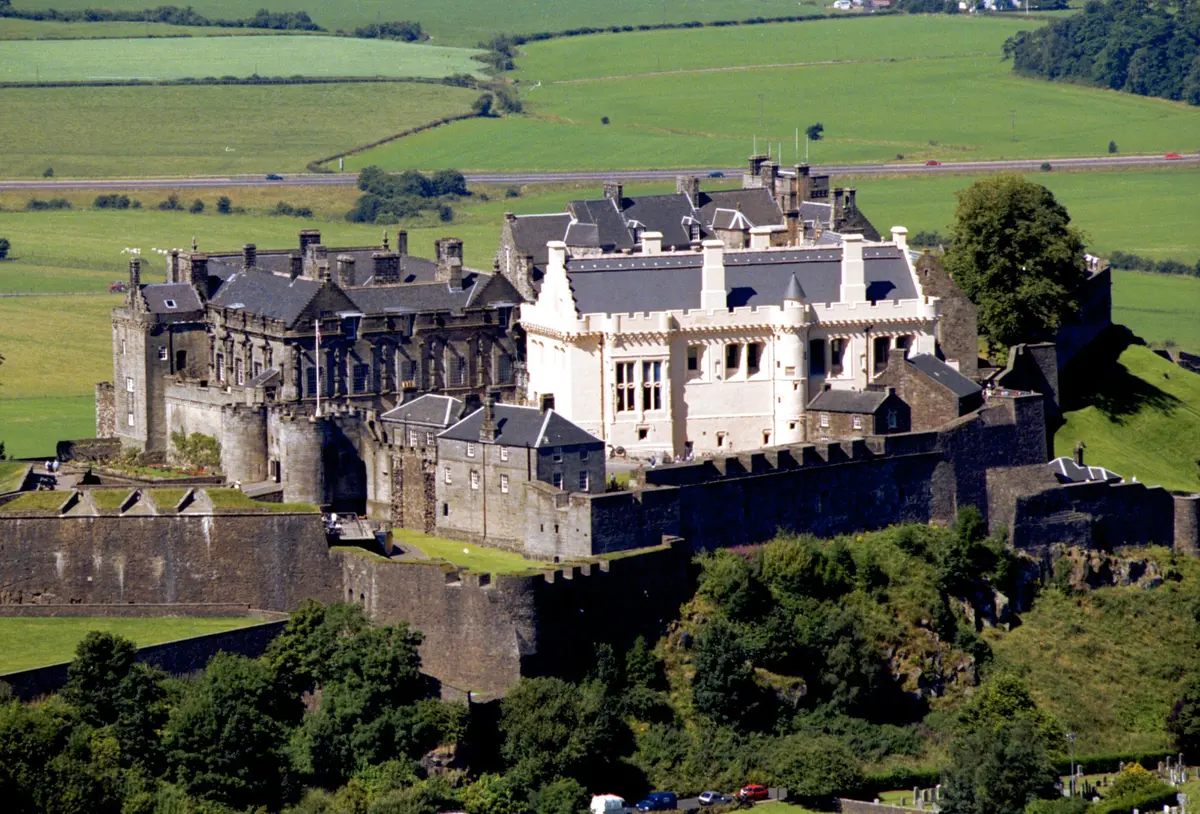
The buildings a visitor sees today are largely a Stewart project. Walter Merlioun began James IV's private lodging, the King's Old Building, in 1496; the Forework went up in the 1490s, and around 1503 came the Great Hall — 42 metres by 14, with five fireplaces, four spiral stairs, a minstrels' gallery and a trumpet loft, the most ambitious building of its type ever raised in Scotland. James V's Palace is worse documented than its contemporary at Falkland, because no detailed Masters of Works accounts for it survive. What is on record is that Sir James Hamilton of Finnart arrived in May 1538 to take charge, that he was executed in 1540, that almost £1,500 was spent between July and December of that year under James Nicholson, and that in 1541 the work passed to Robert Robertson, a master wright and carver — a change that probably marks the shift from building to fitting out. The present Chapel Royal was thrown up in 1594, in haste, for the baptism of Prince Henry.
Mary was crowned in the chapel royal on 9 September 1543, aged ten months, and came back to Scotland a widow in 1561. That autumn produced the one document on which the castle's ghost story rests. Thomas Randolph, Elizabeth I's agent in Scotland, wrote to Sir William Cecil on 24 September 1561: "My man writes, and I see it confirmed, that at Stirling the Queen while asleep in bed, a candle burning by her, the curtains and tester took fire, and was like to have 'smored' her as she lay." He went on: "Those who speak of prophecies, say an old one is now fulfilled — 'that a Queen sholde be burnte at Sterlinge.' It is as true as that of Lady Huntly — that she should never set foot in Scotland!" The same letter places the queen at Stirling on "Sunday eight days, viz. the 14th instant"; 14 September 1561 did fall on a Sunday. Her son James VI was crowned in July 1567 — not in the castle, but in the town's parish church, the Church of the Holy Rude.
After James VI moved south in 1603 the castle stopped being a residence and became a barracks, and stayed one for three and a half centuries. General Monck besieged and took it in August 1651. The outworks were rebuilt between 1708 and 1714 by Captain Theodore Dury. In 1777 the Stirling Heads were taken out of the King's Presence Chamber, whose ceiling and walls were stripped so that the room could become a barrack. Between 1796 and 1799 the Great Hall lost its hammerbeam roof and its crenellated parapet: two floors and five cross-walls were inserted and it became accommodation. In 1855 fire destroyed the north end of the King's Old Building, which Robert William Billings rebuilt in Baronial style. From 1881 the castle was the depot of the Argyll and Sutherland Highlanders, whose museum is still in the King's Old Building. In 1906 Edward VII complained about the "irrevocable damage" being done, and responsibility for the fabric passed to the Office of Works — but real restoration had to wait for the regiment to march out in 1964.
Then the castle was largely rebuilt. The Great Hall's roof, parapet, windows and lime-washed render were only finished in 1999, and Queen Elizabeth II opened it on 30 November of that year. The Royal Palace reopened to the public in June 2011, after research and craftsmanship costing £12 million. Underneath all that, Kirkdale Archaeology dug: between 1992 and 1997 Gordon Ewart and his colleagues took the floor of the Chapel Royal down more than five metres to bedrock, found the wall of the earlier chapel running diagonally beneath it, bronze slag and firebricks from a demolished metalworking complex, eighteen masons' marks on the string course, and graves under the army kitchen range that suggest a second, lost chapel. In 1995 they cleared out the great sandstone cistern west of the Great Hall Transe: 15.5 metres by 4.25, some 120 cubic metres, roughly 26,400 gallons. The excavation report records what it was for. It was built to provide water in the event of fire.
Timeline: the documented record of Stirling Castle
- 1105-1115 Alexander I dedicates a chapel inside an already existing castle on the rock. Historic Environment Scotland treats this as the earliest certain record of a royal association with Stirling.
- 22 April - July 1304 Edward I besieges the castle in person. About twenty-five men under Sir William Oliphant hold out roughly three months while five master carpenters and fifty workmen build the trebuchet called the War Wolf. Oliphant surrenders before it is used; Edward fires it anyway and sends the garrison to prison in England.
- c. 1503 James IV completes the Great Hall, 42 metres by 14, with five fireplaces, four spiral stairs, a minstrels' gallery and a trumpet loft: the most ambitious building of its type raised in Scotland.
- May 1538 - 1541 Sir James Hamilton of Finnart takes charge of building James V's Palace. He is executed in 1540; almost £1,500 is spent between July and December of that year, and in 1541 the work passes to the master wright and carver Robert Robertson. No detailed Masters of Works accounts for the Palace survive.
- 9 September 1543 Mary, Queen of Scots is crowned in the chapel royal of Stirling Castle at the age of ten months. Her son James VI would be crowned in 1567 not here but in the town's parish church, the Church of the Holy Rude.
- 24 September 1561 Thomas Randolph, Elizabeth I's agent in Scotland, writes to Sir William Cecil that at Stirling the queen fell asleep with a candle burning by her and "the curtains and tester took fire, and was like to have 'smored' her as she lay". He adds that those who speak of prophecies claim an old one fulfilled, that a queen should be burnt at Stirling, and dismisses it in the same breath. No servant appears in the account, and nobody dies.
- 1594 The present Chapel Royal is built in haste for the baptism of Prince Henry, on a slightly different axis from the chapel it replaced.
- 1777 The Stirling Heads, the carved oak roundels of the King's Presence Chamber ceiling, are removed; the authorities decide the ceiling and walls should be stripped and the room converted into a barrack. Of an estimated 56 heads, 38 survive.
- 1796-1799 The Great Hall is converted into barrack accommodation: two floors and five cross-walls are inserted, and the hammerbeam roof and crenellated parapet go. It stays military for a century and a half.
- 1855 Fire destroys the north end of the King's Old Building. Robert William Billings rebuilds it in Baronial style. It is the castle's best documented fire after 1561.
- 1964 The Argyll and Sutherland Highlanders march out. It is the end of an unbroken military occupation reaching back to Monck's army, and the beginning of the work to undo it.
- 1995 Kirkdale Archaeology, under Gordon Ewart, clears the great sandstone cistern west of the Great Hall Transe: 15.5 by 4.25 metres, about 120 cubic metres. The excavation report states its purpose plainly - it was intended to provide water in the event of fire.
- 30 November 1999 The restored Great Hall is opened by Queen Elizabeth II after more than thirty years of work: hammerbeam roof and parapet replaced, windows reinstated, outer walls rendered and limewashed. The gold building that dominates photographs of the castle is a 20th-century surface on a 16th-century shell.
- 22 October 2010 BBC Tayside and Central Scotland publishes a Halloween events round-up that gives the castle a single clause: "Stirling Castle with ghosts including a Green Lady, allegedly a maid to Mary Queen of Scots." It is the source that puts the castle into the haunted gazetteers.
- 8 and 12 July 2011 An anonymous editor adds the category "Reportedly haunted locations in Scotland" to the castle's Wikipedia article - an edit of exactly 53 bytes whose entire summary is that BBC link. Four days later another editor adds a two-sentence Ghosts section, under an edit summary reading only "Gallery", citing the Halloween listing and a tour operator's sales page.
- June 2011 The Royal Palace reopens to the public after a £12 million programme that returned six royal apartments to their 1540s appearance, hand-woven tapestries and recreated Stirling Heads included.
- 20 October 2023 Historic Environment Scotland publishes Laurie Risk's "Ghost Stories from Stirling Castle" on its blog, telling the Green, Pink, Black and White Ladies and reporting the author's own unexplained experience in the Prince's Tower. Its Statement of Significance for the same castle contains no occurrence of the words ghost, haunt or apparition.
Is there a rational explanation for Stirling Castle?
The fire is documented. The maidservant is not.
The primary account is Randolph's letter of 24 September 1561, calendared as no. 1023 in the first volume of the Calendar of the State Papers relating to Scotland (Cotton MS Caligula B. I, fol. 184). In it the queen is alone: a candle burning by her, the curtains and tester alight, and nobody else in the room. Nobody rushes in, nobody dies, and no servant is named or implied. Eric Stair-Kerr's Stirling Castle: Its Place in Scottish History (1913) tells the same episode from the same page of the same Calendar and says only that "the Queen was rescued from the flames".
The prophecy has a sceptic, and he is the first witness we have. Randolph reports that "those who speak of prophecies" claimed an old one fulfilled — that a queen should be burnt at Stirling — and then demolishes it in the next sentence by comparing it to a prophecy about Lady Huntly that had plainly failed. The oldest surviving text about the Stirling fire already contains its own debunking. Anyone who tells this story as a fulfilled omen is telling it against its source.
The precise date that circulates is not in the document. Historic Environment Scotland's own blog gives 13 September 1561. Randolph's letter does not date the fire at all; it is dated the 24th and places the queen at Stirling on Sunday the 14th. Coinciding with a respectable source does not make a date documented.
The silence before the 20th century can be measured. I searched the obvious places and counted, with a control term in each: William Drysdale's Old Faces, Old Places and Old Stories of Stirling (1898, 107,730 words) and its second series (1899, 97,151 words) — "ghost" 0, "green lady" 0, "apparition" 0, against 85 and 61 occurrences of "castle". J. S. Fleming's Old Nooks of Stirling (1898, 18,104 words) — 0, against 38 for "castle". The Stirling Antiquary, volume I, reprinting the Stirling Sentinel for 1888–1893 (112,638 words) — 0, against 75 for "castle" and 33 for "Mary". Stair-Kerr's 1913 monograph, which is about nothing but this castle (42,637 words) — "green lady" 0, and its only two hits for "ghost" are metaphors, against 480 for "castle". Outside Stirling: John H. Ingram's The Haunted Homes and Family Traditions of Great Britain (third edition, 140,593 words) has 95 occurrences of "ghost" and 13 of "Glamis" and does not mention Stirling once; Elliott O'Donnell's Scottish Ghost Stories (1911) gives Glamis a chapter and gives another to a white lady at Rownam Avenue, near Stirling, and has no Green Lady in the castle at all.
The dated ghost claims live in sales copy. The specific incidents — a cook fainting in the officers' mess when she appeared behind him, footsteps over the Governor's Block heard by an officer of the Argyll and Sutherland Highlanders in 1946 and by a major in 1956, a sentry found dead at his post on the 1820s beat — trace, as far as I can follow them, to a Scottish tour operator's page selling small-group tours, archived in 2015, and to the sites that copy it. No regimental record, unit diary or newspaper report is ever cited for them, and I could not find one.
Two versions of the Green Lady's death contradict each other, and the commercial one is the milder. The tour operator's page has her wake from a dream, run to the queen's chamber and save her, and live. Historic Environment Scotland's blog has her set the fire herself while dozing on watch, and die in it. Popular retellings have her die saving the queen. These cannot all be true, and none of them is in a document.
The body that runs the castle speaks with two voices, and the gap is measurable. Its Statement of Significance for Stirling Castle — PIC111, about 11,960 words, covering the historical, archaeological, artistic, social and spiritual character of the place — contains "ghost" 0 times, "haunt" 0, "apparition" 0, "supernatural" 0, "Green Lady" 0, against 171 occurrences of "castle" and 80 of "palace". Its public visitor pages, including "History and stories" and the tours page, are the same: zero. Its blog, on 20 October 2023, published a piece by Laurie Risk telling the Green Lady, the Pink Lady, the Black Lady and the White Lady, in which the author reports her own unexplained experience in the Prince's Tower. In the same season it sells Lantern Tours: Mystery and Malice, run in the last week of October and rated 12+. The contradiction is the fact worth knowing: the ghosts are absent from the heritage documentation and present in the October programme.
The Pink Lady has at least three incompatible identities, and the siege will not carry the story. The tour operator's version makes her a survivor of Edward I's siege of 1304, walking from the castle to Lady's Rock, looking for a husband killed in it. Wikipedia said for twelve years that the Pink Lady was Mary, Queen of Scots herself — a claim neither of its two sources supports. Historic Environment Scotland's blog puts her in the kirkyards below the rock as a pink aura and only "possibly" a woman whose lover died in battle. The siege itself is against her: the garrison of about twenty-five surrendered and was imprisoned in England. And Lady's Rock, in the Valley below the castle, is a real place with a documented and entirely unhaunted explanation — it is the outcrop from which the ladies of the court watched tournaments in the hollow beneath. The story explains the name; the name does not confirm the story. Canmore records a second such viewpoint inside the castle itself, "Ladies' Lookout", as part of the Forework.
Finally, three details that circulate and should not. She is not, in any source I have read, seen in the Great Hall — the places named are the officers' mess kitchen, the Governor's Block and the Prince's Tower, and the Great Hall's interior in any case dates from a restoration opened in November 1999. Nothing in the material says that ignoring a sighting brings misfortune; what the sales copy says is that her appearances have been followed by fire. And "reports going back well over a century" cannot be supported: the earliest dated claim is 1946 and the earliest datable printed appearance I can fix is very recent indeed.
That last date is worth stating plainly, because it is the answer to why this castle is filed as haunted at all. On 22 October 2010 BBC Tayside & Central Scotland published a Halloween events round-up that gave Stirling Castle a single clause: "Stirling Castle with ghosts including a Green Lady, allegedly a maid to Mary Queen of Scots." On 8 July 2011 an anonymous editor added the category "Reportedly haunted locations in Scotland" to the castle's Wikipedia article — an edit of exactly 53 bytes, whose entire summary was that BBC link. Four days later another editor added a two-sentence Ghosts section under an edit summary that read only "Gallery", sourced to the same Halloween listing and to the tour operator's page. In February 2014 an editor tagged that source as not "a high quality source for the supernatural"; in June 2018 another removed it as unreliable; in April 2023 the section was rewritten citing a 2004 gift book and two tourism press pages. Stirling Castle is in the haunted gazetteers because of a Halloween listing and a tour company. There is a real fire, a real letter, and a real sceptic in it — and they are all from 1561.
Can you visit Stirling Castle?
Stirling Castle is open to the public every day of the year except 25 and 26 December, and no ghost tour is needed to see any of the places in this file. It is at Castle Wynd, Stirling FK8 1EJ (national grid reference NS 789 940), telephone 01786 450 000, and it is run by Historic Environment Scotland.
Opening hours are 9.30 to 18.00 daily from 1 April to 30 September and 9.30 to 17.00 from 1 October to 31 March; on 1 January it opens 11.00 to 17.00. Last entry is one hour before closing, and 14.30 on 24 December. The Argyll and Sutherland Highlanders Museum, which is independent, closes 45 minutes before the castle.
Prices as published in August 2026, with the online rate first and the on-the-day rate second: adults aged 16 to 64 pay £18.50 or £20.50, over-65s £15.00 or £16.50, and children aged 7 to 15 £11.00 or £12.50. Under-7s go free, Young Scot cardholders pay £1, and Historic Scotland members and Explorer Pass holders enter free. Booking online and arriving without a car earns 25% off with the code GOOD25. Up to two carers accompanying a disabled visitor go free, and no proof of disability is asked for. Historic Environment Scotland's own Statement of Significance notes that people living in the burgh get free access.
Getting there needs planning. The castle car park is closed to everything except coaches and vehicles needing accessible parking; there are ten accessible spaces on the esplanade, first come first served, about 65 metres from the entrance. Everyone else should use the Castleview Park and Ride, which can be busy at peak times, or the council car parks in the town. The castle is about half a mile uphill from Stirling bus and railway stations. It is close to National Cycle Network route 765, and there are five bike racks on the esplanade taking up to ten bicycles.
On access: the approach is cobbled and sloping, at a maximum gradient of 1 in 15, and the main route from the gate to the Inner Close is 160 metres of cobbles at up to 1 in 9. Four manual wheelchairs are available on a first-come basis, and a mobility vehicle to the Inner Close can be requested at the entrance, subject to staff being free. There is an adapted toilet in the first courtyard, the Unicorn Café has ramped level access, and the path around the Queen Anne Garden is level paving. Ear defenders can be borrowed, and visual stories for adults and children are published in advance. Assistance dogs are welcome; other dogs are not.
Guided tours by castle staff are included in the ticket and start outside the Fort Major's House at the castle well; ask on arrival, because the times change daily. A separate paid "Secret Stirling" tour, launched in September 2025 at £15, opens about ten areas normally closed. The castle's supernatural material is sold in one place only, in late October, as the Lantern Tours: Mystery and Malice, suitable for ages 12 and over.
Two things in this file are outside the walls and free. The Church of the Holy Rude, where James VI was crowned in 1567, stands just below the esplanade. Beyond it is the Old Town Cemetery and the Valley, with Ladies' Rock — the outcrop from which the court watched tournaments, and the place where the Pink Lady is said to walk. Both can be visited at any time without a ticket.
Sources consulted
- Thomas Randolph; ed. Joseph Bain, «Randolph to Cecil, 24 September 1561, no. 1023» — Calendar of the State Papers relating to Scotland and Mary, Queen of Scots, 1547-1603, vol. I (Cotton MS Caligula B. I, fol. 184), 1898 archive
- Historic Environment Scotland, «Statement of Significance: Stirling Castle (PIC111)» — Historic Environment Scotland, 2025 report
- Eric Stair-Kerr, «Stirling Castle: Its Place in Scottish History» — James Maclehose and Sons, Glasgow, 1913 book
- G. Ewart, A. Radley, P. Sharman and J. Triscott, «Stirling Castle, Canmore ID 46245 (NS79SE 6): archaeology notes and Kirkdale Archaeology excavation reports, 1992-1997» — Canmore, Historic Environment Scotland, 1997 report
- William Drysdale, «Old Faces, Old Places and Old Stories of Stirling» — Eneas Mackay, Stirling, 1898 book
- W. B. Cook (ed.), «The Stirling Antiquary, volume I: reprinted from The Stirling Sentinel, 1888-1893» — Cook & Wylie, Sentinel Office, Stirling, 1893 newspaper archive
- Elliott O'Donnell, «Scottish Ghost Stories» — Kegan Paul, Trench, Trubner & Co., London, 1911 book
- John H. Ingram, «The Haunted Homes and Family Traditions of Great Britain (third edition)» — W. H. Allen & Co., London, 1886 book
- Laurie Risk, «Ghost Stories from Stirling Castle» — Historic Environment Scotland blog, 2023 web
- James Macivor, «The War Wolf at Stirling Castle» — Historic Environment Scotland blog, 2024 web
- BBC Tayside and Central Scotland, «Halloween happenings in your area» — BBC News, 2010 newspaper archive
- visitdunkeld.com, «Stirling Castle History (Tour Scotland small-group tours), archived page» — Internet Archive Wayback Machine, 2015 web
- Historic Environment Scotland, «Stirling Castle: prices and opening times, tours and accessibility» — historicenvironment.scot, 2026 web
- Wikipedia contributors, «Revision history of the article Stirling Castle (revisions 438489166 and 439159213, July 2011)» — English Wikipedia, 2011 archive
- John S. Fleming, «Old Nooks of Stirling: Delineated and Described» — Munro and Jamieson, Stirling, 1898 book
- Undiscovered Scotland, «Stirling Castle: the Great Hall and the Palace» — undiscoveredscotland.co.uk, 2026 web
Reviewed by V. Serrano on 2026-08-20 · How we verify our content
💬 Field testimonies (0)
No testimonies yet. Add the first.
Add your testimony
🔒 Log in to add a testimony