👻 HAUNTED PLACE · EXP. Nº9476
ACTIVE
Wemyss Castle
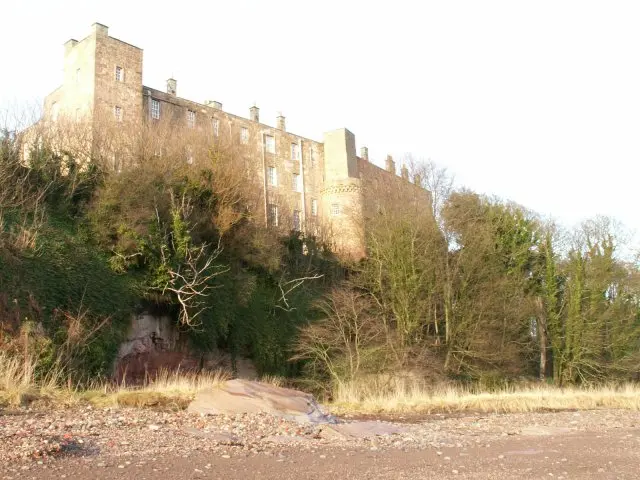
Wemyss Castle is a Category A listed multi-period castle perched on sandstone cliffs overlooking the Firth of Forth, between the villages of East and West Wemyss in Fife, Scotland.
Where is Wemyss Castle?
- Location
- Fife, Scotland, United Kingdom
- Type
- Castle
- Coordinates
- 56.144, -3.081
- Last updated
LOCATION
Why is Wemyss Castle said to be haunted?
Its oldest section, a 15th-century tower, forms the core of a building whose history intersects with some of Scotland's most consequential moments, including the first meeting between Mary, Queen of Scots and Lord Darnley in February 1565. The castle remains the private seat of the Wemyss family, whose lineage stretches back to the 13th century Earls of Wemyss. Its ghost lore centres on a recurring Green Lady, a figure dressed in flowing green silk who has been reported moving through the older wings of the building. The property is listed on the Inventory of Gardens and Designed Landscapes in Scotland and remains closed to the general public, with the family maintaining a policy of silence on the supernatural stories that have attached themselves to the cliffs over generations.
What is the history of Wemyss Castle?
Accounts date the construction of Wemyss Castle to 1421, when Sir John Wemyss decided to rebuild a fortified castle destroyed by the Duke of Rothesay at Kilconquhar in 1402. From that moment, Wemyss became the hereditary seat of the Earls of Wemyss, a lineage that produced one of the most historically significant meetings in 16th-century Scotland. On 17 February 1565, Mary, Queen of Scots met her cousin Henry Stuart, Lord Darnley, at Wemyss Castle. The court of James VI stayed at the castle in July 1583. In May 1590, Danish commissioners led by Peder Munk took sasine of royal properties here on behalf of Anne of Denmark. In April 1591, Lilias Ruthven was confined at Wemyss to prevent her marriage to Ludovic Stewart, Duke of Lennox; the duke managed to spirit her away and marry her at Dunkeld. Sir John Wemyss also sheltered Margaret Vinstarr, a Danish lady-in-waiting to the queen, after her partner John Wemyss of Logie became implicated in a plot with Francis Stewart, Earl of Bothwell against James VI. The incident inspired the ballad 'The Laird o Logie', collected by Francis James Child. The castle was also used as a prison: in 1597, Archie Armstrong of Whitehaugh was held here before being transferred to Falkland Palace.
Timeline: the documented record of Wemyss Castle
- 1402 The original fortified castle on the site is destroyed by the Duke of Rothesay at Kilconquhar.
- 1421 Sir John Wemyss commissions the construction of a new fortified castle on the site.
- 17 February 1565 Mary, Queen of Scots meets Lord Darnley for the first time at Wemyss Castle.
- July 1583 The court of James VI stays at Wemyss Castle, as recorded in the Bowes Correspondence.
- 11 May 1590 Danish commissioners take sasine of royal properties at Wemyss on behalf of Anne of Denmark.
- April 1591 Lilias Ruthven is confined at Wemyss to prevent her marriage to the Duke of Lennox.
- 1592 Sir John Wemyss shelters Margaret Vinstarr; the incident inspires the ballad 'The Laird o Logie.'
- 1597 Archie Armstrong of Whitehaugh is held as a prisoner before being transferred to Falkland Palace.
- 1890s Coaltown of Wemyss is established as an estate village on castle land.
- 30 March 2005 Wemyss Castle is added to the Inventory of Gardens and Designed Landscapes in Scotland.
- October 2007 Fife Today reports that ghost sightings had ceased in recent years.
Is there a rational explanation for Wemyss Castle?
The ghost lore attached to Wemyss Castle rests on a very thin evidentiary base. The most widely cited manifestation is a Green Lady reported in the older wings. Scottish folklore has traditionally associated the colour green with misfortune and bad omens, particularly regarding marriage; a saying recorded in 1892 stated that 'Married in May, and kirked in green / Baith bride and bridegroom winna lang be seen.' This cultural context means that any grey or discoloured fabric seen in poor light in an old building could plausibly generate a Green Lady report. A Fife Today article from October 2007 noted that sightings had ceased in recent years — evidence that the reports clustered in time rather than being continuous. The castle is a private family residence and has never been the subject of a published academic or parapsychological study. No photographs, video recordings, or instrumental measurements have been produced under controlled conditions. The family's silence on the stories might more parsimoniously be interpreted as a lack of interest in encouraging visitors to a private home.
Can you visit Wemyss Castle?
Wemyss Castle is a private residence and is not open to the public. There is no visitor centre, no admission charge, and no regular opening schedule. The property is on private land with no public right of way to the building itself. The nearest public access is the coastal footpath between East and West Wemyss, from which the castle can be viewed from a distance. The nearby Wemyss Caves on the foreshore, accessible at low tide, are a separate attraction of geological and historical interest. Historic Environment Scotland maintains the official record for the building (Site no. NT39NW 14). The Wemyss family do not offer tours, ghost-hunting events, or accommodation.
Sources consulted
- Clare Hunter, «Embroidering Her Truth: Mary, Queen of Scots and the Language of Power» — Sceptre, 2022 book
- Charles Wemyss, «The Noble Houses of Scotland» — Prestel Verlag, 2014 book
- Antonia Fraser, «Mary Queen of Scots» — Phoenix Press, 2002 book
- Joseph Stevenson (ed.), «Bowes Correspondence» — Surtees Society, vol. 14, 1842 archive
- David Stevenson, «Scotland's Last Royal Wedding» — Edinburgh, 1997 book
- William Fraser, «Memorials of the family of Wemyss of Wemyss» — Edinburgh, 1888 archive
- John Gifford, «Fife (Buildings of Scotland series)» — Yale University Press, 2003 book
- Historic Environment Scotland, «Historic Environment Scotland record for Wemyss Castle» — Historic Environment Scotland, 2025 archive
- Fife Today, «Beware the witching hour» — Fife Today, 2007 newspaper archive
- Francis James Child, «The English and Scottish Popular Ballads (Child Ballads, Part VIII)» — Boston, 1892 book
Reviewed by V. Serrano on 2026-08-29 · How we verify our content
💬 Field testimonies (0)
No testimonies yet. Add the first.
Add your testimony
🔒 Log in to add a testimony