📜 LEGEND · EXP. Nº3657
ACTIVE
Oiwa and the Yotsuya Ghost Story
Oiwa and the Yotsuya Ghost Story is a legend from Tokyo, JP — a folk story passed down over generations. This file collects its origins, its meaning and how it has been retold.
Where does the legend of Oiwa and the Yotsuya Ghost Story come from?
- Location
- Tokyo, JP
- Kind of legend
- Ghost story
- Coordinates
- 35.687, 139.728
- Testimonies
- 0
- Last updated
LOCATION
What is the legend of Oiwa and the Yotsuya Ghost Story?
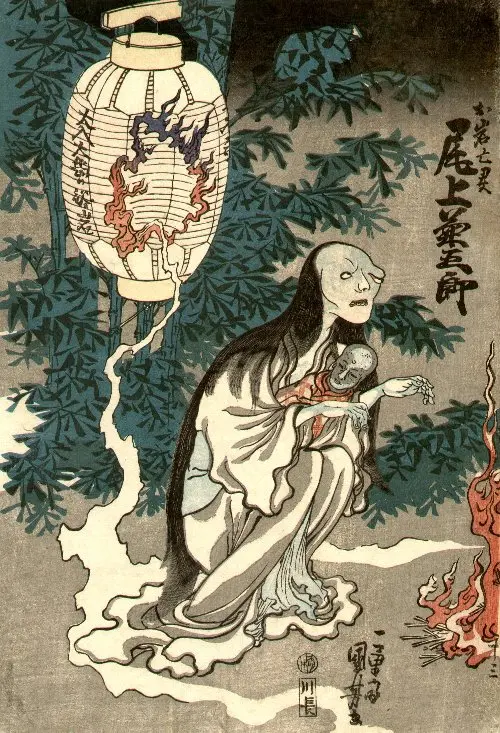
Yotsuya Kaidan is one of Japan's classic ghost stories, first staged as kabuki theater in 1825 and set, according to the tale, in the Yotsuya district of Edo during the seventeenth century. The story follows a woman named Oiwa, married to a ronin, Iemon, who wants to be free of her to marry a wealthier woman. Iemon is said to have arranged for Oiwa to be given a poison disguised as medicine; rather than killing her outright, it disfigures her face and causes her hair to fall out. Overwhelmed by grief and betrayal upon discovering the truth, Oiwa dies, in some tellings by accident during a struggle, in others by her own hand. Folklore holds that her vengeful spirit then returns to torment Iemon, appearing in mirrors, in lantern light and in the face of his new bride, driving him toward madness and ruin. The play became so associated with real misfortune that Japanese actors and film crews still customarily visit Oiwa's grave in Tokyo before staging or filming any version of the story, a tradition observed out of respect rather than as proof of anything supernatural. Countless film, television and manga adaptations have kept the story alive for two centuries.
What is the history of Oiwa and the Yotsuya Ghost Story?
Tōkaidō Yotsuya Kaidan is Japan's most famous ghost story, and its origin is neither popular nor ancient: it is theatrical and precisely dated.
It was written by Tsuruya Nanboku IV and premiered in July 1825 at the Nakamuraza theatre in Edo, now Tokyo. The production was staged as a double bill with the Chūshingura, the story of the forty-seven rōnin and the greatest success in the repertoire. Nanboku deliberately interleaved the two: his tale of domestic horror unfolded at the margins of the great epic of samurai loyalty, and the contrast was the intended effect.
The plot is cruel in a very specific way. Oiwa is married to the rōnin Tamiya Iemon, who wants rid of her so he can marry a rich neighbour's granddaughter. Oiwa is given a poisoned ointment that hideously disfigures her face; the scene in which she combs her hair at the mirror and it comes away in handfuls as she realises what has been done to her is one of the most celebrated in Japanese theatre. She dies, and she returns. Her deformed face appears in a lantern, in water, in place of the bride's. Iemon is destroyed.
Its success was immediate and has never stopped: the play has been adapted to film more than thirty times, and its influence on modern Japanese horror — the woman with long hair and a hidden face — is direct and traceable.
And there is an earlier layer. At Myōgyō-ji temple in Sugamo, northern Tokyo, there is a grave attributed to the wife of the second Tamiya Iemon, with a date of death of 22 February 1636. The grave was moved there from Yotsuya during the Meiji era.
Timeline: the documented record of Oiwa and the Yotsuya Ghost Story
- 22 February 1636 The date of death recorded on the grave attributed to the wife of the second Tamiya Iemon, today at Myōgyō-ji temple in Sugamo. Almost nothing is known of her life.
- July 1825 Tsuruya Nanboku IV premieres Tōkaidō Yotsuya Kaidan at the Nakamuraza theatre in Edo, in a double bill with the Chūshingura. The play is written a hundred and ninety years after the historical Oiwa's death.
- Meiji era Myōgyō-ji, the temple of the Tamiya family that holds the grave attributed to Oiwa, moves from Samegahashi in Yotsuya to Nishi-Sugamo, where it remains today.
- 20th century The play is adapted to film more than thirty times and its iconography — the woman with long hair and hidden face — becomes the basis of modern Japanese horror.
- Present day The tradition persists that cast and director visit the grave and shrine to ask permission before staging the play. Productions that skip the ritual acquire a reputation for accidents.
Is there a rational explanation for Oiwa and the Yotsuya Ghost Story?
Yotsuya Kaidan is the best example I know of a legend whose three layers can be dated separately, and watching them stack explains more about how this works than any argument about whether the ghost exists.
Layer one: a real woman, seventeenth century. There is a grave, now at Myōgyō-ji temple, attributed to the wife of the second Tamiya Iemon, with a death date in 1636. Of her life we know almost nothing. What we do know is that what the play describes did not happen to her, because the play was written a hundred and ninety years after her death.
Layer two: a commercial fiction, 1825. Nanboku IV was a professional dramatist writing for an Edo audience with a very pronounced taste for domestic horror. He took a local surname and a local grave and built a revenge plot on top of them. That is not folklore transmission: it is authorship, with a premiere date and a theatre.
Layer three: a professional superstition, twentieth and twenty-first centuries. The current tradition holds that the cast and director must visit Oiwa's grave and the Yotsuya shrine to ask her permission before staging the play, and that productions which skip the ritual accumulate accidents and misfortune. It is considered especially important for whoever plays Oiwa.
That third layer is the interesting one, and it is not distinctively Japanese: it is precisely the same phenomenon as the Macbeth superstition in Anglophone theatre, and the comparison is frequently made. Every theatrical or film production accumulates accidents — these are environments with height, fire, water, rigging and haste — and a play staged for two centuries and filmed more than thirty times has accumulated, by pure statistics, an impressive list of incidents. The superstition selects those that happened in productions which skipped the visit and forgets the rest.
And there is something to be said for the ritual, even without believing in it. Going to a real grave — that of a seventeenth-century woman about whom almost nothing is known — to ask permission before spending months performing her disfigurement and death is a notably decent gesture. Effective against curses or not, it acknowledges that there was somebody behind the character.
Can you visit Oiwa and the Yotsuya Ghost Story?
The Oiwa Inari Tamiya Shrine stands at 17 Samon-chō, Shinjuku, Tokyo, in a quarter of narrow lanes. Japanese Wikipedia puts it four minutes' walk from exit 3 of Yotsuya-sanchōme station and eight minutes from Shinanomachi station. Kokoro Media, describing a visit in October 2020, reports a plaque at the shrine, in Japanese and English, stating that the real Oiwa lived two hundred years before the play, was happily married and used to pray at the shrine, which stands on land owned by her husband's family, the Tamiya. The same writer found it busy with worshippers on a weekday and noted that a temple almost opposite also claims a connection with Oiwa. Japanese Wikipedia, citing a guidebook published by the Shinjuku ward board of education in 1981, traces the shrine to an Inari shrine kept by the Tamiya household. After a fire in 1879 it moved to Kyōbashi ward, now Chūō ward, where a second Oiwa Inari Tamiya Shrine still stands at Shinkawa. A small shrine remained at Yotsuya, the temple Yōun-ji was founded there in the early Shōwa period, and the Yotsuya shrine was rebuilt in 1952.
The grave attributed to Oiwa is at Myōgyō-ji, 4-8-28 Nishi-Sugamo, in Toshima ward in the north of the city. Japanese Wikipedia, citing a 1994 guide to the historic sites of Toshima, records that the Tamiya family belonged to this temple and that it moved from Samegahashi in Yotsuya to Nishi-Sugamo in 1909. Kokoro Media reports a custom by which the director and leading actors of a new production visit this grave to ask for Oiwa's blessing. José Manuel Zardain, writing for Japan Travel in 2016, describes the same custom for film and stage crews but places it at the Yotsuya shrine.
The play is part of kabuki's summer season. Kabuki Bito, Shochiku's kabuki site, noted in July 2022 that ghost plays and murder scenes have been staged in the hot months since the Edo period as suzumi shibai, "cooling plays", and that Tōkaidō Yotsuya Kaidan was first performed in July 1825. The Japan Arts Council's guide to the repertoire names as the play's major highlight the kamisuki scene, in which Oiwa, disfigured by poison, blackens her teeth and combs out her hair as it falls away.
Sources consulted
- Japan Arts Council, «Tōkaidō Yotsuya Kaidan — ficha de la obra en el repertorio kabuki» — Invitation to Kabuki (UNESCO), 2024 archive
- Universiteit Leiden, «Tōkaidō Yotsuya kaidan's Oiwa: analysis of a kabuki vengeful ghost» — Student Repository, Universidad de Leiden, 2018 academic
- Kokoro Media, «The Japanese ghost story Yotsuya Kaidan and its shrine — santuario y tumba» — Kokoro Media, 2020 web
- José Manuel Zardain, «Oiwa-Inari Tamiya Shrine, Shinjuku — el santuario donde se pide permiso» — Japan Travel, 2016 web
- Satoko Shimazaki, «The end of the 'world': Tsuruya Nanboku IV's female ghosts and late-Tokugawa kabuki» — Monumenta Nipponica, vol. 66, no. 2 (via ResearchGate), 2011 academic
- Wikipedia contributors, «妙行寺 (豊島区) - history of the temple (moved to Nishi-Sugamo in 1909) and the Tamiya family grave (citing 伊藤栄洪・堀切康司『豊島区史跡散歩』, 1994)» — Wikipedia (Japanese), 2026 web
- Wikipedia contributors, «於岩稲荷田宮神社 (新宿区) - origin as the Tamiya household Inari shrine, 1879 fire and move to Kyōbashi (Shinkawa), rebuilding in 1952 (citing 新宿区教育委員会『ガイドブック新宿区の文化財(3)』, 1981)» — Wikipedia (Japanese), 2026 web
- Kabuki Bito (Shochiku), «怪談と歌舞伎 (Ghost stories and kabuki) - summer 'suzumi shibai' and the July 1825 premiere of Tōkaidō Yotsuya Kaidan» — kabuki-bito.jp, 2022 web
Reviewed by V. Serrano on 2026-07-28 · How we verify our content
📎 Source: Enigma Atlas
💬 Field testimonies (0)
No testimonies yet. Add the first.
Add your testimony
🔒 Log in to add a testimony