🦶 CRYPTID SIGHTING · EXP. Nº0555
ACTIVE
Afanc
The oldest surviving account of the afanc of the River Conwy is a letter written in 1693 by the naturalist Edward Lhuyd, printed a century and a half later in The Cambrian Journal from a manuscript owned by Canon Robert Williams of Oswestry.
Where and when was Afanc sighted?
- Location
- Betws-y-Coed, Conwy, Wales, United Kingdom
- Date sighted
- Unknown
- Coordinates
- 53.076, -3.796
- Last updated
LOCATION
What is Afanc?
In it a girl coaxes the creature out of Llyn yr Afanc, a pool above Betws-y-Coed, and holds it asleep on her knees while it is bound with iron chains; it wakes, tears off her breast and flees, and teams of long-horned oxen haul it over the mountains to the lake under Yr Wyddfa now called Glaslyn — beyond the Conwy watershed, so it could flood the valley no more. Lhuyd adds that some took this afanc for a corporeal demon, while he himself knew of an animal of the same name that English calls a beaver, because ceilliau'r afanc means beaver stones. He is glossing a word, not identifying a monster: Giraldus in 1188 had already left the beaver in one river only, the Teifi, five hundred years earlier and 130 km away. No afanc has ever been reported seen. Everything filed about it since is traceable to editors, translators and, latterly, to two edits made three minutes apart in 2018.
What is the history of Afanc?
Llyn yr Afanc is a pool on the Afon Conwy, just above the point where the Lledr comes in, about two kilometres south-south-east of Betws-y-Coed. Almost everything that is said in English about the creature it is named after comes out of one letter, and the letter can be read.
It was written by Edward Lhuyd, who signed himself Edward Llwyd: born 1660, died 30 June 1709, keeper of the Ashmolean Museum at Oxford from 1690-1, and the man who in 1696 posted four thousand copies of his "Parochial Queries in Order to a Geographical Dictionary, a Natural History, etc., of Wales" — three to every parish — before setting out in May 1697 on a tour that took four years and visited every county in Wales. The letter is dated 1693. It is earlier than the Queries and earlier than the tour: a naturalist writing to a correspondent about a story both of them already knew.
It reached print a century and a half later. The Cambrian Journal ran it under the heading "The Legend of Llyn yr Afangc", beginning on page 142, with a covering note that is the whole chain of custody: "I have sent for preservation in your Journal the following interesting letter of the learned Edward Llwyd, which I have transcribed literally from his own manuscript in my possession. It is a good specimen of idiomatic Welsh writing. — Robert Williams, M.A., Rhydycroesau, Oswestry, May 27, 1859." The Welsh text is printed first and an English translation follows it; the signature line at the foot of page 145 reads "CAMB. JOUR., 1860", so the piece ran across the parts of a quarterly, and a later instalment of the same letter ends at page 211 with "Edward Llwyd. 1693."
What Lhuyd actually says is brief. He does not bother to locate the pool — the editors add a footnote putting it "near the river Conway, above Bettws, over against Capel Garmon, near Aberlleder" — and he does not bother to tell the story properly either, because his correspondent knows it. A merch, a girl or young woman, coaxed the afanc out of its dwelling so that it could be bound with iron chains, while it slept with its head on her knees and one hand gripping her breast. It woke, saw what had been done, got up in a temper and made for its old refuge with her breast in its claw. The chain was long enough to fasten to oxen, and the oxen pulled it out. Then the men fell to arguing about who had pulled hardest, and the afanc silenced them with a couplet: "Oni bae y dai ag a dyn, / Ni ddaetha'r Afangc byth o'r llyn."
That couplet has been Englished two incompatible ways by people who had the same Welsh in front of them. The Cambrian Journal's own translator, in 1860, printed "had it not been for the divinity that drew, the avangc would never have come out of the lake". John Rhys, retranslating the same line in 1901, printed "Had it not been for the oxen pulling, / The afanc had never left the pool." A god or a team of cattle: the tradition does not decide, and neither do we.
Then comes the sentence the whole modern file rests on, and it does not say what it is quoted as saying. In Welsh: "mae yn rhaid i chwi ddeuallt fod rhai yn cymeryd yr Afangc yma yn lle Cythrael corphorol: ond mae yn ddigon hysbys gennif fod anifal o'r un henw, yr hwn a elwir yn y Saesonaeg Bever, oblegid fod y gair ceillie'r Afangc yn arwyddocau Bever stones." The 1860 translation: "You must know that some regarded this avangc as a corporeal demon; but I am well aware that there is an animal of the same name, which in English is designated the Beaver, because the expression ceillie'r Avangc means Beaver stones." Lhuyd is not identifying the thing in the pool. He is making a lexical point about a homonym, and the evidence he produces is a word: a fixed Welsh compound, ceillie'r afanc, which he says "signifies Beaver stones". Note also that he wrote yr Afangc yma, "this afanc" — the one in the pool. Rhys's 1901 translation quietly drops the yma, and the sentence generalises from a particular creature to the species of the word.
The rest of the letter is about where the oxen went: the pass since called Bwlch Rhiw'r Ychain, the open ground called Gwaun Lygad Ych where one ox dropped an eye, the knee-deep pool called Pwll Llygad Ych that never dries and never overflows, and a harp tune, Caingc yr Ychain Bannog, "which every minstrel cannot perform", said to imitate the groaning of the oxen under the weight. They delivered the afanc to Llyn Cwm Ffynnon Las. Rhys, on the authority of Elis o'r Nant of Dolwyddelan, identifies that tarn as Llyn Glas or Glaslyn under Yr Wyddfa, and adds the point of the exercise: "the Nant Conwy people, by dragging the afanc there, got him beyond their own watershed, so that he could no more cause floods in the Conwy."
Rhys is the link through which almost everyone has read Lhuyd, and he damages the chain twice. He attaches a footnote to Robert Williams's transcript — "it is not to be supposed that the latter ever took the trouble to make an accurate copy of them any more than he did of any other MSS." — flatly contradicting Williams's own "transcribed literally"; and in the same footnote he says he does not know where the original went: "It would be interesting to know what has become of this letter and others of Llwyd's once in the possession of the canon." Worse, he suppressed a rival version. His best informant on Beddgelert folklore, William Jones of Llangollen, had the afanc story from Twm Ifan Siams of Nanmor, a pedigree-reciter who died about 1835-6 aged some ninety-five, and was struck in 1858 by how little it differed from the printed Lhuyd text; he checked it again against a third man, Gruffudd Rhisiart of Beddgelert, who had heard the same from his uncle. Rhys prints none of it. His reason, in a footnote: "Since the editing of this volume was begun I have heard that it is intended to publish the Welsh collection which Mr. Jones has made: so I shall only give a translation of the Edward Llwyd version of the afanc story." An independent oral line running back into the eighteenth century was left out of the standard book because a rival book was expected.
Two other afancs get folded into ours and should not be. At Llyn Barfog above Aberdyfi the story is about fairy cattle: John Pughe's paper of 1853 is headed "Gwragedd Annwn — The Dames of Elfin Land", and the afanc appears only in his opening flourish, where he glosses the Triadic Afanc y Llyn as "crocodile of the lake" and notes that "many a lakelet in our land has put forward its claim to the location of Llyn Llion; amongst the rest this lake." Rhys rejected the gloss in a footnote of his own. And at Llyn Syfaddon in Powys, the fifteenth-century poet Lewys Glyn Cothi made the afanc a figure of stubbornness — he will no more leave his friend's house than the afanc could be drawn from the mere — which means the Syfaddon story had to end in failure for the joke to work.
Timeline: the documented record of Afanc
- 1188 Giraldus Cambrensis, describing Archbishop Baldwin's journey through Wales, writes that the Teifi is "the only river in Wales, or even in England, which has beavers; in Scotland they are said to be found in one river, but are very scarce" (Book II, ch. 3). It is the notice on which every later beaver argument rests, and it puts the animal about 130 km from the Conwy.
- 15th century The poet Lewys Glyn Cothi, praising Llywelyn ab Gwilym ab Thomas Vaughan of Bryn Hafod, says he can no more be drawn from his friend's house than the afanc could be drawn from Llyn Syfaddon: "Nor wain nor oxen wont to toil / Me to-day will draw from here forth." Rhys prints the Welsh and observes that the Syfaddon story must therefore have ended in failure. The lines cannot be dated more closely than the poet's lifetime.
- 1693 Edward Lhuyd writes the letter that is the oldest surviving version of the Conwy story. He records the girl, the chains, the oxen, the couplet and the delivery to Llyn Cwm Ffynnon Las, and adds that "some regarded this avangc as a corporeal demon" while he himself knows of "an animal of the same name, which in English is designated the Beaver, because the expression ceillie'r Avangc means Beaver stones". The letter predates both his 1696 Parochial Queries and his tour of Wales, begun May 1697.
- 1801 The third and latest series of Trioedd Ynys Prydain is printed for the first time, in the Myvyrian Archaiology of Wales, edited by Owen Jones, Edward Williams (Iolo Morganwg) and William Owen Pughe. Triad 13 has Llyn Llion burst and drown all but Dwyfan and Dwyfach, without naming the afanc; triad 97 has the Ychain Bannog of Hu Gadarn drag the Afanc of the lake ashore "and the lake burst no more". The two are separate statements.
- 1803 William Owen Pughe's Dictionary of the Welsh Language defines "Avanc, s.m. — A beaver", citing the Welsh Laws, Giraldus and a claim that it "has been seen in Nant Francon in Caernarvonshire in the memory of man". Under Banawg he guesses the Ychain Bannog were "probably either the moose, the elk, or bison, most probably the latter", calls the Avanc "another terrible animal under the name of the beaver", reports that at Llanddewi Brefi "they showed, till lately, some very large horns" said to be the oxen's, and notes that "there is hardly a lake, but is asserted in the neighbourhood to be the one out of which the Ychain banawg drew the Avanc".
- 1806 Sir Richard Colt Hoare, annotating his translation of Giraldus, builds the place-name case: "if the castor of Giraldus, and the avanc of Humphrey Llwyd and of the Welsh dictionaries, be really the same animal, it certainly was not peculiar to the Teivi" — and lists among the evidence "a pool in the river Conwy, not far from Bettws". The conditional is his; the certainty is other people's.
- 1853 John Pughe of Aberdovey publishes "Gwragedd Annwn — The Dames of Elfin Land. A Legend of Llyn Barfog" in Archaeologia Cambrensis, pp. 201-205, signing it at Aberdovey. In the opening paragraph he glosses Afanc y Llyn as "crocodile of the lake" and asserts that the Triads make it the cause of the deluge. Both readings are his additions; Rhys rejected the first in a footnote in 1901.
- 27 May 1859 Canon Robert Williams of Rhydycroesau, Oswestry, sends Lhuyd's letter to The Cambrian Journal, stating that he has "transcribed literally from his own manuscript in my possession". It appears under the heading "The Legend of Llyn yr Afangc" from page 142, Welsh text first and an editorial English translation after; the translator renders the afanc's couplet as "had it not been for the divinity that drew".
- 1901 John Rhys prints his own translation of the letter in Celtic Folklore: Welsh and Manx, vol. I, pp. 130-135, rendering the couplet as "Had it not been for the oxen pulling". He doubts Williams's transcript in a footnote, and declines to print the independent oral version collected from Twm Ifan Siams because a rival Welsh collection was expected. He also records that his informant Maclaren said the afanc's name "used to be employed within his memory to frighten girls and children: so much was it still dreaded".
- 30 July 2004 The English Wikipedia article is created by user Gtrmp with the opening words "The addanc ... is a lake monster from Welsh folklore". The same first revision states that the creature's thrashings "crushed the maiden, in whose lap it still laid" — which contradicts Lhuyd, in whom it tears off her breast and escapes. That sentence is still in the article in August 2026.
- 18 December 2005 User Dangherous adds [[Category:Lake cryptids]] to the article. This is the earliest moment at which the afanc is filed as a cryptid rather than as a legend; the edit summary is the category name itself.
- 18 June 2007 User Orangemarlin removes the cryptid category with the edit summary: "This is a myth, hardly a cryptid." The reversal lasts nineteen months.
- 27 March 2009 User Kyle1278 adds the {{Cryptozoology}} navigation box. It has never been removed, and it is why a reader arriving at the afanc in 2026 is shown a menu of Bigfoot, Nessie and the Mothman under a Welsh water demon of 1693.
- 16 April 2014 User Manuel.vegapurificacion creates an Afanc page on the Cryptid Wiki, copying the Wikipedia text almost word for word, crushed maiden included.
- 16 July 2018 At 05:46 UTC, user TheCryptidRaptorAckerman adds to that page an image of Obdurodon tharalkooschild captioned "a possible explanation" — a giant fossil platypus from the Riversleigh deposits of Queensland, named by Pian, Archer and Hand in 2013. Three minutes later, at 05:49, the same user adds Kronosaurus, a Cretaceous marine reptile, on the same terms. This is the first zoological candidate ever offered for the afanc that is not a beaver.
- 17 March 2021 An anonymous editor at IP 24.184.68.222 inserts "or a platypus" into the English Wikipedia's description of the afanc. It is still there in August 2026, and it is the only trace in a general encyclopaedia of an Australian fossil monotreme proposed on a fan wiki three years earlier.
Is there a rational explanation for Afanc?
There is nothing to be sceptical about in the usual sense, because there is nothing to examine. None of the sources cited on this page reports a dated, attributed sighting of an afanc, and the English Wikipedia article, as read on 25 September 2026, cites none either. What exists is a filing decision, and it can be dated.
The naturalistic reading is old, and it rests on a word. Afanc is the ordinary modern Welsh word for a beaver: the Welsh-language Wikipedia article under that headword is about the beaver genus Castor and gives the lake creature a single sentence. William Owen Pughe's Dictionary of the Welsh Language of 1803 gives "Avanc, s.m. — A beaver" and argues it from the Welsh Laws, from Giraldus, and from a report that the animal "has been seen in Nant Francon in Caernarvonshire in the memory of man"; Sir Richard Colt Hoare repeats the place-name argument in a note to his 1806 translation of Giraldus, listing "a pool in the river Conwy, not far from Bettws" among the evidence. That argument is circular: the pool is named after the afanc, and using its name to prove that afancs were beavers assumes the conclusion. Lee Raye, reviewing the medieval evidence for the beaver in Britain in 2015, adds two points against it. Citing Aybes and Yalden (1995), he writes that "the term 'afanc' in early Welsh literature originally refers to a water monster and not the beaver until the seventeenth century", and that "Nant Ffrancon was named after a Frank, not an 'afanc'."
The geography points the same way. Giraldus Cambrensis, describing Archbishop Baldwin's journey of 1188, says the Teifi is "the only river in Wales, or even in England, which has beavers"; he writes it in his account of Cenarth, on the lower Teifi, about 126 km south-south-west of Betws-y-Coed. The Welsh Laws quoted by Pughe in 1832 point to scarcity too: the beaver is one of three animals, with the marten and the ermine, whose value belongs to the king wherever it is killed, "for of their skins are made edgings for the garments of the king", and it is priced at six-score pence. Colt Hoare, annotating Giraldus in 1806, wrote that "the beaver no longer disturbs its streams" even on the Teifi. For the centuries after 1188 the specialists disagree. Raye finds the beaver "almost certainly present until at least 1188" in south Britain, with "very little evidence either way" until the seventeenth century, and argues for extinction there by about 1300; Bryony Coles, in Beavers in Britain's Past (2006) and a revision of 2010, argues that beavers survived in Britain into the eighteenth century. On Raye's reckoning nobody on the Conwy in 1693 had seen a beaver; on Coles's the question stays open.
The flood rests on a juxtaposition, and it can be pinned to a page. The Triads that carry it are the third and latest series, first printed in the Myvyrian Archaiology of Wales in 1801 by Owen Jones, Edward Williams (Iolo Morganwg) and William Owen Pughe. Triad 13 says the bursting of Llyn Llion drowned everyone except Dwyfan and Dwyfach, and does not mention the afanc. Triad 97, of the three great feats of the island of Britain, sets side by side the ship of Nefydd Naf Neifion, which carried a male and a female of every living thing when Llyn Llion burst, and the Ychain Bannog of Hu Gadarn, which "dragged the Afanc of the lake onto land, and the lake burst no more". Neither triad says that the afanc caused the flood. John Pughe made it the cause in 1853 ("the Triads in their record of the deluge affirm that it was occasioned by a mystic Afanc y Llyn"), and the English Wikipedia article still carries the flood, attributed to Iolo Morganwg under a citation-needed tag dated May 2025. William Owen Pughe, who identified the afanc as a beaver in 1803 and guessed that the Ychain Bannog were "probably either the moose, the elk, or bison, most probably the latter", was also one of the three editors who put the third series of Triads into print.
He also, in the same 1803 entry, disposed of any claim that this is one lake's monster: "there is hardly a lake, but is asserted in the neighbourhood to be the one out of which the Ychain banawg drew the Avanc." It is a migratory legend, told wherever there is deep water and an odd hollow in a rock.
Finally, one detail of provenance. The English Wikipedia article attributes to "David Williams, Welsh Folklore: A Guide to the Mythical and the Mysterious, University of Wales Press, 2011" the view that the afanc "was a symbol of both danger and courage in Welsh myth"; the citation gives no ISBN and no page. On 25 September 2026 a search of the University of Wales Press catalogue for "mythical and the mysterious" returned no title, and a search of the same catalogue for "folklore of wales", made the same day as a control, returned the press's The Folklore of Wales: Ghosts.
Can you visit Afanc?
Llyn yr Afanc is a widening of the Afon Conwy, easy to pass without noticing. OpenStreetMap maps it as a stream pool (way 966045972) centred on 53.0763, -3.7955, the pin of this entry, about 1.8 km (1.1 miles) south-south-east of Betws-y-Coed station in a straight line; the nearest postcode centroid, LL24 0SH, lies some 260 metres to the north. About 70 metres upstream, at the southern end of the pool, the A470 crosses the river on Pont yr Afanc, the Afanc's Bridge, a Grade II listed bridge of about 1800 (Cadw records 17832 and 18776, as given by Wikidata): the road bridge takes its name from the pool. On the west bank the Conwy Valley Line, which runs between Llandudno and Blaenau Ffestiniog, passes through a 110-yard tunnel that OpenStreetMap names the Beaverpool Tunnel, an English rendering of the pool's name.
Upstream the river comes out of Ffos Anoddun, the gorge whose English name is the Fairy Glen. On the Fairy Glen footpaths OpenStreetMap marks a picnic site about 410 metres south of the pin and a viewpoint about 460 metres to the south-south-east. The car park nearest the pool, some 140 metres to the south-east, is tagged customers-only and fee-charging.
Llyn Cwm Ffynnon Las, where the oxen delivered the afanc, is Glaslyn, in Cwm Dyli under Yr Wyddfa, 18 km west of the pool in a straight line. The Miners' Track from the Pen-y-Pass car park (SH 647 557) runs along its northern shore. The Eryri National Park Authority grades the full route to the summit Hard/Strenuous, 13 km with 723 metres of ascent, and on 23 September 2026 its route page stated that the Pen-y-Pass car park has to be booked in advance. The writer on Beddgelert in Y Brython for 1861, as Rhys reports him, held that the bottom of the tarn had been found to be lower than the surface of Llyn Llydaw, "which lies 300 feet lower". Present-day figures do not bear that out: Wikipedia gives Glaslyn a surface at 600 metres and a greatest depth of 39 metres, and Llyn Llydaw a surface at 436 metres, which leaves the deepest point of Glaslyn about 125 metres above the surface of Llydaw.
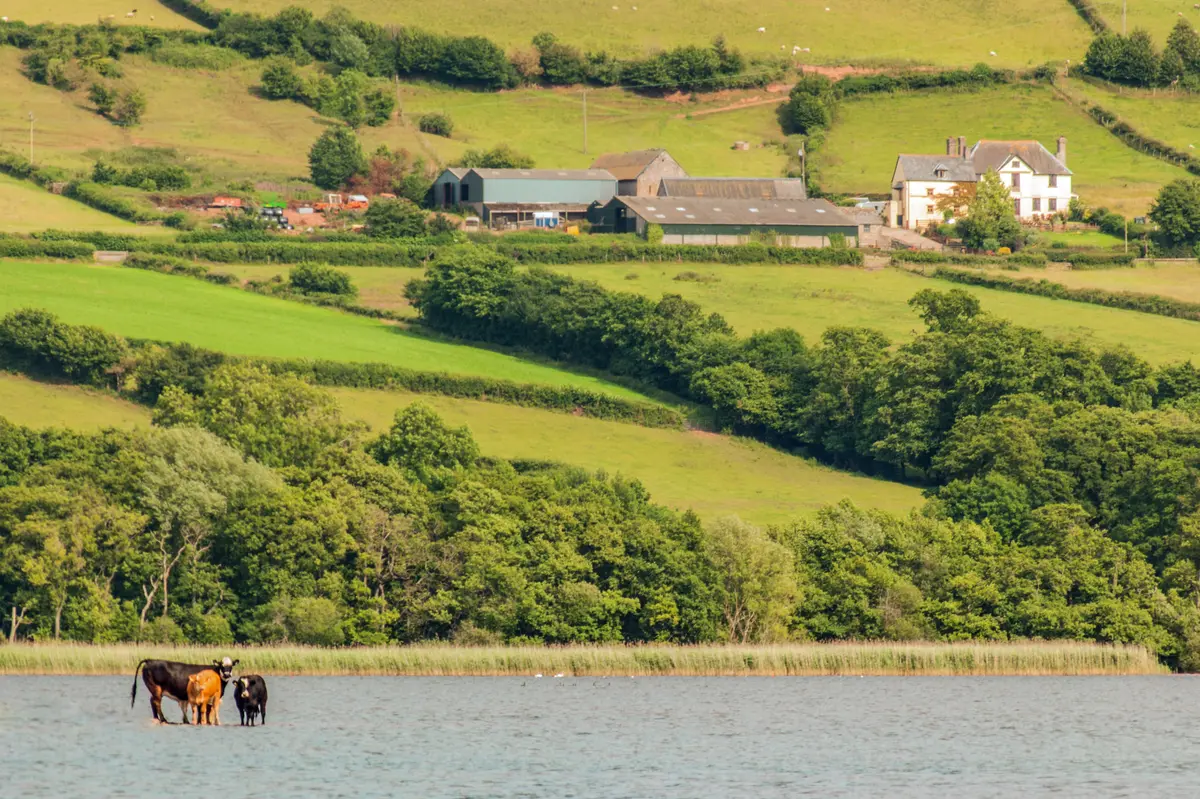
Llyn Barfog sits in the hills behind Aberdyfi, and John Pughe's directions of 1853 still read as directions: "go along the Machynlleth road for two miles, then turning at Abergroes up the defile of Tafolgraig, and ascending Cefnrhosucha a mile". Pughe placed the hoofprint called Carn March Arthur on a rock near the lake. Llyn Syfaddon, the Llangorse Lake of Lewys Glyn Cothi's poem, is in Powys, about 130 km south-south-east of the pool, and it is the lake in the photograph on this page.
Sources consulted
- Edward Lhuyd; communicated by Robert Williams, M.A., «The Legend of Llyn yr Afangc (letter of Edward Llwyd, 1693, with Welsh text and English translation)» — The Cambrian Journal, pp. 142-149 and 207-212, 1859 archive
- John Rhys, «Celtic Folklore: Welsh and Manx, vol. I (ch. II §V, 'The Conwy afanc', pp. 130-135; Llyn Barfog, pp. 141-143; Maclaren, p. 201)» — Oxford, Clarendon Press, 1901 book
- John Pughe, «Gwragedd Annwn — The Dames of Elfin Land. A Legend of Llyn Barfog, pp. 201-205» — Archaeologia Cambrensis, New Series vol. IV, 1853 academic
- William Owen Pughe, «A Dictionary of the Welsh Language, explained in English, vol. I (s.v. Avanc; s.v. Banawg)» — London, 1803 book
- Giraldus Cambrensis, trans. Sir Richard Colt Hoare (1806), «The Itinerary of Archbishop Baldwin through Wales, Book II ch. 3 (beavers of the Teifi), with Sir Richard Colt Hoare's note 106b» — London, J. M. Dent (Everyman), reprinting Bohn's Antiquarian Library, 1912 book
- Owen Jones (Myvyr), Edward Williams (Iolo Morganwg) and William Owen Pughe, eds., «The Myvyrian Archaiology of Wales, one-volume edition (Trioedd Ynys Prydain, third series, nos. 13 and 97)» — Denbigh, Thomas Gee, 1870 book
- English Wikipedia contributors, «Afanc — full revision history of the English Wikipedia article, 163 revisions swept from 30 July 2004 to 8 August 2026» — en.wikipedia.org, 2026 web
- Cryptid Wiki contributors, «Afanc — full revision history of the Cryptid Wiki article, 24 revisions swept from 16 April 2014 to 29 January 2026» — cryptidz.fandom.com, 2026 web
- Rebecca Pian, Michael Archer and Suzanne J. Hand, «A new, giant platypus, Obdurodon tharalkooschild, sp. nov. (Monotremata, Ornithorhynchidae), from the Riversleigh World Heritage Area, Australia» — Journal of Vertebrate Paleontology 33(6), 2013 academic
- William Owen Pughe, «A Dictionary of the Welsh Language, second edition (s.v. Llostlydan, quoting the Welsh Laws on the value of a beaver pelt)» — Denbigh, 1832 book
- Dictionary of Welsh Biography, «Lhuyd, Edward (1660-1709), naturalist, antiquary and philologist» — National Library of Wales, 2026 web
- OpenStreetMap contributors, «Llyn yr Afanc (stream pool, way 966045972) and Pont yr Afanc (A470 bridge), Betws-y-Coed» — OpenStreetMap, 2026 web
- Lee Raye, «The early extinction date of the beaver (Castor fiber) in Britain — author's version; "afanc" as water monster until the 17th century (after Aybes and Yalden 1995), Nant Ffrancon, and the Coles late-extinction view» — Historical Biology 27 (8), pp. 1029-1041; author's version in ORCA, Cardiff University, 2015 academic
- University of Wales Press, «University of Wales Press catalogue search for "mythical and the mysterious" (no result) and, as control, "folklore of wales" (The Folklore of Wales: Ghosts), 25 September 2026» — uwp.co.uk, 2026 web
Reviewed by V. Serrano on 2026-08-14 · How we verify our content
📎 Source: Enigma Atlas
💬 Field testimonies (0)
No testimonies yet. Add the first.
Add your testimony
🔒 Log in to add a testimony