🦶 CRYPTID SIGHTING · EXP. Nº0555
ACTIVE
Am Fear Liath Mòr
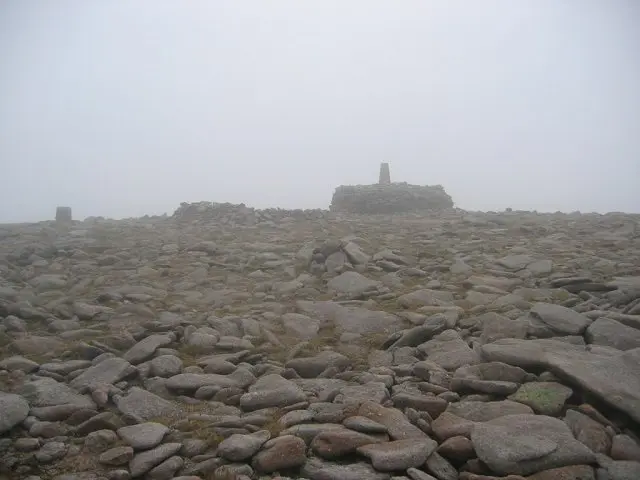
Am Fear Liath Mòr, the Big Grey Man, is said to haunt the summit plateau of Ben Macdui, at 1,309 metres the highest of the Cairngorms and the second highest mountain in Scotland.
Where and when was Am Fear Liath Mòr sighted?
- Location
- Ben Macdui, Cairngorms, Scotland, United Kingdom
- Date sighted
- Unknown
- Coordinates
- 57.07, -3.669
- Last updated
LOCATION
What is Am Fear Liath Mòr?
The whole case rests on one evening. In November 1925, at the Cairngorm Club's annual dinner in Aberdeen, Professor J. Norman Collie told the room that on a solo descent from the summit cairn in mist he had heard a crunching step behind him every few paces, three or four times the length of his own, and had run four or five miles towards Rothiemurchus Forest. Collie reported a sound and a sense of something close to him. He described no figure, gave no size, and used no Gaelic name. Everything the creature is now said to be — ten feet tall, long-armed, broad-shouldered, olive-skinned — was added afterwards by other people, and each addition can be traced. The trail runs through the Cairngorm Club's own journal, from a passing mention in 1922 to a Wikipedia edit of February 2017.
What is the history of Am Fear Liath Mòr?
The Big Grey Man is usually introduced as an ancient Gaelic terror of the Cairngorms. What the documents show is something more interesting: a set of footsteps that acquired a name, then a body, then a height, then a skin colour — each addition traceable, and none of them made by the man whose account started it.
Begin with what was actually said. At the Cairngorm Club's annual meeting and dinner in Aberdeen in November 1925, the Club's Honorary President rose to reply to the toast. He was Professor John Norman Collie, F.R.S., an Aberdeenshire man, first Professor of Organic Chemistry at the University of London and one of the outstanding mountaineers of his generation, and he described a descent from the summit cairn of Ben Macdui made, in the Club's own words, “over thirty-five years ago”. He had been alone, in mist, with snow underfoot. “For every few steps he took he heard a big crunch, and then another crunch, as if someone was walking after him, but taking steps three or four times the length of his own.” He said to himself, “This is all nonsense.” He listened, heard it again, and could see nothing in the mist. Then terror took him and he ran, “staggering blindly among the boulders, for four or five miles, nearly down to Rothiemurchus Forest”. He finished: “Whatever you may make out of it I do not know, but there is something very queer about the top of Ben Macdhui, and I will not go back there again by myself, I know.”
That is the whole of the founding account, printed by the Club itself in the Cairngorm Club Journal for 1926 under the title “The Ben Macdhui Giant Spectre”, after the story had run in the Aberdeen Press and Journal on 30 November 1925; the Journal itself notes that its publication in the press “led to a flood of interviews and correspondence”. Collie reports no figure, no shape, no size and no colour. He does not use the Gaelic name. And he gives no year: “over thirty-five years ago”, counted back from November 1925, points to 1890 or earlier, which sits awkwardly with the 1891 that modern retellings repeat. The year 1891 comes from later writers, among them Alexander Tewnion, who states it flatly in 1999; it is not in the Club's report of what Collie said.
Two other things travelled inside Collie's speech, and both are second-hand. About twelve years after the event he told the story to Dr Alexander Mitchell Kellas, the Aberdeen-born Himalayan pioneer who died in 1921 on the first Everest reconnaissance, and was startled to be answered with another. One June midnight, Kellas said, he had watched a man climb up out of the Lairig, wander round the summit cairn and go back down into the pass. What struck him was that the man was about as tall as the cairn, “which was at least ten feet high” — and that his brother, sitting beside the cairn, answered: “I never saw any man at all.” That is where the ten feet comes from: a figure reported at two removes, by a man four years dead when the story was first told in public.
The name arrives at three removes. “A good many years after that”, Collie said, Mr Colin Phillip repeated the Kellas story to an old man living at the edge of Rothiemurchus Forest who knew the Cairngorms well. The old man was not the least bit surprised: “Oh, aye, that would have been the Ferla Mhor (the Big Grey Man) he would have been seeing.” An unnamed informant, quoted by Phillip, quoted by Collie, printed by the Club.
But the name was not Collie's to introduce, and this is where the usual story of a thirty-four-year secret breaks down. Three years before the dinner, in the Journal for 1922, Robert Clarke described a midwinter crossing of the Làirig Dhrù and wrote that the only thing lacking to complete the desolation “was the presence of the fabled Ferla Mhor himself!”, in passing and without explanation. The Big Grey Man was already current among Aberdeen hill men before Collie spoke. What is absent is any older form of the words. Affleck Gray held that stories of the Grey Man were older than Collie and current among Gaelic-speaking locals, his own grandfather among them; as Michele Tita summarises him in 2025, the records of them “have largely vanished”.
Follow the spelling through the Club's own run and the shape of the thing becomes visible. Searching the digitised Journal in August 2026, “Ferla Mhor” returns eight hits: Clarke's aside of 1922, the 1926 report of Collie, a poem printed under that title in 1935 in which the Grey Man laughs while a man is found dead high on the Ben, Hugh D. Welsh in 1938, Welsh's obituary of Collie in 1942–43, and a passing joke in 1950–51. The plain English “Big Grey Man” runs from 1929. The Gaelic form the world now uses returns three hits in the entire run: “Fear Liath” first appears in 1977, in a note by Dr Bob Murray, and “Am Fear Liath Mor” reaches the Journal only in 1999, as a quotation from Affleck Gray. Controls run in the same index on the same day: “Lairig Ghru” 71 hits, “Bodach” 10. The index works; the early Gaelic is simply not there.
Gray had a view about the spelling. Tewnion quotes the opening paragraph of his preface: the phenomenon is “variously described as Am Fear Liath Mor, which is sometimes corrupted to Ferla Mor or worse, and even Ferla Mhor (a crowning indignity for the aspirate denotes the feminine) or Am Fear Glas Mor”. The form the Cairngorm Club had been printing since 1922 was, to the man who wrote the book, a corruption and a grammatical insult — the lenited “Mhor” makes the Big Grey Man feminine. Tewnion adds that he was the “cringing ignoramus” who provoked the line, in a letter he wrote to Gray in 1966.
Then the body. The oldest description of an animal that can be anchored is not a witness's own. Richard Frere published in the winter 1948 number of the magazine Open Air an account he had from a friend who camped by the summit cairn in 1940 and woke to see a shape between his tent and the moon: “a great brown creature” swaggering downhill, covered with shortish brown hair, its head disproportionately large and its neck thick and powerful, its carriage erect and expressly not ape-like. Affleck Gray gathered that and everything else into The Big Grey Man of Ben MacDhui (Impulse Books, Aberdeen, 1970), still the only monograph on the subject.
The creature of the internet is younger than all of it. The online Encyclopedia Mythica created an unsigned article on the Fear Liath on 3 March 1997. Its earliest archived copy, from 2019, describes him as “ten to twenty feet tall, with broad shoulders and long waving arms”, “gray or olive colored, or covered with short brown hair”, with pointed ears, and gives George Eberhart's cryptozoology guide of 2002 and James MacKillop's Celtic dictionary of 2004 as its sources, so when that description entered the page cannot be dated. When the Wikipedia article was started on 6 September 2004 it carried an Encyclopedia Mythica page on the Fear Liath as one of its three external links, and contained no physical description of its own at all. The description entered Wikipedia on 14 February 2017, added by an editor signing as Paleface Jack: “a large humanoid standing over ten feet tall and having olive toned skin with long arms and broad shoulders”, cited to page 124 of Theresa Bane's Encyclopedia of Beasts and Monsters in Myth, Legend and Folklore (McFarland, 2016). Almost every retelling since descends from that paragraph. None of the witness accounts quoted above — Collie's, Kellas's as Collie relayed it, Tewnion's and that of Frere's friend — mentions skin colour, arm length or ears.
Timeline: the documented record of Am Fear Liath Mòr
- 1922 Robert Clarke, in the Cairngorm Club Journal, describes a midwinter crossing of the Làirig Dhrù and remarks that the only thing lacking was “the presence of the fabled Ferla Mhor himself”. It is the earliest mention of the Big Grey Man traced in the Club's run, three years before Collie speaks, and it is dropped without explanation.
- November 1925 At the Cairngorm Club's annual meeting and dinner in Aberdeen, Professor J. Norman Collie tells the room that on a solo descent from the summit cairn in mist, “over thirty-five years ago”, he heard a crunching step three or four times the length of his own and ran four or five miles towards Rothiemurchus Forest. He reports no figure and uses no Gaelic name.
- 1926 The Club prints the speech as “The Ben Macdhui Giant Spectre”, together with Kellas's second-hand story of a man as tall as the ten-foot cairn and the only appearance of the name in the founding text: an unnamed old man at Rothiemurchus, quoted by Colin Phillip, saying “that would have been the Ferla Mhor (the Big Grey Man)”.
- 1935 A poem titled “Ferla Mhor” appears in the Cairngorm Club Journal: the Grey Man walks in his misty shroud, mocks at the toil of men, and in the silent dawn a man is found dead high on the Ben. Within ten years of Collie's speech the entity has become a literary figure and has acquired a victim, which no witness account claims.
- 1940 A friend of the climber-writer Richard Frere camps by the summit cairn and, he says, wakes to see “a great brown creature” between his tent and the moon: covered in shortish brown hair, head disproportionately large, neck thick, carriage erect and not ape-like. It is the earliest description of an animal that can be anchored, and it is not the reporter's own experience.
- October 1943 Alexander Tewnion, on army leave, is caught in storm cloud above Loch Etchachan, hears slow loud footfalls over the wind, sees a shape charge at him, fires three rounds from a .38 revolver and runs to Glen Derry. It becomes the most cited encounter after Collie's.
- Winter 1948 Richard Frere publishes his friend's account, and his own experiences on the mountain, in the winter number of the magazine Open Air. The magazine has since ceased publication; the account survives mainly because Affleck Gray reprinted it.
- June 1958 Tewnion publishes his 1943 encounter in The Scots Magazine, and with it the reasoning that undercuts it: rock moved by deer or wind in the screes for the footfalls, and cloud for the figure.
- 1970 Affleck Gray publishes The Big Grey Man of Ben MacDhui (Impulse Books, Aberdeen), still the only monograph on the case. Its preface condemns “Ferla Mhor” — the form the Cairngorm Club had printed since 1922 — as a corruption whose aspirate makes the Big Grey Man feminine.
- 1977 The Gaelic form “Fear Liath Mor” appears in the Cairngorm Club Journal for the first time, in a note by Dr Bob Murray — fifty-two years after Collie spoke and fifty-five after the name first reached print as “Ferla Mhor”.
- 3 March 1997 The online Encyclopedia Mythica creates an unsigned article on the Fear Liath. Its earliest archived copy, from 2019, describes him as ten to twenty feet tall, broad-shouldered, with long waving arms, grey or olive coloured or covered in short brown hair, and pointed ears, and lists Eberhart (2002) and MacKillop (2004) as its sources, so the description itself cannot be dated to 1997. No witness in the primary record describes any of this.
- 1999 In the Cairngorm Club Journal, Tewnion dismantles his own 1943 story and recalls being mistaken for the Grey Man himself in 1972 by three walkers on the plateau. He notes that before Collie spoke there was “little more than a few meagre hints in local legend and folklore” to support a spectre on Ben Macdui.
- 14 February 2017 The physical description enters the English Wikipedia article, added by an editor signing as Paleface Jack: “a large humanoid standing over ten feet tall and having olive toned skin with long arms and broad shoulders”, cited to page 124 of Theresa Bane's Encyclopedia of Beasts and Monsters (McFarland, 2016). Almost every popular retelling since descends from this paragraph.
Is there a rational explanation for Am Fear Liath Mòr?
The most useful sceptic of the Big Grey Man is the man who shot at it.
In October 1943, on army leave and walking Ben Macdui alone, Alexander Tewnion was caught by storm cloud with visibility down to twenty yards. Above a little pool by the path from Loch Etchachan he heard, over the wind, a sound “just like a loud footstep”, then another, then another, a couple of seconds apart. “It's Ferla Mor!” was his instant reaction. A strange shape loomed through the mist, receded, then came charging at him; he pulled out a .38 revolver, fired three rounds into it and ran for Glen Derry. He published the account in The Scots Magazine in 1958, and in the Cairngorm Club Journal in 1999 he took it apart himself. The footsteps, he concluded, were most probably a rock dislodged by wandering deer or some freak effect of wind among the screes; the charging figure “was indeed a wraith, but of cloud”, magnified by mist and by an imagination that already knew the story.
He had earned the right to distrust himself, and he set out why. In September 1939, after a day's work and seventy miles on a bicycle, he and Peter Marr stopped dead near Luibeg in front of “a menacing figure, hooded and gowned in white and at least 20 feet tall”; it was smoke from a camp fire hidden in a hollow. In July 1957, camped at about 3,650 feet to study snow buntings, “a truly gigantic figure of a man” stepped out of the mist at his tent; it was Colonel Pat Baird, a very tall man in gym shoes, whistling on purpose so as not to startle him. And in the summer of 1972, crossing the plateau near the Feith Buidhe in grey trousers and a grey cagoule, above average height, a big frame rucksack on his back and a camera bag on his shoulder, Tewnion realised he was being trailed at a nervous distance by three walkers who had seen “a huge grey giant playing tricks with them in the mist”. He found them later stuck on rocks above a snow wreath, got them off the hill, and said: “Maybe you'll remember your Ferla Mor — a benevolent ghost, not a malevolent ogre.”
The Club had reached similar ground in 1926, in the very article that printed Collie. Some correspondents, it recorded, “scouted the suggestion as absurd and ascribed Professor Collie's experience to a fit of nerves”; others reported mysterious music heard on the Cairngorms “which proved to be due to the sound of the wind rising and falling in gullies”. The same page notes that the range had two other legends “of this character” — a spectre with a bloody red hand in Glen More, and a ghost on Bynack shot with an arrow — and makes no claim that the Grey Man was older or better attested than either.
The explanation offered almost everywhere is the Brocken spectre, a walker's shadow thrown by a low sun onto a bank of cloud, where it loses all sense of scale. It does not fit the account the whole case rests on, because Collie saw nothing: he reported a sound. Michele Tita makes the same objection in the Journal of Ethnology and Folkloristics in 2025 — Collie's description “did not imply a sighting”, which “discourages” a Brocken explanation for his and other non-visual encounters — and notes that Affleck Gray had already judged the Collie and Kellas cases unlikely to be Brocken spectres because the effect is so rare. A shadow does not crunch.
For the sound, the plainest candidates are the ones Tewnion arrived at from experience — rock moved by deer, wind funnelled through granite screes, and a walker's own boots on a boulder field reaching him a fraction late. None of it can be tested after the event: none of the accounts comes with a photograph, a cast, a specimen or a measurement of any kind. What can be checked is the paper trail, and the paper trail says that the sounds came first, the figure came from a dead man's second-hand story, the name came from an unnamed old man at three removes, and the body, the height, the ears and the olive skin came from reference works and web pages of the 2000s and 2010s.
Can you visit Am Fear Liath Mòr?
Every episode in the record attaches to a named place on one mountain, and those places lie within four kilometres of each other. Collie's run began at the summit cairn of Ben Macdui and carried him down towards Rothiemurchus Forest. The figure Kellas reported came up out of the Lairig Ghru and went back down into it. Tewnion's shape appeared beside the small pool above Loch Etchachan, whose basin lies 3.7 kilometres east of the summit, on the path in from Glen Derry. The ground that carries the whole case is therefore the summit plateau of Ben Macdui with the two passes that flank it; the ascent routes, the park byelaws and the mountain's fatal record belong to the Ben Macdui entry rather than to this one.
What stands on that summit was put there by surveyors and by a climbing club: an Ordnance Survey trig pillar, the ruined walls of the Sappers' Bothy of 1847 and a stone mountain indicator. The dates of the indicator and of the story run close together. The Cairngorm Club unveiled the first indicator on 1 August 1925, and Collie described his flight at the Club's annual dinner in Aberdeen on 28 November of the same year, four months later. The Club replaced that indicator in a centenary operation in August 2025.
The commonest planning error is to read the funicular railway as a way onto that ground. The railway does not climb Ben Macdui at all. It climbs Cairn Gorm, a separate summit 5.3 kilometres to the north-north-east, and it terminates at the Ptarmigan station below the top of that hill. Cairngorm Mountain (Scotland) Ltd states that passengers who ride up "can only leave the Ptarmigan building for snowsports or to take part in guided group walks led by the Ranger Service", a closed-system restriction in force since the railway opened in 2001 to protect designated European sites on the plateau. The operator ran a bookable summit-access trial in autumn 2025, tracking walkers by mobile phone to keep them on designated paths, and set it out as a step towards opening the Ptarmigan-to-summit paths more widely. The railway is scheduled out of service for maintenance from Monday 2 to Sunday 8 November 2026 and returns on Monday 9 November.
The case itself is held in one periodical, and the relevant numbers are digitised on the Cairngorm Club's own site: the unsigned report of Collie's address in number 64 for 1926, Robert Clarke's account of the midwinter crossing of the Lairig Dhru in number 59 for 1922, and Tewnion's "Ferla Mor" in number 105 for 1999. Those three files cost nothing and carry no risk, which is more than the plateau offers in November.
Sources consulted
- Cairngorm Club (unsigned report of Prof. J. Norman Collie's address), «The Ben Macdhui Giant Spectre» — The Cairngorm Club Journal, vol. XI, no. 64, 1926 archive
- Robert Clarke, «Midwinter in the Làirig Dhrù» — The Cairngorm Club Journal, no. 59, 1922 archive
- Unsigned, «Ferla Mhor (poem)» — The Cairngorm Club Journal, no. 76, 1935 archive
- Alexander Tewnion, «Ferla Mor» — The Cairngorm Club Journal, no. 105, 1999 archive
- Bob Murray, «Notes (Ben MacDhui, fifty years on)» — The Cairngorm Club Journal, no. 97, 1977 archive
- Affleck Gray, «The Big Grey Man of Ben MacDhui» — Impulse Books, Aberdeen (ISBN 0901311049), 1970 book
- Unsigned (article created 3 March 1997), «Fear Liath» — Encyclopedia Mythica (pantheon.org), 1997 web
- Wikipedia contributor “Paleface Jack”, «Am Fear Liath Mòr — revision 765493062, the edit that added the physical description» — English Wikipedia page history, 2017 archive
- Theresa Bane, «Encyclopedia of Beasts and Monsters in Myth, Legend and Folklore, p. 124» — McFarland, 2016 book
- Karl P. N. Shuker, «The Big Grey Man of Ben Macdhui — Britain's very own Bigfoot?» — ShukerNature, 2014 web
- Cairngorm Mountain (Scotland) Ltd, «Cairn Gorm Summit Access Trials» — cairngormmountain.co.uk, 2025 web
- Michele Tita, «Witnessing the Big Grey Man on the Scottish Peaks: Interpretations and Engagement with the Environment of the Mountain Summits, Journal of Ethnology and Folkloristics 19(2), pp. 163-179 (Collie's non-visual account and the Brocken spectre; the Aberdeen Press and Journal of 30 November 1925; Gray on older Gaelic narratives)» — Journal of Ethnology and Folkloristics (University of Tartu), 2025 academic
Reviewed by V. Serrano on 2026-08-14 · How we verify our content
📎 Source: Enigma Atlas
💬 Field testimonies (0)
No testimonies yet. Add the first.
Add your testimony
🔒 Log in to add a testimony