👻 HAUNTED PLACE · EXP. Nº9476
ACTIVE
Ben Macdui
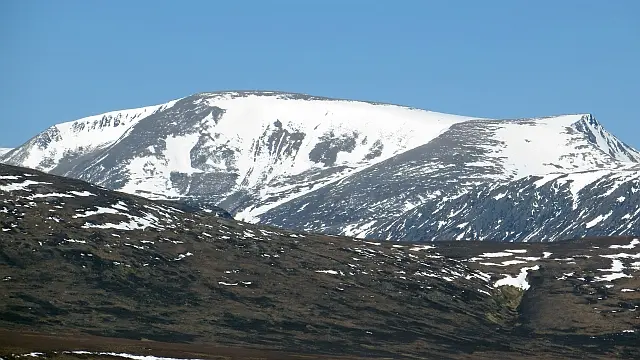
Ben Macdui, 1,309 metres of granite at the heart of the Cairngorm plateau, is the highest summit in the Cairngorms and the second highest in Scotland after Ben Nevis.
Where is Ben Macdui?
- Location
- Scotland, United Kingdom
- Type
- Mountain / summit
- Coordinates
- 57.071, -3.667
- Last updated
LOCATION
Why is Ben Macdui said to be haunted?
It is also the home of Am Fear Liath Mòr, the Big Grey Man, and the case is unusually well documented because the mountain has its own club and the club kept minutes. On Saturday 28 November 1925, at the Cairngorm Club's annual dinner in Aberdeen, its Honorary President, the chemist and mountaineer J. Norman Collie, told more than a hundred members that on a misty descent from the summit cairn in 1891 he had heard a crunching step behind him three or four times the length of his own, and had run four or five miles in terror, nearly to Rothiemurchus Forest. "There is something very queer about the top of Ben Macdhui," he finished, "and I will not go back there again by myself, I know." He described sounds, not a figure. The story is usually told as a secret kept for thirty-four years; it was not. The name was already in print in the club's own journal in 1922, and the incident itself, anonymously, in a mountaineering book of 1923.
What is the history of Ben Macdui?
Ben Macdui is the high point of the Cairngorm plateau: 1,309 metres, or 4,295 feet. It is the highest summit in the Cairngorms and the second highest in Scotland, beaten only by Ben Nevis — and before the Ordnance Survey settled the question it was widely believed to be the highest mountain in Britain. Its Gaelic name, beinn mac dhuibh, is usually read as "hill of the son of the black one", meaning a Duff, the family that held this country for centuries; General Roy's military map of about 1750 already carries "Ben Machdhui".
The mountain's ghost belongs, in a very literal sense, to a club. Six men climbed Ben Macdui in June 1887 to burn fireworks for Queen Victoria's Golden Jubilee, walked down to Loch Avon in the small hours of the 23rd, and there resolved to found the Cairngorm Club; it was constituted in 1889 with Alexander Copland as its first chairman. The Club's great undertaking of 1925 was a stone mountain indicator on the summit, designed and built under the engineer James A. Parker. Ponies carried some six hundredweight of granite up from Glen Derry that July, and Robert Clarke recorded the unveiling in the Club journal: Saturday 1 August 1925, before a crowd he thought large enough that "it is perhaps surprising that no one fell and came by an accident".
Four months later, on Saturday 28 November 1925, the Club held its 37th annual meeting in Aberdeen with the advocate William Garden in the chair, and more than a hundred members and friends sat down to the annual dinner that followed. Replying to the toast of the Club, the Honorary President stood up. He was John Norman Collie, F.R.S., a native of Aberdeenshire, first Professor of Organic Chemistry at the University of London and one of the outstanding mountaineers of his generation, and he told the room about something that had happened to him on the mountain they had just spent a year decorating.
He had been coming down from the summit cairn in mist, more than thirty-five years earlier — he dated it to 1891. For every few steps he took he heard a crunch behind him, as though someone were following with a stride three or four times the length of his own. He told himself, he said, "This is all nonsense"; he listened; he heard it again and could see nothing. Then terror took him and he ran, staggering blindly among the boulders for four or five miles, nearly down to Rothiemurchus Forest. The Club's journal printed his closing words the following July, and the press report of 30 November 1925 agrees with them: "Whatever you may make out of it I do not know, but there is something very queer about the top of Ben Macdhui, and I will not go back there again by myself, I know."
Collie described sounds and a sense of something near him. He did not report seeing a figure, and Affleck Gray, who spent a lifetime assembling the case, considered that point irrefutable. About twelve years after the event — so around 1903 — Collie told the story to Dr Alexander Mitchell Kellas, the Aberdeen-born Himalayan pioneer who would die in 1921 on the first Everest reconnaissance, and was startled to be told that Kellas had his own. On a June night on the summit, Kellas said, he watched a man climb up out of the Lairig Ghru, wander round the cairn and go back down into the pass; what struck him was that the figure was about as tall as the cairn, which stood at least ten feet. His brother, sitting by the cairn, had seen nobody. A rather different version, closer to the Kellas family, reached the Aberdeen press in December 1925 from W. G. Robertson, who had it from the brother, Henry Kellas: in that account both men saw a giant figure coming down towards them, fled by Coire Etchachan, and never mentioned any crunching at all.
The familiar version of all this says Collie kept a secret for thirty-four years. He did not, and the Club's own archive says so. Three years before the dinner, in the journal for 1922, Robert Clarke described a brutal New Year crossing of the Lairig Ghru made on 1 January 1922 and dropped the name in passing, with no explanation and apparently expecting none to be needed: the only thing lacking to complete the picture, he wrote, "was the presence of the fabled Ferla Mhor himself". And in 1923 the mountaineer and librarian Ernest A. Baker printed the incident itself, anonymously, in The Highlands with Rope and Rucksack: "One hard-headed man I know has told me that nothing on earth would induce him to be alone on the top of Ben Muich Dhui, even in broad daylight; and relates how once he ran five miles without stopping down to Rothiemurchus Forest, in mortal panic. What it was he ran away from he will not divulge." Five miles, Rothiemurchus Forest, panic, and a refusal to say what caused it: it is Collie, two years early and without his name on it. Robert Clark, interviewed by the Aberdeen press on 3 December 1925, had already spotted the passage and named the book as the first place he had ever met the story in print. (The sources spell him "Clark" in the press interview and "Clarke" in the journal; the two are very probably the same Cairngorm Club man, but we have kept each spelling where its source has it.)
After 1925 the accounts multiplied. The best documented is Alexander Tewnion's. In October 1943, on army leave and walking alone, he was caught by storm cloud near the summit, heard slow loud footfalls above the wind on the path near Loch Etchachan, saw a shape loom and charge at him, emptied three rounds from a .38 revolver into it and ran to Glen Derry. He published it in The Scots Magazine in June 1958. Affleck Gray gathered everything — press cuttings, correspondence from the Shetlands to Los Angeles, the poems, the cranks — into The Big Grey Man of Ben MacDhui in 1970, and it remains the only real monograph on the subject.
Timeline: the documented record of Ben Macdui
- 1831 Sir Thomas Dick Lauder publishes in the Edinburgh New Philosophical Journal an account of climbing Ben Macdui with Mr Grant of Ballindalloch and seeing the Spectre of the Brocken — the earliest datable record of the optical effect on this summit, sixty years before Collie's experience.
- 1891 The date Collie himself gave, in 1925, for his experience: descending alone from the summit cairn in mist, he heard a crunching step behind him three or four times the length of his own and ran four or five miles, nearly to Rothiemurchus Forest. He reported sounds and a sense of presence, not a figure.
- About 1903 About twelve years after the event, Collie tells the story privately to the Himalayan mountaineer Dr A. M. Kellas, who replies that he and his brother had their own experience on the summit — a figure as tall as the ten-foot cairn, seen by one brother and not the other. Kellas died in 1921 on the first Everest reconnaissance and never wrote his account down.
- 1922 Robert Clarke, writing up a New Year crossing of the Lairig Ghru made on 1 January 1922, mentions "the fabled Ferla Mhor" in passing in the Cairngorm Club Journal, with no explanation offered. This is the earliest appearance of the name we have been able to date, and it is three years before Collie spoke.
- 1923 Ernest A. Baker prints the incident itself, unattributed, in The Highlands with Rope and Rucksack: a hard-headed acquaintance who would not be alone on Ben Muich Dhui even in daylight and who once ran five miles to Rothiemurchus Forest in mortal panic, refusing to say from what. It is Collie's story two years before Collie told it in public.
- 1 August 1925 The Cairngorm Club unveils the stone mountain indicator on the summit of Ben Macdui, designed and built under James A. Parker after ponies hauled the granite up from Glen Derry. Robert Clarke describes the ceremony in the Club journal.
- Saturday 28 November 1925 At the Cairngorm Club's 37th annual meeting and the dinner that followed it in Aberdeen, before more than a hundred people and with William Garden in the chair, Honorary President J. Norman Collie tells his story publicly for the first time in Britain. The Aberdeen press reported it on 30 November and the Club journal printed it in July 1926.
- 28 March 1941 William Garden, the Club president who had called the Big Grey Man "perfect nonsense", writes to The Scotsman explaining that he had himself been convinced more than once of hearing footsteps crunching in the snow behind him on a moonlit Aberdeenshire road, and had found on turning round that it was "pure imagination".
- October 1943 Alexander Tewnion, alone on army leave, is caught by storm cloud near the summit, hears slow footfalls above the wind near Loch Etchachan, sees a shape charge at him and fires three rounds from a .38 revolver before running to Glen Derry. He published the account in The Scots Magazine in June 1958.
- 21 November 1971 The Feith Buidhe disaster: a school party bound for Corrour Bothy by way of Lochan Buidhe and Ben Macdui is reported overdue at 7.25 p.m. and is caught in the open on the plateau for two nights. Five children and the eighteen-year-old trainee instructress die of exposure; two survive. It remains the worst disaster in Scottish mountaineering.
- 1999 Tewnion returns to the case in the Cairngorm Club Journal and takes his own story apart: the footfalls most probably a rock dislodged by deer or wind among the screes, the charging shape a wraith of cloud. He also recounts being mistaken for the Big Grey Man himself by three frightened walkers near the Feith Buidhe in the summer of 1972.
- 9 August 2025 A century after the original was unveiled, the Cairngorm Club carries out a one-day operation to replace the summit indicator, with a commemorative ceremony on the top at one o'clock.
Is there a rational explanation for Ben Macdui?
The most useful sceptics of the Big Grey Man have always been the people who know the mountain best, and most of them are on the record with names.
Start with the optics, because they are documented on this summit and they predate Collie by sixty years. In 1831, according to Affleck Gray — who takes it from John Hill Burton's The Cairngorm Mountains and whose two mentions of it give the journal's title slightly differently, so we flag it as second-hand — Sir Thomas Dick Lauder published in the Edinburgh New Philosophical Journal an account of ascending Ben Macdui with Mr Grant of Ballindalloch and seeing the phenomenon called the Spectre of the Brocken — an observer's own shadow thrown by a low sun onto a wall of mist, magnified out of scale and distorted by every movement of the air and of the observer. When the shadow's head is ringed with coloured bows the effect is called a glory, and the physics is diffraction of light at the edge of water droplets, not refraction. It is not a marginal curiosity: standing on the summit of Ben Nevis in the late summer of 1894, the physicist C. T. R. Wilson was so struck by coronas and glories that he set out to reproduce them in the laboratory, and the apparatus he built on the way became the cloud chamber that won him the Nobel Prize in Physics in 1927.
The footsteps have a plainer explanation and a named advocate. William Garden, president of the Cairngorm Club when Collie spoke, called the suggestion of a Big Grey Man "perfect nonsense", and in a letter to The Scotsman on 28 March 1941 he explained why in the first person: he had more than once been convinced, walking a moonlit Aberdeenshire road in winter, that he heard footsteps crunching in the snow behind him, had been almost afraid to look round, and on looking round found it was "pure imagination". The Club's own journal, reporting the storm of correspondence that followed the dinner, noted that some readers had written in about mysterious music heard on the Cairngorms "which proved to be due to the sound of the wind rising and falling in gullies". Snow underfoot, wind in granite gullies and a walker's own boots reaching him a fraction late off the boulder field will produce a delayed crunch without any help.
The base rate matters too. Robert Clark, interviewed in December 1925 after nearly forty years in the Cairngorms, said he had been alone at the cairn of Ben Macdui in eight months of the year and had crossed the plateau more than a hundred times without a single untoward experience — nothing, he said, except the Spectre of the Brocken. Sir George Adam Smith, former Principal of Aberdeen University, had never in his life heard a whisper of a spectre on the mountain.
Even the most spectacular witness ended up on this side. Alexander Tewnion, the man who shot at the Grey Man in 1943, spent the closing pages of The Scots Magazine in 1958, and a long article in the Cairngorm Club Journal in 1999, taking his own story apart. His conclusion was that the footfalls were most probably a rock dislodged by deer or a freak of wind among the screes, and the charging shape a wraith of cloud enlarged by mist and by an imagination that already knew the story. He had already learned the lesson in 1939, when a twenty-foot hooded giant above the pines at Luibeg turned out to be smoke from a campfire, and he learned it from the other side in the summer of 1972: crossing the plateau near the Feith Buidhe in mist, grey-trousered, grey-cagouled and above average height, he found himself being followed at a nervous distance by three walkers who had taken him for the Big Grey Man. He got them off the hill safely and told them: "Maybe you'll remember your Ferla Mor — a benevolent ghost, not a malevolent ogre."
What about infrasound? The idea that very low-frequency sound produces unease and a sense of presence is real and is usually credited to Vic Tandy, who in 1998 and 2000 published in the Journal of the Society for Psychical Research on a standing wave of around 19 Hz in an enclosed workshop and in a cellar. Two things need saying. First, no infrasound measurement has ever been published for the Ben Macdui plateau, so transferring the mechanism from a sealed room to an open mountain top is a guess, not a finding — that is true as far as we can establish in August 2026, and it is why this entry no longer repeats the claim that the Grey Man is caused by wind-generated infrasound. Second, the hypothesis has been tested and criticised by name: Jason Braithwaite argued in 2006 that a specific effect of infrasound in anomalous experiences had yet to be empirically demonstrated, and in 2009 Christopher French and colleagues built a chamber and put 79 people through fifty minutes of infrasound, complex electromagnetic fields, both or neither. Plenty of participants reported anomalous sensations; the number reported had nothing to do with which condition they were in. Their conclusion, in Cortex, was that the most parsimonious explanation was suggestibility.
Finally, the name. Am Fear Liath Mòr sounds like deep Gaelic tradition, and it may be, but the documentary trail is thinner than the phrase suggests. Affleck Gray, who wanted the tradition to be old and looked hardest for it, concluded that the evidence for a pre-Collie legend "is meagre, and barely sufficient to satisfy the critical mind": he could list a long run of Derry and Luibeg stalkers and Corrour bothy watchers from the mid-nineteenth century onwards who never mentioned the Grey Man, note that the Rothiemurchus laird knew nothing of it beyond what he read in the press, and observe that the district's own Gaelic poet, William Smith of Rynuie, left no mention of the Fear Liath Mòr in any of his songs. The earliest use of the Gaelic name in the case itself is reported speech at two removes: Collie in 1925 relaying what Colin Phillip had been told by an old man at the edge of Rothiemurchus Forest — "Oh, aye, that would have been the Ferla Mhor he would have been seeing." Alexander Tewnion, hardly a hostile witness, wrote in 1999 that before Collie spoke there was "little more than a few meagre hints in local legend and folklore" to support a spectre on Ben Macdui.
We checked that against the one corpus that ought to know. The Cairngorm Club Journal has appeared since 1893 and its complete run was digitised and made text-searchable in 2019. Searching it in August 2026, the phrase "Fear Liath" returns 2 hits, the earliest from 1977; "Ferla Mhor" returns 8, the earliest being Robert Clarke's aside of 1922; "Grey Man" returns 16. The control searches in the same index rule out a broken search: "Lairig Ghru" returns 69 hits and "Bodach" returns 10, including John Milne's Gaelic place-name study of Kirkmichael in Banffshire, published by the Club in 1906, which duly records bodach as the local word for a ghost or spectre. The same journal that printed Collie in 1926 remarked in the very same article that the Cairngorms had two other legends "of this character" — the spectre with the bloody red hand in Glen More, and a ghost on Bynack shot with an arrow — without claiming the same standing for the Grey Man. The Gaelic name is documented from 1922 onwards. Older than that, it is oral, second-hand and unfixed.
Can you visit Ben Macdui?
Ben Macdui rises to 1,309 metres and carries no building on its summit: the highest ground in the Cairngorms has no visitor centre, no ticket office and no shelter kept in repair. It lies inside the Cairngorms National Park, created in 2003 under the National Parks (Scotland) Act 2000, which covers 4,528 square kilometres — about 6 per cent of the land area of Scotland — and is the largest national park in the United Kingdom. The Park Authority describes the plateau as part of the largest area of ground above 1,000 metres in the United Kingdom, and the range as the most extensive arctic area in the country in climatic, geomorphological and biological terms.
Two routes carry almost all of the foot traffic up the hill. From the north the walk starts at the Coire Cas car park of the Cairngorm Mountain ski centre, 6.9 kilometres (4.3 miles) due north of the summit in a straight line, and crosses the plateau by Lochan Buidhe; the plateau is a featureless dome, so the navigation falls to a compass bearing whenever the cloud is down. From the south the classic line leaves the Linn of Dee, 11.9 kilometres (7.4 miles) to the south-east, for Derry Lodge and climbs by Glen Luibeg and Sròn Riach or by Coire Etchachan; that way is longer and sheltered over more of its length. Either line makes a full mountain day of roughly eight to eleven hours, and no point on either of them sells food or water. The nearest settlements are Aviemore, 16.6 kilometres to the north-west, and Braemar, 17.8 kilometres to the east-south-east.
The summit carries three structures, put there by surveyors and by a climbing club. An Ordnance Survey trig pillar marks the high point; the ruined walls of the Sappers' Bothy, raised by the Survey in 1847 as a base for its trigonometrical work, stand close by; and a stone indicator names the hills on the skyline. The indicator in place today is the second of its line: James A. Parker designed the original, which was unveiled on 1 August 1925, and the Cairngorm Club replaced it in a centenary operation on Saturday 9 August 2025.
The plateau has killed repeatedly, and the record of it is precise. A memorial about 500 metres north-west of the summit marks where Avro Anson DJ106 of No. 19 Operational Training Unit, flying from RAF Kinloss, struck the hill on 21 August 1942 and killed all five crew. Two United States Air Force F-15C fighters of the 493rd Fighter Squadron, based at RAF Lakenheath, came down in the upper Garbh Uisge Mòr on 26 March 2001, and both pilots died. The heaviest loss on this ground is the Feith Buidhe disaster. At 7.25 in the evening on Sunday 21 November 1971 Aviemore police station was told that a party of six Edinburgh schoolchildren with an instructress and a trainee instructress had failed to return from an overnight expedition, whose planned route ran from the Cairngorm car park over Lochan Buidhe and Ben Macdui to Corrour Bothy. They spent two nights caught in the open in a blizzard. Five of the children and the trainee instructress, Sheelagh Sunderland, who was eighteen, died of exposure, and two survived with severe frostbite. It remains the worst disaster in Scottish mountaineering, and it is the reason the Curran and the other high shelters were removed afterwards instead of being repaired.
Rescue on the hill runs through 999, which routes the call to the police and from there to mountain rescue; the handler asks for a six-figure grid reference or a What3Words location, and 101 is the non-emergency line. Avalanche forecasts for the Cairngorms are issued in season by the Scottish Avalanche Information Service. A fire management byelaw bans fires and barbecues across the whole National Park between 1 April and 30 September, with fines of up to £500. The Park Authority's own guidance reaches past the byelaw season, stating that "there is still almost nowhere in the National Park where you could light a fire responsibly", and it points to a camping stove instead.
Sources consulted
- The Cairngorm Club, «The Ben Macdhui Giant Spectre» — Cairngorm Club Journal, Vol. XI, No. 64, pp. 214-215, 1926 archive
- The Cairngorm Club, «Proceedings of the Club: the Annual Meeting and the Annual Dinner, 28 November 1925» — Cairngorm Club Journal, Vol. XI, No. 64, pp. 216-218, 1926 archive
- Robert Clarke, «Midwinter in the Lairig Dhru: a Strenuous Crossing from Spey to Dee» — Cairngorm Club Journal, Vol. X, No. 59, pp. 196-201, 1922 archive
- Ernest A. Baker, «The Highlands with Rope and Rucksack» — H. F. & G. Witherby, London (p. 124), 1923 book
- Affleck Gray, «The Big Grey Man of Ben MacDhui» — First published 1970; author's preface dated Pitlochry, spring 1989, 1970 book
- Alexander Tewnion, «Ferla Mor» — Cairngorm Club Journal, No. 105, pp. 342-347, 1999 archive
- Robert Clarke, «Inauguration of the Ben Macdhui Indicator» — Cairngorm Club Journal, Vol. XI, No. 64, 1926 archive
- The Cairngorm Club, «Centennial Celebration of the Replacement of the Ben Macdui Mountain Indicator» — Commemorative brochure, 9 August 2025, 2025 report
- The Cairngorm Club, «The Feith Buidhe disaster» — Cairngorm Club Journal, No. 95, pp. 95-104, 1973 archive
- Christopher C. French, Usman Haque, Rosie Bunton-Stasyshyn and Rob Davis, «The "Haunt" project: an attempt to build a "haunted" room by manipulating complex electromagnetic fields and infrasound» — Cortex, 45(5), 619-629, 2009 academic
- John Milne, LL.D., «Kirkmichael (Banffshire) Place Names» — Cairngorm Club Journal, No. 26, 1906 archive
- The Nobel Foundation, «Charles Thomson Rees Wilson - Biographical» — NobelPrize.org, 1927 web
- Cairngorms National Park Authority, «About the National Park; Mountains and the plateaux; In an emergency; Campfires and barbecues» — cairngorms.co.uk, consulted 11 August 2026, 2026 web
Reviewed by V. Serrano on 2026-08-11 · How we verify our content
💬 Field testimonies (0)
No testimonies yet. Add the first.
Add your testimony
🔒 Log in to add a testimony