🦶 CRYPTID SIGHTING · EXP. Nº0555
ACTIVE
Barghest
The Barghest of northern English folklore is not an animal, and the printed record says so from the start.
Where and when was Barghest sighted?
- Location
- North Yorkshire, England, United Kingdom
- Date sighted
- Unknown
- Coordinates
- 54.052, -1.897
- Last updated
LOCATION
What is Barghest?
The earliest definition anyone has been able to read is Francis Grose's, in 1787: a ghost, all in white, with large saucer-eyes, appearing near gates or stiles — which in York are called bars. A year later William Marshall called it a hobgoblin of the highest order, terrible in aspect and loaded with chains of tremendous rattle. No dog, no black, no death. The huge black hound that haunts a limestone gorge called Troller's Gill in Wharfedale arrives in print in 1828, in a ballad contributed to William Hone's Table Book by a correspondent signing himself T. Q. M. — who used the same pages to invent the bear-ghost etymology, and to report how the wags of Threshfield frightened a miller with a he-goat and a chain. Seven derivations of the name have been proposed since; the two lexicographers who knew the material best declined to choose between them. The record and the legend are two different things.
What is the history of Barghest?
Read the printed record of the Barghest in the order it was printed, and the black dog is the last thing to arrive.
The word is not in the first systematic gathering of northern speech. John Ray's A Collection of English Words Not Generally Used (1674) runs, in its North Countrey list, from Balk to Bannock to Bargh — "A Horseway up a steep hill. York-shire" — and straight on to Barn, Bearn-trams, Beck. The lemma next door is there; the Barghest is not.
The earliest definition quoted in this file is Francis Grose's, in A Provincial Glossary (first edition 1787; the text below is from the corrected second edition of 1790), and almost nothing in it survives into the modern creature: "Bar-guest. A ghost, all in white, with large saucer-eyes, commonly appearing near gates or stiles; there called bars. Yorksh. Derived from Bar and Gheist." The ghost is white, and there is no dog in it. And the first etymology on record is local and concrete: in Yorkshire, Grose says, gates and stiles are called bars.
A year later William Marshall, surveying Yorkshire farming, printed the word in his glossary of provincialisms (The Rural Economy of Yorkshire, 1788, vol. II, p. 316): "BARGUEST; a hobgoblin of the highest order; terrible in aspect, and loaded with chains of tremendous rattle." On the next page he ranks the competition: "BOGGLE; an inferior hobgoblin." Still no dog, and still no death. Robert Willan's Yorkshire word-list of 1811, quoted in the English Dialect Dictionary, has "a spirit or demon attached to a town or village"; and William Carr's glossary — Horae Momenta Cravenae in 1824, enlarged as The Dialect of Craven in 1828 — glosses it "A sprite that haunts towns, and populous places."
Walter Scott is usually named at this point, and he did use the word twice. In Rob Roy (1817, chapter XIV) it is only a dialect noun in a northern household: a man who knows Greek and Hebrew "needed not to care for ghaist or bar-ghaist, devil or dobbie." In The Betrothed (1825) Scott spells it Bahr-geist and has his heroine define it — "a spectre, usually the image of a departed person, who … haunts the spot from time to time, becomes familiar to those who dwell there, takes an interest in their fate, occasionally for good, in other instances or times for evil." A family ghost on the Welsh March, borrowed, as Scott's own footnote says, "from a passage in the Memoirs of Lady Fanshaw". No dog there either.
Everything the modern Barghest is can be traced to a single article. In 1828, in volume II of William Hone's Table Book (cols. 653-658), an anonymous correspondent signing T. Q. M. contributed "Stories of the Craven Dales, No. II". It contains three things. First, a ballad, "The Legend of the Troller's Gill", in which a man goes "to the horrid gill of the limestone hill, / To call on the Spectre Hound" and is found at dawn with "marks … imprest on the dead man's breast — / But they seem'd not by mortal hand." Second, the encounter that every later book reprints, told by a named-but-masked witness, Billy B——y, a clock-dresser walking home to Threshfield from Grassington: something going "brush, brush, brush, wi' chains rattling a' the while", and on his own doorstep "a girt thing like a sheep, but it war larger … and it war woolly like", with eyes "as big as saucers". Third — and this is where the etymology quarrel starts — T. Q. M. quotes Carr's glossary, declares it "most erroneous", floats German berg (hill), and then settles it: "the real derivation appears to me to be bar, Germ. a bear, and geist, a ghost." His evidence is a footnote: "That bears were common in Craven in ancient times is evident from one of our villages being called Barden, i.e. the bear's den."
The compilers took it from there. William Henderson (Notes on the Folk-Lore of the Northern Counties, 1866), in his second edition of 1879 (pp. 274-6), added the death-omen in its fullest form — on the death of anyone of local importance a Barguest came out above the Oxwells, near Leeds, "a large black dog with flaming eyes as big as saucers, followed by all the dogs of the place howling and barking" — his informant "a Yorkshire gentleman, lately deceased" who as a child had seen it before the death of "a certain Squire Wade, of New Grange". Henderson also handed on a fourth etymology, and to a famous name: "Sir Walter Scott's derivation of his name from the German 'bahrgeist,' spirit of the bier, seems the most probable among the many suggested."
Billy B——y, meanwhile, went round again. His narrative reappeared in the Leeds Mercury Supplement of 28 February 1881 signed "F. W. J.", still opening "having, only a few days ago, seen Billy B——y" — fifty-three years after it was written. Joseph Lucas lifted it from there into Studies in Nidderdale (1882), and Thomas Parkinson lifted it from Lucas into Yorkshire Legends and Traditions (1888), where the ballad is at last attributed, sixty years late and with a hedge, to "the late Dr. Dixon" — James Henry Dixon (1803-1876) — "and is probably from his own pen".
Timeline: the documented record of Barghest
- 1674 — a silence with its neighbour intact John Ray's North Countrey word-list runs Balk, Bannock, Bargh ("A Horseway up a steep hill. York-shire"), Barn, Beck. The lemma that would sit beside Barghest is present; Barghest is not.
- 1732 — the dictionary's date The Oxford English Dictionary dates its earliest evidence for the word to 1732, in the Gentleman's Magazine.
- 1787 — the first definition, and it is white Francis Grose's Provincial Glossary: "Bar-guest. A ghost, all in white, with large saucer-eyes, commonly appearing near gates or stiles; there called bars. Yorksh. Derived from Bar and Gheist." No dog, no black, no death omen — and the first etymology on record.
- 1788 — a hobgoblin of the highest order William Marshall, surveying Yorkshire agriculture, prints in his glossary: "BARGUEST; a hobgoblin of the highest order; terrible in aspect, and loaded with chains of tremendous rattle." On the next page: "BOGGLE; an inferior hobgoblin."
- 1805 — the gorge without the hound T. D. Whitaker describes Troller's Gill in detail in his history of Craven and identifies it as the lost Gordale of Appletreewick. A full-text search of the volume returns no Barghest in any spelling, against 57 hits for Barden and 23 for the word "Gill".
- 1817 and 1825 — Scott's two uses In Rob Roy the word is only a northern noun — a learned man "needed not to care for ghaist or bar-ghaist, devil or dobbie". In The Betrothed Scott spells it Bahr-geist and defines it as "a spectre, usually the image of a departed person" attached to a family, crediting the Memoirs of Lady Fanshawe. The spelling, not any argument, is all Scott contributes to the etymology.
- 1828 — Carr's second edition William Carr's Dialect of Craven: "BARGHEST, BAR-GUEST, A sprite that haunts towns and populous places", with "A. S. burge" added and Scott's Betrothed quoted. The entry sits immediately below BARGH, "a hill".
- 1828 — the ballad In Hone's Table Book vol. II, cols. 653-655, a correspondent signing T. Q. M. prints "The Legend of the Troller's Gill", in which a man goes "to the horrid gill of the limestone hill, / To call on the Spectre Hound" and is found dead with marks that "seem'd not by mortal hand". This is the origin of the Troller's Gill hound.
- 1828 — the bear, and the goat In the same article T. Q. M. calls Carr's derivation "most erroneous" and coins the bear-ghost reading — "bar, Germ. a bear, and geist, a ghost" — on the strength of a footnote deriving the village name Barden from "the bear's den". The same pages report the Threshfield wags who put a chain on a he-goat and frightened a miller into praying in his cart.
- 1866 and 1879 — the funeral procession William Henderson prints the fullest death-omen version: above the Oxwells near Leeds a Barguest came out at the death of any notable person, "followed by all the dogs of the place howling and barking". His informant is "a Yorkshire gentleman, lately deceased", unnamed; the death is that of "a certain Squire Wade, of New Grange". Henderson also assigns the "spirit of the bier" derivation to Scott.
- 28 February 1881 — the witness recycled The Leeds Mercury Supplement reprints Billy B——y's narrative signed "F. W. J.", still opening "having, only a few days ago, seen Billy B——y" — fifty-three years after T. Q. M. wrote it. Joseph Lucas took it into Studies in Nidderdale (1882) and Thomas Parkinson took it from Lucas in 1888.
- 1898 — the dictionary that refused Joseph Wright's English Dialect Dictionary gives BARGHEST nine counties and some thirty quotations — and no etymology at all, where the entry above it and the entry for Shuck in volume V both carry one.
- 1911 — the fusion, and a false attribution The Encyclopædia Britannica lines up Gwyllgi, Trash, Shuck, the Mauthe Doog, the Demon of Tedworth and the Black Dog of Winchester as one "spectre-hound", and states that Scott mentions the Barghest in The Lay of the Last Minstrel. The lines it quotes are Scott's on the Manx Mauthe Doog; the word appears nowhere in that poem or its notes.
- 1913 — "but whatever its origin" Elizabeth Mary Wright lists three more derivations — barn-ghaist, bier-ghaist, and a bar-ghaist explained by the spectre's habit of "sitting on the top rail of a gate or fence" — and declines to choose between them.
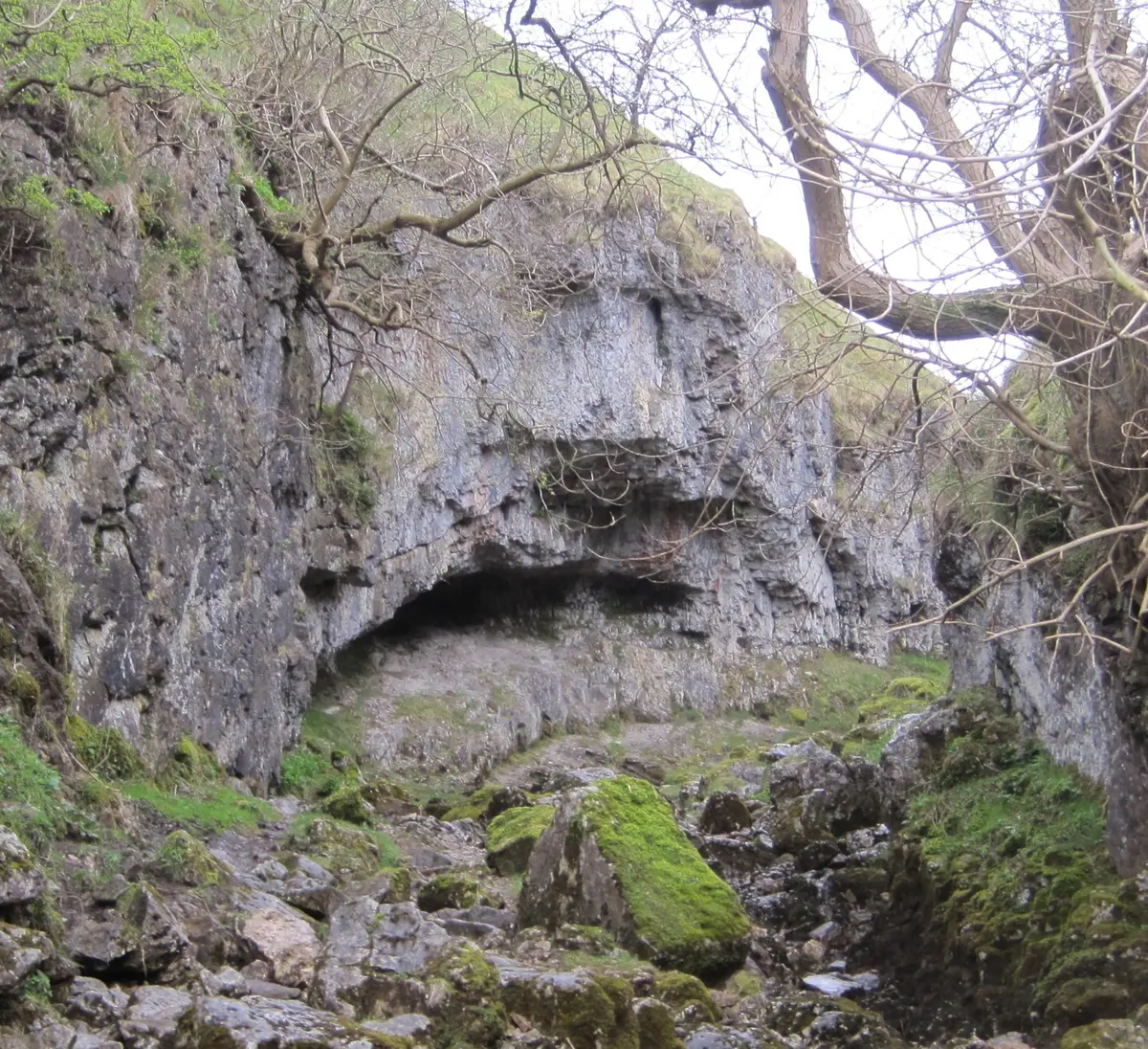
- 16 April 2017 Adrian Smith photographs a limestone outcrop in the gorge and files it with Geograph as "Face of the Troll (Barghest) in Trollers Gill", captioned "Dry limestone gorge with the semblance of a face". It is the image on this page.
Is there a rational explanation for Barghest?
None of the writers quoted here proposes an animal. In two centuries of dictionaries, county histories, folklore collections and dialect surveys, from Grose in 1787 to Simpson and Roud in 2000, none treats the Barghest as an undescribed species, a survival, or a candidate for zoology. It is a bogey: Simpson and Roud, in A Dictionary of English Folklore (2000), file it as "a particularly alarming shape-changing bogey animal", note that "sometimes it was only heard, not seen", and add that to hear it "was an omen of someone's approaching death — possibly one's own". A being defined by what its appearance means cannot be a species.
The etymology is where the case is really argued, and nothing in it is settled. Counting only derivations printed by people who worked on the word, there are seven: bar + gheist, from the Yorkshire gates and stiles "there called bars" (Grose, 1787); birg + geest, the "Belg." derivation Carr printed in his first edition of 1824 beside the gloss "A sprite that haunts towns, and populous places", with "A. S. burge" added in 1828; berg-geist, hill-spirit, and bär-geist, bear-spirit (T. Q. M., 1828); bahrgeist, spirit of the bier (Henderson, 1866); and barn-ghaist plus a second bar-ghaist, explained by the spectre's "habit of sitting on the top rail of a gate or fence" (E. M. Wright, 1913). Two verdicts matter more than the seven. Joseph Wright's English Dialect Dictionary (1898) gives the word no etymology at all — nine counties, some thirty citations, and no square-bracketed derivation, where the entry immediately above it (BARGHAM) has one and so does Shuck in volume V. And E. M. Wright, having listed three, simply writes: "But whatever its origin…". Where the two people who knew the material best declined to choose, this file declines too.
Two attributions to Walter Scott do not survive checking. Henderson credits Scott with the bahrgeist = "spirit of the bier" derivation, already in his first edition of 1866, on page 239. Scott supplies the spelling and no derivation: in The Betrothed the Bahr-geist is explained at length and never etymologised, and a full-text search of Letters on Demonology and Witchcraft (1830), the obvious place for it, returns zero occurrences of bahr, barghest, barguest or bar-ghaist, against 77 matches for the string "ghost". Worse is the Encyclopædia Britannica of 1911, which states flatly "It is mentioned by Sir Walter Scott in 'The Lay of the Last Minstrel'" and quotes three lines. The lines are real, and they are about the Manx Mauthe Doog, as Scott's own note to that stanza explains. In the 1806 edition of the poem, notes included, barghest and its variants appear zero times (controls in the same file: "spectre" 4, "Mauthe Doog" present). That Britannica article is also where the fusion happens — Gwyllgi, Trash, Shuck, the Mauthe Doog, the Demon of Tedworth and the Black Dog of Winchester laid side by side as one "spectre-hound" — and every modern sentence beginning "folklorists group the Barghest with…" descends from that paragraph.
The Troller's Gill hound is literature, and it can be dated against a control. Thomas Dunham Whitaker described the gorge minutely in The History and Antiquities of the Deanery of Craven (1805) — "a winding but nearly perpendicular fissure in the lime-stone rock, about half a mile in length, a very few yards in width, and, upon an average, about sixty feet high" — and identified it as the lost medieval Gordale of Appletreewick. He says nothing about a hound. A search of the whole 1.8-megabyte text returns no barghest in any spelling (the only near-misses are "Bargh", "bargain"), while the controls in the same file return Barden 57, Burnsall 24, Grassington 20, Appletreewick 5 and "Gill", as a word, 23. The gorge acquires its Spectre Hound in 1828, in T. Q. M.'s ballad.
And the star witness is thinner than the legend he carries. Billy B——y is the only first-person Barghest account in this whole file, and even he did not see a dog: he heard chains and found something "like a sheep, but it war larger … and it war woolly like". The hound is the ballad's. More telling still, the same 1828 article that made the Barghest famous also debunks it: T. Q. M. reports, with relish, that the wags of Threshfield used to turn a he-goat with a chain round its neck into the lanes at night, and that a miller coming from Kettlewell market took it for the Barghest and knelt in his cart to pray. The contemporary natural explanation was printed inside the tradition, by a believer, on the same page.
Two accretions are recent and worth naming. The Yorkshire Dales National Park Authority's own page describes "a magical dog living there called the Barguest that turns you to stone with one look from its huge eyes": petrifaction is in none of the nineteenth-century sources. And the recurring claim that the Barghest inspired The Hound of the Baskervilles rests on newspaper features (Yorkshire Evening Post, 2006; Yorkshire Post, 2010). Conan Doyle's own dedication of the novel thanks Bertram Fletcher Robinson: "It was to your account of a West-Country legend that this tale owes its inception."
The fullest death-omen version is also the latest to arrive. Henderson's story of the Barguest of the Oxwells, which came out at the death of Squire Wade of New Grange, is not in his first edition of 1866; it first appears in the second edition, of 1879. For the black-dog tradition as a whole, Simpson and Roud point to Ethel Rudkin in Folk-Lore 49 (1938) and Theo Brown, "The Black Dog", in Folklore 69 (1958).
Can you visit Barghest?
Troller's Gill is a dry limestone gorge on Skyreholme Beck, by the hamlet of Skyreholme near Appletreewick in Wharfedale, inside the Yorkshire Dales National Park. The pin on this file, 54.0522° N 1.8966° W, converts to Ordnance Survey grid reference SE 068 618 and lies about 7 km east-south-east of Grassington, measured between the two coordinates.
The National Park Authority's page on the gill, consulted on 24 September 2026, says that for most of the year the streambed is dry because the water runs underground, and gives one warning: "During heavy rain, take care, the rocks can be very slippy." The page also points to the remains of lead mining around the gorge and to the plants that grow on the lead spoil heaps. It carries a modern form of the legend as well, in which the Barguest "turns you to stone with one look from its huge eyes".
Welcome to Yorkshire, the county tourist board, publishes a circular walk from Burnsall called Burnsall and Troller's Ghyll: 8.3 miles (13.4 km) with 476 metres of ascent, graded moderate and timed at 208 minutes. It crosses the River Wharfe and passes through the gorge, the Gill Head Mines, Parcevall Hall and Howgill. The route description, read on the same day, says that lead was mined at Gill Head from the eighteenth century to the early 1900s, and that the workings reopened in the 1920s as a fluorspar mine which stayed in production until 1981.
Parcevall Hall Gardens, at Skyreholme near Appletreewick, BD23 6DE, is the nearest place with published opening hours. Its visit page, consulted on 24 September 2026, gives a season running from April to October, open daily from 10am to 6pm with last admission at 4.30pm. Admission is £12 for adults and £11 for senior citizens, with children under 12 free, and the gardens state: "We can only accept payment by credit card." Well-behaved dogs are admitted, and the toilets are in the tea room and in the garden. The home page adds that "free parking for garden visitors is available on site".
The photograph on this page is picture 5358612 on Geograph, taken by Adrian Smith on 16 April 2017 and registered at grid reference SE 066 619, about 300 metres west-north-west of the pin. Its title calls the rock the Face of the Troll, or the Barghest, and the caption reads: "Dry limestone gorge with the semblance of a face."
York is the other place attached to the name. The English Dialect Dictionary of 1898 quotes Brand's Popular Antiquities, in the edition of 1848, placing "the bar-guest of York" beside the demon of Tidworth and the black dog of Winchester. Grose's glossary, in its edition of 1790, ties the word more loosely to Yorkshire gates and stiles, "there called bars", without naming the city.
Sources consulted
- Francis Grose, «A Provincial Glossary, with a Collection of Local Proverbs and Popular Superstitions, s.v. Bar-guest — "A ghost, all in white, with large saucer-eyes, commonly appearing near gates or stiles; there called bars. Yorksh. Derived from Bar and Gheist." First published 1787; quoted here from the corrected and enlarged second edition» — S. Hooper, London; Internet Archive, 1790 book
- William Marshall, «The Rural Economy of Yorkshire, vol. II, Provincialisms, p. 316 — "BARGUEST; a hobgoblin of the highest order; terrible in aspect, and loaded with chains of tremendous rattle", with "BOGGLE; an inferior hobgoblin" on the next page, p. 317» — T. Cadell, London; Internet Archive, 1788 book
- John Ray, «A Collection of English Words Not Generally Used, North Countrey Words — the B sequence (Balk, Bannock, Bargh, Barn, Beck) with no entry for Barghest» — Printed by H. Bruges for Tho. Burrell, London; Internet Archive, 1674 book
- William Carr, «The Dialect of Craven, in the West-Riding of the County of York, 2nd ed., vol. I, s.v. BARGHEST / BAR-GUEST — "A sprite that haunts towns and populous places", with the derivation and quotations from Whitaker and from Scott's Tales of the Crusaders» — Wm. Crofts, London; Internet Archive, 1828 book
- T. Q. M. (attributed by Parkinson to James Henry Dixon), in William Hone's compilation, «"Stories of the Craven Dales, No. II" — the ballad "The Legend of the Troller's Gill", the narrative of Billy B——y, the bear-ghost etymology and the Threshfield he-goat, signed T. Q. M., in The Table Book, vol. II, cols. 653-658» — Published for William Hone by Hunt and Clarke, London; Internet Archive (Wellcome Library copy, vols. I-II), 1828 book
- Thomas Dunham Whitaker, «The History and Antiquities of the Deanery of Craven, in the County of York — Appletreewick: Troller's Gill described as "a winding but nearly perpendicular fissure in the lime-stone rock" and identified as the ancient Gordale of Appletreewick, with no mention of a barghest» — Nichols and Son, London; Internet Archive, 1805 book
- Walter Scott, «Rob Roy, ch. XIV — "needed not to care for ghaist or bar-ghaist, devil or dobbie"» — Archibald Constable, Edinburgh; Project Gutenberg, 1817 book
- Walter Scott, «The Betrothed (Tales of the Crusaders) — the Bahr-geist defined as "a spectre, usually the image of a departed person", with the author's footnote crediting the Memoirs of Lady Fanshawe» — Archibald Constable, Edinburgh; Project Gutenberg, 1825 book
- Walter Scott, «The Lay of the Last Minstrel, with the author's notes — the stanza "For he was speechless, ghastly, wan…" and Scott's own note explaining it as the Mauthe Doog of Peel Castle, Isle of Man. Zero occurrences of barghest or its variants in the whole volume» — Longman, Hurst, Rees and Orme, London; Internet Archive, 1806 book
- Walter Scott, «Letters on Demonology and Witchcraft — searched in full for bahr, barghest, barguest and bar-ghaist: zero occurrences, against 77 matches for the string "ghost"» — John Murray, London; Project Gutenberg, 1830 book
- William Henderson, «Notes on the Folk-Lore of the Northern Counties of England and the Borders, 2nd ed., pp. 274-276 — the Barguest of the Oxwells and the death of Squire Wade of New Grange, and the attribution to Scott of the derivation from German bahrgeist, "spirit of the bier"» — Folk-Lore Society, London; Internet Archive, 1879 book
- Thomas Parkinson, «Yorkshire Legends and Traditions, pp. 126-133 — "The Bargest of the Troller's Gill" and "The Bargest, near Grassington", with the ballad attributed to "the late Dr. Dixon" and Billy B——y's narrative taken from Joseph Lucas's Studies in Nidderdale, itself from the Leeds Mercury Supplement of 28 February 1881 signed F. W. J.» — Elliot Stock, London; Internet Archive, 1888 book
- Joseph Wright (ed.), «The English Dialect Dictionary, vol. I (A-C), s.v. BARGHEST — nine counties, some thirty quotations (Marshall 1788, Grose 1790, Willan 1811, Scott 1817, Henderson 1879, Dixon 1881, Lucas 1882) and no etymology at all» — Henry Frowde, Oxford; Internet Archive, 1898 book
- Elizabeth Mary Wright, «Rustic Speech and Folk-Lore, pp. 193-194 — the Barghest as "the most dramatic and awesome of all the boggarts", taking "the shape of a large dog, donkey, pig, or calf", with three further etymologies listed and none accepted: "But whatever its origin…"» — Oxford University Press, London; Internet Archive, 1913 book
- Encyclopædia Britannica (unsigned), «"Barghest", Encyclopædia Britannica, 11th ed., vol. III, p. 399 — the article that fuses Gwyllgi, Trash, Shuck and the Mauthe Doog into one spectre-hound, gives three etymologies and credits Scott with a mention in The Lay of the Last Minstrel» — Cambridge University Press; Wikisource transcription, 1911 book
- Jacqueline Simpson and Steve Roud, «A Dictionary of English Folklore, s.vv. "bargest, barguest" and "black dogs" — the barguest as a shape-changing bogey heard as often as seen, and the distinction between plain Black Dogs and the shape-changers that carry regional names» — Oxford University Press, Oxford, 2000 book
- Yorkshire Dales National Park Authority, «Troller's Gill — the National Park Authority's page: the dry streambed, the warning that "during heavy rain… the rocks can be very slippy", the lead-mining remains and their flora, and the modern claim that the Barguest "turns you to stone with one look"» — yorkshiredales.org.uk, 2026 web
- Parcevall Hall Gardens, «Visit — opening season and hours, last admission, admission prices, card-only payment, dogs, toilets and the address at Skyreholme nr Appletreewick BD23 6DE» — parcevallhallgardens.co.uk, 2026 web
- Adrian Smith, «Face of the Troll (Barghest) in Trollers Gill, photograph 5358612, taken 16 April 2017 at grid reference SE 066 619 — "Dry limestone gorge with the semblance of a face"» — Geograph Britain and Ireland; Wikimedia Commons, CC BY-SA 2.0, 2017 web
- Welcome to Yorkshire, «Walk: Burnsall & Troller's Ghyll — 8.3 miles, about 3½ hours, 476 m of ascent, moderate, circular from Burnsall via Troller's Ghyll, Parcevall Hall and Howgill; notes the Gill Head fluorspar mine» — yorkshire.com, 2026 web
- William Carr, «Horæ Momenta Cravenæ, or, The Craven Dialect, exemplified in two dialogues — glossary, s.v. Bargest: "A sprite that haunts towns, and populous places. Belg. birg and geest, a ghost." First edition of Carr's glossary, published anonymously "by a native of Craven"» — Hurst, Robinson and Co., London, and Robinson and Hernaman, Leeds; Internet Archive, 1824 book
- William Henderson, «Notes on the Folk-Lore of the Northern Counties of England and the Borders, 1st ed., p. 239 — the Barguest as "a presage of death" and "Sir Walter Scott's derivation of his name from the German 'bahrgeist,' spirit of the bier"; the Oxwells story is not yet in this edition» — Longmans, Green and Co., London; Internet Archive, 1866 book
- Arthur Conan Doyle, «The Hound of the Baskervilles — dedication to Bertram Fletcher Robinson: "It was to your account of a West-Country legend that this tale owes its inception"» — George Newnes, London; Project Gutenberg, 1902 book
Reviewed by V. Serrano on 2026-08-15 · How we verify our content
📎 Source: Enigma Atlas
💬 Field testimonies (0)
No testimonies yet. Add the first.
Add your testimony
🔒 Log in to add a testimony