🦶 CRYPTID SIGHTING · EXP. Nº0555
ACTIVE
Black Annis
Black Annis is a blue-faced hag of Leicestershire folklore, said to have lived in a cave in the Dane Hills, on the western edge of Leicester.
Where and when was Black Annis sighted?
- Location
- Leicestershire, United Kingdom
- Date sighted
- Unknown
- Coordinates
- 52.636, -1.164
- Last updated
LOCATION
What is Black Annis?
Her name belonged to a place before it belonged to a monster. The oldest trace of it is a manuscript note by the antiquary William Burton, who died in 1645: he records a cave west of the town at that day called Black Agnes's Bower, and guesses it was named after Agnes Scott, an anchoress buried at Swithland whose brass calls her a cave-dweller. The story of the child-eater, by contrast, can be dated exactly. It first reaches print in 1797, in a poem by John Heyrick junior, a young Leicester officer answering a little girl's questions: vast talons foul with human flesh in place of hands, features livid blue, warm human skins about her waist. Heyrick wrote the whole thing in the past tense and hedged it, saying it happened only if the uncouth song of former days does not soil his page with falsehood. None of these sources mentions a Celtic goddess; the identification with Anu, a mother goddess, first reaches print in 1846, in John Dudley's Naology. The cave is gone, and the Dane Hills are houses now.
What is the history of Black Annis?
Black Annis does not begin as a monster. She begins as a field name.
The oldest trace is a manuscript note by William Burton, the Leicestershire antiquary who died in 1645. Describing the church of Swithland, Burton records a flat gravestone inlaid with brass showing a veiled woman, with a Latin epitaph naming her Agnes Scott camerata and calling her Antrix devota Dominae Ferrers — the devout cave-dweller of Lady Ferrers. The verse ends with the commonest of medieval formulas, "Sum quod eris, fueramque quod es: pro me, precor, ora", which reads in English "I am what you will be, and I was what you are: pray for me." Burton then adds his own reading, and flags it as a guess: "This Agnes Scott, as I guess, was an Anchoress; and the word Antrix in this epitaph coined from antrum, a cave, wherein she lived; and certainly (as I have been credibly informed) there is a cave near Leicester, upon the West side of the town, at this day called Black Agnes's Bower."
That passage is not in Burton's printed book. The Description of Leicester Shire (1622) gives Swithland barely a page — patron, valuation, heraldry in the chancel windows — and nothing else. Burton's note reached print only when John Nichols set it into his county history, at Swithland, in volume III part II (1804), a hundred and fifty-nine years after Burton died.
Between those two dates the Dane Hills were open ground. Nichols's own county flora lists crested Poa "About the Dane Hills, and Closes near Danet Hall, Leicester" and autumnal gentian "On the Dane Hills, and about Glenfield near Leicester": rough pasture on the western edge of the town, running out towards Glenfield, and immediately next to the estate of the Danet family, whose name appears in Leicester records from the Middle Ages.
The first full narrative is a poem, and it can be dated exactly. John Heyrick junior, a young Leicester man and by then a lieutenant in the Fifteenth (or King's) Regiment of Light Dragoons, published a small collection called First Flights (London: printed by T. Gillet for C. Dilly, 1797). On pages 13 to 15 stands "On a Cave called Black Annis's Bower, being an Answer to a very young Lady's Enquiries about the Story of Black Annis". It sets the bower on the path "From Glenn-field vill, to Lester's ancient walls", under an oak that "Spreads his broad arms above the stony cell"; it gives her "Vast talons, foul with human flesh… In place of hands, and features livid blue", and a waist that "Warm skins of human victims close embrac'd". And it is written entirely in the past tense: Time has already drawn his bow against her, the shepherds have thrown her body into the rock, and the poet calls what he is doing prolonging "the dying tale".
Heyrick never saw the book. Its Advertisement, dated Leicester, 18 August 1797, states that "The following Poems were in the Press, and the latter part of the proof sheets in the hands of the Author, when it pleased God to remove him suddenly from all his earthly concerns", and remembers him as "a Man of superior talents, a Soldier of undaunted courage, and a Gentleman of unbounded liberality".
Seven years later Nichols reprinted the poem — without naming its author — directly underneath Burton's note on Agnes Scott, introducing it as the work of "an ingenious young poet, whose early loss his friends had much reason to deplore as a man of superior talents, and his country as a soldier of undaunted courage". The wording is lifted almost verbatim from the 1797 Advertisement. That page of Nichols is where the anchoress and the child-eating hag first appear side by side, and every later account inherits the pairing from it.
Timeline: the documented record of Black Annis
- 1622 William Burton publishes The Description of Leicester Shire. Its Swithland entry runs to barely a page — patron, valuation, heraldry — and contains no cave, no anchoress and no Black Agnes. A full-text search of the digitised edition returns zero hits for "Bower", "Antrix" and "Anchoress", against 269 for "Leice-" and five for "cave" in the same file.
- Before 1645 In a manuscript note that stays unpublished until 1804, Burton records the brass of Agnes Scott at Swithland and guesses that the cave "upon the West side of the town, at this day called Black Agnes's Bower" is named after her. It is the oldest known reference to the place, and it explains the name by a real woman.
- 1689 Earliest written mention of the Dane Hills themselves, according to Leicester City Council's heritage service.
- 1764 Legal documents refer to a parcel of land "known by the name of Black Anny's Bower Close". The name is still attached to a field, not to a creature.
- 1791 John Throsby describes the Easter Monday outing to Black-Annis'-Bower Close, page 166 of his history of Leicester: the mayor and his brethren in scarlet, a dead cat "prepared by aniseed water" dragged behind a horse as a mock hare, the hounds, and dinner at the mayor's house. Throsby's own explanation is civic, not magical — "a custom, perhaps, originating out of a claim to the royalty of the forest".
- 1795 Nichols reprints Throsby's account in volume I of the county history, page 449 note, and opens it by recording that the custom was already "dwindling into disuse".
- 1797 The oldest datable narrative of Black Annis as a monster appears in print: John Heyrick junior's poem on pages 13-15 of First Flights, written to answer a little girl's questions. Heyrick died suddenly with the book in the press; its Advertisement is dated Leicester, 18 August 1797. The poem is in the past tense throughout and calls itself "the dying tale".
- 1804 Nichols prints Burton's Agnes Scott note and Heyrick's poem together on page 1051 of volume III part II, the poem anonymously, introduced with wording lifted almost verbatim from the 1797 Advertisement. This is the page from which every later account inherits the equation between the anchoress and the hag.
- 1920s Easter gatherings on the Dane Hills continue into this decade, according to Leicester City Council. The ground is then built over; the suburb of that name today is housing, and no cave is marked or shown.
- c. 1982 Black Annis Morris, an all-women morris side, is founded in Leicester and takes her name; the team's own account is that nobody wrote the exact date down at the time.
Is there a rational explanation for Black Annis?
The single most repeated claim about Black Annis — that she is a survival of a Celtic goddess, Anu or Danu, fossilised in the name of the Dane Hills — is absent from every document that carries the story up to 1804, and it can be followed in print from 1846.
The digitised full texts of those five documents — Burton's Description of Leicester Shire (1622), Throsby's history of Leicester (1791), Heyrick's First Flights (1797), and Nichols's county history, volumes I and III — contain no occurrence of "Danu", "Danann" or "Dana". "Goddess" and "Celtic" occur twelve times across the twenty-three megabytes of Nichols's two volumes, and every one of them is about something else: a Diana passage out of Ovid, a line of somebody's verse, and a run of place-name etymologies (the word "carr", the word "caer", a citation of a Celtic dictionary). The same files answer a search when the word is there: "Leice-" returns 269 hits in Burton and 8,257 in Nichols volume I, "cave" 133 and 303 in Nichols's two volumes, and "Annis" as a whole word 16 in Nichols volume I and 7 in volume III.
What those documents do contain is a mundane explanation offered by the earliest witness. Burton, writing before 1645, already reads the cave name as a memory of Agnes Scott, and marks his own reading as a guess twice over: "as I guess", "as I have been credibly informed".
By 1846, forty-two years after Nichols printed that note, the goddess is in print. John Dudley (1762-1856), in Naology (London, 1846), page 249, writes that "The name of Annis, to whom this cave is said to have belonged, is known to the Celtic mythologist by the name of Anu or Nannu, names signifying the mother goddess, according to the authority of Vallancey", and draws the conclusion that "the tales of the cannibal practices of Black Annis of the Bower cannot be with reason doubted". Charles James Billson reprinted that paragraph for the Folklore Society in County Folk-Lore, volume I (1895), pages 7-8. Donald A. Mackenzie, in Myths of Crete and Pre-Hellenic Europe (1917), page 61, made Black Annis the English survival of "the mother-goddess of ancient Europe", "remembered as a devourer of children". T. C. Lethbridge, the author the goddess reading is usually credited to, comes last of the four: in Gogmagog: The Buried Gods (1957), pages 161-162, he writes that the name of the hills "may be derived from Danu, the Irish goddess, or from Diana", and that Black Annis "also appears to be Danu, or Anu".
The rest of the standard portrait thins out the same way when checked against the 1797 text. The claws are not iron: Heyrick writes "Vast talons, foul with human flesh", with no metal anywhere in the poem. The skins are worn — "her obscene waist / Warm skins of human victims close embrac'd" — and the oak "Spreads his broad arms above the stony cell". The skins hung out to dry reach print in the Leicester Chronicle of 6 September 1874, as reprinted by Billson: children who ran on the Dane Hills were told that she had "scratched to death with her claws, sucked their blood, and hung up their skins to dry". Heyrick himself does not vouch for any of it. His third stanza is conditional: this happened "if the uncouth song of former days / Soil not the page with Falsehood's artful lays".
The Easter Monday custom is also read as a ritual expulsion of the witch. John Throsby, who described it in 1791 from living memory, proposed something far duller and said so: "a custom, perhaps, originating out of a claim to the royalty of the forest". The mayor and his brethren walked in scarlet to a field that merely bore the name Black-Annis'-Bower Close; the quarry was a dead cat "prepared by aniseed water", dragged behind a horse and then trailed through the streets to the mayor's own door, where he gave his friends dinner. When Nichols reprinted the account in 1795 he opened it by noting that the custom was already "dwindling into disuse".
Two men described the cave from the inside, and neither found anything in it. Dudley writes that he "was actually in the cave about seventy years ago": a round hollow "of diameter of ten or twelve feet, and height about five", cut into the sandstone and by 1846 "nearly filled up by soil carried into it by rains". William Kelly, in the Leicester Chronicle of 3 October 1874, remembered crawling in as a schoolboy to a space "some seven or eight feet long by about four or five feet wide", with a ledge of rock along each side for a seat; by then its mouth had long been closed. The only object in the whole record is the Swithland brass, and it names a woman, Agnes Scott, whom Burton read as an anchoress.
Can you visit Black Annis?
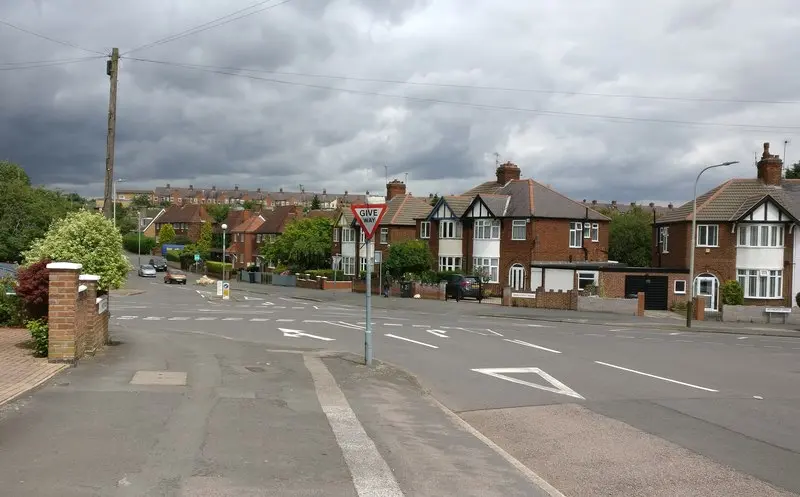
No cave survives at the Dane Hills, whose name now belongs to an inner suburb of west Leicester in the LE3 postal district; the OpenStreetMap node for Dane Hills lies about 2.1 km due west of the Clock Tower in the city centre, on the Glenfield side of the city, which is the direction of Heyrick's line "From Glenn-field vill, to Lester's ancient walls". Leicester City Council's Story of Leicester records that Easter gatherings at the Dane Hills continued up to the 1920s; the ground is now residential streets.
An OpenStreetMap query made on 24 September 2026 over a box of about 13 by 20 km around the city centre returns, for names containing "Dane", the suburb itself and a bus stop called Dane Hill, along with the streets Dane Hill, Daneshill Road and Danehurst Avenue and the Danehills Tennis Club. The same query for "Annis" returns a single feature, Bannister Road; the box contains 187 mapped pubs.
Agnes Scott, whose epitaph Burton read, by his own account as a guess, as that of an anchoress living in the cave "called Black Agnes's Bower", is buried at Swithland, about 9 km north-north-west of the Clock Tower in a straight line, in the church of St Leonard, Main Street, Swithland, LE12 8TJ, listed at Grade II* on 1 June 1966. Burton saw her brass "on a flat gravestone inlaid with plates of brass, in the body of the church, near the entrance into the chancel"; Nichols later recorded that "When the Danvers chapel was new built, this stone was placed in the present vestry". The Church of England's heritage record for the parish gives the church's visiting status as "open for worship". The Church of England's directory site, achurchnearyou.com, gives the address and the telephone numbers of the two churchwardens, and points to the parish website, stleonardsswithland.org.
Black Annis Morris, an all-women side formed in Leicester "some time around 1982", dances in the Suffragette colours of purple, green and white. Its website says that the side arranges its own dance spots at local pubs and accepts paid bookings, for example at summer fetes; other sides invite it to their events, and it dances at folk festivals.
Sources consulted
- William Burton, «The Description of Leicester Shire — Swithland, pp. 281-282 (the printed 1622 entry, which contains no cave, no anchoress and no Black Agnes)» — Early English Books 1475-1640; Internet Archive, 1622 book
- John Throsby, «The History and Antiquities of the Ancient Town of Leicester, p. 166 — the Easter Monday mock hare hunt at Black-Annis'-Bower Close and Throsby's own explanation of its origin» — Printed for the author, Leicester; Internet Archive, 1791 book
- John Nichols, «The History and Antiquities of the County of Leicester, vol. I, p. 449 n. — Throsby's account reprinted, prefaced with the note that the custom was 'dwindling into disuse'; also the county flora entries locating the Dane Hills next to Danet Hall and Glenfield» — Printed by and for John Nichols, London; Internet Archive, 1795 book
- John Heyrick, junior, «First Flights, pp. 13-15 — 'On a Cave called Black Annis's Bower, being an Answer to a very young Lady's Enquiries about the Story of Black Annis', with the Advertisement dated Leicester, 18 August 1797 recording the author's sudden death while the book was in the press» — Printed by T. Gillet for C. Dilly, London; Internet Archive, 1797 book
- John Nichols, «The History and Antiquities of the County of Leicester, vol. III part II, p. 1051 (Swithland) — Burton's manuscript note on the Agnes Scott brass and 'Black Agnes's Bower', with Heyrick's poem reprinted anonymously beneath it» — Printed by and for John Nichols, London; Internet Archive, 1804 book
- Leicester City Council, «Black Annis and Dane Hills — the city's heritage service on the 1689 first mention of the Dane Hills, the 1764 'Black Anny's Bower Close' deeds, the Easter fair and its survival into the 1920s» — Story of Leicester, storyofleicester.info, 2026 web
- Charnwood Borough Council, «Church of St Leonard, Main Street, Swithland — listed building entry: Grade II*, listed 1 June 1966, C13 and later, granite and slate rubble with Swithland slate roof» — charnwood.gov.uk, 2026 web
- Church of England, «Church Heritage Record 619212, Swithland: St Leonard — the parish's own heritage record, which lists the Danvers tomb and the churchyard monuments and does not mention the Agnes Scott brass» — facultyonline.churchofengland.org, 2026 web
- Black Annis Morris, «About Black Annis — the Leicester morris side founded 'some time around 1982', its colours and where it dances» — blackannismorris.org, 2026 web
- OpenStreetMap contributors, «Nominatim and Overpass queries on the Leicester area: the Dane Hills node (52.6364423, -1.1644730, LE3 6DA) and the absence of any feature named 'Annis' in a 20 x 13 km box containing 233 mapped pubs» — nominatim.openstreetmap.org and overpass-api.de, 2026 web
- Church of England, «St Leonard's, Swithland — address (Main Street, Swithland, LE12 8TJ), churchwardens' contacts and the parish website» — A Church Near You, achurchnearyou.com, 2026 web
- John Dudley, «Naology: or, A Treatise on the Origin, Progress, and Symbolical Import of the Sacred Structures of the Most Eminent Nations and Ages of the World, p. 249 — the Dane Hills cave ('a round cave, of diameter of ten or twelve feet, and height about five'), the author's own visit 'about seventy years ago', and the equation of Annis with 'Anu or Nannu, names signifying the mother goddess, according to the authority of Vallancey'» — London; Internet Archive (Google scan), 1846 book
- Charles James Billson (ed.), «County Folk-Lore, vol. I: Leicestershire and Rutland, pp. 4-9 — Heyrick's poem, the Leicester Chronicle of 26 February 1842, 6 September and 3 October 1874 (William Kelly's schoolboy visit to the cave) and 7 November 1874 (the 1764 deeds), and Dudley's Naology paragraph reprinted» — The Folk-Lore Society, London; Internet Archive, 1895 book
- Donald A. Mackenzie, «Myths of Crete and Pre-Hellenic Europe, pp. 61-62 — Black Annis as the survival in Leicestershire of 'the mother-goddess of ancient Europe', 'remembered as a devourer of children'» — Gresham Publishing, London; Internet Archive (Digital Library of India scan), 1917 book
- T. C. Lethbridge, «Gogmagog: The Buried Gods, pp. 161-162 — glossary entry on Black Annis: the name of the Dane Hills 'may be derived from Danu, the Irish goddess, or from Diana', and Black Annis 'also appears to be Danu, or Anu'» — Routledge & Kegan Paul, London; Internet Archive (IGNCA scan), 1957 book
Reviewed by V. Serrano on 2026-08-14 · How we verify our content
📎 Source: Enigma Atlas
💬 Field testimonies (0)
No testimonies yet. Add the first.
Add your testimony
🔒 Log in to add a testimony