🦶 CRYPTID SIGHTING · EXP. Nº0555
ACTIVE
Nuckelavee
The nuckelavee has one source. Everything written about it descends from four pages published in January 1891, when Walter Traill Dennison, a farmer on the Orkney island of Sanday, printed "Orkney Folklore. Sea Myths. — 4. Nuckelavee" in The Scottish Antiquary.
Where and when was Nuckelavee sighted?
- Location
- Orkney Islands, Scotland, United Kingdom
- Date sighted
- Unknown
- Coordinates
- 59.117, -2.563
- Last updated
LOCATION
What is Nuckelavee?
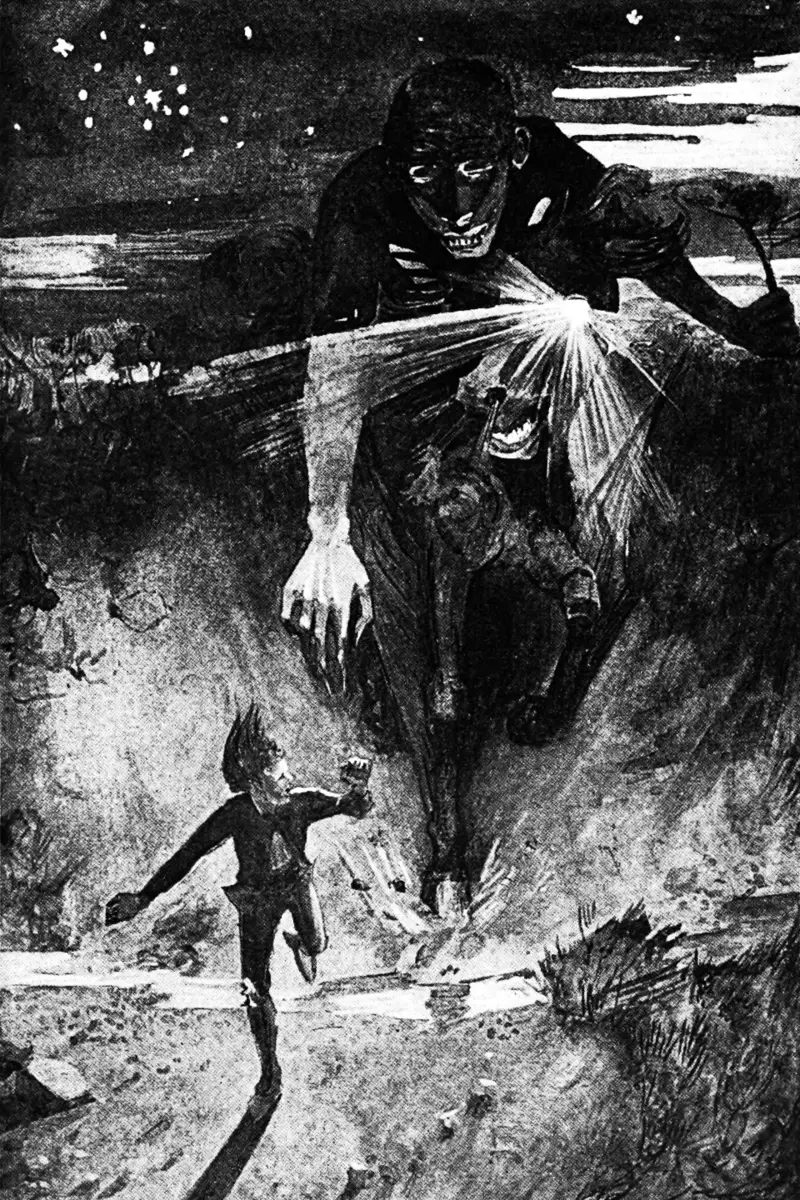
He had gathered the tale by Orkney firesides some forty years earlier. What he set down is a monster with no skin at all, black blood running through yellow veins and white sinews working as it moved; a horse below with fins about its legs, a whale's mouth and one eye red as fire, and above it a legless man whose arms reached nearly to the ground and whose head rolled from shoulder to shoulder. Blighted crops, cattle over the cliffs, epidemics and drought were laid at his door, and it was unlucky to say his name without adding a prayer. Burning seaweed for kelp enraged him, so he struck the horses of Stronsay with a disease called Mortasheen. Only the Mither o' the Sea in summer, and fresh water in winter, held him back. Dennison knew an old man who was credited with escaping him — and said so in exactly those cautious words.
What is the history of Nuckelavee?
This is one of the few creatures in this atlas whose entire documentary base can be read in an afternoon: it is four pages long.
The text is item 326 of The Scottish Antiquary, or Northern Notes and Queries — a quarterly of one-shilling parts edited in Edinburgh by the Rev. A. W. Cornelius Hallen — volume V, number XIX, pages 130 to 133. The volume is dated 1891, and the number can be pinned down by arithmetic: the parts were quarterly, the preceding number contains a letter written in July 1890 and a notice of a death on 4 July 1890, and number XIX itself quotes a document of 27 September 1890 — so this is the January 1891 part. The piece is headed "Orkney Folklore. Sea Myths. — 3. The Stoor Worm. — 4. Nuckelavee", the Nuckelavee section beginning at the foot of page 131, and it is signed at the end: "W. Traill Dennison, West Brough, Sanday, Orkney." Walter Traill Dennison (1825–1894) farmed on Sanday, and the series ran on through 1892 and 1893 with the Sea Trows, the Fin Folk and Finfolkaheem.
When he collected it matters, and he says so himself: in the first instalment of the same series, published the previous October, Dennison says plainly: "It is upwards of forty years since the myths now offered were collected by the hearths of Orkney cottages." That puts the fieldwork in 1850 or earlier — the old weaver whose words he gives for the Mester Ship, he adds, "died in 1840", when Dennison was fifteen — and the printing forty years or more later. In the same paragraph he warns that the tales will seem "monstrously extravagant and absurd", and he admits what he does to them: of his weaver informant he writes, "I only change his old-world words into English."
The description on page 132 is the source of everything that circulates today. Nuckelavee "was a spirit in flesh"; his home was the sea, and on land "he rode a horse as terrible in aspect as himself. Some thought that rider and horse were really one." His head "was like a man's, only ten times larger, and his mouth projected like that of a pig and was enormously wide. There was not a hair on the monster's body, for the very good reason that he had no skin." Black blood ran visibly through his veins; the working of the muscles "showed white sinews in motion". Dennison ends the paragraph with a joke that no later retelling keeps: "What a study for an anatomist!"
Two things restrained him, and Dennison gives each a season: "if not restrained by the Mither of the Sea in summer, and in winter by his terror of fresh water, he would long ago have made Orkney a manless desert." Blighted crops, stock falling from the cliffs, epidemics among people and animals and long droughts were all laid at his door.
Then the economics, in Dennison's words: "The burning of sea-weed for kelp gave terrible offence to Nuckelavee, and filled him with diabolical rage. He vented his wrath by smiting with deadly disease horses in the island of Stronsay (for that was the island where kelp was first made in Orkney), and that disease spread over all the islands where kelp was made. That disease was called Mortasheen."
Only then does the witness appear, and Dennison is careful about him: "I knew an old man who was credited with having once encountered Nuckelavee, and with having made a narrow escape from the monster's clutches. This man was very reticent on the subject. However, after much higgling and persuasion, the following narrative was extracted." He also records the taboo — it was unlucky to say the name without adding "Guid save us a'!"
In the narrative the man is Tammas in the first sentence and Tammie in the twelve that follow, and Dennison's very first clause names what he thinks the story is made of: "Tammas, like his namesake Tam o' Shanter, was out late one night." The road ran between the sea on one side and a deep fresh-water loch on the other. The lower half was "like a great horse, with flappers like fins about his legs, with a mouth as wide as a whale's, from whence came breath like steam from a brewing-kettle. He had but one eye, and that as red as fire." On it sat, "or rather seemed to grow from his back, a huge man with no legs, and arms that reached nearly to the ground", his head as big as a clue of simmons — a ball of straw rope about three feet across — rolling from shoulder to shoulder. And then the sentence everyone quotes: "the whole surface of it showing only red raw flesh, in which Tammie saw blood, black as tar, running through yellow veins, and great white sinews, thick as horse tethers, twisting, stretching, and contracting, as the monster moved."
The escape comes in two stages: Tammie hugged the loch side of the road; a foot went into the water and splashed the monster's foreleg, "whereat the horse gave a snort like thunder and shied over to the other side of the road". Only after that came the run for the rivulet draining the loch to the sea, the leap, and the bonnet left in the monster's clutches.
Timeline: the documented record of Nuckelavee
- 1529 Jo Ben's Descriptio Insularum Orchadiarum describes a sea creature that lay with a farmer's wife on Stronsay. He calls such beings Troicis — trows — and the body is "clothed with sea-weed over the whole body, like a colt". Hairy and weed-covered: the opposite of a skinless monster. The passage is offered on the internet as the nuckelavee's earliest appearance; it does not contain the word.
- 1722 James Fea of Whitehall introduces kelp-burning to Orkney on Stronsay. Barry's Statistical Account records the islanders' objections: it would drive the fish from the coast, they were "certain it would destroy both the corn and the grass", and they feared it would stop their women bearing children. The nuckelavee's rage at the kelp fires cannot be older than this date.
- 1768 The Stenness Kirk Session records in Orkney describe a horse's sudden death "called the Mortasheen". The disease Dennison attributes to the nuckelavee is glanders, and it is documented in Orkney a hundred and twenty-three years before the monster who is blamed for it reaches print.
- 1822 Samuel Hibbert, in A Description of the Shetland Islands, derives the water-god's names "Nocka, Nickur, or Necker" from the Latin necare, and prints Jo Ben's Stronsay passage in a footnote as an account of that water-god. He is not discussing the nuckelavee; the word will not appear in print for another sixty-nine years.
- c. 1850 (the fieldwork) Dennison collects the Orkney sea myths. He dates the work himself in the first instalment of the series, October 1890: "It is upwards of forty years since the myths now offered were collected by the hearths of Orkney cottages." He also states his method — of one informant, an old weaver who died in 1840, "I only change his old-world words into English."
- 1866 Thomas Edmondston's Etymological Glossary of the Shetland & Orkney Dialect records "Niggle, a sort of water-kelpie" and proposes a derivation from "gneg, a horse, and el, water". It has no entry for nuckelavee — the control that makes that silence meaningful.
- 1883 John R. Tudor's The Orkneys and Shetland devotes pages 105-106 to the kelp trade and carries a dialect glossary with "Nuggle or Niogle, O. and S., a kind of water kelpie". Stronsay appears thirty-five times in the Internet Archive text of the book. Nuckelavee appears not once.
- January 1891 Walter Traill Dennison publishes "Orkney Folklore. Sea Myths. — 4. Nuckelavee" in The Scottish Antiquary, vol. V, no. XIX, pages 130-133, signed from West Brough, Sanday. It is the oldest printed appearance of the word that can be dated: the skinless body, the Mither o' the Sea, the kelp and the Mortasheen, the taboo on the name, and the escape of the old man he calls Tammas, then Tammie.
- 1893 Sir George Douglas reprints the tale in Scottish Fairy and Folk Tales (Walter Scott), the edition James Torrance illustrated and the source of the picture on this page. Douglas credits Dennison in a one-line footnote and silently drops the kelp, Stronsay, the Mortasheen, the Mither o' the Sea, the protective prayer and the gloss "Devil of the Sea". For a century this abridgement is the version most readers meet.
- 17 September 2008 The word "knoggelvi" enters the English Wikipedia, sourced to the Orkney website Orkneyjar, which asserts without a source that nuckelavee is "a later corruption of the dialect name". Dennison wrote no such word; his article expressly declines to derive the name. The Orkneyjar page cited is now a dead link.
- June 2014 The Wikipedia article is rebuilt from Dennison and Marwick. The editor who adds the Jo Ben paragraph on 22 June leaves the edit summary "I'm not sure whether this is a reliable source?" — the doubt is on the record, and the paragraph is still there.
Is there a rational explanation for Nuckelavee?
The question the record can answer is how old the word is.
The January 1891 article is the oldest dated printed appearance of "Nuckelavee" in the Dictionary of the Scots Language, and the earlier books where the word ought to be do not have it. The Internet Archive full texts, searched on 25 September 2026 with a control in each file, give these results. Thomas Edmondston's An Etymological Glossary of the Shetland & Orkney Dialect (1866) has no nuckelavee, and no nuck- word except nuckie, a fish-hook and a cap's tassel; the control in the same file is positive: "Niggle, a sort of water-kelpie", with Edmondston's guess at a derivation from "gneg, a horse, and el, water". John R. Tudor's The Orkneys and Shetland (1883) has none either, against 35 hits for Stronsay, 14 for trow and a glossary entry "Nuggle or Niogle, O. and S., a kind of water kelpie". Samuel Hibbert's Description of the Shetland Islands (1822) also has none, while its water-god "Nocka, Nickur, or Necker" is there. The Dictionary of the Scots Language has no headword nuckelavee at all: the word appears in it under NEUGLE, as a quotation dated 1891 from the Scottish Antiquary and as the form nucklavee, dated 1929 and credited to Marwick — where the earliest dated quotation of the family is a "neagle" from the Statistical Account of 1845.
So the creature reaches print once, from one collector, quoting one unnamed informant, forty years after he heard it.
Dennison is his own best sceptic. He does not say the old man met the Nuckelavee; he says the man "was credited with" having met it. And in the first line of the narrative he names the model himself: Tam o' Shanter. Burns's poem of 1790 ends with Tam saved by the fact that the witches cannot follow him over running water — which is, exactly, how Tammie is saved. Whatever else the story is, its escape is a device already famous in Scotland a century before Dennison wrote it down.
The kelp gives the belief a floor it cannot slip below. Kelp-burning was introduced to Orkney in 1722 by James Fea of Whitehall in Stronsay, and Tudor quotes George Barry's Statistical Account of Kirkwall on how the islanders received it: they were sure it would drive the fish from the coast, "certain it would destroy both the corn and the grass", and afraid it might stop their women having children. The Nuckelavee's rage at the kelp fires is that documented grievance with a face on it, and it cannot be older than 1722. The disease is real too: Mortasheen is glanders, and the Scottish National Dictionary records it in Orkney in the Stenness Kirk Session records of 1768 — a hundred and twenty-three years before Dennison printed the story that explains it.
The rest of what circulates today was added after him, and can be dated.
The etymology first. Dennison declines to give one: "Without speculating on the derivation of this name, which will be pretty obvious to those acquainted with northern mythology, it may be said that in plain English the name means Devil of the Sea." The word "knoggelvi", which many pages now attribute to him, is absent from his article and from the whole Internet Archive text of volumes V to VII of the Scottish Antiquary, which contain his series; the control, "Devil of the Sea", occurs once. On the web it comes from the Orkney website Orkneyjar, run by the Orcadian journalist Sigurd Towrie, which states without a source that "Nuckelavee is a later corruption of the dialect name 'knoggelvi'". The word itself is older than the website: the Scottish National Dictionary lists knoggelvi among the Orkney derived forms of NEUGLE, with the reference "Ork. Ib.", which points back to Jakobsen's dictionary of 1928; it does not connect the word to Dennison. It entered the English Wikipedia on 17 September 2008, cited to that page — a page which today returns a 404, so that the article's only authority for its etymology is a dead link. The Shetland name mukkelevi comes from the same website.
Samuel Hibbert is quoted for a second etymology, and here the direction of the argument has been reversed. Hibbert (1822) is discussing the water-god of the Celts and Teutons, "Nocka, Nickur, or Necker, answering to the Latin necare" — he is not analysing the name Nuckelavee, which did not exist in print for another sixty-nine years.
The sixteenth century is offered as a precursor and does not hold either. Jo Ben's Descriptio Insularum Orchadiarum of 1529 does describe a sea creature molesting a woman on Stronsay, and Hibbert printed the Latin himself: the being is "indutus … algis marinis, toto corpore, similis est pullo equino" — clothed in seaweed over the whole body, like a colt, and in Hibbert's text with matted hair. Jo Ben calls such beings Troicis, trows. Hairy and clothed in weed is the precise opposite of Dennison's Nuckelavee, whose whole horror is that he has neither hair nor skin; and Dennison, who wrote a separate instalment on the Sea Trows, would have filed it there. The Wikipedia editor who added the Jo Ben paragraph in June 2014 left the honest edit summary "I'm not sure whether this is a reliable source?"
And one loss, rather than an addition. The version that reached the twentieth century is not Dennison's. Sir George Douglas reprinted the tale in Scottish Fairy and Folk Tales (Walter Scott, first published 1893, reprinted 1900, 1901 and 1903) — the edition James Torrance illustrated, and the source of the picture on this page. Douglas credits Dennison in a one-line footnote and then cuts, in silence, the kelp, Stronsay, Mortasheen, the Mither o' the Sea, the protective prayer and the gloss "Devil of the Sea". His own introduction reduces the creature to a centaur, "shaped like a man above and like a horse below". For a century that abridgement was the Nuckelavee that most people read.
Can you visit Nuckelavee?
Dennison gives no road, loch or burn for the meeting between Tammie and the Nuckelavee, so the places connected with the creature are the ones where the story was printed and the island it blames. The original, "Orkney Folklore. Sea Myths", is in volume V of The Scottish Antiquary (1891), digitised at the Internet Archive together with volumes VI and VII; the Nuckelavee section runs from the foot of page 131 to page 133, and the instalments of the series are signed "W. Traill Dennison, West Brough, Sanday, Orkney". Sir George Douglas's abridged reprint is also online, in the New York edition of A. L. Burt, where the tale starts on page 197. The modern edition is Orkney Folklore & Sea Legends (The Orkney Press, 1995), Dennison's material compiled by Tom Muir with illustrations by Bryce Wilson.
Orkney Library & Archive is at 44 Junction Road, Kirkwall KW15 1AG, telephone 01856 873166. Its opening-times page, read on 24 September 2026, gives the hours of the Archive & Orkney Room as 10am to 6pm on Monday, Tuesday and Thursday and 10am to 5pm on Friday and Saturday, with the room closed on Sundays and on Wednesdays, when the Orkney Family History Society uses it. The archive holds records of Orkney Islands Council and its predecessors and of "local individuals, estates, businesses and organisations".
Dennison names Stronsay as "the island where kelp was first made in Orkney", and John R. Tudor dates that to 1722, when James Fea of Whitehall introduced kelp-burning there. On the Orkney Ferries summer timetable for 2026, valid from 3 May to 27 September, the direct Monday sailing leaves Kirkwall at 07:00 and reaches Stronsay at 08:40. The boat lands at Whitehall, whose Fish Mart was built in the early 1900s as the trading centre of the herring fishery. Undiscovered Scotland's page on the building says it has been refurbished as a hostel, that the café keeps historic photographs and maps on display, and that the heritage centre it used to house "is awaiting a new home on the island".
Sanday, where Dennison farmed, is served by the same timetable: the Monday boat leaving Kirkwall at 07:40 arrives there at 09:05.
Sources consulted
- Walter Traill Dennison, «Orkney Folklore. Sea Myths. — 3. The Stoor Worm. — 4. Nuckelavee» — The Scottish Antiquary, or Northern Notes and Queries, vol. V, no. XIX, pp. 130-133, 1891 academic
- Walter Traill Dennison, «Orkney Folklore. Sea Myths. — 1. The Mester Ship» — The Scottish Antiquary, or Northern Notes and Queries, vol. V, no. XVIII, pp. 68-71, 1890 academic
- Sir George Douglas (ed.), illustrated by James Torrance, «Scottish Fairy and Folk Tales — 'Nuckelavee', pp. 197-201» — London: Walter Scott (first published 1893; reprinted 1900, 1901, 1903); the linked scan is the New York edition of A. L. Burt, dated 1900 in the Internet Archive record, where the tale begins on p. 197, 1893 book
- Thomas Edmondston, «An Etymological Glossary of the Shetland & Orkney Dialect» — Edinburgh, 1866 book
- John R. Tudor, «The Orkneys and Shetland: Their Past and Present State — the kelp trade, pp. 105-106, and dialect glossary» — London: Edward Stanford, 1883 book
- Samuel Hibbert, «A Description of the Shetland Islands — the water-god Nocka, Nickur or Necker, p. 233» — Edinburgh, 1822; Lerwick reprint, 1891, 1822 book
- Jo Ben, ed. George Barry, «Descriptio Insularum Orchadiarum (1529) — Stronsay, printed as an appendix to The History of the Orkney Islands, p. 435» — Edinburgh: George Barry, The History of the Orkney Islands, 1805 archive
- Scottish National Dictionary, «Dictionary of the Scots Language — entries NEUGLE and MORTERCHEYN» — Scottish Language Dictionaries, Edinburgh, 2026 web
- English Wikipedia contributors, «Nuckelavee — revision history of the English Wikipedia article» — Wikimedia Foundation, 2026 web
- Sigurd Towrie, «The Nuckelavee — Devil o' the Sea (archived 28 October 2014; the live page now returns 404)» — Orkneyjar, 2014 web
- Orkney Library & Archive, «Opening Times (Archive & Orkney Room: Monday, Tuesday and Thursday 10am-6pm, Friday and Saturday 10am-5pm, closed Wednesday and Sunday; consulted 24 September 2026)» — orkneylibrary.org.uk, 2026 web
- Orkney Ferries, «Eday, Sanday and Stronsay vehicle and passenger service, summer timetable 3 May until 27 September 2026» — orkneyferries.co.uk (PDF), 2026 web
- Undiscovered Scotland, «Whitehall Fish Mart, Stronsay (note that the heritage centre formerly housed there "is awaiting a new home on the island")» — undiscoveredscotland.co.uk, 2026 web
Reviewed by V. Serrano on 2026-08-14 · How we verify our content
📎 Source: Enigma Atlas
💬 Field testimonies (0)
No testimonies yet. Add the first.
Add your testimony
🔒 Log in to add a testimony