👻 HAUNTED PLACE · EXP. Nº1190
ACTIVE
Abbey House, Cambridge
Abbey House stands at the corner of Abbey Road and Beche Road in Cambridge, on land of Barnwell Priory, which was surrendered in 1538.
Where is Abbey House, Cambridge?
- Location
- Cambridge, United Kingdom
- Type
- House / mansion
- Coordinates
- 52.209, 0.139
- Last updated
LOCATION
Why is Abbey House, Cambridge said to be haunted?
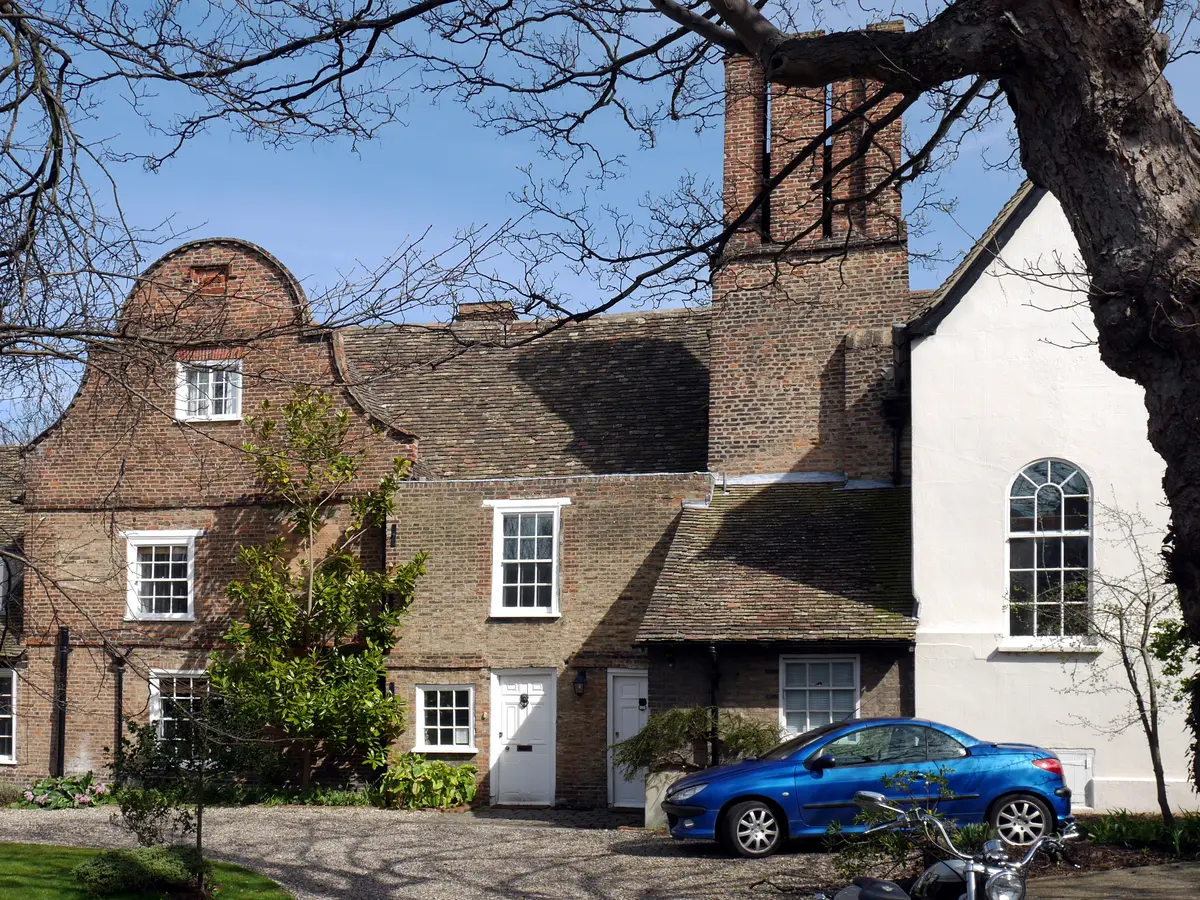
The Royal Commission dates its oldest, timber-framed part to the late sixteenth century, with a brick addition of 1678 under a dated gable and a refit of about 1700; stones from the priory survive in its walls, hall floor and garden. Its name as Cambridge's most haunted house dates from the tenancy of J. C. Lawson of Pembroke College, who moved in in October 1903: his household and others reported a nun in a dark robe and ghostly animals in the garden, and in the 1920s the owner's wife a disembodied head. The astronomer F. J. M. Stratton kept the accounts in a file that passed to the Society for Psychical Research in 1961, and local legend ties the nun to St Radegund's priory, closed in 1496. Lord Fairhaven gave the house away at the end of the Second World War; since 2002 it has belonged to the Buddhist organisation now called Triratna, whose community lives there and opens it on heritage open days.
What is the history of Abbey House, Cambridge?
Abbey House stands at the corner of Abbey Road and Beche Road in Barnwell, east Cambridge, on ground that belonged to Barnwell Priory. According to the Victoria County History (vol. 2, 1948), Picot, sheriff of Cambridgeshire at the time of Domesday, settled six canons at a church of St Giles by Cambridge Castle about 1092; Pain Peverel obtained for them a site by a holy well on the royal common of Chesterton, which they took possession of in 1112, and Prior Jonas Badcock surrendered the house on 8 November 1538. The Royal Commission's survey of the city (1959) found that the old boundary wall running from the house towards Beche Road is built for much of its length on fifteenth-century walling, "probably part of the precinct wall of Barnwell priory", and that the only surviving building of the priory, a single vaulted chamber at the corner of Priory Road and Beche Road owned by the Cambridge Antiquarian Society since 1886, stands some 30 yards to the north. The garden holds wrought stones from the priory, among them twelfth-century voussoirs with chevron ornament, and two medieval carved heads are set in the wall beside the gateway.
The same survey (monument 270) reads the house as the work of three periods. The original timber-framed, T-shaped house of the late sixteenth century forms the south half; in 1678 a brick addition almost doubled it on the north, under the dated "Dutch" gable; about 1700 the old part was faced in brick and the rooms refitted with bolection-moulded panelling. The hall is paved with flagstones brought from the priory ruins by a Mr Bullen before 1812. Historic England listed the house at Grade II on 26 April 1950 as "C17, perhaps containing parts of earlier date" and "said to contain a fragment of the old Priory". Wikipedia, citing Westwood and Simpson, names Alexander Butler as the builder, and says the barrister Jacob Butler inherited the house in 1714, with land that hosted Stourbridge Fair, and lost it in a lawsuit before his death in 1765.
J. C. Lawson of Pembroke College and his family moved into the house, then called "The Old Abbey", in October 1903, according to Andrew MacKenzie's study for the Society for Psychical Research (1982). The reports that made its name date from their tenancy. Westwood and Simpson, as cited by Wikipedia, say that from 1907 Lawson and others saw a nun wrapped in a dark robe who stood sighing at the foot of Mrs Lawson's bed during a long illness; Peter Underwood adds ghostly animals in the garden, a red squirrel and a large hare, and a disembodied female head that Mrs Ascham, the owner's wife, saw at the foot of her bed in the 1920s. The accounts run through that decade, when, according to Peter Underwood as cited by Wikipedia, the astronomer F. J. M. Stratton rented it for a month; MacKenzie's chapter later records the long lease taken by Professor Peter Danckwerts on two of the three dwellings into which the house had been divided.
Lord Fairhaven of Anglesey Abbey gave the house away at the end of the Second World War: to the Cambridge Folk Museum in 1946, according to the Royal Commission, or to the people of Cambridge in 1945, according to the Cambridge News. The museum let it until 1973, when the city council took it over, and private tenants lived there until the last leaseholder died in 2001. In August 2002 the Cambridge News reported that the council had chosen a buyer for the house, offered at £700,000, under a contract clause requiring it to be opened to the public. According to Wikipedia the buyer was the Friends of the Western Buddhist Order, now the Triratna Buddhist Community, and the Heritage Open Days listing of 2025 describes the house as home to a Triratna community.
Timeline: the documented record of Abbey House, Cambridge
- c.1092 Picot, sheriff of Cambridgeshire, settles six canons at a church of St Giles by Cambridge Castle; the community takes possession of its Barnwell site in 1112.
- 1496 Henry VII licenses Bishop Alcock to expel the last nuns of St Radegund's priory and found Jesus College on its site.
- 8 November 1538 Prior Jonas Badcock surrenders Barnwell Priory.
- Late 16th century The original timber-framed, T-shaped house, now the south half of Abbey House, is built.
- 1678 A brick addition almost doubles the house on the north side; its shaped gable bears the date 1678.
- October 1903 The family of J. C. Lawson of Pembroke College moves into the house, then called "The Old Abbey"; the reports that made its name begin during their tenancy.
- 1946 Lord Fairhaven gives the house to the Cambridge Folk Museum.
- 26 April 1950 Abbey House is listed at Grade II.
- 1961 After the death of the astronomer F. J. M. Stratton, his file on Abbey House passes to the Society for Psychical Research.
- 2002 The city council sells the house to the Friends of the Western Buddhist Order, who agree in the contract to open it to the public.
Is there a rational explanation for Abbey House, Cambridge?
The haunting rests on first-hand accounts that were collected privately. MacKenzie, who wrote it up for the Society for Psychical Research in 1982, says Stratton, later President of the Society, "only once referred to Abbey House in print and then not by name", and that after Stratton's death in 1961 "his file on Abbey House was passed to the Society". The published versions disagree on dates: MacKenzie has the Lawsons arriving in October 1903, Westwood and Simpson, as cited by Wikipedia, give 1904 to 1910, and the Cambridge News of 2002 placed their tenancy in "the late 1800s".
The nun's backstory is, in MacKenzie's words, a "local legend" that "connects the phantom nun of Abbey House with a bricked-up opening". Its two religious houses closed well before the oldest part of the present house was built. The Victoria County History records that by 1496 St Radegund's nunnery was down to two nuns, "of whom one is elsewhere professed and the other is of ill-fame", and that Henry VII licensed Bishop Alcock to expel them and found Jesus College on the site; Barnwell was surrendered in 1538; the Royal Commission dates the earliest fabric of Abbey House to the late sixteenth century. The site itself carries the priory into the house: medieval ashlar in the plinths of the eighteenth-century additions, flagstones from the ruins in the hall, carved stones in the garden.
The most recent report in MacKenzie's chapter came from the occupants at the time, Professor and Mrs Danckwerts. The Buddhist community that has owned the house since 2002 shows the ghosts as part of its history: the Heritage Open Days listing for 13 September 2025 described guided tours "spiced with stories of ghosts and former owners".
Can you visit Abbey House, Cambridge?
Abbey House is at Abbey Road, Cambridge CB5 8HQ, on the corner with Beche Road just east of the roundabout where Elizabeth Way meets Newmarket Road; the Historic England list entry (1331811) gives grid reference TL 46216 58920. The Royal Commission placed it about 17 yards east of Abbey Road. It is the home of a Triratna Buddhist community.
The house opens on heritage open days. The Heritage Open Days listing for Saturday 13 September 2025, organised by Open Cambridge and read on 4 October 2026, gave opening from 12:00 to 16:00 with guided tours of the house and grounds, the last starting at 15:30, no advance booking, tea in the walled garden and a small exhibition of historic maps. When the city council sold the house in 2002, the Cambridge News reported that the buyers were willing to admit visitors by prior appointment and were talking of open days. The only surviving building of Barnwell Priory, a vaulted chamber at the corner of Priory Road and Beche Road, stands about 30 yards to the north.
Sources consulted
- Historic England, «Abbey House, Cambridge» — National Heritage List for England, 1950 archive
- Wikipedia, «Abbey House, Cambridge» — Online encyclopedia, 2026 web
- British History Online, «Barnwell Priory» — Victoria County History, 1948 archive
- Royal Commission on Historical Monuments (England), «An Inventory of the Historical Monuments in the City of Cambridge: (270) Abbey House» — London: HMSO, 1959, pp. 366-367 (British History Online), 1959 archive
- Nik Shelton, «'Haunted house' to be opened» — Cambridge News, 2002 (Wayback Machine capture of 23 September 2015), 2002 newspaper archive
- Andrew MacKenzie, «Hauntings and Apparitions, chapter 13: Abbey House, Cambridge» — London: Granada for the Society for Psychical Research, 1983 (first published 1982; lending copy read through the Internet Archive full-text index), 1983 book
- Heritage Open Days / Open Cambridge, «Abbey House Open Day (13 September 2025)» — heritageopendays.org.uk (read 4 October 2026), 2025 web
- British History Online, «Houses of Benedictine nuns: Priory of St Radegund, Cambridge» — Victoria County History, Cambridgeshire, vol. 2, pp. 218-219, 1948 archive
Reviewed by V. Serrano on 2026-08-21 · How we verify our content
💬 Field testimonies (0)
No testimonies yet. Add the first.
Add your testimony
🔒 Log in to add a testimony