👻 HAUNTED PLACE · EXP. Nº9476
ACTIVE
Ackergill Tower
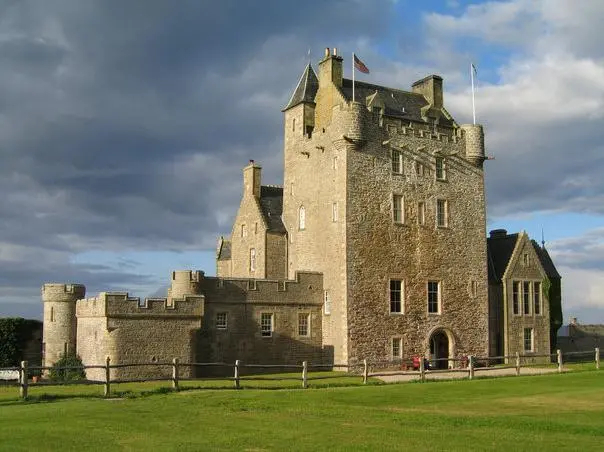
Ackergill Tower stands on the shore of Sinclair's Bay, two and a half miles north of Wick in Caithness: a five-storey oblong tower house of about 1500, listed Category A, whose battlements and cap-house were rebuilt by the architect David Bryce in 1851-52.
Where is Ackergill Tower?
- Location
- Caithness, Highland, Scotland, United Kingdom
- Type
- Castle
- Coordinates
- 58.475, -3.111
- Last updated
LOCATION
Why is Ackergill Tower said to be haunted?
It is known for Helen Gunn, the "Beauty of Braemore", who in the earliest telling anyone here has been able to read - James T. Calder's history of Caithness, Glasgow, 1861 - was seized on her wedding eve by Dugald Keith, factor to the Keiths of Ackergill, held prisoner in the tower and threw herself from its parapet. Calder gives no year for it, names no witness and reports no ghost; in roughly 109,000 words he never uses the word ghost at all. The apparition, described since as green, red or white, cannot be traced back beyond the tower's career as a luxury venue - and that career is over. The hotel closed on 15 December 2018, Highland Council approved its change of use to a private house on 22 January 2019, and it was bought by the American philanthropist Dr Betsee Parker. There is no public access and the official website is gone.
What is the history of Ackergill Tower?
Ackergill Tower is a five-storey oblong tower house on the low shore of Sinclair's Bay, about two and a half miles north of Wick. The surveyors of the Royal Commission on the Ancient and Historical Monuments of Scotland, who visited in 1910, described it as "a massive rectangular keep, built about 1500 and still occupied", forty-eight feet by thirty-four, with walls some ten feet thick and a draw-well twenty-four feet deep inside it. Historic Environment Scotland, which listed the tower Category A on 13 April 1971, puts it in the late fifteenth or early sixteenth century and notes that the castle appears in the record by 1538.
The lands came to the Keiths, Earls Marischal, from the Cheyne family by marriage around 1350. The tower itself is first named in 1510, when it is said to be captained by Gilbert Mowat of Brabstermyre. In 1538 James V granted the castle and half the lands to William, Earl Marischal, and Lady Margaret Keith; in 1547 the Queen Regent had to grant a remission to George, Earl of Caithness, for "their treasonable taking and holding of the castle" and for seizing Alexander Keith. Ackergill was fought over for another century — the Sinclairs held it, the Keiths took it back by night with ladders, Sir Robert Gordon took its keys in the king's name, Cromwellian troops garrisoned it in 1651 — until the Dunbars of Hempriggs acquired it and held it for nearly three hundred years.
The Helen Gunn story belongs to the beginning of that history, and comes to us through one man. James T. Calder, a Caithness schoolmaster, printed it in Glasgow in 1861 in his Sketch of the Civil and Traditional History of Caithness. Lachlan Gunn, "a small proprietor in Braemore", had an only daughter, Helen, "particularly distinguished for her good looks, and was called the 'Beauty of Braemore'". She was to marry her cousin Alexander Gunn. Dugald Keith — Calder is precise, and later retellings are not: "a retainer of Keith of Ackergill, and who acted as factor on his property in Caithness" — made her a dishonourable proposal, was refused, mustered a party of Keiths, surrounded Lachlan's house on the wedding eve and killed most of the Gunns gathered there. Helen was carried to Ackergill, "where she was kept a prisoner, and became the victim of the brutal and licentious Keith". She could not endure her situation: "Like another Lucretia, she resolved on self-destruction; and having found an opportunity one evening when the keepers were off their guard, she ascended to the top of the tower, and threw herself headlong from the battlements."
Calder gives no year for any of it. The first date he prints afterwards is 1426, for a battle at Harpsdale; then 1438 for Tannach, where Keith of Ackergill called in Angus Mackay against the Gunns; then 1464 for the massacre at the Chapel of St Tayre, halfway between Ackergill and Castle Sinclair Girnigoe, where the Keiths came with twenty-four men on twelve horses and killed Crowner George Gunn at prayer. For that last episode Calder cites Sir Robert Gordon, who recorded that the blood was still on the chapel walls in his own day. He cites nobody at all for the abduction.
Between Calder's book and the tower we see today stands the architect David Bryce. In 1851-52 he remodelled Ackergill for the Dunbars: the top storey, cap-house and battlements were renewed, the windows and doors enlarged, a dining room panelled in oak, a stable range built. A print dated 1821, hanging in the tower when Ordnance Survey staff called in 1982, showed a crenellated tower of four storeys with no cap-house at all.
The modern chapter is short and documented. A company called Ackergill Limited was registered on 10 October 1986 with hotels as its business; by 2003 a guest was photographing his own wedding on the lawn. AmaZing Venues, owned by the bed retailer Mike Clare, bought the tower in 2009. On 5 January 2014 a fire that began in the cellar gutted it and smoked the whole castle; the police treated the cause as suspicious, a million pounds was spent, and it reopened in April with Jack Nicholson and Michael Douglas among the names its managers liked to drop. On Friday 14 December 2018 about thirty-one staff were called to an emergency meeting and told the hotel was closing. Three days earlier an application had gone to Highland Council to turn it into a house; on 22 January 2019 the council approved it, and Dr Betsee Parker, an American Episcopalian minister and philanthropist, bought Ackergill as a private holiday home.
Timeline: the documented record of Ackergill Tower
- c. 1350-1354 The Ackergill lands pass from the Cheyne family to the Keiths, Earls Marischal, by marriage. Historic Environment Scotland dates the transfer to about 1350 and the RCAHMS inventory to 1354; the two authorities are four years apart and neither cites a charter.
- 1426 Calder's first dated event after the abduction: a battle at Harpsdale, in the parish of Halkirk, between the Gunns and the Mackays of Strathnaver. The abduction of Helen Gunn is narrated immediately before it, as the origin of the Gunn-Keith feud, with no year of its own.
- 1438 Battle of Tannach, three miles from Wick: Keith of Ackergill, doubting his own strength, calls in Angus Mackay and defeats the Gunns.
- 1464 The massacre at the Chapel of St Tayre, halfway between Ackergill and Castle Sinclair Girnigoe: the Keiths arrive with two men on each of their twelve horses and kill Crowner George Gunn and his party at prayer. Calder dates it 1464 and credits the account to Sir Robert Gordon, who wrote that the blood was still visible on the chapel walls in his own time.
- 1510 The tower first appears on record, captained by Gilbert Mowat of Brabstermyre. The RCAHMS surveyors, who visited in 1910, date the building itself to about 1500.
- 1538 James V grants the castle and half the lands of Ackergill to William, Earl Marischal, and his wife Lady Margaret Keith. Calder takes the grant from the Origines Parochiales Scotiae, vol. II part II; Historic Environment Scotland gives the same year as the first appearance of the castle in the record.
- 1547 The Queen Regent grants a remission to George, Earl of Caithness, and others for their treasonable taking and holding of the castle belonging to William, Earl Marischal, and for their treasonable taking of Alexander Keith.
- 1651-1652 Cromwellian troops garrison the tower; Calder prints entries from the Canisbay kirk session records of March 1652 about soldiers stationed in the parish.
- 1699 The Dunbars of Hempriggs acquire Ackergill. Historic Environment Scotland gives 1699; the RCAHMS entry says only that by 1726 the tower had come into Dunbar hands.
- 1821 A print then hanging inside the tower, dated 1821, shows a crenellated tower of FOUR storeys, without cap-house and without the modern wings. Ordnance Survey field staff recorded it on 18 September 1982.
- 1851-1852 The architect David Bryce remodels Ackergill for the Dunbars: the top storey, cap-house and battlements are renewed, the windows and doors enlarged, the dining room panelled, and the stable range built. The parapet visible in every photograph of the tower, including ours, is this work.
- 1861 James T. Calder prints the story of Helen Gunn in Glasgow, in a book dedicated to Sir George Dunbar of Hempriggs, then the owner of Ackergill, nine years after Bryce finished the battlements. This is the earliest telling of the abduction that this article has been able to read. It carries no date for the event and no ghost.
- 10 October 1986 Ackergill Limited is incorporated at Companies House with hotels as its stated business, the registry trace of the sale of the tower out of the Dunbar family and of its conversion into a hospitality venue. The company was later renamed Amazing Retreats Scotland Ltd and dissolved in 2012.
- 2003 A guest photographs the tower at his own wedding there and later releases the image into the public domain; it is the photograph this article uses. It is also the oldest first-hand, dated evidence located here that Ackergill was already a wedding venue, eleven years before the date usually given.
- 5 January 2014 A fire that started in the cellar destroys it and leaves smoke damage throughout the castle; the police treat the cause as suspicious. AmaZing Venues, which had bought the tower in 2009, spends a million pounds on repairs and reopens in April 2014 - the date later miscopied as the start of its tenure.
- 14 December 2018 The hotel shuts. About thirty-one workers are told at an emergency staff meeting; chief executive Suzanne Hurndall calls it a seasonal closure with a reopening set for 1 March, councillor Nicola Sinclair calls it 'a shameful decision by the owners', and a change-of-use application had been lodged with Highland Council three days earlier. It never reopened.
- 22 January 2019 Highland Council approves the change of use from hotel to private house, and the American Episcopalian minister and philanthropist Dr Betsee Parker buys Ackergill as a holiday home. In January 2021 she gave 40,000 pounds to the Wick charity Pulteneytown People's Project and 10,000 to the Episcopal diocese of Moray, Ross and Caithness.
- 6 October 2020 Amazing Venues Ltd is dissolved. Its last accounts, for the year to 31 December 2018, were filed as those of a dormant company. The tower's website, ackergilltower.co.uk, had been serving a default server page since October 2019 and a domain-parking page by 2021; the domain no longer resolves.
Is there a rational explanation for Ackergill Tower?
Three checks, all of them cheap, take most of the weight out of the version this article used to carry.
The first is arithmetic. Calder places the abduction as the origin of the Gunn-Keith feud and the first date he prints after it is 1426. The tower is dated to about 1500 by the RCAHMS surveyors, to the late fifteenth or early sixteenth century by Historic Environment Scotland, first named in a document in 1510 and first granted by charter in 1538. On the sources' own numbers, the building Helen Gunn is said to have jumped from was raised something like three quarters of a century after the event. Calder himself noticed the difficulty and dealt with it by not measuring: "It is not known when this formidable stronghold was erected, but it cannot be less than from four to five hundred years old" — which, written in 1861, means anywhere from 1361 to 1461, a span chosen wide enough to hold his own story and accepted by no architectural authority since.
The second is the parapet. RCAHMS: "Top storey, with its cope-house and battlements, was renewed in mid-19th century, when tower's windows and doors were also enlarged." Historic Environment Scotland names the architect and the years: David Bryce, 1851-52. And a print dated 1821, still hanging inside the tower when Ordnance Survey staff called in 1982, showed a crenellated tower of four storeys with no cap-house. The battlements in every photograph of Ackergill, this article's included, were finished about nine years before Calder printed the story, in a rebuilding paid for by the family to whom he dedicated the book.
The third is the ghost, and it is the largest gap. Calder's book runs to roughly 109,000 words, uses the word "tradition" 272 times, "superstition" and its relatives 14 times, "fairy" or "fairies" eight, and tells a full supernatural legend, the Piper of the Windy Ha'. In that whole volume the words ghost, spectre, apparition, phantom and wraith appear zero times; "haunt" appears three times and never means a revenant. He gives Ackergill five pages, tells the Helen Gunn story in full, and even records a separate Ackergill tradition — a black servant drowned in the draw-well, after which it was sealed — and reports no apparition at all. That is a silence measured in a corpus that demonstrably records the supernatural when it finds it.
What the ghost does have is a commercial address. The colour of the lady is not stable: the standard modern reference, Martin Coventry's Castles of Scotland, makes her a Green Lady; ghost-tourism sites offer "either as a green lady, or as a lady in a long red ball gown with tall black hair"; this article used to say white. Three incompatible descriptions, no witness attached to any of them.
There is one first-hand account that can be named and dated, and it does not describe a lady at all. The food writer Elizabeth Atia published on 25 January 2013 that during a stay in 2004 she woke twice in the night to the sound of a drum, "loud and clear as day, a sound not unlike that of an executioner's drum roll" — and she says plainly that she cannot tell whether she heard something or dreamed vividly. She adds that a woman who had worked at the tower in 2004 told her Ackergill was "reputedly haunted by several different ghosts, although it is not something they particularly want to advertise". That last remark is consistent with what the venue's own website looks like from outside: the Wayback Machine's index holds 679 captures of ackergilltower.co.uk between 2006 and 2022, and in the years when the site still had content, 2006 to 2013, those captures cover 191 distinct addresses. Not one of those 191 addresses contains the words ghost, haunted, legend, Helen or Gunn. The replay service was returning errors throughout this research, so that is a measurement of the site's addresses, not of the text on its pages, and it is offered as such.
Can you visit Ackergill Tower?
Ackergill Tower is a private house. The hotel that occupied it closed without notice in December 2018: the Press and Journal reported on Saturday 15 December that about 40 employees had been called to an emergency meeting "yesterday morning", Friday the 14th, and told that the venue was closing immediately. On 30 January 2019 the same paper reported that Highland Council had approved the change of use from hotel to private home sought on behalf of Dr Betsee Parker, an American Episcopalian minister, and quoted the council's report: "Residential use is considered appropriate for the building because it re-establishes its original purpose and ensures its continued occupation and subsequent upkeep." The Scotsman reported on 1 February 2019 that Parker had lodged the application on 11 December and that the change of use was approved on 22 January. The John O'Groat Journal wrote in January 2021 that Parker had bought the tower in early 2019 and lived in Virginia.
Companies House records that Amazing Venues Ltd, incorporated in 2012 as Clares Beds Limited, filed accounts for a dormant company for the year to 31 December 2018, applied to be struck off on 17 April 2020 and was dissolved on 6 October 2020. The hotel's website, ackergilltower.co.uk, appears in the Wayback Machine as a server's default page from 14 October 2019 and as a domain-parking script from November 2021. On 24 September 2026 a DNS lookup for the domain returned no address, while the same lookup for bbc.co.uk did.
The tower stands on the south side of Sinclair's Bay, about 3.8 km (2.4 miles) north-north-west of the centre of Wick in a straight line from the town's point in OpenStreetMap; the hotel's own contact page, captured in 2009, gave the postcode KW1 4RG. Historic Environment Scotland lists it at Category A (LB14072, added on 13 April 1971) at national grid reference ND 35284 54669, and the listing covers the garden walls, the walled gardens and the stable range that David Bryce built in 1851-52. The Highland Historic Environment Record (MHG418) dates the two lean-to dovecots south of the tower to the eighteenth century. Access rights under the Land Reform (Scotland) Act 2003 do not extend to the ground a house needs for privacy, so the building is seen from the shore of the bay. Calder placed the Chapel of St Tayre, where the Keiths killed the Gunns at prayer, halfway between Ackergill and Castle Sinclair Girnigoe, and wrote in 1861 that "not a vestige now remains".
Sources consulted
- James T. Calder, «Sketch of the Civil and Traditional History of Caithness, from the Tenth Century (chap. V, pp. 81-86)» — Glasgow: Thomas Murray and Son, 1861 book
- Royal Commission on the Ancient and Historical Monuments of Scotland / Highland Historic Environment Record, «Keep, Ackergill Tower (MHG418) - reproduces the RCAHMS Inventory of Caithness entry ND35SE 16.00, visited 1910» — Highland HER, 1911 report
- Historic Environment Scotland, «Ackergill Tower, Garden Walls, Walled Gardens and Stable Range (LB14072), Category A, listed 13 April 1971» — Designations portal, 1971 report
- Companies House, «ACKERGILL LIMITED, later AMAZING RETREATS SCOTLAND LTD (company 02063424): incorporated 10 October 1986, SIC 5510 hotels, dissolved 14 August 2012» — UK register of companies, 2012 archive
- Companies House, «AMAZING VENUES LTD (company 08188616): incorporated 22 August 2012 as Clares Beds Limited, dormant accounts to 31 December 2018, struck off, dissolved 6 October 2020» — UK register of companies, 2020 archive
- John O'Groat Journal staff, «Ackergill set to reopen after GBP 1m refurbishment» — John O'Groat Journal, 2014 newspaper archive
- John O'Groat Journal staff, «'Shafted', shocked and angry over shutdown» — John O'Groat Journal, 2018 newspaper archive
- John O'Groat Journal staff, «Ackergill Tower owner's GBP 40,000 gift to Pulteneytown People's Project» — John O'Groat Journal, 2021 newspaper archive
- Elizabeth Atia, «A Story of Porridge, a Scottish Castle and a Ghost» — Elizabeth's Kitchen Diary, 2013 web
- LeeNapier, «File:Ackergill.JPG - 'Ackergill Castle, circa 2003. This is a picture taken by me at my wedding at Ackergill Castle in 2003'» — Wikimedia Commons (first uploaded to English Wikipedia, 10 April 2007), 2007 archive
- Martin Coventry, «Ackergill Tower» — The Castles of Scotland (Goblinshead), 2015 web
- Internet Archive, «Capture index for ackergilltower.co.uk (679 captures, 2006-2022)» — Wayback Machine CDX index, 2026 archive
- Ben Hendry, «Luxury north hotel shut down as plans to turn it into holiday home for rich American take shape» — The Press and Journal, 15 December 2018 (Internet Archive capture of 19 October 2021), 2018 newspaper archive
- Ben Hendry, «Ackergill Tower finished as hotel as council grants American millionaire permission to use it as holiday home» — The Press and Journal, 30 January 2019 (Internet Archive capture of 8 October 2021), 2019 newspaper archive
- Alison Campsie, «Millionaire American minister buys 15th century Highland castle (application lodged 11 December 2018, change of use approved 22 January 2019)» — The Scotsman, 1 February 2019 (Internet Archive capture of 7 November 2020), 2019 newspaper archive
Reviewed by V. Serrano on 2026-08-17 · How we verify our content
💬 Field testimonies (0)
No testimonies yet. Add the first.
Add your testimony
🔒 Log in to add a testimony