👻 HAUNTED PLACE · EXP. Nº9475
ACTIVE
Ballygally Castle
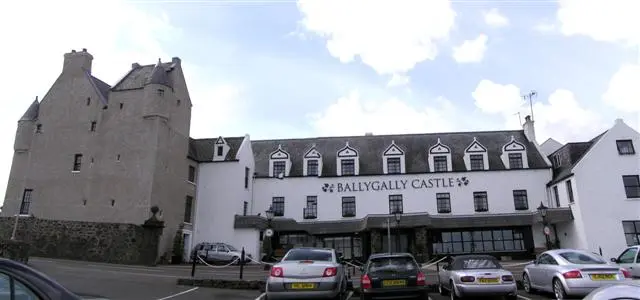
Ballygally Castle stands on the Antrim coast road three miles north of Larne, and the date cut over its old doorway settles both its age and its builders: 1625, above the motto GODIS PROVIDENS IS MY INHERITANS and a shield bearing the initials I.S. and I.B. — James Shaw, a younger son of the lairds of Greenock, and his wife Isabella Brisbane.
Where is Ballygally Castle?
- Location
- Northern Ireland, United Kingdom
- Type
- Castle
- Coordinates
- 54.899, -5.861
- Last updated
LOCATION
Why is Ballygally Castle said to be haunted?
It has been a hotel since 1938 and has belonged to Hastings Hotels since 1966. The hotel tells guests that Isabella was shut in a turret room by her husband and fell to her death from the window, and it keeps a Ghost Room at the top of the spiral stair. That story is absent from the castle's fullest history, written in 1884 by the Rev Classon Porter while his own family was living in the building. Porter records a different ghost altogether — Madam Nixon, an eighteenth-century widow who was said to walk the passages in a silk dress and knock on bedroom doors — and notes that even she had stopped being heard of.
What is the history of Ballygally Castle?
The age of Ballygally Castle is not a matter of opinion: it is cut in stone over the old entrance doorway. When the Rev Classon Porter wrote the castle's history he copied the inscription exactly — "1625. GODIS . PROVIDENS . IS . MY INHERITANS" — and described the armorial escutcheon above it, which carries the letters I.S. and I.B. and the arms of two families. Those are the initials of James Shaw, who built the castle, and of Isabella Brisbane, his wife. The stones, Porter noted, were mostly local, not shipped from Scotland as tradition claimed, and 1625 was probably the year the work was finished rather than begun.
James Shaw was a younger son of the lairds of Greenock. Like many Scottish cadets he came to Ireland to make his fortune, arriving about 1606 and settling first on the County Down lands of his brother-in-law Sir Hugh Montgomery of Braidstane. Within a few years he moved north to the parish of Cairncastle, between Larne and Glenarm, where he held land not from the Crown but as a freeholder under Randal MacDonnell, Earl of Antrim. The surviving grants are dated 21 February 1621, 1 February 1634 — eighteen score acres in Ballygellie, Tarnemoney, Nogher, Carncaslen and Corcermain, in fee farm at twenty-four pounds a year — and 8 August 1637. No grant survives for the year the castle was built.
What went up was a Scottish tower house on the French chateau model: high walls about five feet thick pierced with loopholes for musketry, a steep roof, dormer windows and cone-topped corner turrets. The stairs inside were stone and spiral, and an open stream of water ran through the outer hall so that the household could withstand a siege. Two walled courtyards enclosed it, one inside the other, running to the sea at either end, with stables, byres, a brew-house and a dovecot inside them and a corn mill in the glen across the river. Porter could still point to the gate pillars of both courtyards in 1884, and noted that one of them had been knocked down to make way for the shore road.
The defences were used. When the rising of 1641 broke out, Shaw shut his gates and took in his servants, tenants and neighbours; called away to Scotland that Christmas, he left the little garrison under his agent James Cromie of the Droagh. An Irish garrison at Glenarm tried repeatedly and never got in. Porter records, from an official document of the period, what happened to some who were sheltering there: the two sons and the daughter of John Jamieson of Ballygawn were sent to a barn for corn and were ridden down by six horsemen; one boy escaped by swimming a river, the other was hanged over Glenarm bridge and his sister held prisoner for weeks. A boy named William Hunter was drowned, held under with pikes. The Ballygally garrison rode out on reprisals of the same kind. Shaw's own son, Captain John Shaw, was away with his regiment at the siege of Antrim; his daughter Eleanor had married Captain John Agnew of Kilwaughter.
Towards the middle of the eighteenth century the castle filled up. Squire Henry Shaw had married a Miss Hamilton, of the family of Sir John Hamilton of Donemana in County Tyrone. Two of her sisters, both widowed and childless — one had been married to the last Lord Slane, the other to a Nixon of County Fermanagh — came to live with her, bringing their servants. A new block was built at the west corner and joined to the castle by a passage; it was known as "the new room" or "Madam Nixon's room". A well outside the entrance was called My Lady's Well after Lady Slane, and another at the foot of Ballygally hill was called Madam Nixon's Well. In the same years the Larne educational reformer David Manson lived at the castle as tutor to the Shaw children, and a room was long called after him.
The family's ruin came from a lawsuit, not a ghost. John Shaw, childless, had adopted his nephew Henry as heir. Shaw's brother-in-law Dr M'Cullough of Larne turned him against the boy, took him to Larne where he fell ill, kept his relatives from seeing him, and after five or six weeks rode out and seized the castle. Only then did it emerge that John Shaw was dead and had been buried at midnight in Cairncastle churchyard. M'Cullough produced a will leaving him everything, installed a seneschal who watched a window with a loaded blunderbuss, and sold perpetual leases cheaply to fund his defence. The case came to trial at Carrickfergus in 1790; Henry Shaw accepted a compromise against his counsel's advice, paid M'Cullough 4,000 pounds and got back an estate halved in value. Henry died in 1799. His son William, the last Squire of Ballygally, sold the property in 1820 for 15,400 pounds to Jones Agnew of Kilwaughter. The castle then served for several years as a coastguard station, and by 1884 it was occupied by the widow and family of Classon Porter himself.
The first hotel opened in 1938, after the Earl of Antrim bought the place. In the early 1950s the textile millionaire Cyril Lord took it over and refitted it, and in 1966 Sir William Hastings bought it from him for 40,000 pounds. It has been a Hastings hotel ever since: four-star status from the Northern Ireland Tourist Board in 2007 after a three-million-pound programme, a further extension in 2014 that added ten Coastal Deluxe bedrooms and the Kintyre Ballroom, and a 400,000-pound refurbishment announced in March 2025 for the castle's four hundredth anniversary.
Timeline: the documented record of Ballygally Castle
- c. 1606 James Shaw, a younger son of the lairds of Greenock, settles in Ireland, first on his brother-in-law Sir Hugh Montgomery's lands in County Down and then in the parish of Cairncastle, County Antrim.
- 1625 The date cut over the entrance — GODIS PROVIDENS IS MY INHERITANS — with an escutcheon bearing the initials I.S. and I.B. for James Shaw and Isabella Brisbane. Porter read it as the year the work was completed.
- 1 February 1634 The Earl of Antrim grants John Shaw the elder of Ballygellie eighteen score acres in fee farm at twenty-four pounds a year. Further grants are dated 1621 and 1637; none survives for the year of building.
- 1641-42 Shaw shuts the gates against the rising and shelters tenants and neighbours, leaving his agent James Cromie in charge. The Irish garrison at Glenarm never gets in, but kills two children of families sheltering there. Shaw's son, Captain John Shaw, is away with his regiment.
- 1657 James Shaw of Ballygally marries his cousin Elizabeth Brisbane, takes her name and inherits the Brisbane estate in Ayrshire — the line that produced Sir Thomas Makdougall Brisbane.
- mid-18th century Squire Henry Shaw's widowed sisters-in-law, Lady Slane and Mrs Nixon of County Fermanagh, come to live at the castle. A new block is built for them, known as 'the new room' or 'Madam Nixon's room'; two local wells are named after the two ladies.
- 1790 The suit against Dr M'Cullough, who had seized the castle after John Shaw's death and midnight burial, comes to trial at Carrickfergus. Henry Shaw settles, pays 4,000 pounds and recovers an estate stripped of half its rental.
- 1820 William Shaw, the last Squire of Ballygally, sells the estate for 15,400 pounds to Jones Agnew of Kilwaughter. The castle is afterwards used for several years as a coastguard station.
- 1884 The Rev Classon Porter, whose family is then living in the castle, publishes its history in the Larne Reporter. The only haunting he records is Madam Nixon's — silk dress, knocking on doors — and he adds that she has not been heard of latterly. Isabella's ghost does not appear.
- April 1901 Porter's article is reprinted, edited by Francis Joseph Bigger, in the Ulster Journal of Archaeology, which is why the 1884 text is still readable today.
- 1938 The Earl of Antrim buys the castle and opens the first hotel there — twelve years before the date the hotel's own history page gives for its conversion.
- 1966 Sir William Hastings buys Ballygally Castle Hotel from the textile millionaire Cyril Lord for 40,000 pounds. It has been a Hastings hotel ever since.
- 2004 Jeff Belanger opens The World's Most Haunted Places with a chapter on Ballygally Castle Hotel, carrying the Lady Isabella story to an international readership.
- 29 September 2008 The earliest archived Hastings page for the hotel already advertises it as 'reputedly haunted by a friendly ghost' with a 'ghost room' in one of the towers.
- 4 November 2016 The hotel's ghost page states that Lord Shaw wanted a son and that 'when his wife delivered his heir, he snatched the baby from his wife and locked her in a room at the top of the castle'. By 2026 the hotel's ghost page reprints a 2021 post from the Belfast Entries blog in which she gives birth to a daughter.
- March 2025 Hastings Hotels announces a 400,000-pound refurbishment for the castle's four hundredth anniversary, including a private dining space named the 1625 Room. Chairman Howard Hastings calls it 'the jewel in the crown of Hastings Hotels'.
Is there a rational explanation for Ballygally Castle?
The story the hotel tells — that Lord James Shaw locked his wife in a turret because she failed to give him a son, and that she fell to her death from the window — has one very awkward witness against it. Classon Porter wrote the fullest history of the castle in 1884, while his own family lived in the building, and it was reprinted in the Ulster Journal of Archaeology in 1901. He worked from grants, leases and family tradition, and he was not squeamish about scandal: he devotes pages to a doctor who may have poisoned a squire and buried him at midnight. He never mentions Isabella's imprisonment, her fall, or any ghost of hers.
That silence can be measured. Searching the 1901 volume for the castle gives 73 hits for Ballygally and 68 for Shaw; searching the same file for ghost gives three hits, all elsewhere in the volume (two are the Holy Ghost, one is a ballad title), and for haunt just two, one of them in an unrelated article. The single haunting Porter records at Ballygally is somebody else entirely. "Madam Nixon died at Ballygally," he writes, "and for many years it was said that she haunted the castle, walking about the passages at night, attired in a silk dress, and amusing herself by knocking at the doors of the different rooms. Latterly, the old lady has not been heard of at Ballygally."
So the oldest ghost on record here is not the builder's wife but her successors' sister-in-law, and the knocking on bedroom doors that guests now attribute to Lady Isabella was Madam Nixon's signature a century and a half ago. Madam Nixon was not a servant: she was the widow of a Nixon of County Fermanagh and sister of the squire's wife, with a wing of the castle and a roadside well named in her honour. And the man who knew the tradition best reported it as finished, not thriving.
Isabella Brisbane herself is real, which is why the legend is easy to swallow: her initials are on the 1625 escutcheon. What the record contradicts is the motive. The castle passed in the male line: by 1641 the builder had an adult son, Captain John Shaw, serving as an army officer, and a married daughter; the genealogist Chris West identifies two sons of James Shaw and Isabel Brisbane, the elder of whom married his cousin Elizabeth Brisbane in 1657 and inherited the Brisbane estate in Ayrshire — a line that produced Sir Thomas Makdougall Brisbane, after whom the Australian city is named. Porter, who traced that descent, would have had to suppress a murder in a family whose every marriage he lists. The titles are wrong too: there was never a Lord or Lady Shaw of Ballygally. The grants call them gentlemen and Porter calls them squires.
There is a precedent for an invented tradition at this exact building, and Porter records it with some heat. The castle was widely called O'Halloran's Castle in his day, after a character in a novel by James McHenry, a Larne-born writer. "Such a person as O'Halloran never had any connection with Ballygally," Porter wrote. "Of all perverts of history, historical novels have been the worst."
The commercial incentive is not hidden and is not new. By September 2008 the Hastings website was already telling visitors the castle was "reputedly haunted by a friendly ghost" and that "brave guests can visit the 'ghost room' in one of the towers". The story has also drifted in the hotel's own telling: the 2016 version of the page said that Lord Shaw wanted a son "and when his wife delivered his heir, he snatched the baby from his wife and locked her in a room at the top of the castle" — a version in which the punishment follows the birth of the son he wanted — while the page online in 2026 reprints a 2021 post from the Belfast Entries blog in which she gave birth to a daughter. A legend that changes its own premise in ten years is not being remembered; it is being written.
None of which touches what guests actually report. Knocking at night in a four-hundred-year-old tower, reached by a stone spiral stair and surrounded by an occupied hotel, is not in dispute; no published investigation of the building has ever attributed it to anything in particular.
Can you visit Ballygally Castle?
Ballygally Castle is a working hotel of 54 bedrooms, owned by Hastings Hotels since 1966, on the Coast Road at Ballygally, County Antrim, BT40 2QZ; the telephone is +44 (0)28 2858 1066. It stands on the A2 coast road facing Ballygally Bay, about 6 km (just under 4 miles) north-north-west of Larne town centre and about 34 km (21 miles) north of Belfast City Hall in a straight line. The hotel's FAQ, consulted on 23 September 2026, gives Larne as the nearest railway and bus station, about ten minutes away by bus or taxi, and describes a 70-space car park that is free for residents, with disabled parking at the front.
The core of the building is the tower house of 1625, built for James Shaw and Isabella Brisbane. Cyril Lord bought it in the early 1950s and refurbished it as a hotel, and Hastings has extended it since; the 2014 works added ten Coastal Deluxe bedrooms, a larger reception and the Kintyre Ballroom. The hotel sells no admission to the castle as a monument. Its Tower Rooms, which it bills as the oldest hotel bedrooms in Northern Ireland, open off the stone spiral staircase that rises from the original entrance. The Ghost Room is a turret room in that oldest part. The hotel's page of 2016 said it had "dedicated a bedroom to her" in one of the turrets and invited anyone who wanted "a Ghost Tour with a member of the Hotel staff" to telephone. The ghost page on the hotel's website today reprints a post from the Belfast Entries blog, whose authors remember that "in those days you had to ask for the key", and it gives no current arrangement for seeing the room.
Afternoon tea is served daily from 13:00 to 16:00 in the Lounge and has to be booked at least 24 hours ahead by telephone; on 23 September 2026 the hotel's page listed a sparkling afternoon tea at £45 and a Game of Thrones one at £36 a head. The FAQ lists two fully accessible bedrooms with wet rooms; the Tower Rooms are reached from the spiral stair.
Sources consulted
- Rev. Classon Porter (ed. Francis Joseph Bigger), «Ballygally Castle» — Ulster Journal of Archaeology, 2nd ser., vol. 7, no. 2, pp. 65-77 — reprint of an article published in the Larne Reporter in 1884, 1901 academic
- Hastings Hotels, «Ballygally Castle History» — ballygallycastlehotel.com (official site), consulted 12 August 2026, 2026 web
- P&P (Belfast Entries), «Ballygally Castle Ghost: The Friendly Ghost On The Antrim Coast» — Belfast Entries blog, 19 July 2021, reprinted on ballygallycastlehotel.com (hotel website), consulted 12 August 2026, 2021 web
- Hastings Hotels, «Ballygally Castle (hotel website), as archived 29 September 2008» — Internet Archive Wayback Machine, 2008 archive
- Hastings Hotels, «The friendly Ghost on the Antrim Coast, as archived 4 November 2016» — Internet Archive Wayback Machine, 2016 archive
- Gary McDonald, «400,000 pound upgrade for Ballygally Castle and its 'ghost room'» — The Irish News, 4 March 2025, 2025 newspaper archive
- Jeff Belanger, «The World's Most Haunted Places: From the Secret Files of Ghostvillage.com (chapter 1, Ballygally Castle Hotel)» — New Page Books, 2004 book
- Chris West, «The Shaws of Down and Antrim in the 17th Century (part 2)» — Chris West Ancestry Blog, 13 February 2018, 2018 web
- Chris West, «The later history of Ballygally» — Chris West Ancestry Blog, 10 July 2020, 2020 web
- The Irish Aesthete, «Quaint and Old-Fashioned (Ballygally Castle)» — theirishaesthete.com, 18 March 2024, 2024 web
Reviewed by V. Serrano on 2026-08-12 · How we verify our content
💬 Field testimonies (0)
No testimonies yet. Add the first.
Add your testimony
🔒 Log in to add a testimony