👻 HAUNTED PLACE · EXP. Nº9477
ACTIVE
Berry Pomeroy Castle
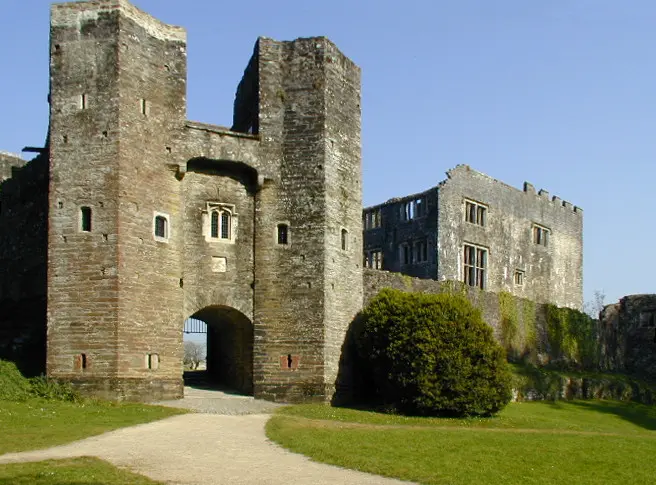
Berry Pomeroy Castle stands above a wooded limestone gorge in South Devon: a late 15th-century artillery fortress with a four-storey Elizabethan mansion built inside its walls and a vast Jacobean range beside it that was never finished.
Where is Berry Pomeroy Castle?
- Location
- Devon, England, United Kingdom
- Type
- Castle
- Coordinates
- 50.449, -3.637
- Last updated
LOCATION
Why is Berry Pomeroy Castle said to be haunted?
The Pomeroys held the manor from the Norman Conquest and sold it on 1 December 1547 to Edward Seymour, Duke of Somerset. It is famous, though, for two ghosts. The White Lady is said to be Margaret Pomeroy, starved in a tower dungeon by a jealous sister, Eleanor; the Blue Lady is said to beckon visitors towards a fatal drop. No sisters of those names appear in the family pedigree. The oldest datable printed version of the two-sisters story is a Minerva Press Gothic novel of 1806, in which the sisters are called Elinor and Matilda, and a Totnes guidebook of 1892 retold that novel as local history. The dungeon is a tower basement with a loophole, two small windows and a triple gun port. English Heritage's pages note that some people still believe the ghost stories and that the place is promoted as the most haunted castle in Devon, perhaps unfortunately.
What is the history of Berry Pomeroy Castle?
For a long time Berry Pomeroy was described as a Norman castle turned into a Tudor mansion by Protector Somerset. Excavation has taken that story apart. Between 1980 and 1996 Stewart Brown dug roughly half the site for English Heritage, and the results, published by the Devon Archaeological Society, show a fortress begun on previously unused ground in the later 15th century — some four hundred years after the family whose name it carries first arrived.
The Pomeroys came from La Pommeraye, near Falaise in Normandy. William the Conqueror granted the manor of Berri to Ralf de Pomaria, and his descendants held it for over four centuries without, as far as the archaeology can tell, building a castle on this spot at all. The castle that exists was raised in a lawless Devon during the Wars of the Roses, most likely by Henry Pomeroy, who held the manor between 1461 and 1487, or by his heir Sir Richard, whose death in 1496 produces the first documentary mention of it.
It was built for guns. The gatehouse has six gunports on the ground floor, with wide internal splays so a single piece could be swung across a broad field of fire, and the basement of St Margaret's Tower, at the south-east corner, holds a port designed for three guns of graduated sizes covering the southern approach — a design English Heritage describes as the only known example of its kind outside Germany, and one that would not reappear in England until Camber Castle in 1512–14.
On 1 December 1547 Sir Thomas Pomeroy, impoverished, sold castle, park and manor to Edward Seymour, Duke of Somerset, Lord Protector to the boy king Edward VI. Somerset was executed in January 1552 and the estate was briefly forfeit to the Crown before passing to his eldest son, Edward, Lord Seymour (1529–1593). The house the visitor sees inside the walls is the son's work: between about 1560 and 1580 he cleared the Pomeroy buildings away and put up a compact four-storey Elizabethan house within the medieval defences.
His son, Edward Seymour II, began around 1600 a Jacobean north range conceived on the scale of Longleat or Hatfield, with one of the longest galleries ever built in England and a classical loggia below a balcony. He died in 1613 with it unfinished, and it was never finished. An inventory taken in 1688, after the death of a later Sir Edward, shows the family living in an updated version of the old Elizabethan house and using the great range hardly at all.
The end was deliberate. Sir Edward Seymour, 4th Baronet (1633–1708) — Speaker of the House of Commons, and a man with a seat in Wiltshire he preferred — had the building stripped: timbers, flagstones, lead, roof tiles, window glass and dressed stone all carted off. By 1697 the Devon clergyman John Prince could write of it as demolished. The Seymours moved to Maiden Bradley, succeeded to the dukedom of Somerset in 1750, and kept the ruin. In 1734 the brothers Buck published a south view of it; by then the wreck was already a picturesque subject, and it has been one ever since.
Timeline: the documented record of Berry Pomeroy Castle
- Late 11th century William the Conqueror grants the manor of Berri to Ralf de Pomaria, a Norman knight from La Pommeraye near Falaise. His descendants hold it for more than four hundred years, but the archaeology finds no castle of theirs on this site.
- 1496 Sir Richard Pomeroy dies as owner: the first documentary mention of a castle at Berry Pomeroy. Excavation dates the fortress to the later 15th century, built on previously unused ground, probably by Henry Pomeroy (1461–87) or by Sir Richard himself.
- 1 December 1547 Sir Thomas Pomeroy, impoverished, sells the castle, park and manor to Edward Seymour, Duke of Somerset, Lord Protector to Edward VI. It is the end of the Pomeroy tenure.
- January 1552 Somerset is executed. The estate is briefly forfeit to the Crown before passing to his eldest son, Edward, Lord Seymour (1529–1593), who from about 1560 builds a four-storey Elizabethan house inside the medieval walls.
- 1613 Edward Seymour II dies with the Jacobean north range begun around 1600 still unfinished. Conceived on the scale of Longleat, with one of the longest galleries built in England, it is never completed.
- 1688 An inventory taken on the death of a later Sir Edward Seymour shows the family living in an updated version of the old Elizabethan house and barely using the great range. It is among the last records of the castle inhabited.
- By 1697 Sir Edward Seymour, 4th Baronet (1633–1708), Speaker of the House of Commons, has the castle stripped of timber, flagstones, lead, tiles, glass and dressed stone. The Devon clergyman John Prince already writes of it as demolished. The family settles at Maiden Bradley in Wiltshire.
- 1734 Samuel and Nathaniel Buck publish 'The South View of Berry-Pomery Castle'. The ruin is already a picturesque subject, and no ghost appears in the topographical literature of the period.
- 1806 William Lane's Minerva Press publishes 'The Castle of Berry Pomeroy' under the name Edward Montague: Lady Elinor de Pomeroy contrives the death of her sister Matilda, whose ghost then hounds the conspirators. It is the oldest datable printed appearance of the two-sisters plot. Two copies of the first edition are known.
- 1892 The Totnes printers T. & A. Mortimer reissue the novel and publish a guidebook, 'Berry Pomeroy Castle: An Historical and Descriptive Sketch', which retells its invented plot as fact. Emma McEvoy raises the possibility that 'Edward Montague' was a Mortimer of Totnes.
- 1915 H. Michell Whitley surveys the castle for the Devonshire Association. He describes the basement of St Margaret's Tower — the legendary dungeon — as a rock-cut chamber with a loophole, two small windows, an angle aumbry and a bracket, and mentions no ghost anywhere in the paper.
- 1927 H. R. Watkin publishes a note on Berry Pomeroy Castle in the Journal of the British Archaeological Association.
- 1990 Deryck Seymour publishes 'The Ghosts of Berry Pomeroy Castle' (Obelisk Publications), the fullest survey of the legends. He notes that the oral versions are growing more lurid, the victim now starved to death or walled up alive.
- 1980–1996 Stewart Brown excavates about half the site for English Heritage. The results, published by the Devon Archaeological Society, dismantle the Norman-castle story and date the fortress to the later 15th century.
- 2016 Emma McEvoy devotes a chapter of 'Gothic Tourism' to Berry Pomeroy, tracing the change from eighteenth-century accounts of a charming and idyllic ruin to accounts of a place overrun by spectres.
Is there a rational explanation for Berry Pomeroy Castle?
The two ladies have a short paper trail. Albert A. Pomeroy's family history of 1912 quotes an earlier description of the castle for the tradition that in the basement of St Margaret's Tower "the proud Lady Eleanor de Pomeroy confined her sister, Lady Matilda, for a lengthened period". The pedigree printed in the same book has no pair of sisters called Eleanor and Matilda, or Eleanor and Margaret. The daughters it gives for Sir Thomas Pomeroy, the last of the line to own the castle, are Jane, Elizabeth and Katharine.
The victim's name has changed with the retelling. The oldest datable printed version of the plot is a Gothic novel, The Castle of Berry Pomeroy, issued by William Lane's Minerva Press in 1806 under the name Edward Montague; in it Lady Elinor de Pomeroy contrives the death of her sister Matilda over the castle and a man, and Matilda's ghost then hounds the conspirators. The novel is scarce — two copies of the first edition are known, in the British Library and the Corvey collection — but it did not stay put. In 1892 the Totnes printers T. & A. Mortimer reissued it and also published a guidebook, Berry Pomeroy Castle: An Historical and Descriptive Sketch, which, as Emma McEvoy notes, presented the novel's invented adventure as fact; McEvoy also raises the possibility that "Edward Montague" was a Mortimer of Totnes. The 1912 family history still calls the prisoner Matilda. By 1972, in Leon Metcalfe's Discovering Ghosts, Lady Eleanor "had a sister, Margaret", which is the name most modern tellings use.
The tower had its name long before it had a prisoner. John Prince, vicar of Berry Pomeroy, wrote of "a tower called St. Margaret's, from which several gentlemen of this county antiently held their lands", in a passage that H. Michell Whitley quoted when he surveyed the castle for the Devonshire Association in 1915. Whitley described the basement of that tower as "approached by a flight of steps from the room above, mainly cut in the solid rock", with a roof "arched in rough rubble masonry" and "a loophole and two small windows, an angle aumbry, and a rude bracket in the north wall". English Heritage's statement of significance identifies the "splayed triple gunport in the basement of St Margaret's Tower", "designed for three guns of graduated sizes". Its architectural description of the castle does not use the word dungeon.
English Heritage is, in fact, the best sceptic on offer. Its published source list for Berry Pomeroy runs from record-office manuscripts, patent rolls and excavation reports to county histories, three of its own guidebooks and an anonymous Totnes history of about 1825, and it contains no book about the hauntings. Its architectural description and its statement of significance do not mention a ghost. The castle's visitor page says the ruins "inspired blood-curdling ghost stories" and that "some people still believe them", and offers an audio guide that tells some of the stories. Its history page names the 1806 novel and adds that the castle is promoted as "the most haunted castle in Devon", "perhaps unfortunately".
The account most often cited has a printed source. Dr (later Sir) Walter Farquhar is said to have met a richly dressed woman on a stair at the castle while attending the steward's sick wife. The story is in print by 1833, in Erskine Neale's Whychcotte of St. John's (London, E. Wilson), where a major's widow tells it at a fireside and says she heard it from Farquhar and gives it "as closely as may be in his own words". In Neale's text the woman has no name and no colour. The steward explains that she "is supposed to represent the daughter of a former baron of Berry Pomeroy, who bore a child to her own father" and strangled it in the room above. John Ingram's Haunted Homes and Family Traditions of Great Britain retells it in nearly the same words and credits an unnamed "authority" who "derived it from Sir Walter Farquhar". Later versions disagree about whether Farquhar saw the White Lady or the Blue one, and about which tower each lady haunts.
Can you visit Berry Pomeroy Castle?
Berry Pomeroy Castle is in the guardianship of English Heritage, at Berry Pomeroy, Totnes, Devon TQ9 6LJ; the site telephone is 01803 866618 and the charity's general line 0370 333 1181. English Heritage places it 2½ miles (4 km) east of Totnes, off the A385. The nearest railway station is Totnes, about 3½ miles (5.6 km) away, and the Country Bus 149 serves the castle.
English Heritage's 2026/27 schedule of opening times and group prices, valid from 28 March 2026 to 16 March 2027, has the castle open daily from 10:00 to 17:00 until 30 September and from 10:00 to 16:00 between 1 October and 1 November. It then closes from 2 November to 12 February, opens daily again from 13 to 21 February and at weekends only from 22 February to 16 March. The property page, consulted on 23 September 2026, gives last entry as 16:30. General admission in the same schedule, before any group discount, is £7.65, £8.50 or £9.26 for an adult according to the date band, with concessions from £6.88 and children from £3.82. Members enter free, and the charity advertises 15 per cent off tickets booked online until midnight the day before. An individual adult membership costs £84 a year; the joining page's "from £44 a year" is the rate for young adults and students aged 18 to 25.
The car park, free for castle and café visitors, has 25 to 30 spaces about 50 metres from the entrance, and coaches cannot reach the site; at busy times the overflow is in Totnes. The castle stands on a promontory above the steep-sided valley of the Gatcombe Brook. A path goes down through woodland that English Heritage does not own to the old fish ponds, with views of the ruin from below. The free audio tour tells the ghost stories alongside the history.
The ruin has no roofs: the Elizabethan mansion inside the medieval walls stands four storeys high to roof level. It is a scheduled monument (list entry 1017855) and a Grade I listed building (list entry 1108571), at grid reference SX 8390 6231 in the Gatehouse gazetteer.
Sources consulted
- English Heritage, «History of Berry Pomeroy Castle» — english-heritage.org.uk, 2026 web
- H. Michell Whitley, «Berry Pomeroy Castle» — Transactions of the Devonshire Association, vol. 47, pp. 285–293, 1915 academic
- Emma McEvoy, «Becoming a Haunted Castle: Literature, Tourism and Folklore at Berry Pomeroy» — Gothic Tourism (The Palgrave Gothic Series), Palgrave Macmillan, London, pp. 127–159, 2016 academic
- Edward Montague, «The Castle of Berry Pomeroy» — Lane, Newman & Co. (Minerva Press), London; repr. Valancourt Books, 2014, 1806 book
- English Heritage, «Sources for Berry Pomeroy Castle» — english-heritage.org.uk, 2026 web
- Philip Davis, «Berry Pomeroy Castle (Gatehouse Gazetteer record 823)» — The Gatehouse: a comprehensive gazetteer of the medieval fortifications of England and Wales, 2024 web
- Deryck Seymour, «The Ghosts of Berry Pomeroy Castle» — Obelisk Publications, Newton Abbot (ISBN 978-0-946651-38-2), 1990 book
- English Heritage, «Description and Significance of Berry Pomeroy Castle» — english-heritage.org.uk, 2026 web
- Albert A. Pomeroy, «History and Genealogy of the Pomeroy Family, part 1 (pedigree of the Devon Pomeroys, with the children of Sir Thomas Pomeroy; quotes the tradition of Lady Eleanor and her sister Lady Matilda in St Margaret's Tower)» — The Franklin Printing and Engraving Co., Toledo (Ohio), 1912 book
- Erskine Neale (published anonymously), «Whychcotte of St. John's, vol. 1, 'Sir Walter Farquhar' (a major's widow tells the Berry Pomeroy apparition 'as closely as may be in his own words')» — E. Wilson, London, 1833 book
- John H. Ingram, «The Haunted Homes and Family Traditions of Great Britain, 'Berry Pomeroy Castle' (edition of 1897; the account credited to an authority who 'derived it from Sir Walter Farquhar')» — Gibbings & Co., London, 1897 book
- Leon Metcalfe, «Discovering Ghosts (Lady Eleanor de Pomeroy and her sister Margaret; read in Internet Archive full-text search snippets)» — Shire Publications, Aylesbury, 1972 book
- English Heritage, «Significance of Berry Pomeroy Castle (the triple gunport in the basement of St Margaret's Tower)» — english-heritage.org.uk, 2026 web
- English Heritage, «Berry Pomeroy Castle — visitor page ('inspired blood-curdling ghost stories. Some people still believe them.')» — english-heritage.org.uk, 2026 web
Reviewed by V. Serrano on 2026-08-17 · How we verify our content
💬 Field testimonies (0)
No testimonies yet. Add the first.
Add your testimony
🔒 Log in to add a testimony