👻 HAUNTED PLACE · EXP. Nº9477
ACTIVE
Bodmin Jail
Bodmin Jail was built in 1779 on a hill above the town of Bodmin — not out on the moor — to a design by the military engineer Sir John Call, following John Howard's prison report; it was among the first English prisons to give every inmate a cell of their own.
Where is Bodmin Jail?
- Location
- Cornwall, England, United Kingdom
- Type
- Prison
- Coordinates
- 50.475, -4.728
- Last updated
LOCATION
Why is Bodmin Jail said to be haunted?
Howard inspected it himself in 1784 and called it a monument to the county's humanity; returning in 1788 he found the women crowded together while the rooms opposite stood empty. The attraction counts 55 executions at the jail between 1802 and 1909. The last public hanging in Cornwall was John Doidge's, on 18 August 1862; after the Capital Punishment Amendment Act 1868 every execution here was carried out in private, including those of Selina Wadge in 1878 and William Hampton in 1909, the last person hanged in the county. The prison emptied of civilian men in 1916 and closed in 1927. Today the Grade II listed buildings are a paid attraction and a hotel, run by an operator that states in its own FAQ that genuine paranormal activity happens on a regular basis — and charges £50 a head to come and look for it.
What is the history of Bodmin Jail?
Bodmin Jail exists because of a book. In 1777 the reformer John Howard published The State of the Prisons in England and Wales, an inventory of filth, gaol fever and extortion gathered county by county; Cornwall responded with an Act and a new building. The design was drawn by Sir John Call, a Cornish magistrate and former military engineer, on the principle Howard had argued for — that every prisoner should sleep in a room of their own. The labour was supplied by prisoners of war. The gaol was first inhabited in June 1779.
Howard came to inspect his own idea. His entry for the County Gaol at Bodmin, printed in 1784, is the earliest description we have of the building and it settles a detail that later writers keep getting wrong: "This new gaol is built on a fine eminence, at a little distance from the town, where there is a constant current of water." Not on the moor — on a hill above Bodmin, with water piped through every ward. He recorded cells of about 8 feet 2 inches by 5 feet 8, each with a bedstead, a straw bed, two blankets and a coverlet; two infirmary rooms with three condemned cells underneath them; baths in two of the courts; and, in the middle of the gaoler's house, "a turret with an alarm-bell and clock" — the tower that still stands over the roofline today. He judged that the gentlemen of the county "have erected a monument of their humanity".
Nine years later he came back, and the tone changes completely. Of his visit of 26 June 1788 he wrote: "This gaol was not so clean, nor in such order as at my former visits; the gaoler, as I understand, having many avocations. The women felons and petty offenders were crowded together, though the opposite rooms were all empty. The chaplain's curate, who has but a small salary, too seldom attends." The reforming ideal had lasted less than a decade, and the first people to lose by it were the women.
The building kept failing and kept being enlarged. Overcrowded during the Napoleonic wars, extended repeatedly, declared unfit for purpose in 1850 and then largely rebuilt between 1856 and 1861 as a prison of some 220 cells. From 1887 part of it was taken over as a naval prison, an overflow from the Royal Navy's establishment at Plymouth, housed in the former women's wing.
Executions are what the place is now sold on, and the chronology of them is precise. Before 1802 Cornwall hanged people at Bodmin Common. From 1802 the gallows moved to the field in front of the gaol — the first recorded hangings there were John Vanstone and William Lee, executed for burglary on 1 September 1802. The drop over the main gate was later condemned by the Inspector of Prisons on the grounds that the gate faced north-east and the hangings were not public enough; it was moved to the south wall so that the crowd could watch from Asylum Hill. When the brothers James and William Lightfoot were hanged on 13 April 1840 for the murder of the merchant Nevell Norway, a crowd put at some 25,000 gathered, and a railway company ran a special train whose 1,100 passengers watched from the carriages.
That ended by statute. The Capital Punishment Amendment Act 1868 required executions to be carried out inside prisons. The change is visible in the local press within weeks of taking effect on a Cornish case: writing on 9 August 1878, the Royal Cornwall Gazette noted that "under the new Act, the ghastly proceedings take place in comparative privacy within the precincts of the gaol". In Cornwall the last public execution had already happened six years earlier: John Doidge, hanged outside Bodmin Jail on 18 August 1862 by William Calcraft for the killing of Roger Drewe after a pub brawl, before a crowd the attraction estimates at six to eight thousand.
Selina Wadge was therefore not part of that spectacle, and neither was William Hampton. Wadge was about 28, the daughter of a labourer at Altarnun, unmarried, with two illegitimate sons; she had been living at the Launceston workhouse because her parents could not keep her. In June 1878 she drowned her younger boy, Harry, who was two, weakly and unable to walk, in a well. Her Home Office file survives at Kew as HO 45/9464/75879. Tried at the Cornwall Summer Assizes before Mr Justice Denman, she was convicted in forty-five minutes by a jury that recommended mercy. A memorial to the Home Secretary, Richard Assheton Cross, "has been numerously signed and forwarded", the Royal Cornwall Gazette reported, and the chaplain of the asylum and the vicar of Bodmin wrote to him separately urging him to spare her. His refusal reached Bodmin on the morning she died. The execution, delayed from the Monday because the executioner William Marwood had another engagement at Nottingham, was carried out at eight o'clock on Thursday 15 August 1878. "The first execution in Cornwall since the abolition of public executions," the Gazette began, "was consummated this (Thursday) morning within the walls of her Majesty's Prison at Bodmin. The utmost privacy was observed, none but the officials of the gaol being allowed admission." Outside, "small knots of people had gathered without the walls, but their morbid taste was not gratified with anything beyond a view of the fatal flag and the deep tolling of the prison bell". She was buried inside the prison. Her case has since been the subject of a peer-reviewed study — Tamar Hager, "Justice, Morality or Politics: why did the British legal system execute Selina Wadge?", Women's History Review 26:3 (2017), 455–476 — which sits behind a paywall and which we have not read; the account above rests on the contemporary press and the catalogue entry for her Home Office file.
William Hampton was the last. His file, HO 144/1037/180624, is dated 24 June 1909 and reads simply: "Criminal: Hampton, William; Court: Bodmin; Offence: Murder; Sentence: Death." He was convicted of strangling Emily Tredrea, described in every account as his girlfriend. A petition said to carry more than three thousand signatures was rejected, and he was hanged at eight in the morning on 20 July 1909. It was the last execution at Bodmin and the last in Cornwall; afterwards, Cornish capital cases went to Exeter.
The prison then emptied by stages: the women's section closed in 1911, the last civilian men left in July 1916, the naval prisoners were the last inmates and their section closed in the early 1920s, and the prison was formally decommissioned in 1927. Cornwall has had no prison since. The buildings were auctioned to demolition contractors who took down the smaller structures and tried dynamite on the wings, but the walls were over a metre thick in places and would not come down. What followed was a century of improvised uses — fishmongers, a car garage, a badminton court, and from the 1930s the '99 Club', a cabaret venue, casino and nightclub that also staged mock executions. Later there was a museum and a pub, and professional wrestling in the courtyard. In 2004 a local family, the Whetens, began proper restoration; in 2015 the Tudor Hotels Collection took the project on, and the hotel and the present attraction opened in 2021.
Timeline: the documented record of Bodmin Jail
- 1777 John Howard publishes The State of the Prisons in England and Wales. Cornwall responds with an Act to build a new county gaol on his principle of one cell per prisoner.
- June 1779 The county gaol at Bodmin, designed by Sir John Call and built with prisoner-of-war labour, is first inhabited. It is among the first English prisons to give every inmate a separate room.
- 1784 Howard prints his own inspection of the building: "This new gaol is built on a fine eminence, at a little distance from the town, where there is a constant current of water." He notes three condemned cells beneath the infirmary and a turret with an alarm-bell and clock.
- 26 June 1788 Howard returns and is disappointed: the gaol "was not so clean, nor in such order as at my former visits", and "the women felons and petty offenders were crowded together, though the opposite rooms were all empty".
- 1 September 1802 John Vanstone and William Lee are hanged for burglary on drop gallows in the field in front of the gaol — the first executions recorded at the jail itself, after a century of hangings on Bodmin Common.
- 13 April 1840 The brothers James and William Lightfoot are hanged for the murder of the merchant Nevell Norway before a crowd the attraction puts at 25,000; a railway company runs a special train and 1,100 passengers watch from the carriages.
- 1856–1861 Declared unfit for purpose in 1850, the gaol is largely rebuilt as a prison of some 220 cells, with a new heating system, to meet legal requirements to separate classes of inmate.
- 18 August 1862 John Doidge is hanged outside the jail by William Calcraft for killing Roger Drewe after a pub brawl. This is the LAST PUBLIC execution in Cornwall — not 1909, as this page previously claimed.
- 1868 The Capital Punishment Amendment Act requires executions to be carried out inside prisons, ending the public spectacle. Ten years later the Royal Cornwall Gazette describes the effect: "under the new Act, the ghastly proceedings take place in comparative privacy within the precincts of the gaol".
- 15 August 1878 Selina Wadge, about 28, of Altarnun, is hanged by William Marwood for drowning her two-year-old son Harry. The Royal Cornwall Gazette records it as "the first execution in Cornwall since the abolition of public executions", carried out with "the utmost privacy" after a widely signed plea for mercy was refused. Her Home Office file is HO 45/9464/75879.
- 1897 New gallows are built to the standards of the Aberdare Report, in an execution shed in the front yard. The pit is lost after the prison closes and is rediscovered during renovation works in 2005.
- 20 July 1909 William Hampton is hanged at eight in the morning for the murder of Emily Tredrea, after a petition said to carry over 3,000 signatures is rejected. It is the last execution at Bodmin and the last in Cornwall; his Home Office file is HO 144/1037/180624, dated 24 June 1909.
- 1911–1916 The women's section closes in 1911 and the last civilian men leave in July 1916. Naval prisoners, housed at Bodmin since 1887, are the final inmates and their section closes in the early 1920s.
- 1927 The prison is formally decommissioned. Cornwall has had no prison since. Demolition contractors take down the smaller buildings but fail to bring down the wings, whose walls are over a metre thick in places.
- 10 November 1969 Bodmin Gaol and its boundary wall are listed Grade II (National Heritage List entry 1298241, amended 1994). The chaplaincy and governor's house and the former naval officers' quarters are listed separately in January 1994.
- 29 March 2005 Most Haunted broadcasts an investigation filmed at Bodmin Gaol. That October the show's parapsychologist Ciarán O'Keeffe tells the Daily Mirror that he invented a jailer called Kreed Kafer — an anagram of "Derek Faker" — and had a crew member plant the name; the medium Derek Acorah was then possessed on camera by a person who never existed.
- 2021 After restoration begun by the Wheten family in 2004 and taken on by the Tudor Hotels Collection from 2015, the jail reopens as a paid attraction with an immersive Dark Walk and as a hotel in the converted cell wings.
Is there a rational explanation for Bodmin Jail?
Most heritage bodies in this catalogue distance themselves from their own ghost stories. Bodmin Jail does the opposite, and it says so in writing. Asked in its own published FAQ "Is Bodmin Jail really haunted?", the operator answers: "We will give you a great insight into the paranormal world at Bodmin Jail in a factual and entertaining way. Genuine paranormal activity happens on a regular basis – nothing is made up for entertainment." Asked which areas are the most haunted, it answers that the question is "impossible to answer as the whole jail is paranormally active" — a claim constructed so that nothing can count against it.
This matters because the ghost is a product with a price list. Self-guided entry starts at £13.50 online. The lantern-lit Ghost Walk starts at £15.00 and is sold for ages 12 and over. The overnight paranormal investigation, "After Dark", is £50.00 a head, ages 18 and over, and invites guests to bring their own ghost-hunting equipment. None of that makes the reports false. It does mean the party affirming them is the party being paid, and a reader is entitled to know that before weighing them.
There is also a documented fabrication, and it happened in this building. On 29 March 2005 the LivingTV series Most Haunted broadcast an investigation filmed at Bodmin Gaol. In October that year the show's resident parapsychologist, Dr Ciarán O'Keeffe, told the Daily Mirror what he had done there: "While on a shoot at Bodmin gaol he invented a long-dead South African jailer called Kreed Kafer — an anagram of Derek Faker. 'I wrote the name down and asked another member of the crew to mention it to Derek before filming. I honestly didn't think Derek would take the bait. But during the filming he actually got possessed by my fictional character!'" The medium Derek Acorah left the programme; its presenter Yvette Fielding said in 2006, "We tell people everything is real, then it turns out he was a fake, so he had to go." A named person, on a named date, produced a spirit at Bodmin Jail that did not exist. Any account of the site's hauntings has to be read next to that.
The ordinary explanations are unusually well evidenced here, and the best statement of them comes from the jail's own guide. Reporting an all-night After Dark session for The Guardian in 2016, Leah Harper found the lead guide Mark Rablin "keen to dismiss anything that might be misinterpreted as paranormal. Something brushing your head in the tower? Probably a bat. Those glowing orbs floating past the CCTV screens? Just dust. And by all means take photos – but don't be fooled by any reflections in the retro-fitted glass windows." The bats are not a figure of speech: the jail publishes that seven of Britain's seventeen resident bat species live in the buildings, with four more foraging around them and a horseshoe-bat maternity roost in the Gatehouse, and that construction work was suspended each time a hibernating bat was found behind the plaster.
Where our own old text went wrong. Until this rewrite this page said the jail saw "more than 50 public executions" and that William Hampton's hanging in 1909 was "the last public execution in Cornwall". The second statement is impossible: public executions in Britain ended with the Capital Punishment Amendment Act 1868, forty-one years before Hampton was hanged. The error is traceable. The English Wikipedia article on Bodmin Jail opens by saying the prison "saw over 50 public hangings", and describes the site as "in Bodmin, on the edge of Bodmin Moor"; the Guardian piece above repeats both, almost word for word ("more than 50 public executions", "on the edge of Cornwall's Bodmin Moor"). The count itself is not far off — the attraction and the local press both give 55 executions at the jail, and only four of them are named in the post-1868 period — but the public ones stopped in 1862, and putting Wadge and Hampton among them inverts the single fact that the Royal Cornwall Gazette thought worth putting in its first sentence in 1878.
Two more claims we could not stand up. First, the geography: the jail is at Berrycoombe Road in Bodmin, a couple of minutes' walk from the town centre, and its own operator writes that it "looms over the town of Bodmin". Measured against Natural England's national character areas, the site sits inside area 152, Cornish Killas; the nearest boundary of area 153, Bodmin Moor, is about 2.7 km away. Near the moor, not on it. Second, the story that Britain's national treasures were hidden here in the First World War. The version with the best pedigree is narrow — Wikipedia attributes to Bill Johnson's The History of Bodmin Jail (Bodmin Town Museum, 2006, pp. 107–108) the statement that "State Papers and Records" including the Domesday Book were in the jail in 1918–19, and we have not been able to consult that book. The Crown Jewels appear only in later retellings. The National Archives' own catalogue returns nothing for the removal of Domesday to Bodmin, though that is weak evidence either way: the same catalogue, searched the same way in the same session, returns Hampton's file at HO 144/1037/180624 on demand, so the search works — but catalogue descriptions are terse and an absence there is not a disproof. Most tellingly, the attraction's own history page, which has every commercial reason to mention it, does not.
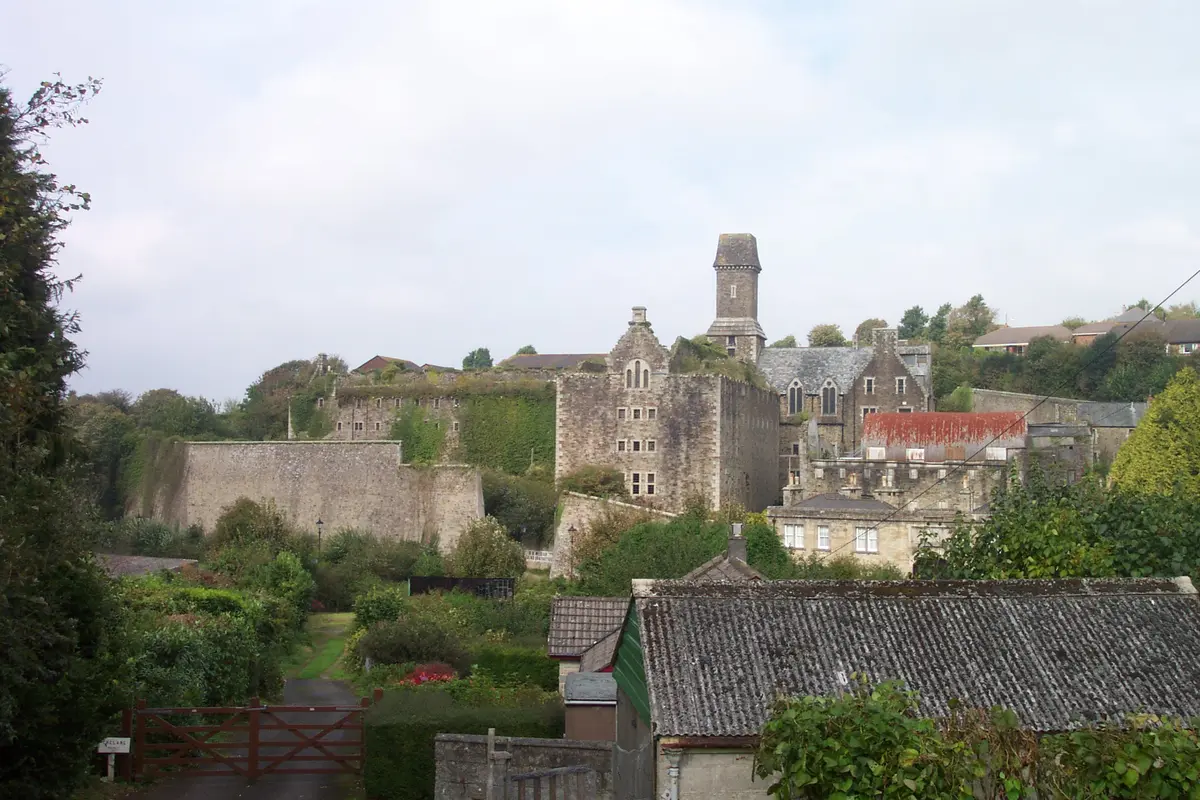
Finally, a caution about the retail history in general. The operator's redevelopment page dates the closure to 1929 while its own timeline page says 1927, and states that the walls were "built using limestone mined from Bodmin Moor" — Bodmin Moor is granite, and the specialist account of the building describes some 20,000 tonnes of local Delank granite and stone from the adjacent quarry. The photograph on this page, taken from Cardell Road before the restoration, shows grey stone, an allotment gate and suburban rooftops.
Can you visit Bodmin Jail?
Bodmin Jail is open as a commercial attraction at Berrycoombe Road, Bodmin, Cornwall PL31 2NR, telephone 01208 76292. Its own site prints two different sat-nav postcodes: the directions page says "Sat Nav please use PL31 2PL", which is the car park, while the footer on every page says "(Sat Nav PL31 2PY)". The gaol and its boundary wall to north, west and south are Grade II on the National Heritage List, entry 1298241, listed on 10 November 1969 at grid reference SX 06490 67456. The operator is Bodmin Jail Museum Ltd, company 06776084, incorporated on 18 December 2008 and active with a confirmation statement dated 20 March 2026.
On 22 September 2026 the published calendar gave 9.30am to 6pm with last entry at 4pm, and the same hours for the following day. Entry is by timed slot, with arrival asked for ten minutes before it. The attraction suggests allowing an hour and a half to two hours inside.
Prices came out identical on the August 2026 and the 22 September 2026 readings. Self-guided entry, which includes the immersive Dark Walk, is £13.50 booked online and £16.50 on the door. A guided tour with a heritage guide starts at £17.00. The lantern-lit Ghost Walk starts at £15.00 and is marked "Ages 12+". The overnight paranormal investigation, After Dark, costs £50.00 per person and is marked "Ages 18+".
Parking is "not available onsite". Drivers are sent to Berrycoombe Car Park, postcode PL31 2PL, pay-and-display, with a 2.2-metre height restriction and a five-minute walk, and the operator asks guests "not to park on the road or grass verges outside the Jail". Local buses reach Bodmin town, ten minutes away on foot. The operator warns that "buses are only frequent in high season". The mainline station is Bodmin Parkway, which the attraction places "four miles outside of Bodmin Town"; measured from this entry's coordinate it is 5.6 km, or 3.5 miles, to the south-east. The Camel Trail cycle route from Padstow through Wadebridge finishes here — "You'll find the jail at the end of the trail!" — with limited secure bike racks. Coaches drop off on Berrycoombe Road and park in the bay alongside the hotel wall.
A 7-metre incline leads to the entrance, and anyone with mobility difficulties can be set down at the front gate. The courtyard is "gravelled with solid, even surfaces laid across the main routes". Stairs and platform lifts move between levels, a resin-bound gravel ramp with zig-zag bends climbs to the stables, and the Dark Walk itself is level. One lift was still out of service in September 2026, which leaves the Dark Walk unable to take wheelchair users while the rest of the museum stays open. Some original doorways measure 75 cm across. One accessible WC sits on the Naval Wing level, past the main audiovisual area. A free companion ticket is given on proof such as a Blue Badge, a DLA or PIP letter, or an Access Card dated within two years. Parts of the attraction carry a photosensitive-epilepsy warning, and there are dark, cramped sections with loud noises and lighting effects. Assistance dogs go everywhere. Pet dogs stay out of the museum route because of the effects and are welcome in the courtyard, the Moor Café, the gift shop and the hotel, where whoever stays behind to mind the dog is offered a café drink token.
The Bodmin Jail Hotel occupies the converted cell wings at Scarlett's Well Road, Bodmin PL31 2PL, telephone 01208 822 822. It is run by Bodmin Jail Hotel Ltd, company 09861358, incorporated on 6 November 2015 and likewise active with a confirmation statement dated 20 March 2026. Rooms are converted cells of about 30 m², in king, twin, family and accessible versions, and the restaurant occupies the former chapel. Booking goes through the hotel, separately from the attraction.
Selina Wadge, William Hampton, John Doidge and the Lightfoot brothers were real people, several of them very poor, and at least two of them were buried in the ground the route crosses. Cornwall Live puts it at "55 people were executed within its imposing walls".
Sources consulted
- John Howard, «The State of the Prisons in England and Wales, 3rd edition — 'County Gaol at Bodmin', p. 394» — William Eyres, Warrington, 1784 book
- John Howard, «An Account of the Principal Lazarettos in Europe… with additional remarks on the present state of those in Great Britain and Ireland — 'County Gaol at Bodmin', visit of 26 June 1788» — J. Johnson, C. Dilly and T. Cadell, London, 1791 book
- Royal Cornwall Gazette, transcribed by Claudia Richards, «'The Launceston Murder — Execution of Selina Wadge', with the reports of 9 and 23 August 1878» — Cornwall Online Parish Clerks, 1878 newspaper archive
- Home Office: Registered Papers, «HO 45/9464/75879 — 'Criminal: WADGE, Selina. Court: Cornwall Assizes. Offence: Murder. Sentence: Death', July 1878» — The National Archives, Kew, 1878 archive
- Home Office: Registered Papers, Supplementary, «HO 144/1037/180624 — 'Criminal: Hampton, William; Court: Bodmin; Offence: Murder; Sentence: Death', 24 June 1909» — The National Archives, Kew, 1909 archive
- Peter Higginbotham, «County Gaol and Bridewell, Bodmin, Cornwall — history, inspectors' reports and prisoner statistics» — theprison.org.uk, 2026 web
- Bodmin Jail Museum Ltd, «Executions · Bodmin Jail History · The People of Bodmin Jail · Tickets & Prices · FAQs · The Bats of Bodmin Jail» — bodminjail.org (official site of the attraction), 2026 web
- Matt Roper, «Spooky Truth: TV's Most Haunted Con Exposed» — Daily Mirror, 2005 newspaper archive
- Leah Harper, «Dead scary: Bodmin Jail ghost tours» — The Guardian, 2016 newspaper archive
- Aaron Greenaway, «The Deathly Gallows: a chronicle of the evil within the Bodmin Jail walls» — The Cornish Times, 2024 newspaper archive
- Historic England, «National Heritage List for England, entries 1298241 (Bodmin Gaol and boundary wall), 1195250 (chaplaincy and governor's house) and 1206176 (former naval officers' quarters) — all Grade II» — National Heritage List for England, 1969 report
- Natural England, «National Character Areas: the site lies in NCA 152 Cornish Killas; the nearest boundary of NCA 153 Bodmin Moor is about 2.7 km away (measured against the published boundaries)» — National Character Areas of England (open data), 2026 report
- Companies House, «Bodmin Jail Museum Ltd (06776084) and Bodmin Jail Hotel Ltd (09861358) — both active, confirmation statements filed 20 March 2026» — Find and update company information, GOV.UK, 2026 report
- Lee Trewhela, «Unsettling stories of prisoners hanged in Cornwall — '55 people were executed within its imposing walls'» — Cornwall Live, 2023 newspaper archive
Reviewed by V. Serrano on 2026-08-11 · How we verify our content
💬 Field testimonies (0)
No testimonies yet. Add the first.
Add your testimony
🔒 Log in to add a testimony