👻 HAUNTED PLACE · EXP. Nº9476
ACTIVE
Borthwick Castle
Borthwick Castle, a twin-towered keep raised on a royal licence dated 2 June 1430, is where Mary, Queen of Scots spent the last free night of her reign.
Where is Borthwick Castle?
- Location
- Midlothian, Scotland, United Kingdom
- Type
- Castle
- Coordinates
- 55.827, -3.007
- Last updated
LOCATION
Why is Borthwick Castle said to be haunted?
On 10 June 1567 the confederate lords came for her husband Bothwell; he slipped away to Dunbar, the blockade was lifted at once, and the following night Mary rode out after him — not, as the guidebooks say, disguised as a page boy, but "in men's clothes, booted and spurred", in the words of the letter Archbishop James Beaton wrote six days later. The page is Walter Scott's, added in 1826 to his own accurate transcript of that letter. The gouged stonework visitors are shown is not from 1567 either: it is Cromwell's, blasted into the east wall in November 1650 at the point where a chimney flue had thinned it, and never successfully repaired. The ghosts came last of all. The minister who wrote 18,673 words on the parish in 1839 recorded no haunting here at all, and the oldest one anyone can date is a magazine feature from 1997.
What is the history of Borthwick Castle?
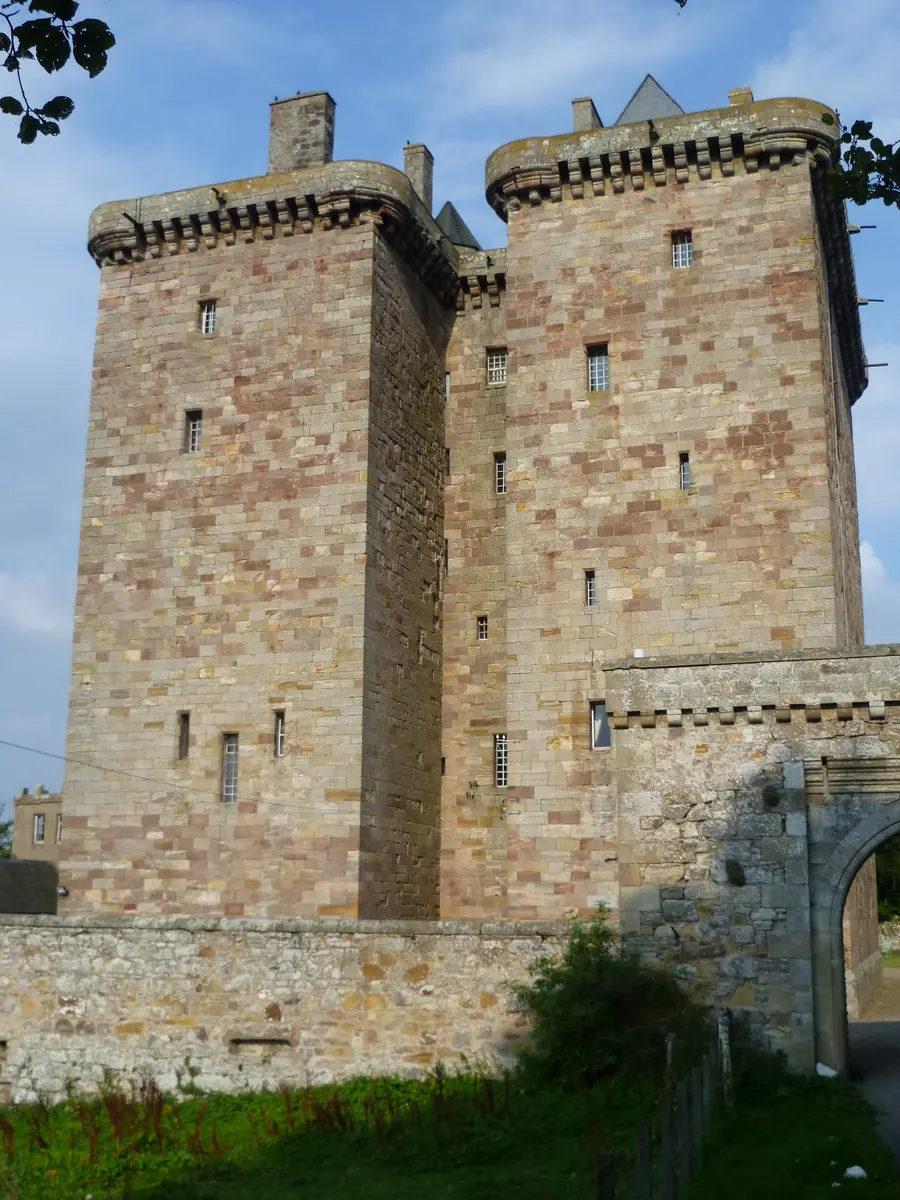
The castle begins with a piece of paper. At Edinburgh on 2 June 1430, James I granted Sir William de Borthwick a "licentia specialis" to raise a castle on the spot "vulgarly called le Mote de Lochorwart" in the sheriffdom of Edinburgh: to ring it with walls and ditches, hang it with gates of brass or iron, crown it with "defensive ornaments", and keep in it a constable, a porter and whatever guards he saw fit. The grant is entered in the Register of the Great Seal (book 3, no. 86), and Walter Scott printed it in full in 1826. Licences of that kind were uncommon in Scotland, where barons fortified as they pleased; this one belongs to James I's effort to make the crown's permission necessary. What Sir William built on the strength of it is a double tower: seventy-four feet long, sixty-eight broad, ninety feet from floor to battlement, with walls thirteen feet thick at the base narrowing to six at the wall-head, set on a knoll in a loop of the Gore Water inside a walled outer court and entered over a stone ramp and a drawbridge.
The best-documented scene of its first century has nothing to do with sieges. In 1547, in a suit between Master George Hay of Minzeane and Lord Borthwick, letters of excommunication were issued against the lord, and William Langlands, an apparitor of the see of St Andrews, carried them to the parish church to be published at high mass. The castle household was at that moment playing the Abbot of Unreason, the Scottish Lord of Misrule. The mock abbot and his retinue walked into the church, seized the apparitor, dragged him to the mill dam on the south side of the castle and ducked him twice — the second time flat on his back, the first having been judged neither wet enough nor deep enough. They took him back to the church, tore the letters up, steeped the pieces in a bowl of wine and made him swallow both, with the assurance that any further letters would "gang the same gait". Langlands's own deposition survives in the Consistory Register of St Andrews.
The Borthwicks were loyalists, and Mary used their castle more than once. Walter Scott and the parish minister after him both name her host as John, fifth Lord Borthwick; the peerage record does not support them, because John died and his son William succeeded as sixth Lord in 1566, so the man who took her in was William, sixth Lord Borthwick. The journal usually called Cecil's Diary records that on 7 October 1566, when Bothwell was wounded in Liddesdale, "the Queen raid to Borthwick". She came again on 7 June 1567, three weeks after marrying him. On 10 June the Earl of Morton and Alexander, Lord Home, arrived at what the Diurnal of Occurrents calls "the palice of Borthuick" with five or six hundred men, meaning to take Bothwell; Bothwell "depairtit thairfra quietlie the same nycht, and raid to Dunbar". The lords withdrew by Dalkeith and were inside Edinburgh on the 11th. That day Mary had a proclamation cried summoning every able-bodied man between sixteen and sixty to come to Borthwick and relieve her and her husband on pain of death; when a second proclamation was to be read at eleven at night, the lords arrested the heralds. James Beaton, Archbishop of Glasgow, carried her the news himself and wrote it up to his brother Andrew six days later. He found her at Borthwick "so quiet, that there was none with her passing six or seven persons", and: "Her majesty, in men's clothes, booted and spurred, departed that same night from Borthwick to Dunbar: whereof no man knew, save my lord duke, and some of his servants, who met her majesty a mile from Borthwick, and conveyed her to Dunbar." Four days later she surrendered at Carberry Hill and never saw Bothwell again.
The damage visitors are shown is a century younger. On 18 November 1650, from Edinburgh, Oliver Cromwell sent a trumpet to "the Governor of Borthwick Castle" with terms: walk away with your company and carry off your arms and goods, or "if you necessitate me to bend my cannon against you, you must expect what I doubt you will not be pleased with". The garrison held out until the guns opened and then surrendered on honourable terms. The Rev. Thomas Wright, minister of the parish, writing in October 1839, placed the battery on the rising ground behind the house then occupied by the proprietor of Currie, and noticed that Cromwell — "whether by good luck, or by advice from within" — had aimed at the one stretch of wall thinned by a chimney flue. The scar is on the eastern wall and it is still open: repairs were tried more than once and failed, because the ancient and the modern masonry would not bond.
A tree grew through the Great Hall chimney in 1813 and had to be cut out of the stonework; the hall's woodwork was renewed in 1903 and the building restored in 1913. Electricity, central heating and bathrooms cut into the thirteen-foot walls arrived in the early 1970s, when the castle opened as a conference centre and guest house. Helen Bailey, who leased it from the Borthwick family, restored it before it passed to later owners; a full refit followed from 2013, the year Borthwick Castle Management Company Limited was registered at the castle's own address.
Timeline: the documented record of Borthwick Castle
- 2 June 1430 James I grants Sir William de Borthwick a special licence, entered in the Register of the Great Seal, to build a castle at the Mote of Locherwart, wall and ditch it, and keep a constable and porter in it.
- 1547 The castle household, playing the Abbot of Unreason, ducks an apparitor of St Andrews in the mill dam and makes him eat the letters of excommunication he had brought against Lord Borthwick, steeped in wine. His deposition survives in the Consistory Register of St Andrews.
- 7 October 1566 Cecil's Diary: "My Lord Bothwell was hurt in Lyddisdale, and the Queen raid to Borthwick." It is the first of Mary's recorded visits to the castle.
- 1566 William Borthwick succeeds his father John as sixth Lord Borthwick. He, and not the fifth Lord named by Scott and by the New Statistical Account, is the man who shelters Mary and Bothwell the following June.
- 10 June 1567 Morton and Lord Home reach "the palice of Borthuick" with five or six hundred men to seize Bothwell; he leaves quietly the same night and rides to Dunbar.
- 11 June 1567 The lords enter Edinburgh. Mary has a proclamation cried summoning every man between sixteen and sixty to Borthwick to relieve her; the lords arrest the heralds carrying a second one. That night, "in men's clothes, booted and spurred", she rides out for Dunbar and is met a mile away by Bothwell's servants.
- 18 November 1650 Cromwell sends his summons to the Governor of Borthwick Castle from Edinburgh. The garrison holds out until the artillery opens on the eastern wall and then surrenders on terms; the breach is never successfully repaired.
- 1826 Walter Scott prints the 1430 licence and Beaton's letter in his Provincial Antiquities — and, in the descriptive prose of the same book, writes for the first time that Mary escaped "in the disguise of a page".
- October 1839 The Rev. Thomas Wright finishes his 18,673-word account of the parish for the New Statistical Account. He describes the castle at length, prints local traditions and records no haunting: "Scarcely any recollection... haunts the visitant of this castle, but such as is genial and pleasant to be indulged."
- 1880 J. Douglas Borthwick publishes Borthwick Castle; or, Sketches of Scottish History in Montreal: 71,246 words, the castle named 248 times, and not one ghost attached to it.
- 22 January 1971 Borthwick Castle, with its outer walls and gatehouse, is listed Category A (LB805). The statutory record attributes the surviving damage to Cromwell around 1650 and calls Mary's disguise only "dressed as a man".
- 1997 Betsa Marsh publishes the earliest datable account of the castle's ghosts in British Heritage: a servant girl and a family chancellor on the spiral stairs, and presences in the Great Hall. The castle later quotes her on its own website.
- 14 May 2013 Borthwick Castle Management Company Limited (SC449952) is incorporated and registered at the castle; a full restoration follows and the building reopens as an exclusive-use venue rather than a hotel.
Is there a rational explanation for Borthwick Castle?
Almost every retelling of the escape, ours included, dressed Mary as a page boy. The contemporary documents do not. Beaton's letter of 17 June 1567 says "in men's clothes, booted and spurred" — the clothes of someone about to ride more than twenty miles in the dark. The Diurnal of Occurrents, written in Scots at the time, says she was "cled in menis clething". The page arrives in the nineteenth century, and it can be watched arriving inside a single book. In The Provincial Antiquities and Picturesque Scenery of Scotland (1826) Walter Scott prints Beaton's letter accurately in his antiquarian section, "in men's clothes, booted and spurred"; and in his descriptive prose about the Great Hall, in the same volume, he writes of Mary "finally obliged to escape in the disguise of a page". Elsewhere in the same work he has her "closely pursued by Lord Home", which no document supports. When the New Statistical Account reached the parish in 1839, its footnote fused the two voices into what reads like a quotation: the queen escaped "butit and spurred, and in the guize of a page". Nothing stands behind that sentence. It is Beaton's document plus Scott's imagination, inside quotation marks. Everything downstream inherits the page: a 1997 magazine feature, the castle's own website, the travel writing, and until now this page.
The siege is the second thing we had wrong. There was no assault on Borthwick in 1567, and by the time Mary left there was nothing to escape from. Scott, reading his own document, said so plainly: when Bothwell's escape became known "the blockade of Borthwick was instantly raised, although the place had neither garrison nor means of defence". The lords came on the 10th and were in Edinburgh on the 11th; Mary rode out that night. The two contemporary sources do not even agree on how many men came — five or six hundred in the Diurnal, "nine hundred or a thousand horse" in Beaton — which is a fair measure of how thin the record is beneath a story everyone tells with confidence.
The gouged stonework is the third. This page used to attribute it to the 1567 siege and place it on the south-east tower; both halves are wrong and no source says otherwise. The lords of 1567 brought horsemen, not guns, and stayed one day. The damage was made by Cromwell's battery on or about 18 November 1650; it is on the eastern wall, at the point thinned by a chimney; and the attribution is identical in the minister's account of 1839, in the statutory listing LB805 — "circa 1650 the 10th Lord Borthwick refused to leave the castle when requested to do so by Oliver Cromwell, the damage which still remains being the result" — and on the castle's own website today.
The ghost can be dated, and it is not old. The Rev. Thomas Wright wrote 18,673 words on the parish of Borthwick in October 1839. He names the castle sixty-nine times, Mary ten, Bothwell ten, Cromwell five. He is not shy of folklore: he uses the word tradition seven times and prints a tragic tradition of the neighbouring Catcune, a tradition about the building of the mill and a traditional story of the Whytes' Highland descent. He never once writes ghost, spectre, apparition, superstition or legend, and the single occurrence of "haunt" in his whole account is a denial: "It is pleasing to recollect, that the castle, of whose occupants we have been detailing the history, has not been stained or rendered in any respect horrible to the imagination by the perpetration of any of those darker and more atrocious crimes... Scarcely any recollection, accordingly, haunts the visitant of this castle, but such as is genial and pleasant to be indulged." J. Douglas Borthwick's Borthwick Castle; or, Sketches of Scottish History (Montreal, 1880) runs to 71,246 words and names the castle 248 times; its two occurrences of "ghost", three of "haunt" and one of "phantom" are all quotations from Shakespeare, a ballad by Scott, and a metaphor about Darnley.
The oldest haunting we have been able to read is Betsa Marsh's feature in British Heritage in 1997, the text the castle later quoted on its own site — and her ghosts are not Mary. They are an unnamed servant girl said to have borne a Borthwick child and to have been put to the sword with it in the Red Room, and a family chancellor said to have been burned to death for embezzlement. They walk "the stony spiral staircases", and visitors report "invisible presences in the Great Hall". There is no queen on the stair and no cold bedroom in any source we could find: that detail, which this page used to carry, belongs to the stock vocabulary of haunted-castle writing rather than to Borthwick. The distance between the night of 11 June 1567 and the oldest haunting anyone can date here is four hundred and thirty years.
One last correction runs against our own sources rather than for them. Scott in 1826, and the New Statistical Account copying him in 1845, both make Mary's host "John, the fifth Lord Borthwick". John was dead by then: his son William had succeeded as sixth Lord in 1566, and it is William who sheltered her. The 1997 magazine feature, which gets the page boy wrong, gets the lord right. It is worth saying plainly, because the temptation with a source as good as Scott is to stop checking once he has produced the document.
Can you visit Borthwick Castle?
Borthwick Castle stands at North Middleton, Gorebridge, Midlothian EH23 4QY, which is also the registered office of Borthwick Castle Management Company Limited (SC449952). The national grid reference on the Historic Environment Scotland list entry is NT 36990 59732, in the parish of Borthwick, about 18 km (11 miles) south-south-east of Edinburgh Waverley.
Historic Environment Scotland listed the building at Category A on 22 January 1971 under designation reference LB805, taking in the outer walls together with the gatehouse. The list entry describes a "3 storey and basement main block with 2 6 storey and basement wings" inside a "U plan keep within courtyard" of circa 1430.
Access to the interior is private. The venue's own site, consulted on 9 September 2026, presents it as "An exclusive-use castle venue, beautifully preserved for weddings & private stays", with twelve bedchambers hired as a single let rather than room by room; enquiries go to +44 (0)1875 820 514 and rates are quoted on request. The site advertises no day visits and no ticketed access to the interior, and there is no visitor centre.
Companies House, consulted the same day, records SC449952 as active under SIC code 55100 for hotels and similar accommodation. Accounts run to 31 May 2025, with the next set due by 28 February 2027. The company was incorporated on 14 May 2013 and traded as Lister Square (No. 160) Limited until 6 June 2013.
The exterior is another matter, and it costs nothing: the twin towers rise above the public road through the village of Borthwick, and the damage left by the bombardment of 1650 is on the east wall.
Sources consulted
- Walter Scott, «Borthwick Castle, in The Provincial Antiquities and Picturesque Scenery of Scotland» — London: John and Arthur Arch, 1826 book
- ed. Thomas Thomson, «A Diurnal of Remarkable Occurrents that have passed within the Country of Scotland since the death of King James the Fourth till the year MDLXXV» — Edinburgh: Bannatyne Club, 1833 book
- Rev. Thomas Wright, «Parish of Borthwick, in The New Statistical Account of Scotland, vol. I: Edinburghshire» — Edinburgh: William Blackwood and Sons, 1845 book
- Historic Environment Scotland, «Borthwick Castle, including outer walls and gatehouse (LB805), Category A listed building» — Statutory list of buildings of special architectural or historic interest, 1971 report
- Betsa Marsh, «The Ins and Outs of Borthwick Castle» — British Heritage, 1997 newspaper archive
- J. Douglas Borthwick, «Borthwick Castle; or, Sketches of Scottish History» — Montreal: J. M. O'Loughlin, 1880 book
- Companies House, «Borthwick Castle Management Company Limited, company SC449952» — UK register of companies, 2026 report
- Register of the Privy Council of Scotland, vols. 1 and 3, «William Borthwick, 6th Lord Borthwick (succession 1566-1582)» — Edinburgh: H.M. General Register House, 1880 archive
- Borthwick Castle, «Borthwick Castle: history and accommodation» — Official website of the venue, 2026 web
Reviewed by V. Serrano on 2026-08-17 · How we verify our content
💬 Field testimonies (0)
No testimonies yet. Add the first.
Add your testimony
🔒 Log in to add a testimony