👻 HAUNTED PLACE · EXP. Nº9477
ACTIVE
Burford Church (St John the Baptist)
On the night of Monday 14 May 1649, Fairfax and Cromwell rode forty-five miles in a day and fell on Burford at midnight.
Where is Burford Church (St John the Baptist)?
- Location
- Oxfordshire, England, United Kingdom
- Type
- Church / religious site
- Coordinates
- 51.81, -1.634
- Last updated
LOCATION
Why is Burford Church (St John the Baptist) said to be haunted?
Between three and four hundred mutineers of the New Model Army — soldiers who had refused to be split up and shipped to Ireland, and who wanted the army's own Solemn Engagement honoured — were shut in the parish church of St John the Baptist. Three days later three of them were shot: Cornet James Thompson and Corporals Church and Perkins. A fourth condemned man, Cornet Henry Denne, was reprieved at the place of execution. On the lead lining of the font, one of the prisoners scratched ANTHONY SEDLEY PRISNER 1649 — a name belonging to none of the dead, and to a man about whom nothing else is known. It is still legible. Katharine Briggs's Folklore of the Cotswolds does give Burford a ghost, but it is the coach of the Jacobean judge Sir Laurence Tanfield, and the parish itself says nobody knows where the soldiers fell. What Burford has instead is Levellers' Day, held every May since 1975.
What is the history of Burford Church (St John the Baptist)?
The mutiny that ended at Burford was not a riot about back pay, although back pay was part of it. It was an argument about who the New Model Army belonged to, and the mutineers put their case in writing before anyone fired a shot.
In the spring of 1649 the English Commonwealth was four months old. Charles I had been executed in January, and the Levellers — the movement around John Lilburne, pressing for a written constitution, a wider franchise and religious toleration — had gone from allies of the army's commanders to their most dangerous critics. Regiments were being picked by lot for service in Ireland. Troopers of Commissary-General Ireton's and Colonel Scrope's regiments refused to go.
Their own letter to the Lord General, dated 12 May 1649 and in print within days, is the clearest statement of what they wanted. They invoked "our Engagement made at Triploe heath, June 5. 1647", by which the army had solemnly bound itself "not to disband nor divide" until its terms were met, and they asked Fairfax to summon a General Council "consisting of two Officers and two private Souldiers of each Regiment, indifferently chosen". They complained that comrades who could not go to Ireland were being disbanded "without a competent pay in hand of their Arrears". The officers' own dispatches record two further grievances: "the proceeding against Mr. Lockyer" — the trooper Robert Lockyer, shot in London that spring — and "the strict dealing with the prisoners in the Tower", where the Leveller leaders were held.
Fairfax answered on 13 May in a letter signed "T. Fairfax", telling them their complaint rested on "false suggestions" and that their own "disorderly precipitance" was the sole reason forces were marching towards them. Then he marched anyway. On Monday 14 May 1649 the Lord General and Lieutenant-General Cromwell covered forty-five miles in a day — a distance their own staff said they had never matched in the whole war — and fell on Burford at midnight. Colonel Reynolds's horse entered the town first, with Colonel Okey's dragoons, Major Shelburne and the Buckinghamshire horse behind. The fighting was brief: one mutineer killed, one man on Fairfax's side.
Fairfax wrote to William Lenthall, Speaker of the Commons, that same night and dated the letter "Burford, May 14. midnight, 1649". The account printed with it reports "between three and four hundred prisoners in the church, the rest escaped in the darke; many of them are very resolute, and say (as the Cavaliers used to speak) it is our day to day, it may be theirs to morrow". On 15 May Fairfax issued a hue and cry to every sheriff and justice of the peace for the men who had got away.
The council of war condemned four men: Cornet James Thompson, brother of the Captain William Thompson who had raised Banbury; Cornet Henry Denne; and two corporals, Church and Perkins (the narrative reprinted by Monk spells the first "Cheworth"). Denne, the 1649 pamphlet notes drily, "hath bought himselfe a winding-sheet". On 17 May the four were brought out one after another in sight of the rest, who had been put up on the church roof to watch. Thompson was shot first, then the two corporals. Denne was reprieved at the place of execution; the narrative reprinted by W. J. Monk in 1891 gives his answer — "I am not worthy of such a mercy, I am much more ashamed to live than afraid to die" — and adds that he wept bitterly. Cromwell then went into the church and told the survivors they had been treated mercifully: by the rules of war he could have decimated them, one man in ten.
The parish register makes the plainest record of all. Squeezed in above the margin, out of date order but in the vicar's own hand, it reads: "1649. — Three soldiers shot to death in Burford Churchyard buried May 17th."
And on the lead lining of the church font, in jagged letters, one of the men shut inside cut his name: ANTHONY SEDLEY PRISNER 1649. He was not one of those who died, and nothing else about him is known. It is the only voice from inside that church that still survives in the building itself.
Timeline: the documented record of Burford Church (St John the Baptist)
- 5 June 1647 The New Model Army swears the Solemn Engagement at Triploe Heath, binding itself "not to disband nor divide" until its terms are met. Two years later the Burford mutineers quote this document back at Fairfax as the whole basis of their case.
- 12 May 1649 The agents of Ireton's and Scrope's regiments write to Fairfax refusing to be "divided and sent over into Ireland" and demanding a General Council of "two Officers and two private Souldiers of each Regiment". Their letter is printed within days.
- 13 May 1649 Fairfax replies in a letter signed "T. Fairfax", dismissing their grievance as founded on "false suggestions" and blaming their own "disorderly precipitance" for the troops moving against them.
- Midnight, Monday 14 May 1649 After a forced march of forty-five miles in a day, Fairfax and Cromwell surprise the mutineers at Burford. One mutineer and one of their own are killed. Fairfax writes to Speaker Lenthall the same night, dating the letter "Burford, May 14. midnight, 1649"; between three and four hundred prisoners are shut in the parish church.
- 15 May 1649 Fairfax issues a hue and cry, under his hand and seal, ordering every sheriff and justice of the peace to hunt down the mutineers who escaped in the dark. The Burford register records a soldier killed at the Crown inn buried the same day.
- 16 May 1649 A dispatch datelined "Burford, Wednesday May 16. 1649" reports that Cornet Denne and Cornet Thompson have been tried by a council of war and condemned, and that Denne "hath bought himselfe a winding-sheet".
- 17 May 1649 Cornet James Thompson and Corporals Church and Perkins are shot, the other prisoners watching from the church roof. Cornet Henry Denne, the fourth condemned man, is reprieved at the place of execution and answers: "I am not worthy of such a mercy, I am much more ashamed to live than afraid to die." The parish register notes: "Three soldiers shot to death in Burford Churchyard buried May 17th."
- 1891 W. J. Monk publishes his History of Burford, transcribing the font graffito as "ANTHONY SEDLEY PRISNER, 1649" and reprinting both the parish register entries and the contemporary narrative of the executions. His 1890 official guide had already illustrated Sedley cutting his name.
- 1951 Christopher Fry's play A Sleep of Prisoners is first performed. His biographers agree the germ of it was Fry seeing the inscription in Burford church: "Antony Sedley Prisner 1649".
- 12 September 1955 The church is listed Grade I (list entry 1053287). The official description runs to the font, the Tanfield monument and the Street restoration; it does not mention the Levellers, the graffito or any haunting.
- 1974 Katharine Briggs's The Folklore of the Cotswolds records Burford's ghost tradition: a spectral coach, associated with Sir Lawrence Tanfield of Burford Priory. No Leveller apparition appears in the standard regional survey.
- 1975 Members of the WEA Oxford Industrial Branch hold the first Levellers' Day meeting at Burford, "to reclaim a piece of history that seemed to be missing from the school books". Tony Benn came the following year and read in the church.
- 21 May 2023 The historian Norah Carlin comments publicly on the Levellers' Day website, correcting its own account: "I don't want to exonerate Cromwell in any way, but the commander giving orders there was Thomas Lord Fairfax." She links to the 1649 pamphlet.
- 9 May 2026 Levellers' Day is held at Warwick Hall and the church, with singing in the churchyard, a commemoration and posies, a march round Burford, a walking tour with historians Jonathan Healey and John Rees, and an afternoon debate. Fifty-one years of continuous commemoration, and still no ghost on the programme.
Is there a rational explanation for Burford Church (St John the Baptist)?
Burford's printed ghost stories belong to Burford Priory and its Jacobean owner.
Katharine Briggs, who lived in the town, sets out the Tanfield haunting in The Folklore of the Cotswolds (1974), the standard survey of the region's traditions: the occupant of the phantom coach "was Sir Laurence Tanfield", the Jacobean judge who held the Priory and whose widow raised the great tomb in the church. Theo Brown returned to the couple in 1979 as a West Country coach of the dead: "Sir Laurence Tanfield (d. 1625) of Burford and Lady Tanfield sit side by side in a carriage". A full-text search of the Internet Archive's copy of Briggs's book, run on 28 September 2026, finds "Tanfield" in several passages and "Levellers" in none.
The same index, the same day, gives the wider measure. The phrase "haunted by the Levellers" returns no hits across the Internet Archive's full-text books. "Ghosts of the Levellers" returns two, both in Martin C. Strong's indie discographies (1999 and 2003), where it is a track on a Cherry Red 12-inch EP of August 1984. The control phrase "Anthony Sedley", the name cut in the font, returns 296 texts. The Burford Leveller material is plentiful, and in this index none of it is about a haunting.
The parish is the best sceptic available. Burford Church's own heritage page on the Levellers describes the imprisonment, the roof, the shooting and the plaque, and then states: "we have no evidence as to where the executions took place or where the bodies were subsequently buried." A claim that figures are seen standing where the men fell depends on knowing where they fell. The church, which owns the ground, says nobody does.
Two further details do not survive contact with the sources. The order was Fairfax's: the sentence came from the Lord General's council of war, and Cromwell — Lieutenant-General, and the officer who led the midnight attack — went into the church afterwards to announce the reprieve of the rest. The organisers of Levellers' Day themselves write "on Oliver Cromwell's orders" on their About page, and in May 2023 the historian Norah Carlin left a public comment underneath it: "I don't want to exonerate Cromwell in any way, but the commander giving orders there was Thomas Lord Fairfax", linking to the 1649 pamphlet. And four men were condemned; the fourth, Cornet Henry Denne, was reprieved at the place of execution.
Even the label is contested. Edward Vallance notes in A Radical History of Britain (2009) that "historians question whether the Burford mutineers should really be regarded as Levellers at all" — the movement was looser, and the regiments' grievances more particular, than the commemoration implies.
The dates disagree too, and the disagreement is instructive. The plaque and the parish register say 17 May; the church's own website says 16 May. The register is the contemporary document, and the date it gives is that of the burial, which could fall on the day of the shooting or the day after. What is not in doubt is the arithmetic of the printed accounts: the 1649 pamphlet's title page dates Fairfax's advance from London to "Thursday May 10" and the surprise at Burford to "Munday May 14. at mid-night", and in the Julian calendar England was still using, 10 May 1649 was indeed a Thursday and 14 May a Monday.
What happens at Burford every May is a procession, a debate and a laying of posies, organised since 1975 by people who think the argument these men lost is still open.
Can you visit Burford Church (St John the Baptist)?
The church of St John the Baptist is a working parish church at Church Green, Burford OX18 4RY, run by the Burford Benefice, registered charity 1130342 ([email protected], 01993 823 788). Historic England lists it Grade I as entry 1053287, listed on 12 September 1955, and its description notes that the heavy restoration by G. E. Street in the 1870s was "one of the cases which led to William Morris's founding of the SPAB".
The building is "open to visiting Monday - Saturday from 10am-4pm and Sunday from 1pm-4pm (excluding Christmas, Easter and New Years Day)". Entry is free, and the parish asks for a donation towards the extensive cost of keeping the building open to the public. It counts "over 75,000 visitors to Burford Church each year", and it provides free printed tour guides in many languages, a duty verger who answers questions on the building, and, with advance notice, a verger to guide a tour party. Services and other events close the church to visitors, and the parish publishes those dates as they come: the list on the page on 22 September 2026 ran 10 September closed all day, 11, 13, 18, 22 and 25 September closed after 1pm, and 26 September closed all day.
The font stands in the north aisle, and the inscription is cut into its lead lining rather than into the stone: ANTHONY SEDLEY PRISNER 1649, in irregular scratched capitals small enough to need leaning in for. The Bartholomew Aisle holds the prisoners' other mark, a nine men's morris board scratched into a tomb. The memorial on the church wall records "three Levellers, executed and buried in this churchyard, 17th May 1649". The parish's own heritage page dates the shooting to 16 May 1649, says the other prisoners were taken onto the roof of the Lady Chapel to watch it, and adds that there is no evidence of where the men were shot or where they were buried.
Levellers Day is the commemoration rather than the building. The organisers hold it on the Saturday nearest 17 May, at the church and in Warwick Hall in Burford, and have set 2027 for Saturday 15 May. It is free. The first was held in 1975 by members of the WEA Oxford Industrial Branch, and Tony Benn read in the church the following year.
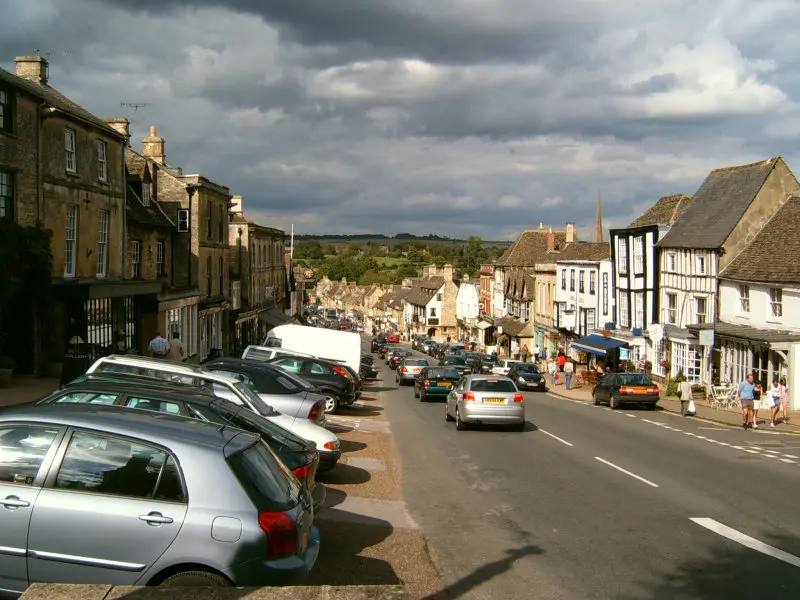
Burford is a busy Cotswold tourist town on the A40, about 18 miles (29 km) west of Oxford, with no railway station of its own. The church sits below the town at the bottom of the hill, a short walk down from the High Street: the approach across Church Green is level, and the main street back up into the town is steep.
Sources consulted
- Published by speciall authority, «A full narative [sic] of all the proceedings betweene His Excellency the Lord Fairfax and the mutineers, since his Excellencies advance from London, Thursday May 10. to their routing and surprizall, Munday May 14. at mid-night» — London, 1649 (Thomason E555_27; Wing F2350; EEBO-TCP A84986), 1649 archive
- William John Monk, «History of Burford» — C. W. Swatman, Burford, 1891 book
- Burford Benefice, «The Levellers (heritage pages)» — burfordchurch.org, 2026 web
- Historic England, «Church of St John the Baptist, Burford — National Heritage List for England, entry 1053287 (Grade I)» — National Heritage List for England, 1955 report
- Levellers Day (Burford), «Levellers Day — About, and the annual programmes» — levellersday.wordpress.com, 2026 web
- Matthew Teller, «The Rough Guide to the Cotswolds» — Rough Guides, 2015 book
- Edward Vallance, «A Radical History of Britain: Visionaries, Rebels and Revolutionaries» — Little, Brown, 2009 book
- Katharine M. Briggs, «The Folklore of the Cotswolds» — B. T. Batsford, London, 1974 book
- Theo Brown, «The Fate of the Dead: A Study in Folk-Eschatology in the West Country after the Reformation» — D. S. Brewer / Folklore Society, 1979 book
- Derek Stanford, «Christopher Fry Album» — Peter Nevill, London, 1952 book
Reviewed by V. Serrano on 2026-08-11 · How we verify our content
💬 Field testimonies (0)
No testimonies yet. Add the first.
Add your testimony
🔒 Log in to add a testimony