👻 HAUNTED PLACE · EXP. Nº9477
ACTIVE
Bursledon
Bursledon is a village on the River Hamble in Hampshire, and its ghost story is younger and narrower than the internet suggests.
Where is Bursledon?
- Location
- Hampshire, England, United Kingdom
- Type
- Village / settlement
- Coordinates
- 50.885, -1.312
- Last updated
LOCATION
Why is Bursledon said to be haunted?
The one tale that belongs to the village is Polly Crook, said to have set herself alight with a clay pipe on the railway bridge in Coal Park Lane; the earliest source anyone cites for it is a 2011 collection of retellings by the Hampshire storyteller Michael O'Leary, and it reached the web in a single Wikipedia edit made on 2 January 2015. The Victoria County History of 1908 describes the parish in close detail - the windmill, the toll bridge, the shipyards, even the villagers' own nickname for their church - and records no ghost at all. The two haunted venues usually attached to Bursledon are not in it: the Grade II* Victorian brickworks stands on Coal Park Lane in Lower Swanwick, in the borough of Fareham, and Manor Farm lies in the parish of Botley, more than three kilometres north. What the village really holds is on the riverbed - the wreck of the Grace Dieu, flagship of Henry V, burnt at her moorings in 1439.
What is the history of Bursledon?
Bursledon's real history is on the water, and it is older, stranger and far better documented than anything the ghost tours sell.
The River Hamble here holds the wreck of the Grace Dieu, flagship of Henry V. Launched in 1418 to a design proposed by William Soper, burgess of Southampton and Clerk of the King's Ships, she measured 218 ft with a 50 ft beam — comparable in size to HMS Victory and twice the size of the Mary Rose. She sailed on a single voyage, was laid up in the Hamble, and burned to the waterline in 1439 after a lightning strike. Until a survey in 1933 her timbers were taken for a Danish galley or a nineteenth-century merchantman. The site was designated under the Protection of Wrecks Act on 5 February 1974, and fifty metres away lie remains believed to be those of her contemporary, the Holigost. Guidebook copy that hands the Hamble fleet to Henry VIII has the wrong king by a full century.
Georgian Bursledon built warships. Philemon Ewer's private yard produced the 60-gun Anson in 1747; his monument in the parish church, where he was buried in 1750, carries a model of the ship and records that he built "seven large ships-of-war for his Majesty's service during the late war with France and Spain". The Parsons yard launched HMS Elephant in 1786 — the ship that carried Nelson to Copenhagen in 1801. The Victoria County History names the builder Henry Parsons; most modern accounts say George Parsons, and I have not been able to settle which is right. Hulls were floated round to Portsmouth to be sheathed in copper. A wooden toll bridge crossed the river from about 1783, replaced by the present concrete structure in 1933-5, with the M27 crossing added in the 1970s.
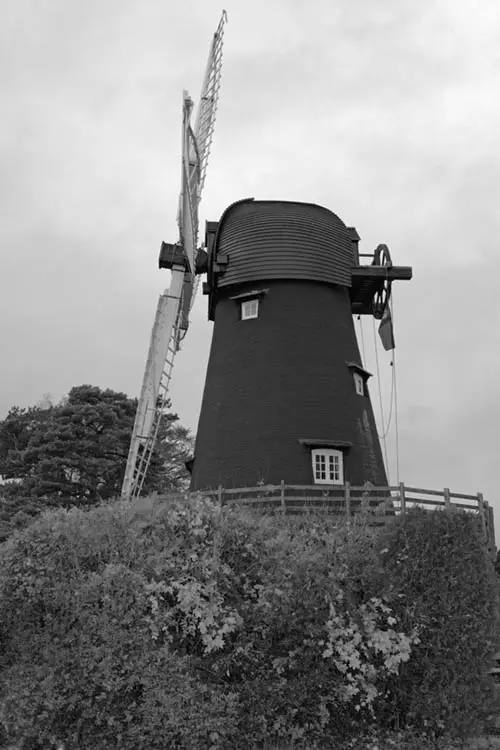
Two industrial monuments frame the village, and only one of them is actually in it. On the hill at Lowford stands Bursledon Windmill, a five-storey brick tower mill listed Grade II* on 14 February 1983. The statutory list entry dates it to 1741, "built on the site of a post-mill"; the restoration history instead credits a Mrs Phoebe Langtry with building it in 1813-14. The two dates have never been reconciled in anything I could read. The mill stopped work in 1907 and lost its cap, sails, chain gear and timber gallery; the Hampshire Buildings Preservation Trust restored it between 1978 and 1991, new sails going up in 1990.
A mile and a half east, on Coal Park Lane in Lower Swanwick — borough of Fareham, not Bursledon — the Ashby family, partners in the Southampton builders' merchants Hooper & Ashby, opened a brickworks in 1897; the date is still on the chimney. The southern complex gained a northern one in 1903 and a further extension in 1935, and at its height the works turned out more than twenty million bricks a year and employed around 180 people, children among them. Listed Grade II* on 30 January 1981, it keeps a Staffordshire-type continuous kiln of ten chambers, drying sheds on cast-iron columns marked "Lankester, Founder, Southampton", and a horizontal steam engine by John Wood of Wigan of about 1885, modified by Tangye of Birmingham around 1907. It closed in 1974: the M27 had cut the site in two, the clay had to be dug ever further away, and the Health and Safety at Work Act made a plant that had never been modernised impossible to bring up to standard. The Hampshire Buildings Preservation Trust took it on, a Heritage Lottery Fund grant of £666,300 followed in 2012, and the Bursledon Brickworks Museum Trust was registered in 2015.
Manor Farm, the third site the ghost trade attaches to Bursledon, is in the civil parish of Botley, three and a third kilometres north of the village centre. Its farmhouse is listed Grade II — entry 1112064, listed 14 February 1983 — and the list entry reads "C15, C17, early C19… a timber-framed house of medieval origin, now rendered externally".
Timeline: the documented record of Bursledon
- 1418 Henry V's flagship Grace Dieu is launched, 218 ft long with a 50 ft beam. She sails once and is then laid up at anchor in the River Hamble at Bursledon.
- 1439 Struck by lightning, the Grace Dieu burns to the waterline where she lies. Her timbers are not correctly identified until a survey in 1933.
- 1747 Philemon Ewer's yard at Bursledon launches the 60-gun HMS Anson. Ewer dies in 1750 and is commemorated in the parish church with a model of the ship.
- 1786 HMS Elephant is launched at Bursledon. Fifteen years later she carries Nelson to the Battle of Copenhagen, and the Elephant Boatyard still takes its name from her.
- 1897 The Ashby family open a brickworks on Coal Park Lane, Lower Swanwick. The date is still legible on the chimney and appears in the statutory list entry.
- 1907 Bursledon Windmill stops work. Its cap, sails, chain gear and timber gallery are subsequently lost, leaving a bare brick tower.
- 5 February 1974 The Grace Dieu site is designated under the Protection of Wrecks Act. The same year the brickworks closes, cut in two by the M27 and unable to meet the new Health and Safety at Work Act.
- 30 January 1981 The kiln, chimney, drying sheds and engine house at Bursledon Brickworks are listed Grade II*. The list entry calls it apparently the last steam-driven brickworks remaining in England.
- 14 February 1983 Manor Farm farmhouse at Botley is listed Grade II as "C15, C17, early C19… a timber-framed house of medieval origin". Bursledon Windmill is listed Grade II* the same day.
- May 1991 Bursledon Windmill reopens to the public after a restoration by the Hampshire Buildings Preservation Trust begun in 1978, with new sails fitted the previous year.
- 2011 Michael O'Leary publishes Hampshire and Isle of Wight Folk Tales. It is the earliest printed source anyone cites for Polly Crook, and the publisher describes the collection as the author's own retellings, many appearing in print for the first time.
- 2012 The Brickworks receives a Heritage Lottery Fund grant of £666,300 to become a museum; the Bursledon Brickworks Museum Trust is registered in 2015.
- 2 January 2015 An editor signing as Mutt adds a "Folklore and local legends" section to the Wikipedia article on Bursledon: 476 bytes containing the Polly Crook sentence and a citation to O'Leary with the page field left blank. Every later retelling on the web postdates this edit.
Is there a rational explanation for Bursledon?
The ghost story of Bursledon can be dated, and dating it is the whole argument.
Polly Crook, the woman said to have set fire to herself with a clay pipe on the railway bridge in Coal Park Lane, has a single citable source: Michael O'Leary's Hampshire and Isle of Wight Folk Tales (The History Press, 2011). I could not obtain the book, so I cannot confirm that the passage is in it or what exactly it says — that gap is worth stating plainly. What the publisher does say about the collection is relevant on its own: the tales were "collected by the author over his years of working as a greenkeeper, gardener, teacher and storyteller in Hampshire", and "many are published here for the first time, and others have evolved through countless retellings". A storyteller's repertoire in print for the first time in 2011 is not evidence of an old tradition.
Everything else in circulation is downstream of one edit. The sentence about Polly Crook entered the Wikipedia article on Bursledon on 2 January 2015 at 22:30 UTC, in a 476-byte addition by an editor signing as Mutt, which created the article's "Folklore and local legends" section and attached the O'Leary citation with the page field left empty. A local blog post repeating the tale is dated May 2015; the fullest version on the web is the sleeve note to "Cider on the Bridge", a song by the Gosport folk band The Gilkicker Weevils. Our own earlier text was a paraphrase of the Wikipedia sentence.
Against that, silence. The Victoria County History article on the parish, published in 1908, runs to 2,174 words and describes the windmill, the toll bridge, the railway and its bridge, the shipyards, the church plate and even the villagers' own nickname for their church ("Jerusalem", from its position above them). It contains no instance of ghost, haunt, apparition, spectre, phantom, legend or superstition — zero against thirty-three occurrences of "Bursledon", seventeen of "church", twelve of "ship" and two of "Domesday" in the same file. A writer collecting local naming lore recorded no ghost at all. The same article notes, usefully, that the Bursledon registers are incomplete and that many parish entries were made at Hamble instead.
I looked for Polly Crook in the archives. A search of The National Archives' Discovery catalogue returns zero records for "Polly Crook" and zero for "Crook Bursledon", against 1,155 records for "Bursledon" and 1,796 for "Polly" in the same catalogue on the same day; unquoted, "Polly Crook" returns six records, none of them a person of that name. Discovery indexes catalogue descriptions and not the interiors of parish registers, so this does not prove that no such woman lived — it establishes that no archival record is catalogued under her name. I was not able to reach the British Newspaper Archive, where a coroner's inquest on a woman burned to death would be the obvious place to look.
The other two sites have a different problem: their phenomena come from the people selling tickets. Almost every detail in this entry's earlier text traces, item for item and in the same order, to commercial ghost-hunt listings — footsteps on the cobbles, whistling across the yard, male voices in the dark and a tall dark figure that looms are the four bullet points of a Haunted Houses Events sales page for the Brickworks. Manor Farm's "15th-century farmhouse recorded in the Domesday Book" is an operator's line too, and the operators do not agree with each other: one bills the house as fifteenth-century, another as Tudor, while the statutory list entry reads "C15, C17, early C19". Recent Manor Farm nights have been advertised at £40 and £45 a head.
The institutions themselves are more restrained than their tenants. The Brickworks Museum's own history page tells the industrial story in full and contains no mention of ghosts, hauntings or the paranormal — the only two matches for "ghost" in the page source are icon names in a font library. The museum does run family Halloween days, and one listing invites visitors to "a genuine haunted museum"; it appears alongside monster masks, fancy dress prizes and train rides, which is the register it belongs to.
Finally, the arithmetic that needs no sources at all. A house built in the fifteenth century cannot be recorded in a survey compiled in 1086. What Domesday records at Botley is the manor, not the surviving building; and as for this village, the Victoria County History states it flatly — "the name of Bursledon does not occur in Domesday Book".
Can you visit Bursledon?
Three places are filed under "Bursledon" and they lie up to 3.3 km apart; only one of them is in the village.
The Brickworks Museum stands at Lower Swanwick, in the borough of Fareham. Its postal address is Coal Park Lane, but the visitor entrance is reached from Swanwick Lane, and the museum gives SO31 7HB for satnav. Its Art Fund listing, read on 22 September 2026, gives "regular opening every Wednesday, Thursday and Sunday from 11am until 4pm (last entry at 3pm) from March to October"; the telephone number is 01489 576 248. Bursledon station is 1.3 miles away and has no taxi rank; Swanwick station, at 1.7 miles, has one. First buses X4 and X5 stop at The Navigator pub eastbound and at Swanwick Marina westbound. The kiln, the chimney, the drying sheds and the boiler and engine house of the south section are listed Grade II* as a group under list entry 1233725. The floors are uneven and much of the ground floor is wheelchair accessible.
Manor Farm is reached from Pylands Lane, Bursledon, postcode SO31 1BH. The listed farmhouse (list entry 1112064), the old church of St Bartholomew and the barns all stand in the parish of Botley, across four hundred acres of Hampshire County Council countryside. Walking the country park is free; the farm itself is ticketed at the visitor centre. The council's pages, indexed on 22 September 2026, give the farm as open from 10am to 5pm between April and October and from 10am to 4pm between November and March, with last entry 45 minutes before closing.
Bursledon Windmill is on Windmill Lane at Lowford; it is the only one of the four inside Bursledon civil parish. It was built in 1814 and is listed under list entry 1281479, and it is shut. Hampshire Cultural Trust's operating responsibility ended on 1 April 2024 and the mill closed to the public that year for lack of funding; it is now with Hampshire Buildings Preservation Trust. On 10 September 2026 the Meon Valley Times reported an award of £247,000 from the National Lottery Heritage Fund, with £25,000 matched by the Bursledon, Hamble and Hound Local Area Committee, for repairs "including the reinstatement of its sails and the restoration of its wooden machinery so it can once again produce flour using wind power". The same report records that the mill "has not been able to produce flour using wind power for more than a decade". A reopening is planned for 2027. The stocks and sails were taken down before the closure, and the mill opened from noon to 4pm on 16 September 2026 for Heritage Open Days.
The Coal Park Lane bridge is a public road over a live railway. It has no parking and no interpretation panel; the railway land on either side is out of bounds.
Overnight paranormal events at Manor Farm and at the Brickworks are sold by third-party operators rather than by the museum or the county council.
Sources consulted
- Historic England, «Manor Farm; Farmhouse, Botley (List Entry 1112064)» — National Heritage List for England, 1983 report
- Historic England, «Brick Kiln, Chimney, Drying Sheds, Boiler and Engine House at Bursledon Brickworks South Section (List Entry 1233725)» — National Heritage List for England, 1981 report
- Historic England, «Bursledon Windmill (List Entry 1281479)» — National Heritage List for England, 1983 report
- William Page (ed.), «Parishes: Bursledon» — A History of the County of Hampshire, Volume 3, pp. 283-284 (Victoria County History), 1908 book
- Michael O'Leary, «Hampshire and Isle of Wight Folk Tales» — The History Press, 2011 book
- Wikipedia contributors, «Bursledon, revision 640715762 of 2 January 2015 (the edit that added the Polly Crook section)» — English Wikipedia, 2015 web
- The Brickworks Museum, «History of the Brickworks» — thebrickworksmuseum.org, 2026 web
- The National Archives, «Catalogue search for "Polly Crook", "Crook Bursledon" and controls, consulted 17 August 2026» — Discovery catalogue, 2026 archive
- Historic England, «Grace Dieu and the possible site of the Holigost (List Entry 1000061)» — National Heritage List for England, 1974 report
- Hampshire Cultural Trust, «Bursledon Windmill» — hampshireculture.org.uk, 2026 web
- Antony McCallum (Wyrdlight), «File:Burlesdon2-windmill.jpg — photograph of Bursledon Windmill by Antony McCallum, 21 November 2006» — Wikimedia Commons, 2006 web
Reviewed by V. Serrano on 2026-08-17 · How we verify our content
💬 Field testimonies (0)
No testimonies yet. Add the first.
Add your testimony
🔒 Log in to add a testimony