👻 HAUNTED PLACE · EXP. Nº9476
ACTIVE
Carbisdale Castle
Carbisdale Castle sits on a crag above the Kyle of Sutherland, and the crag is a battlefield.
Where is Carbisdale Castle?
- Location
- Highland, Scotland, United Kingdom
- Type
- Castle
- Coordinates
- 57.926, -4.409
- Last updated
LOCATION
Why is Carbisdale Castle said to be haunted?
On 27 April 1650 the Marquis of Montrose lost his last fight on the plain below it, an ambush that ended with some 200 men drowned in the river and Montrose himself on the gallows in Edinburgh less than a month later. The castle came 256 years afterwards: built between 1906 and 1917 for Mary Caroline, Dowager Duchess of Sutherland, after a savage inheritance fight with her stepson, and sited in full view of the road and railway her in-laws used. Its clock tower has faces on only three sides. Later it sheltered King Haakon VII of Norway in wartime, then spent sixty-six years as a youth hostel before frost damage closed it in 2011. The ghost stories are attributable and datable: a piper heard before the castle existed, a white lady seen by a gardener, a corridor apparition dressed for a battle fought two and a half centuries before the corridor was built.
What is the history of Carbisdale Castle?
The hill came first, and it came with a body count.
On Saturday 27 April 1650 James Graham, 1st Marquis of Montrose, fought his last battle on the flood plain below the crag where Carbisdale Castle now stands. Historic Environment Scotland's Inventory of Historic Battlefields, which designated the site as BTL19 on 30 November 2011, draws its boundary so as to take in "the craggy peak which accommodates Carbisdale Castle" and the low pass between that crag and the river, down which Montrose brought his army onto the plain.
Montrose had come back from exile as Charles II's Lieutenant-Governor of Scotland with a force raised largely in Orkney: a core of Danish professionals stiffening a body of Orcadian levies, at most around 1,500 men. Colonel Archibald Strachan, commanding for the Covenanter government, had some 200 to 230 cavalry, 36 musketeers of Lawers' regiment, and about 400 Monro and Ross clansmen who, by a local tradition that HES reports from Cowan (1977), sheltered behind a ridge to await the outcome and joined in once they saw the way it was going. Strachan hid the bulk of his horse in the broom and showed a single troop as bait. The ruse worked. When the concealed cavalry charged, the Royalist withdrawal towards the woods turned into a rout; Montrose's Danes managed a single volley. The killing in the wood went on for two hours, around 200 men drowned trying to cross the Kyle of Sutherland, and roughly 400 were taken prisoner. The Covenanters lost one trooper, drowned in the pursuit.
Montrose escaped the field, wandered for several days, was handed over at Ardvreck and was hanged in Edinburgh on 21 May 1650. His head was fixed on a spike on the Tolbooth and his limbs sent to Stirling, Glasgow, Perth and Aberdeen; his remains were gathered up again and buried in St Giles' in May 1661. Sir John Hurry, who had led his vanguard, was executed on 29 May 1650. The hill above the field is Creag a' Choineachan, commonly translated as Lamentation Hill.
Nothing of consequence stood on that crag for the next two and a half centuries. Then came the Duchess.
Mary Caroline Michell, born in Oxford in 1848, first married Captain Arthur Kindersley Blair of the 71st Highland Light Infantry, who died of his wounds in a shooting accident near Pitlochry in 1883. In 1889 she married George Granville William Sutherland-Leveson-Gower, 3rd Duke and 18th Earl of Sutherland — a marriage his family detested, and which left her known to her contemporaries as "Duchess Blair". When the Duke died in 1892 leaving his will almost wholly in her favour, his heir contested it; in the proceedings she was found guilty of destroying documents and served six weeks in Holloway Prison in London. The settlement that finally ended the fight obliged the Sutherlands to build her a residence at their own expense and to her own specification, on one condition: it had to stand outside Sutherland land.
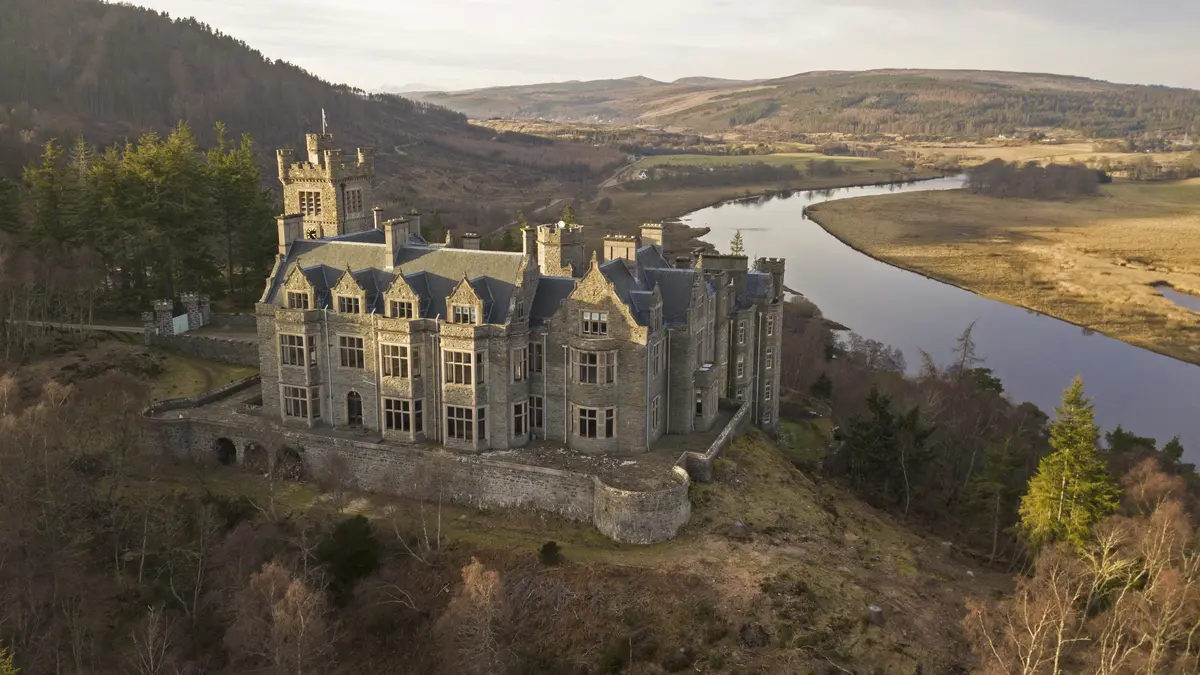
She chose a hillside in Ross-shire, just over the county boundary, in full view of the road and the railway the family used to travel south. Work began in 1906, according to the history page the hostel later published, and was not finished until 1917. Historic Environment Scotland attributes the design "probably" to John Robertson of Inverness, with the date 1907, and records that the castle was built on the site of — and possibly incorporating — the former Culrain Lodge. The castle and its entrance gates are listed at category B (LB7165, listed on 18 March 1971): a large Baronial mansion of bullfaced grey rubble with polished sandstone dressings, a porte cochere on the north front, three canted bays on the terraced south front, and a high square clock tower at the north-west angle.
That clock tower carries the detail everybody repeats: it has clock faces on three of its four sides. The Gazetteer for Scotland says the blank side is the one the new Duke could see as he passed on the railway to Dunrobin, and that he in turn had the blinds on that side of his private carriage drawn as he went by. What is beyond dispute is that the Duchess never saw the house finished. Denis Stuart's biography of her successor as Duchess of Sutherland records that Carbisdale "was still unfinished when 'Duchess Blair' died, aged 63, on 25th May 1912", and MacGregor adds that work on the castle was suspended for a year after her death. It was completed five years later, in 1917, for nobody in particular.
In 1933 the castle was bought by Colonel Theodore Salvesen, head of the Christian Salvesen shipping and whaling firm of Leith and a Scot of Norwegian descent. During the German occupation of Norway he made Carbisdale available as a refuge to King Haakon VII and Crown Prince Olav, later Olav V. The history page that the hostel itself published states that, after Germany attacked the Soviet Union on 22 June 1941, King Haakon presided at the castle over the "Carbisdale Conference", which led to an Allied agreement that Soviet forces entering Norwegian territory would not remain there after the war; the Red Army did enter Norway on 25 October 1944 and later withdrew.
The Colonel's son, Captain Harold Salvesen, gave the castle, its contents and the estate to the Scottish Youth Hostels Association. Carbisdale Castle Youth Hostel opened to members on 2 June 1945 and ran for sixty-six years — about 1.5 million guests, on the SYHA's own count — until frost damage closed it in February 2011.
Timeline: the documented record of Carbisdale Castle
- 27 April 1650 Montrose is ambushed by Colonel Archibald Strachan on the flood plain below the crag where the castle now stands. Around 200 Royalists drown in the Kyle of Sutherland and about 400 are captured; the Covenanters lose a single trooper.
- 21 May 1650 Montrose, handed over at Ardvreck days after the battle, is hanged in Edinburgh. His head is spiked on the Tolbooth and his limbs sent to four cities; his remains are reburied in St Giles' in May 1661.
- 1892 The 3rd Duke of Sutherland dies leaving his will almost wholly to Mary Caroline. The heir contests it; she is found guilty of destroying documents and serves six weeks in Holloway Prison. The settlement obliges the family to build her a house outside Sutherland land.
- 1906–1917 Construction of the castle, on a Ross-shire hillside in full view of the Sutherland road and railway. HES attributes the design "probably" to John Robertson of Inverness and records that it stands on the site of the former Culrain Lodge.
- 25 May 1912 Mary Caroline, Duchess of Sutherland, dies aged 63 with Carbisdale still unfinished; MacGregor records that building work was then suspended for a year. The hostel's own ghost page later suggests the white lady is "the poor Duchess Blair who did not live to see her Castle completed".
- 1933 Colonel Theodore Salvesen, of the Christian Salvesen shipping and whaling firm of Leith, buys Carbisdale. During the German occupation of Norway he makes it available to King Haakon VII and Crown Prince Olav.
- 1939 Alasdair Alpin MacGregor publishes "The Goat-Wife: Portrait of a Village", the earliest datable printing of the Carbisdale ghost lore. He names his informant, "Old Grainger", who heard pipes playing under the rocky site before the castle was built.
- after 22 June 1941 According to the history page later published by the hostel, after Germany attacks the Soviet Union on 22 June 1941, King Haakon presides at the castle over the "Carbisdale Conference", which leads to an Allied agreement that Soviet forces entering Norwegian territory would not remain after the war. The Red Army entered Norway on 25 October 1944 and later withdrew.
- 2 June 1945 Captain Harold Salvesen having given the castle, its contents and the estate to the Scottish Youth Hostels Association, Carbisdale Castle Youth Hostel opens to members.
- 1965 MacGregor's "Land of the Mountain and the Flood" devotes chapter seven to "Carbisdale Castle and the Incredible Duchess" and prints the gardener George Murray's sighting of a woman in white beside a whin bush.
- 18 March 1971 The castle and its entrance gates are listed at category B (LB7165). The statutory description makes no mention of ghosts and does not state how many clock faces the tower carries.
- February 2011 Frost damage closes the hostel after sixty-six years and some 1.5 million guests. More structural damage turns up during the repairs, and in March 2013 SYHA chief executive Keith Legge says it will not reopen for the foreseeable future.
- 15 April 2016 The castle goes back on the market at offers over £900,000. The BBC notes that the ghost, by then widely known as Betty, "does not get a mention in the sales material".
- June–July 2026 Carbisdale Castle Estates Ltd is incorporated at the castle on 25 June with two United States-resident directors, and Samantha Kane's Carbisdale Castle Ltd is renamed Lady Carbisdale Limited on 30 July. The castle's own website goes dark behind a holding message.
Is there a rational explanation for Carbisdale Castle?
Start with the arithmetic, because it does most of the work.
The battle was fought on 27 April 1650. The corridor in which an angry, sword-carrying figure "dressed for the battle" is said to appear belongs to a building on which work began in 1906 and which was not completed until 1917, between 256 and 267 years later. A soldier of 1650 could not have walked that route, because the corridor did not exist.
The honest complication is that the ground underneath is genuinely the battlefield. HES drew the Inventory boundary to include the crag the castle sits on, and Montrose's army marched through the pass immediately below it. An apparition at Carbisdale is therefore set on the right ground and inside the wrong building. The story takes a battle fought across a flood plain and files it inside a twentieth-century link corridor, complete with an interior fitted for a dowager duchess who was not born until 1848.
The same problem runs through the rest of the file. "Room 218" is a youth-hostel room number, and the hostel's own ghost page ties the "Spook Room" to "the bells beside Room 218": the numbering belongs to the SYHA period, 1945 to 2011. And the hostel's own ghost page supplies the deflating alternative in its final paragraph: that the Duchess decided the old nursery was too fine a room to waste on children, so she called it "The Spook Room" and told them it was haunted, to keep them out. The page prints the ghost story and its mundane origin side by side and does not choose between them. It also sits awkwardly with the dates: the Duchess died on 25 May 1912, work stopped for a year, and the castle was not finished until 1917, so there were no children in that nursery for her to keep out of it.
The stories can be dated as well as the events. In the Internet Archive's full-text book corpus, searched on 25 September 2026, the earliest printing of Carbisdale ghost lore is Alasdair Alpin MacGregor's "The Goat-Wife: Portrait of a Village" (1939), which names an informant — "Old Grainger" — who, "just before the Castle was built", "heard pipes playing under what, to-day, is its rocky site". The piper is therefore a story about the hill, set before there was a building, and carries no evidence about the building. The white lady seen by the gardener George Murray beside a whin bush appears in MacGregor's "Land of the Mountain and the Flood" (1965), in a chapter titled "Carbisdale Castle and the Incredible Duchess", where the phrasing runs "In a nonce she was gone. George proceeded instantly to the spot…". George Murray therefore comes from MacGregor, and the record of him is a chapter in a folklore book published fifty-nine years after work on the castle began.
The name "Betty" does not appear on the hostel's ghost page at all. It reaches the press through The Gazetteer for Scotland, which describes "a 'lady in white', affectionately known as 'Betty'"; the BBC cited the Gazetteer for it in March 2013. Betty is therefore a nickname later attached to MacGregor's white lady. The Gazetteer, the BBC reports of 2013 and 2016 and the hostel's ghost page all describe a woman in white, and none of them describes her as hooded.
One quotation on the hostel's page is MacGregor reworded. The page attributes to him, inside quotation marks, a piper whose "unaccountable strains foretold great changes in the locality". The 1939 book says: "He could not imagine what an unseen piper was doing here, until he realised that the strains were the forerunner of profound changes." The hostel's version keeps the sense and changes the words.
Finally, the commercial thread, which is unusually visible in this case. The SYHA's own hostel listing sold Carbisdale on "Be warned though, some say a ghost roams the halls at night!" and listed "Go ghost hunting!" among the reasons to book. The castle's later website advertised itself to television as a location, citing a "Ghost Hunt" series. Against that, the BBC noted in April 2016 that when the castle was put on the market the ghost got no mention at all in the sales material. The same page that claims the castle "has been investigated several times by paranormal experts with varying results" names no investigator, gives no date and points to no report.
Can you visit Carbisdale Castle?
Do not travel expecting to get in. Carbisdale Castle is private property and has not been open to the general public for years.
The youth hostel closed in February 2011 after frost damage; further structural problems were found during the repairs, the SYHA said publicly in March 2013 that it would not reopen, the sculpture and picture collection was auctioned in 2015, and the building was sold in 2016. It has changed hands since. In October 2022 it was bought by the barrister Samantha Kane, who restored parts of it and used it as a residence.
As of 11 August 2026 the picture at the castle is unsettled, and the UK company register is the clearest public record of it. Lady Carbisdale Limited (SC783852), registered at Carbisdale Castle and with Samantha Kane as sole director, was incorporated on 26 September 2023 as Carbisdale Castle Ltd and renamed on 30 July 2026; its stated activity is "museums activities". Carbisdale Castle & Forest Preservation Board CIC (SC841102), incorporated at the castle on 13 March 2025 for the operation of historic sites and visitor attractions, is shown as active but with a proposal to strike it off and an overdue confirmation statement. A third company, Carbisdale Castle Estates Ltd (SC894073), was incorporated at the same address on 25 June 2026, with two United States-resident directors and "other letting and operating of own or leased real estate" as its business. The castle's own website, carbisdalecastle.com, which until early 2026 advertised stays, a whisky bar, corporate events and filming, currently shows nothing but a holding message. Two other Carbisdale domains are parked and carry no information about the castle. Check directly before making any plan that depends on getting inside.
The battlefield, on the other hand, is public ground and free. The action was fought on the flood plain around and south of the village of Culrain, in the Highland council area; the designated centre point is NGR NH 57307 94431, and the castle stands at NH 57448 95457. Culrain has its own station on ScotRail's Far North Line, 61 miles from Inverness between Ardgay and Invershin: one platform, step-free access, a shelter and a help point, no ticket machine — buy in advance or from the guard. Since 20 December 2022 it works as a "Press & Ride" request stop, with a button on the platform instead of flagging the train down. There are around four trains a day each way from Monday to Saturday. Bonar Bridge and Ardgay are a few kilometres to the south-east by road.
Walk the plain south of the village and you are on the ground where Strachan sprang the ambush; the wooded slope to the north-west is the "Scroggie Wood" into which the Royalists fled, and the crag above is Creag a' Choineachan, Lamentation Hill. The possible earthwork identified during the Inventory survey — an arrowhead-shaped feature HES reads as a ravelin in front of Montrose's camp — lies in a field near the village hall, on private farmland: look from the road, do not enter, and do not dig or metal-detect on a designated battlefield. The best free view of the castle itself is the classic one, from the railway and from across the Kyle of Sutherland, which is exactly what the Duchess intended.
Sources consulted
- Historic Environment Scotland, «Battle of Carbisdale (BTL19), Inventory of Historic Battlefields» — HES Designations Portal, 2011 report
- Historic Environment Scotland, «Carbisdale Castle and Entrance Gates (LB7165), listed building record, category B» — HES Designations Portal, 1971 report
- Alasdair Alpin MacGregor, «The Goat-Wife: Portrait of a Village» — Museum Press, London, 1939 book
- Alasdair Alpin MacGregor, «Land of the Mountain and the Flood, chapter seven: Carbisdale Castle and the Incredible Duchess» — Michael Joseph, London, 1965 book
- Scottish Youth Hostels Association, «Ghosts at Carbisdale Castle (official hostel website, archived 17 May 2006)» — carbisdale.org via the Internet Archive, 2006 archive
- Scottish Youth Hostels Association, «Carbisdale Castle History (official hostel website, archived 29 June 2007)» — carbisdale.org via the Internet Archive, 2007 archive
- SYHA Hostelling Scotland, «Carbisdale Castle hostel listing (archived 4 May 2012)» — syha.org.uk via the Internet Archive, 2012 archive
- The Editors of The Gazetteer for Scotland, «Carbisdale Castle (Castle of Spite)» — The Gazetteer for Scotland, University of Edinburgh and the Royal Scottish Geographical Society, 2022 web
- BBC News, «Sutherland's 'Castle of Spite' hostel may close for good» — BBC News, Highlands and Islands, 2013 newspaper archive
- BBC News, «'Haunted' Carbisdale Castle near Ardgay up for sale» — BBC News, Highlands and Islands, 2016 newspaper archive
- Steven McKenzie, «'I booked a last-minute flight and bought a castle'» — BBC News, Highlands and Islands, 2023 newspaper archive
- Companies House, «Company records SC783852 (Lady Carbisdale Limited), SC841102 (Carbisdale Castle & Forest Preservation Board CIC) and SC894073 (Carbisdale Castle Estates Ltd), consulted 11 August 2026» — Find and update company information, UK Government, 2026 report
- Denis Stuart, «Dear Duchess: Millicent Duchess of Sutherland 1867-1955» — Victor Gollancz, London, 1982 book
- Carbisdale Castle, «Film and TV (castle website under private ownership, archived 12 February 2026)» — carbisdalecastle.com via the Internet Archive, 2026 archive
Reviewed by V. Serrano on 2026-08-11 · How we verify our content
💬 Field testimonies (0)
No testimonies yet. Add the first.
Add your testimony
🔒 Log in to add a testimony