👻 HAUNTED PLACE · EXP. Nº9476
ACTIVE
Castle Levan
On the lip of a wooded ravine above the Firth of Clyde at Gourock stand two towers welded at the corner: a keep of the late 14th or 15th century and a second raised on the barmkin wall early in the 16th.
Where is Castle Levan?
- Location
- Inverclyde, Scotland, United Kingdom
- Type
- Castle
- Coordinates
- 55.947, -4.859
- Last updated
LOCATION
Why is Castle Levan said to be haunted?
It passed from the Mortons to William, second Lord Sempill, in 1547, and much later to the Shaw Stewarts of Ardgowan, who in the 19th century built a large house beside it and confusingly gave it the same name. Castle Levan is said to be haunted by a White Lady — Sempill's widow Marion Montgomery, who supposedly murdered her tenants, was condemned by Mary of Guise and was starved to death in the tower by her own husband. The court record printed in 1833 tells the same story inside out. Her servants really did kill a man, Gilbert Rankyne, in 1553; she was charged with sheltering them, and with holding two prisoners in the castle for twenty-four hours without food or drink. There was no death sentence, her husband was already dead, and she went on to marry the man who stood surety for her. The bed and breakfast that briefly opened the tower to guests closed in 2022.
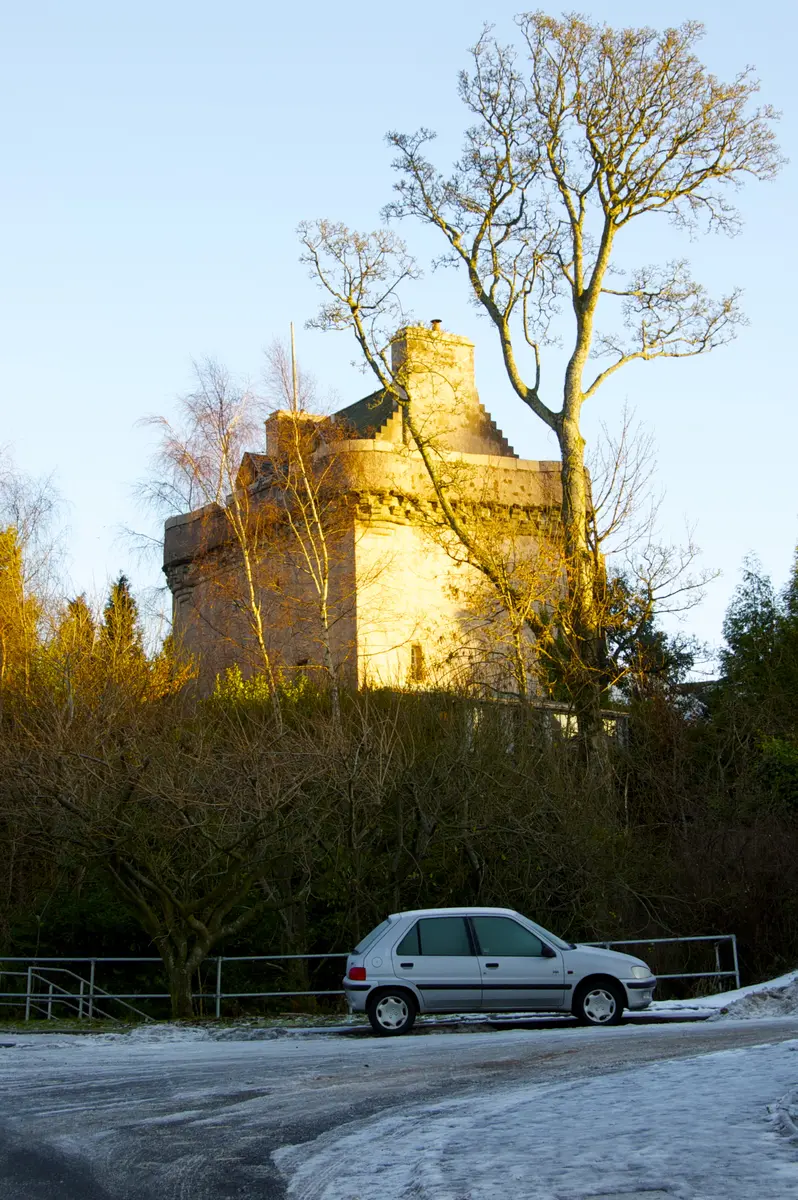
What is the history of Castle Levan?
Castle Levan stands on the steep bank of the Leven Burn between Gourock and the Cloch, with the whole width of the Firth of Clyde in front of it. It is not one building but two joined at the corner, and the join is the key to reading it.
The northern block is a rectangular keep of the late 14th or 15th century, about 10.6 metres by 7.9, with walls a metre and a half thick, rising three storeys to a garret inside a corbelled parapet with roundels at the angles. Inside are two vaulted cellars, a straight stair set in the thickness of the wall, and a first-floor hall whose windows have square recesses fitted with stone seats. Early in the 16th century a second three-storey tower was raised on the line of the barmkin's east wall and welded to the south-east corner of the first, bringing with it what the older tower lacked: a kitchen. MacGibbon and Ross, surveying it in 1887, judged from the style of the ornamental corbel table that the wing was added "about the beginning of the sixteenth century, when the old keep seems to have been remodelled, and the same cornice continued all round the building" — and argued that the big newel stair between the two towers was inserted at the same time, since the straight stair and the guarded entrance lobby were plainly the original arrangement.
The first owners were a family surnamed Morton. George Crawfurd, writing in 1710 and reprinted with additions by William Semple in 1782, records that the line "failed in the person of Adam Morton of Leven, who alienated these lands, anno 1547, to William lord Semple", and that Robert, Lord Sempill made over Leven to his uncle Andrew, Master of Sempill, in 1584.
Crawfurd's 1547 marks a change of owner, and it may not even be the date of the sale. Nigel Tranter, in 1970, has Adam Morton of Lavane selling the property to William, second Lord Sempill, "previous to 1539", the year Sempill had the lands of Lavane incorporated in his free barony; Morton's son James then raised an action to stop Sempill "uplifting the mails, fermes, proffittis and dewties of the landis of Lavenbrayis", and lost the long litigation. MacGibbon and Ross had added a guess to the 1547 date — "it is not unlikely that the remodelling was carried out about that time" — and closed their entry with a sentence written from 1887: "It is now the property of the Shaw Stewarts." Later summaries fused the guess and the sentence, and a 16th-century Sempill remodelling ended up credited to an 18th-century family.
The Sempill who bought it, William, second Lord Sempill, is well documented. The Scots Peerage records that he bought the lands of Auchinfour and others in the parish of Inverkip from Sir James Hamilton of Finnart on 31 August 1529; that he sat on the Privy Council of James V and was Justiciar and Bailie of the regality of Paisley; that he was acquitted in February 1533-34 of art and part in the slaughter of William Cunynghame of Craigends; that he sat on the jury at the trial of Janet Douglas, Lady Glamis, in July 1537; and that he took a remission in March 1540 for every crime short of treason. He married three times. Sources disagree on when he died — Crawfurd says 1547, Pitcairn says 1548, the Scots Peerage says Edinburgh, 3 June 1552, citing the Acts and Decreets — but on the point that matters they agree: by the middle of the 1550s his widow was a widow.
Her name was Mariota, or Marion, Montgomery, and she is the reason anyone tells stories about this tower. What she actually did is on record, and it is on record because she was tried for it.
On 8 November 1555 she appeared before the Justiciary Court in Edinburgh. Robert Pitcairn printed the entry in his Criminal Trials in Scotland in 1833. The charge is headed "Ratihabition of Slaughter, Wounding, &c. — Imprisoning — Usurpation of the Queen's authority", and it says that her servants killed Gilbert Rankyne in Lecheland on 17 March 1553, "under silence of night"; that at the same time they cruelly hurt and wounded John Fynné, mutilating his arm, and wounded John Roger in sundry parts of his body to the effusion of his blood; that she received those servants red-hand that same night within the Castle of Laven; that two more men, Humphry Malcolmesoun and Archibald Scherare, were taken and brought to the castle by them; and that she held those two prisoners inside it "by the space of twenty-four hours, without food or drink; thereby usurping the Queen's authority".
She came in the Queen's will — that is, she submitted rather than stood trial — during the regency of Mary of Guise, and a note in the margin of the record reads Deletur, quo ad partem Regine, per preceptum: the Crown's part of the penalty was struck out by warrant. The jury is named, the local gentry of Renfrewshire among them. And the man who stood surety for satisfying the injured parties was John Campbell of Skipness — the man she went on to marry, between 31 August 1553 and 20 December 1556.
After the Sempills the estate passed to the Stewarts of Ardgowan, said to have taken it in 1649, with a ratification of 1672 in favour of Sir Archibald Stewart of Blackhall naming Levan. In the 18th century that family became the Shaw Stewarts. In the 19th they built a large new house a short distance north of the old towers and called it Castle Levan as well, which is why the medieval tower is "Levan Castle" and the mansion is "Castle Levan" and almost every account since has muddled them.
The parish minister writing the New Statistical Account in January 1842 lists both among the inhabited houses of Inverkip — "Leven House, belonging to Mrs M'Inroy; and Leven, the seat of Mr Crooks". Hugh Macdonald walked up to it in the 1850s and was let in by Mrs Crooks, who "generously permits such wayward wanderers as ourselves to spend a passing hour or two in the tower of other days", and found it ivy-smothered and roofless inside, with nettles on the hearth and wallflowers in the crevices, and open to any passing stranger except on Sundays. By 1879 the property is said to have belonged to John Polson, co-founder of the Brown & Polson cornflour firm; through the early 20th century the tower survived as a picturesque folly in the grounds of the newer house.
A housing proposal brought the archaeologists. Renfrewshire's planning authority needed to know how far the barmkin and outbuildings ran, and after first work in 1966 there were seasons in 1970, 1971 and 1972. They traced the barmkin, found foundations in the courtyard read as a possible gatehouse, and dug a kitchen midden against the east side of the south tower holding some 5,000 fragments of bone and shell — oysters among them — with green-glazed pottery of the mid-15th to early 16th century, continental imports included, and a spurred clay pipe bowl of the mid-17th.
When the tower was listed at Category B on 10 June 1971 the record described it in four words that date it exactly: "Roofless, existing to wallhead", with an archaeological dig in progress. The mansion was listed separately at Category C on 10 September 1979, as "3-storey; plain; stone-built; slated; (early XIX cent.)".
Reconstruction began in 1980; between 1984 and 1987 the architect Ian Begg carried out a full refurbishment for the owners, the advertising executive and art collector David Pearson and his wife Sheila. They lived in it until they retired and sold in 1995, after which it became a bed and breakfast. Kim Munro took it on in 2016 and renovated again, and on 11 July 2018 she and Maria Hockin registered Castle Levan Bed and Breakfast LLP at the castle, both as designated members. The partnership shortened its accounting period to 31 December 2021, filed its last accounts in March 2022, applied to be struck off on 12 May and was dissolved on 9 August 2022.
Timeline: the documented record of Castle Levan
- 31 August 1529 William, second Lord Sempill, buys the lands of Auchinfour and others in the parish of Inverkip from Sir James Hamilton of Finnart — the family's documented arrival in the parish.
- 1547 Adam Morton of Leven, last of his line, alienates the lands to William, Lord Semple, as Crawfurd records in 1710. This is a change of owner, not a building campaign, and no Shaw Stewart is involved: that family did not arrive for another century.
- 17 March 1553 Servants of Lady Sempill kill Gilbert Rankyne in Lecheland "under silence of night", wounding John Fynné and John Roger. She receives them red-hand in the Castle of Laven the same night, and holds two men, Humphry Malcolmesoun and Archibald Scherare, prisoner there for twenty-four hours "without food or drink".
- 8 November 1555 Dame Mariota Montgomery, Lady Sempill, comes in the Queen's will before the Justiciary Court for those offences, during Mary of Guise's regency. The margin records that the Crown's part was struck out by warrant; John Campbell of Skipness stands surety. There is no death sentence, and she is already a widow.
- Between 31 August 1553 and 20 December 1556 She marries John Campbell of Skipness — the man who had gone surety for her — years after the moment at which the legend has her starving to death in a locked room at Levan.
- 1710 and 1782 Crawfurd's description of Renfrewshire, and Semple's enlarged reprint, carry the same unchanged paragraph on "the ruinous castle of Leven" and the full Sempill genealogy. In 257,317 words, ghost, haunt, spectre, apparition, legend and phantom return zero.
- 1833 Robert Pitcairn prints the 1555 Justiciary record in Criminal Trials in Scotland. He publishes the crime and no legend, and his footnote identifies the accused as the relict of the second Lord Sempill.
- 1845 (written January 1842) The New Statistical Account lists both houses among the inhabited mansions of Inverkip — "Leven House, belonging to Mrs M'Inroy; and Leven, the seat of Mr Crooks" — and gives its "Antiquities" paragraph to Ardgowan's tower and the Dunrod bridge. The neighbouring parish fills the same heading with the Bargarran witch trial.
- 1878 (visited in the 1850s) Hugh Macdonald, admitted by Mrs Crooks, describes the ivy-covered roofless tower in Days at the Coast and writes of it: "It has no tale to tell." The same book prints eight ghosts, thirty hauntings and a full ghost ballad for Rothesay Castle.
- 1887 MacGibbon and Ross survey the castle over two pages, date the south-east wing to the early 16th century, and close: "Before 1547 this castle belonged to the Mortons. At that date it passed to the family of the Sempills, and it is not unlikely that the remodelling was carried out about that time. It is now the property of the Shaw Stewarts." Later summaries fused the conjecture with the closing sentence.
- 10 June 1971 The medieval tower is listed at Category B as "Levan Castle (restored ruin)", described as "Roofless, existing to wallhead" with an archaeological dig in progress. The statutory record mentions no ghost.
- 1966 and 1970-72 Excavation prompted by a housing proposal traces the barmkin, a possible gatehouse and a kitchen midden of some 5,000 bone and shell fragments with late medieval pottery, continental imports among it, and a 17th-century clay pipe bowl.
- 10 September 1979 The 19th-century mansion is listed separately at Category C as "Castle Levan and West Lodge", confirming in the statutory record that two different buildings carry the same name.
- 1980-1987 Reconstruction begins in 1980 and a full refurbishment is carried out from 1984 to 1987 by architect Ian Begg for David and Sheila Pearson, who live in the tower until they sell in 1995. The earliest printed White Lady found, in Martin Coventry's guide of 1996, comes nine years after the refurbishment.
- 10 May 2012 A Scottish paranormal research group publishes its file on the castle, quoting the owners' own website: "Castle Levan is reputed to have a ghost - not that we've ever seen her!" The ghost is female and is the White Lady; nobody mentions Sleeping Beauty.
- 11 July 2018 Kim Munro and Maria Hockin register Castle Levan Bed and Breakfast LLP at the castle, both as designated members. Accounts of the castle have credited Munro alone.
- 9 August 2022 The partnership is dissolved by voluntary strike-off, having applied on 12 May. The website had stopped being archived after October 2021 and the domain no longer resolves. The bed and breakfast is closed.
Is there a rational explanation for Castle Levan?
The legend Castle Levan really has is the White Lady, and what makes it interesting is how exactly it mirrors the court record: it is that document turned inside out.
In the version told today, Marion Montgomery tortured and murdered her tenants, was condemned to death by Mary of Guise, had the sentence commuted to imprisonment in the castle, and was then starved to death there by a husband home from the wars and appalled at what he found. Set that beside the Justiciary Court record of 8 November 1555, printed by Pitcairn in 1833, and every element has been reversed or moved.
The killing is real, and it has a victim with a name: Gilbert Rankyne of Lecheland, killed by her servants on 17 March 1553 under silence of night, with two other men wounded. She was charged with harbouring the men who did it, red-hand, inside the castle that same night. There was no death sentence: she came in the Queen's will, and the margin of the record notes that the Crown's part was struck out by warrant. The husband could not have imprisoned her, because he was dead — Pitcairn's own footnote calls her, at the time of the trial, the relict of William, second Lord Sempill. And the starving is the sharpest inversion of all. It is in the record, but it runs the other way: the charge is that she held Humphry Malcolmesoun and Archibald Scherare prisoner in the castle "by the space of twenty-four hours, without food or drink". The woman the legend starves to death is the woman the document accuses of starving other people. Finally, the man who stood surety for her that day, John Campbell of Skipness, is the man she married afterwards — so the person the story kills went on to remarry her prosecution's guarantor.
The genealogy has been shuffled as well. Pitcairn, in 1833, believed she was Lord Sempill's first wife, eldest daughter of Hugh, first Earl of Eglinton. The Scots Peerage, in 1910 and with the charters in front of it, distinguishes them: the first wife was Margaret Montgomery of the Eglinton family, and the third and surviving wife was Marion, daughter of Hugh Montgomery of Hazelhead and widow of Thomas Crawford of Auchinames. Every modern retelling makes her father "John Montgomerie of Hessilhead", which is neither. There is also a name-mirror that may have helped the confusion along: Pitcairn's volumes carry a separate case in which Marioun Sempill, Lady Hesilheid, wife of Hew Muntgumrie of Hesilheid, is the victim of violence and a killing at Hessilhead — the same ingredients with the surnames swapped.
So how old is the ghost? Older than the story is the silence. Six independent works covering this exact building, across 177 years, contain no ghost, no White Lady, no torture, no condemnation and no immurement: Crawfurd in 1710; Crawfurd enlarged by Semple in 1782, where ghost, haunt, spectre, apparition, legend and phantom all return zero in 257,317 words against 286 mentions of Semple; Pitcairn in 1833, who prints the crime and no legend; the New Statistical Account of 1845; Macdonald in 1878; and MacGibbon and Ross in 1887, whose two-page architectural entry sits in a 145,762-word volume without a single ghost, haunt or apparition. The counts were rerun on the Internet Archive's text of each book on 28 September 2026.
One of those six is a proper control rather than an absence. Hugh Macdonald was a lover of ghost stories who printed them freely on the same Clyde tour: his book uses "ghost" eight times, "haunt" thirty, "tradition" thirty-six, and gives Rothesay Castle a full haunting ballad, "The Bluidy Stair", about a murdered lady. He had the appetite, the genre and the space. Standing inside Leven Castle, he asked: "Who were the inhabitants of this dreary pile before the glory had departed? Who? who? is the question; and echo answers, 'who?'" His answer follows: "It has no tale to tell, or, at least, only a tale of which a modern gravestone might well be ashamed." The tale he then gives is the Morton sale of 1547, copied from Crawfurd and Semple. The two parish memoirs say the same by omission: between the Old Statistical Account of 1793 and the New of 1845, 3,945 words of parish text contain not one instance of ghost, haunt, spectre, apparition, legend, tradition, superstition or witch — while the 1845 volume uses "tradition" 158 times elsewhere, and the neighbouring parish of Erskine, beginning three lines after Inverkip ends and under the very same heading "Antiquities", spends two pages on the Bargarran witches with names, a nickname and the barrel of tar. The heading was available; Inverkip's minister filled his with an old tower and a bridge.
In none of these books is the castle spelled "Levan". It is Laven in the 1555 record and Leven from 1710 to 1887, so a search on the modern spelling returns nothing from any of them and says nothing about the building.
The White Lady's own trail in print is short. The earliest version found by a full-text search of the Internet Archive's library on 28 September 2026 is in Martin Coventry's A Wee Guide to the Haunted Castles of Scotland (Goblinshead, 1996): the castle "is reputedly haunted by a White Lady, ghost of Lady Montgomery, who was starved to death by her husband for mistreating local tenants". Coventry's gazetteer The Castles of Scotland carries a near-identical sentence in its second edition of 1997, and Gordon W. Mason's The Castles of Glasgow and the Clyde, from the same publisher in 1999, repeats it with a hedge: "There is apparently a 'White Lady' who haunts Levan. She is said to represent one Lady Montgomery who mistreated the peasantry. As punishment she was starved to death by her husband." Two earlier castle books have the building without a ghost. Nigel Tranter's The Fortified House in Scotland (1970) tells the Morton sale and the lawsuit over the lands of Lavane, and in the digitised copy "White Lady", "haunted", "starved" and "Montgomery" return nothing, while "ghost" does turn up in the same volume, at Duntrune. Maurice Lindsay's The Castles of Scotland (1986) gives Castle Levan an entry, and the whole book has no "ghost" and no "White Lady"; its one "haunted" is at Meggernie. The digitised run of Coventry's gazetteer begins with the 1997 edition; the first appeared in 1995. On this evidence the White Lady reaches print within a decade of the 1980-87 restoration and the tower's opening to paying guests.
A sceptical version of the ghost is already in print. Dane Love's Scottish Spectres (Robert Hale, 2001) reports that "some folk claim that the White Lady of Castle Levan has never existed. They say that she was created in the imagination of a Semple-Stewart son in order to persuade his parents that the old castle had become too old-fashioned and cramped for his aspirations", after which a new mansion "was erected nearby in the Georgian style early in the nineteenth century". Love names none of the folk. Their story would put the ghost around 1800, and the 19th-century witnesses — the minister of 1842, Macdonald let in by Mrs Crooks of the new house, MacGibbon and Ross in 1887 — all have the tower and no lady.
One last voice is the owners'. When a Scottish paranormal research group wrote the castle up in May 2012, it quoted the castle's own website: "Castle Levan is reputed to have a ghost - not that we've ever seen her!" A business with rooms to fill, declining to claim the sighting.
Can you visit Castle Levan?
Castle Levan is not open to visitors, and the bed and breakfast that made it briefly visitable has closed.
Castle Levan Bed and Breakfast LLP, registered at the castle on Stirling Drive, Gourock PA19 1AH, applied to be struck off the register on 12 May 2022 and was dissolved on 9 August 2022. Its website was last captured by the Internet Archive in October 2021 and the domain no longer resolves — an old castle-levan.com link now returns nothing. Booking aggregators still carry the listing; it is stale. Do not travel on the strength of it, and do not turn up at the door expecting a tour. This is a private house.
What can be done is to look at it. The tower stands on the seaward side of Cloch Road, the A770, at the south-west edge of Gourock, on the rim of the Leven Burn ravine, at grid reference NS 21584 76365 — 55.9471, -4.8587. It is a Category B listed building. The coast in front of it is public and worth the walk: Cloch Road runs south-west along the shore to the Cloch Point lighthouse, first lit on 11 August 1797 and built by Thomas Smith and Robert Stevenson, and on to Lunderston Bay, which has parking, paths and a beach. Gourock's railway station and the ferry terminals for Dunoon and Kilcreggan are some three kilometres north-east, and buses along Cloch Road pass the castle.
One thing to settle before you go looking, because nearly every account confuses it: there are two buildings here with the same name. The medieval tower is listed as "Levan Castle (restored ruin)"; the plain three-storey early 19th-century house eighty-odd metres to the north is listed separately as "Castle Levan and West Lodge". That mansion has since been divided into flats and is now addressed as Castle Levan Manor, Cloch Road, PA19 1AY, where individual flats changed hands in 2023. The tower with the corbelled parapet and the round angle turrets — the one photographed on this page — is the old one. Note that the photograph shows it roofed and harled, as Ian Begg left it in 1987; the listing text, written in 1971, still calls it roofless.
The other castles of the parish are mostly gone. Chrisswell, Gourock and Dunrod survive as sites only, and Inverkip Castle is about 3.6 kilometres away. The Kempock Stone, a standing stone long bound up with local superstition, is in Gourock itself, under three kilometres off, and makes a better stop than a locked gate.
Sources consulted
- Robert Pitcairn, «Criminal Trials in Scotland, from A.D. MCCCCLXXXVIII to A.D. MDCXXIV, vol. I, pp. 381-382 — Justiciary Court, 8 November 1555: "Dame Mariota Montgomery, Lady Symple… Ratihabition of the Slaughter of Gilbert Rankyne in Lecheland… Incarceration… within the space of twenty-four hours, without food or drink"» — Bannatyne Club, Edinburgh, 1833 archive
- Sir James Balfour Paul (ed.), «The Scots Peerage, founded on Wood's edition of Sir Robert Douglas's Peerage of Scotland, vol. VII — "Sempill, Lord Sempill", pp. 535-537 (William, second Lord Sempill; his three marriages; Marion Montgomery's escheat and her remarriage to John Campbell of Skipness)» — David Douglas, Edinburgh, 1910 book
- David MacGibbon and Thomas Ross, «The Castellated and Domestic Architecture of Scotland from the Twelfth to the Eighteenth Century, vol. I, pp. 295-296 — "Leven Castle, Renfrewshire", with plan (fig. 249) and view from the south-west (fig. 250)» — David Douglas, Edinburgh, 1887 book
- Hugh Macdonald, «Days at the Coast: a series of sketches descriptive of the Firth of Clyde — "Gourock and Inverkip", pp. 122-124, on Leven Castle ("It has no tale to tell"), entry permitted by Mrs Crooks» — John Cameron, Glasgow (Monumental Edition), 1878 book
- George Crawfurd and William Semple, «A General Description of the Shire of Renfrew, including an account of the noble and ancient families — Leven Castle, the Mortons and the Sempill genealogy; George Crawfurd's 1710 text enlarged and continued by William Semple» — Alex. Weir, Paisley, 1782 book
- Ministers of the respective parishes, «The New Statistical Account of Scotland, vol. VII: Renfrew–Argyle — parish of Inverkip, drawn up January 1842: land-owners, mansion-houses and antiquities, pp. 525-526» — William Blackwood and Sons, Edinburgh, 1845 book
- Sir John Sinclair (ed.), «The Statistical Account of Scotland, vol. IX — parish of Innerkip, Renfrewshire, pp. 93-102» — William Creech, Edinburgh, 1793 book
- Historic Environment Scotland, «Levan Castle (restored ruin), adjoining Castle Levan, Cloch Road, by Gourock — listed building record LB12478, Category B, listed 10 June 1971, NGR NS 21584 76365, "Roofless, existing to wallhead"» — Historic Environment Scotland Designations Portal, 1971 report
- Historic Environment Scotland, «Castle Levan and West Lodge, Cloch Road, by Gourock — listed building record LB12477, Category C, listed 10 September 1979, NGR NS 21581 76449, "3-storey; plain; stone-built; slated; (early XIX cent.)"» — Historic Environment Scotland Designations Portal, 1979 report
- Companies House, «Castle Levan Bed and Breakfast LLP, company number SO306475 — incorporated 11 July 2018, designated members Maria Hockin and Kim Munro, application to strike off 12 May 2022, dissolved 9 August 2022» — Companies House register, United Kingdom, 2022 archive
- Internet Archive, «Wayback Machine capture index for castle-levan.com — last successful capture of the site 19 October 2021; the domain's delegation no longer resolves» — Internet Archive Wayback Machine CDX index, 2026 archive
- The Gazetteer for Scotland, University of Edinburgh and the Royal Scottish Geographical Society, «Castle Levan — entry in The Gazetteer for Scotland (Morton family c.1457; Semples 1547; Shaw Stewarts 1649; restored 1980-87 under Ian Begg; the White Lady)» — scottish-places.info, 2026 web
- Stravaiging around Scotland, «Castle Levan, Inverkip, Renfrewshire — castle gazetteer entry with measured description, ownership history, the 1984-87 Ian Begg restoration for David and Sheila Pearson, and the White Lady legend together with its refutation» — stravaiging.com, 2026 web
- Haunted Scotland / Scottish Paranormal, «Castle Levan — case file published 10 May 2012, quoting the castle's own website ("Castle Levan is reputed to have a ghost - not that we've ever seen her!")» — scottish-paranormal.co.uk, 2012 web
- P. C. Denholm, with A. Halifax-Crawford, «Excavations at Levan Castle, Gourock, 1966 and 1970-72 — barmkin, possible gatehouse, kitchen midden of c.5,000 bone and shell fragments, late medieval pottery including continental imports» — Scottish archaeological journal literature; record consulted via JSTOR and Academia.edu, 1972 academic
- Wikipedia contributors, «Sleeping Beauty (ATU 410) — documented publication history: Perceforest, written in French between 1330 and 1344; Basile, "Sun, Moon and Talia", Pentamerone, 1634-36; Perrault, "La Belle au bois dormant", 1697; Grimm, "Dornröschen", 1812» — Wikipedia, 2026 web
- Martin Coventry, «A Wee Guide to the Haunted Castles of Scotland — entry 32, «Castle Levan»: «reputedly haunted by a White Lady, ghost of Lady Montgomery, who was starved to death by her husband for mistreating local tenants» (earliest printed White Lady found)» — Goblinshead, Edinburgh, 1996 book
- Martin Coventry, «The Castles of Scotland: a comprehensive reference and gazetteer to more than 2000 castles, 2nd edition — «Castle Levan» (White Lady, «the ghost of a Lady Montgomery, who was starved» to death)» — Goblinshead, Edinburgh, 1997 book
- Gordon W. Mason, «The Castles of Glasgow and the Clyde — «Castle Levan»: «There is apparently a 'White Lady' who haunts Levan. She is said to represent one Lady Montgomery who mistreated the peasantry»» — Goblinshead, Musselburgh, 1999 book
- Nigel Tranter, «The Fortified House in Scotland — «Castle Levan, Renfrewshire»: Adam Morton of Lavane sells to William, 2nd Lord Sempill «previous to 1539»; James Morton's action over «the landis of Lavenbrayis»; acquired by the Stewarts in 1649. No ghost in the entry» — W. & R. Chambers, Edinburgh, 1970 book
- Maurice Lindsay, «The Castles of Scotland — entry «Castle Levan» (no ghost; the book's one «haunted» is Meggernie)» — Constable, London, 1986 book
- Dane Love, «Scottish Spectres — the White Lady of Castle Levan and the claim that she «was created in the imagination of a Semple-Stewart son in order to persuade his parents that the old castle had become too old-fashioned and cramped»» — Robert Hale, London, 2001 book
Reviewed by V. Serrano on 2026-08-17 · How we verify our content
💬 Field testimonies (0)
No testimonies yet. Add the first.
Add your testimony
🔒 Log in to add a testimony